How to Request a Floor Plan Credit Line Increase (Without Tripping a Review)
How to increase a floor plan credit line: what lenders check before approving a request, and how to time it so you don't trigger a hard review.
Part of the Floor plan financing guide: How dealer floor plans actually work — and where they quietly eat your gross
Switching from another DMS? Compare DealerVLO to DealerCenter, Frazer, or Lot Wizard, or see what DealerVLO's car dealer management software includes.
You're not under-capitalized because you can't find cars. You're under-capitalized because your floor plan line is maxed and every new unit you want to buy has to wait for one to sell first. That's the moment most independent dealers start thinking about a floor plan line increase — and it's also the moment a sloppy request can do more harm than good.
A line increase isn't a form you fill out and forget. Lenders like NextGear Capital run it through an actual review, and that review looks past your original approval at how you've actually performed on the line you already have. Get that part right and a request is routine. Ignore it and you can trip a harder look than you expected, or worse, get flagged right as you need the extra capacity most.
14-day free trial, then $29/mo · Cancel anytime
What a line increase request actually looks like
With NextGear Capital, the request itself runs through the lender's own account management platform, Account Portal — there's a dedicated "Request Credit Increase" button. You pick which floor plan line you want to extend (if you have more than one), then say how much you want to add to it (NextGear). The portal also shows your upcoming payments and available credit at a glance, which is where a dealer typically notices they're closing in on the ceiling in the first place (NextGear).
Here's the distinction worth knowing before you click the button: NextGear separates temporary and permanent increases, and they aren't reviewed the same way. A temporary bump — say, to cover a seasonal auction push — only requires a short review, and NextGear reviews temporary increases for a term of up to 60 days. If you're not sure which one fits your situation, NextGear tells dealers to call their Performance Manager before submitting (NextGear). That's a cheap phone call that can save you from requesting the wrong type and getting routed into a deeper underwriting review than you needed.
Other lenders run their own version of this process with their own portals and their own thresholds. If you're comparing NextGear against alternatives, this breakdown of NextGear vs. AFC vs. Westlake covers how the major players differ, and the pillar guide to how dealer floor plans work is worth reading first if you're still fuzzy on how curtailments, fees and interest fit together on a floored unit.
What happens if you don't ask and just hit the ceiling
A lot of small lots treat the credit limit as a soft number — something you'll deal with when you get there. NextGear's own guidance says dealers near their limit get a little room to go slightly over before flooring is denied outright. But once you actually max out the line, you're done: no new units get floored until you pay the balance down (NextGear).
That's the real cost of waiting too long to ask. It's not a fee — it's a dead stop on buying, right when you've probably got a car sitting at the auction waiting on a flooring decision. If you can see the ceiling coming two or three auction trips out, that's the time to request, not the week you actually need the extra room.
Knowing you're approaching the ceiling means knowing your numbers in real time, not reconstructing them from memory at the lane. On DealerVLO, every car's all-in cost rolls up from its acquisition cost plus whatever recon and other cost lines you've logged against it, and the dashboard flags cars sitting 60+ days — both useful signals when you're deciding whether to grow the line or just move what you've got faster. DealerVLO doesn't calculate floor-plan carrying cost itself; floor plan shows up as overhead on your P&L, and for a quick daily-cost estimate on a unit, the floor plan calculator does that math separately.
What the lender is actually scoring: performance, not just the original credit check
For a brand-new line, underwriting looks a lot like any small-business credit decision — trade references, business credit, equity, cash position, overall health of the business (NextGear). But once you already have a line and you're asking to grow it, NextGear is explicit that a different factor gets weighed on top of all that: performance. How closely you've adhered to the terms and conditions of your existing agreement matters directly (NextGear).
In practice, "performance" breaks down into a few things a lender can actually check:
- Curtailment compliance. Did your minor paydowns hit on schedule, every cycle?
- Audit results. Were the units the lender expects to see on your lot actually there, titled correctly, not already sold out of trust?
- Payoff timing. When you sell a floored unit, does the payoff hit the lender fast, or does it lag?
- Credit utilization generally. NextGear flags maxed-out credit cards as a red flag even without a single late payment — the logic is that a dealer should keep a meaningful amount of available credit on hand, not run everything to the edge (NextGear).
None of this is exotic. It's the same discipline that got you the line in the first place, just measured against how you've actually run it. If you want the fuller underwriting picture before you ever request an increase, this guide to floor plan financing requirements walks through what a small lot typically needs to get approved and roughly how big a line to expect.
Estimate your daily floor-plan carrying cost per unit.
Open the Floor Plan CalculatorCurtailments: the clock you can't afford to miss
NextGear structures its floor plans around an interest rate, term periods, fees, and curtailments or extensions, and gives an illustrative example of a plan requiring a minor payment at the 30, 60, 90 and 120-day marks (NextGear).
That's one lender's example, not a universal schedule — curtailment timing varies by lender and is set in your own loan agreement, so don't assume another provider's intervals match NextGear's. What matters for a credit increase request is simpler: missed or late curtailments are exactly the kind of performance gap that shows up when a lender reviews your account before approving more credit. If you've been catching curtailments late because you genuinely didn't know when they hit, this explainer on how curtailment schedules work is worth reading before you submit anything.
Audits: the check that decides whether your request is routine or a problem
Floor plan audits — physical lot checks confirming the units the lender financed are actually there — are the mechanism that verifies performance before a lender signs off on growth. NextGear has put real investment into self-audit tooling, and its own guidance lists bad audits among the things that block more buying power. After rolling out a mobile self-audit feature, NextGear reported nearly 67% dealer adoption of its mobile app overall, with 95% of surveyed users calling the self-audit process easy to use (NextGear). Trade press later reported the self-audit feature itself had crossed 50% adoption among independent dealers, letting them complete audits within an assigned window at their own convenience, cutting disruption and avoiding certain fees (Auto Remarketing).
The takeaway for a line increase request isn't about the app specifically — it's that audits happen, they're how performance gets verified, and a dealer with a history of clean audits is walking into the increase conversation from a stronger position than one who's never been checked or who's had issues flagged. If you've never been through a flooring audit and want to know what a lender is actually looking for, this guide to passing a floor plan audit covers the mechanics.
14-day free trial, then $29/mo · Cancel anytime
Selling out of trust: the fastest way to turn a routine request into a hard no
If there's one thing that will sink a credit increase request — and sink a lot more than that — it's selling out of trust. A dealer sells out of trust when a floored vehicle is sold and the lender's payoff isn't remitted within the window the floor plan agreement requires. The OCC (the federal regulator for national banks) defines it the same way in its Comptroller's Handbook on floor plan lending: a dealer sells out of trust when inventory is sold and the funds aren't immediately remitted to the bank to retire the corresponding debt, and the handbook tells banks to get that loan repaid immediately (OCC). SMB Compass notes it can get a line frozen or called entirely (SMB Compass).
Beyond the lender's own remedies under your agreement, consequences vary by state and by contract. This isn't legal advice: if you're ever unsure whether a payoff is late enough to matter, talk to your lender and, if it's gotten serious, an attorney, not a forum thread.
Nothing in DealerVLO files anything with your lender or tracks whether a payoff actually went out — that's between you and the floor plan company. What it does do is give you a complete deal jacket that keeps the sale date and sale price on each deal, so there's no ambiguity on your end about when a unit sold and what it sold for, which is exactly the information you need on hand if a lender or an auditor ever asks.
Turn rate: the context lenders see, even without a hard number
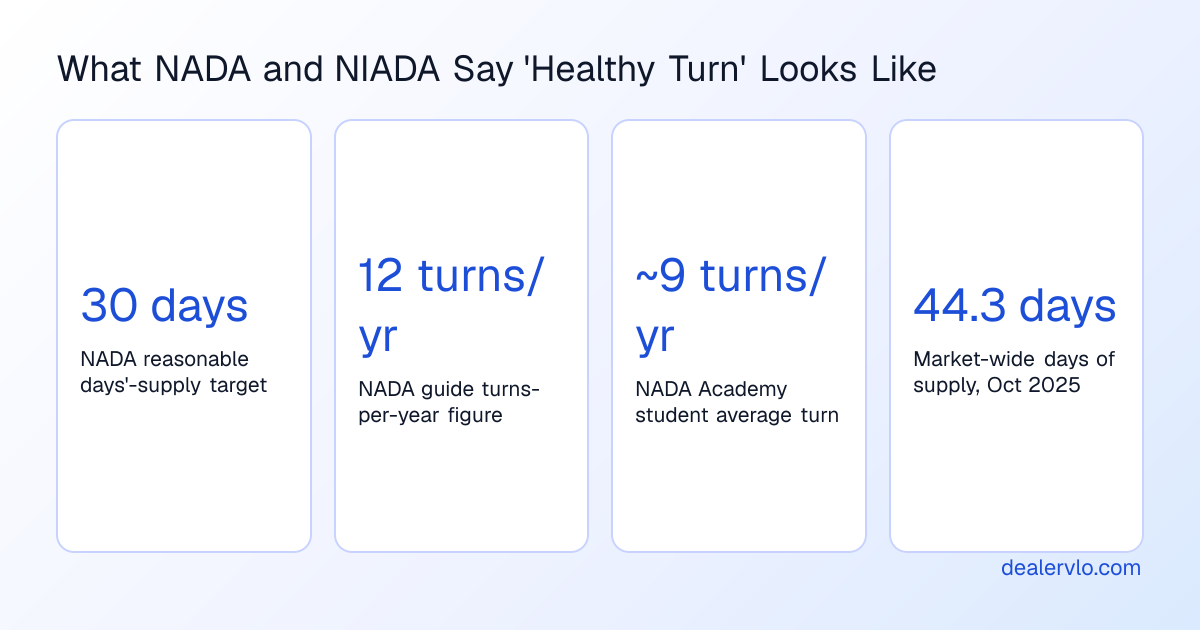
No lender source puts a specific turn-rate threshold on approving a credit increase — don't let anyone tell you there's a magic number that guarantees approval. But turn rate is still useful context for judging your own health against the market. NADA's own guide treats 30 days as a reasonable days'-supply target for used retail inventory, on the logic that gross profit margin erodes the longer a car sits unsold, and cites twelve turns a year as the benchmark figure; separately, NADA Academy student data showed an average closer to nine turns a year, or about every 40 days (NADA). More current market-wide data from NIADA's dashboard put used-vehicle days of supply at roughly 44 days as of early October 2025 — slightly better than the prior year (NIADA).
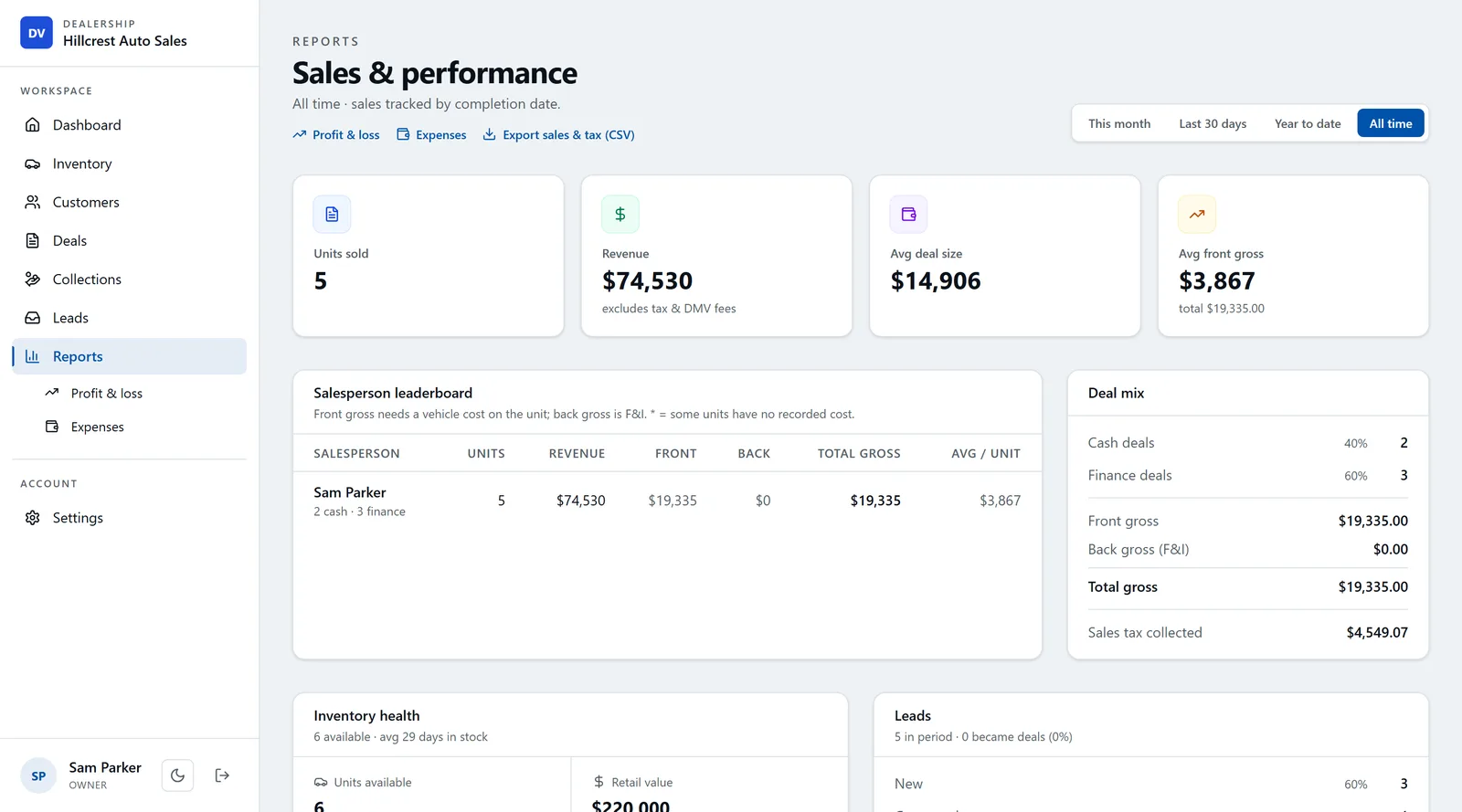
These are industry-wide benchmarks, not a specific lender's underwriting cutoff — nobody in this research confirms a lender gating increases on a specific turn number. But if your own inventory is sitting well past 44 days average, a lender reviewing your account is going to notice slower-moving stock before you even ask for more capacity, because it shows up in aging units and tighter cash flow. DealerVLO's Reports page shows average days in stock for cars currently available, bucketed into 0-30, 31-60, 61-90 and 90+ day ranges, so you can see where your lot actually sits against that kind of benchmark before a lender does.
Timing the request
There's no verified lender rule about requesting "60 days before renewal" or "right after tax season" — if you see that kind of specific advice elsewhere, treat it as someone's guess, not a stated lender policy. What NextGear's own materials do support is simpler and more useful:
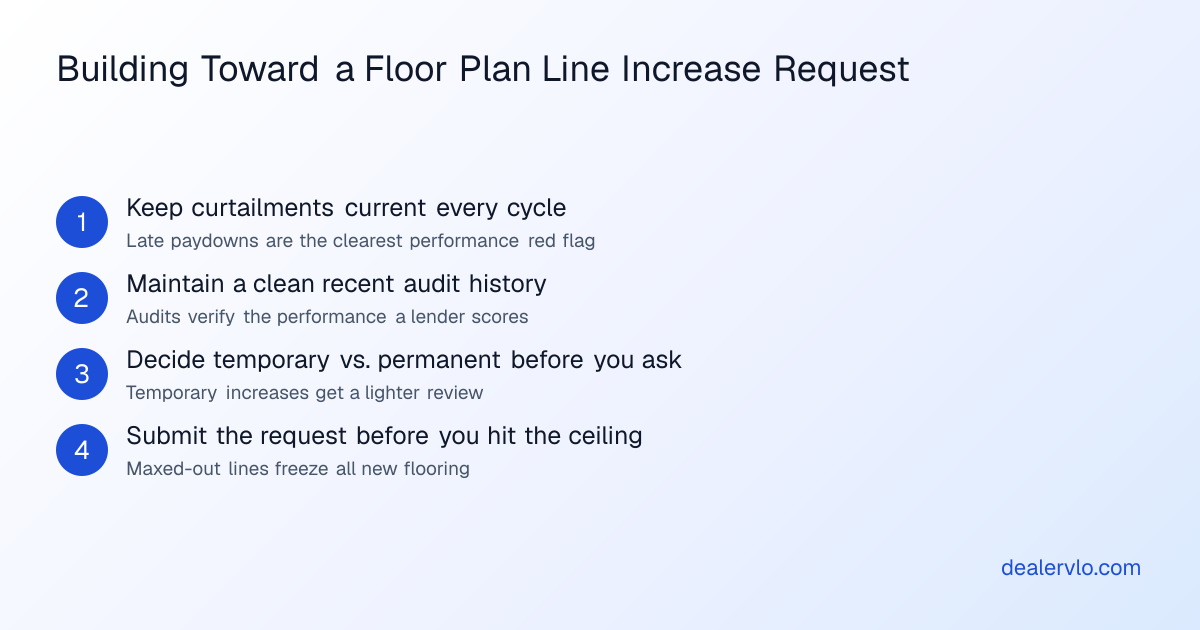
- Know whether you need temporary or permanent capacity. A seasonal push through an auction event is a different request than a durable increase to support higher ongoing volume — and NextGear reviews them differently, with the temporary request going through a lighter check.
- Request before you're pinned against the ceiling, not after. The margin you get for running slightly over the limit is small, and once you're fully maxed, flooring stops cold until you pay down balance.
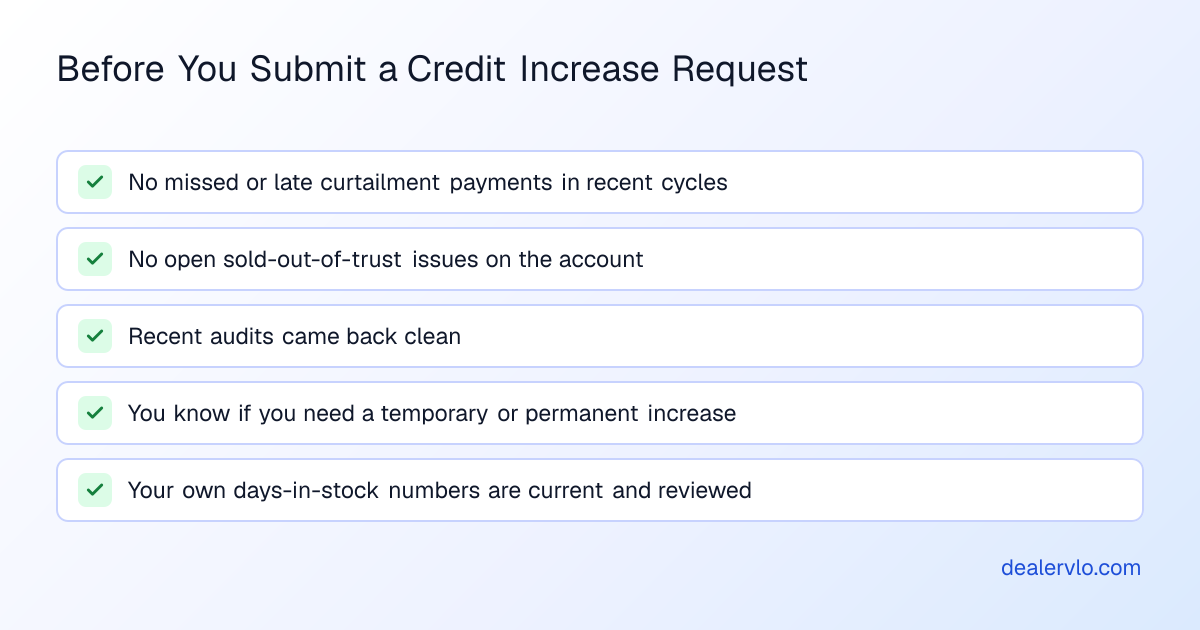
- Build a clean recent track record first. Since performance — curtailment timing, audit results, adherence to terms — is the differentiator on an increase request specifically, a dealer who's been clean for the last several cycles is simply walking in stronger than one who's had recent hiccups.
14-day free trial, then $29/mo · Cancel anytime
A word on going it alone instead
Floor plan financing isn't the only way to fund growth, and it comes with real strings attached — curtailments, audits, the sold-out-of-trust exposure above. One dealer on a forum thread described securing $225,000 in NextGear financing within 24 hours after local banks wanted six months of operating history first; another dealer in the same thread warned that floor plan companies run strict terms and that independent dealers should exhaust other financing options first (Dealer Refresh forum). These are individual dealer accounts, not lender policy or an industry norm — but they're a reminder that a line increase isn't the only lever, and sometimes paying down what you have or weighing floor plan against buying outright is the better move for your specific cash position.
Keeping the numbers that back your request
Whatever lender you're floored with, a credit increase request is ultimately a conversation backed by your own numbers — how fast cars move, what you're actually carrying in inventory, and whether your payment history is clean. A dealer walking into that conversation with a spreadsheet reconstructed from memory is in a weaker spot than one who can pull it up on demand.
None of that replaces talking to your Performance Manager, but it means you're not guessing at your own performance when the lender asks.
Frequently asked questions
How do I request a NextGear credit increase?
Log into NextGear's Account Portal and use the "Request Credit Increase" button. You'll choose which floor plan line to extend and how much to increase it by. If you're unsure whether you want a temporary or permanent increase, contact your Performance Manager before submitting, since the two get reviewed differently.
What's the difference between a temporary and permanent floor plan increase?
A temporary increase — useful for a short-term need like a seasonal auction push — only requires a short review. A permanent increase to your overall credit line goes through deeper underwriting, similar to what a lender checks on a new line, plus your performance history on the existing one. If you're not sure which applies, ask your lender's Performance Manager rather than guessing.
What do lenders check before approving a floor plan line increase?
Beyond the original credit factors (business credit, trade references, equity, cash position), lenders weigh how closely you've adhered to your existing agreement's terms — curtailment payments made on time, clean audit results, and prompt payoff remittance when units sell. Maxed-out personal or business credit, even without late payments, can also be flagged as a risk signal.
What happens if I hit my floor plan credit limit without requesting an increase?
You get a small margin to run slightly over the limit before flooring gets denied outright. Once you're fully maxed, you can't floor any new units until you pay down the existing balance — which can freeze your buying right when you need inventory most. Requesting an increase before you're pinned against the ceiling avoids that gap.
Does my inventory turn rate affect whether I get approved for more credit?
No lender source confirms a specific turn-rate number that gates a credit increase approval. That said, slower-than-average turn shows up in aging inventory and tighter cash flow, both of which a lender reviewing your account performance is likely to notice. Keeping your own days-in-stock numbers visible helps you catch a slowdown before it affects a request.
Can selling a car out of trust affect my request for a credit increase?
Yes, and it's the single worst thing that can happen to a request. Selling out of trust — selling a floored unit without remitting the lender's payoff on time — is treated as a serious default that can get your line frozen or called, independent of whatever increase you were hoping to get.
Bottom line
A floor plan credit line increase isn't hard to request — the button's right there in most lenders' portals. What makes it easy or hard to get approved is the track record you've built on the line you already have: curtailments paid on time, clean audits, no sold-out-of-trust issues, and inventory that isn't sitting and aging past a healthy turn. Build that record before you need the extra room, request before you're pinned against the ceiling, and you'll rarely trigger more review than a temporary bump deserves.
14-day free trial, then $29/mo · Cancel anytime