Should Your Lot Offer a 30-Day Warranty? What an In-House Limited Warranty Really Commits You To
Thinking about a 30-day or 1,000-mile warranty instead of As Is? What it changes under federal law, how to fill the Buyers Guide, and how to price it.
Part of the Compliance, taxes & deal paperwork guide: What goes in a used-car deal jacket: the complete checklist
Switching from another DMS? Compare DealerVLO to DealerCenter, Frazer, or Lot Wizard.
Most small lots sell everything As Is, and most buyers have heard "As Is" enough to tune it out. A short warranty, say 30 days or 1,000 miles on the engine and transmission, is an easy thing to advertise and an easy thing to like. It also isn't free, and it changes more than the line on your Buyers Guide.
Here's what a dealer's own limited warranty actually commits you to: what it does to As Is under federal law, the difference between a full and a limited warranty, how to fill in the Buyers Guide, what your state may already require, and how to put a per-car number on it before you start. It's general information, not legal advice. Have an attorney look at your warranty document before you hand it to a buyer.
14-day free trial, then $29/mo · Cancel anytime
The trade: what you give up when you stop selling As Is
Selling As Is means you've disclaimed implied warranties: the buyer takes the car with whatever problems it has. The moment you give a written warranty, that option is gone. The Magnuson-Moss Warranty Act says no supplier may disclaim or modify an implied warranty if it "makes any written warranty" on the product. The FTC's Dealer's Guide to the Used Car Rule puts it in plain terms: the Act "prohibits you from eliminating implied warranties when you provide a written warranty."
What you can do with a limited warranty is cap how long the implied warranties last. The same section lets you limit them "to the duration of a written warranty of reasonable duration," as long as the limit is conscionable, "set forth in clear and unmistakable language," and "prominently displayed on the face of the warranty." So a 30-day limited warranty can carry 30-day implied warranties, if you write it correctly.
There's a second trigger dealers miss. The same law blocks the disclaimer if you enter into a service contract with the buyer at the time of sale or within 90 days after. If you sell your own service contracts, As Is may already be off the table on those deals. Our guide to aftermarket warranty companies covers the third-party side.
Full or limited: almost every dealer warranty is limited
Federal law has two labels. A warranty that meets the federal minimum standards must be called a "full" warranty; anything else must be called "limited" (15 U.S.C. 2303). The minimum standards for a full warranty (15 U.S.C. 2304) are a lot to promise on a used car:
- Fix covered defects "within a reasonable time and without charge."
- Put no limit on how long implied warranties last.
- After "a reasonable number of attempts" to fix it, let the buyer choose a refund or a replacement.
The FTC's Dealer's Guide adds that full-warranty service goes to anyone who owns the car during the warranty period. That's why nearly every dealer warranty is a limited one: you choose the systems, your share of the cost, and the duration.
Filling the warranty box on the Buyers Guide
The FTC's Buyers Guide has the space built in. Under Dealer Warranty you check Full or Limited, and the limited line reads: "The dealer will pay ___% of the labor and ___% of the parts for the covered systems that fail during the warranty period." Then two columns: systems covered, and duration. The rule itself (16 CFR 455.2) uses "30 days or 1,000 miles, whichever occurs first" as its example duration.
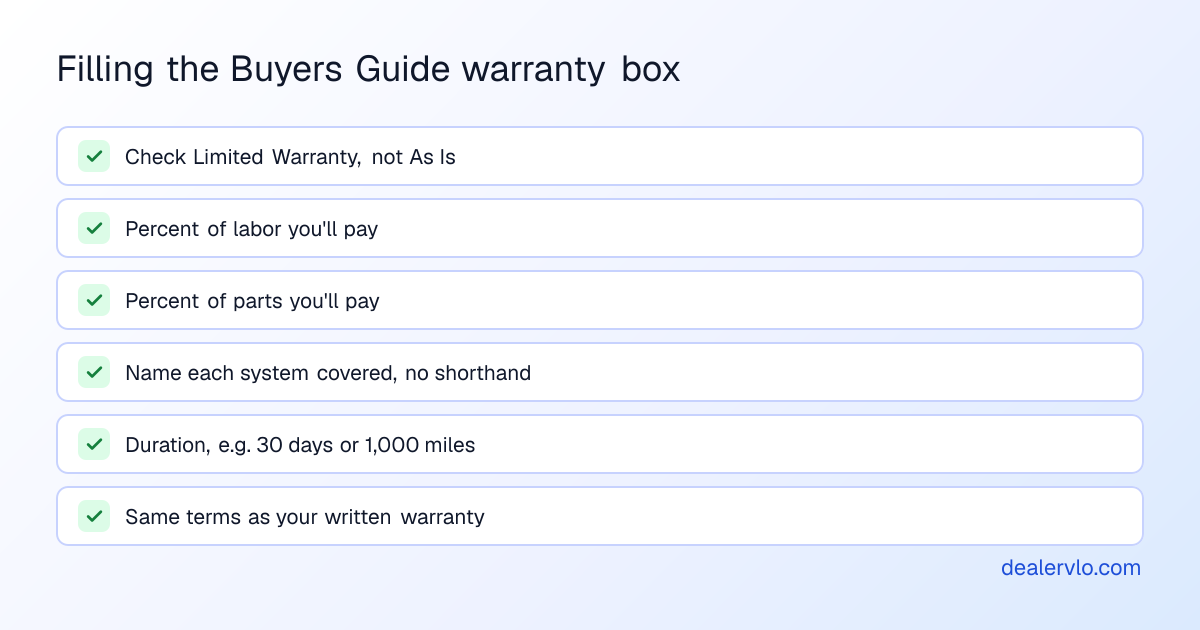
Two rules from the Dealer's Guide catch people. Name the systems; don't write shorthand like "drive train" or "power train." And the Buyers Guide is a summary, so the buyer also needs your written warranty with the full terms. Our walkthrough on how to fill out the FTC Buyers Guide covers the rest of the form.
In DealerVLO, the warranty is set on each deal: As-Is — No Warranty, Implied Warranties Only, or Dealer Warranty, with a description of the coverage. The Buyers Guide from that deal prints the matching heading and your description, and choosing Dealer Warranty adds a Dealer Warranty document to the deal's paperwork. It fills in the warrantor, the car, the buyer and the sale date, prints the federal disclosure statements word for word, and leaves the Full or Limited box and the coverage terms for you to complete, because those are your decisions.
14-day free trial, then $29/mo · Cancel anytime
Check your state before you choose
Your state may have already made this decision for you. The Used Car Rule says that if "your State law limits or prohibits 'as is' sales of vehicles, that State law overrides" the federal rule, and the As Is heading has to come off the Buyers Guide.
Some states go further and require a warranty:
- Massachusetts requires a written warranty on most used cars a dealer sells to a consumer: 90 days or 3,750 miles under 40,000 miles, 60 days or 2,500 miles from 40,000 to under 80,000, and 30 days or 1,250 miles from 80,000 to under 125,000 (M.G.L. c.90 §7N¼). Our Massachusetts used vehicle warranty guide covers it in full.
- New York sets minimum warranties by mileage, from 90 days or 4,000 miles at 36,000 miles or less down to 30 days or 1,000 miles from 80,000 to 100,000 (General Business Law 198-b).
If your state already requires a warranty, your "30-day warranty" decision is really about whether to offer more than the minimum. Check with your state attorney general's office or your dealer association before you settle your policy.
Pricing the warranty: set a reserve per car
A warranty is a cost you pay later on cars you've already sold, so put it in the price now. There's no reliable published figure for what in-house warranties cost small lots, so use your own history. Count the comeback repairs you paid for over the last year (the ones you fixed "to keep the customer happy" count), divide by the cars you sold, and that's your starting reserve.
Here's how the math works with example numbers, not an average:
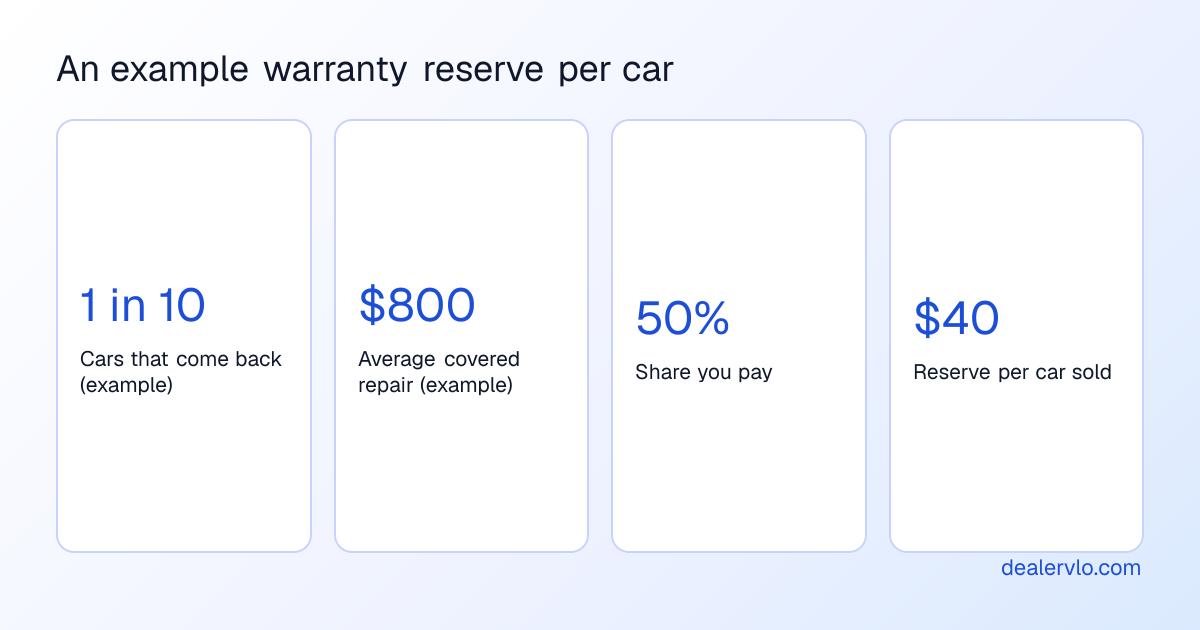
If one car in ten comes back with a covered repair, that repair averages $800, and you pay 50% of parts and labor, you'll spend about $40 per car sold ($800 × 50% ÷ 10). Change the systems, the share or the duration and the number moves, which is the point: you can design a warranty you can afford instead of guessing. Our used car reconditioning cost budget is the other half of that equation, because better recon means fewer comebacks.
Then put the reserve in your deal math. If your typical front gross is thin, check whether $40 (or whatever your number is) still leaves a deal you want. The free calculator below shows your margin on a car with the extra cost included.
Punch in cost, recon, holding days, and sale price to see your true net gross and margin.
Open the Profit Margin CalculatorSetting it up
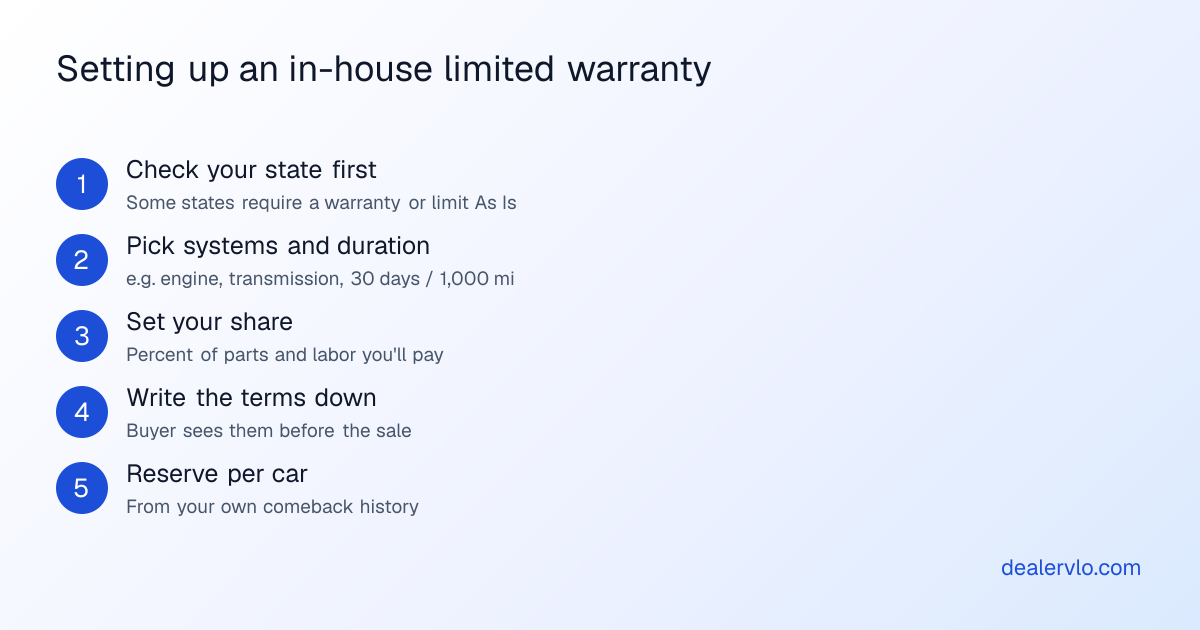
- Check your state first. A required warranty or a limit on As Is changes everything below.
- Pick the systems and the duration. Engine and transmission for 30 days or 1,000 miles is a common shape, but it's yours to choose.
- Set your share. 50% or 100% of parts and labor, and whether there's a deductible.
- Write the terms down, including the implied-warranty duration limit, and make sure the buyer sees them before the sale.
- Set a reserve per car from your own comeback history, and revisit it every few months.
Say who does the repairs, too: your shop, a shop you name, or any licensed shop with your approval first. Ambiguity there turns a $400 repair into an argument.
Where DealerVLO fits, and what it doesn't do
DealerVLO doesn't write your warranty terms, administer claims, or sell service contracts. Here's what it does with the warranty on a deal:
- The warranty on each deal: As-Is — No Warranty, Implied Warranties Only, or Dealer Warranty, with your coverage description.
- A matching Buyers Guide: the deal's Buyers Guide prints the heading for that warranty choice and your description, and a Buyers Guide also prints from each car's page without a deal so it can hang on the window.
- A Dealer Warranty document: generated from the deal when you choose Dealer Warranty, with the federal disclosure statements printed word for word and the Full or Limited box and coverage terms left for you.
- Warnings, not blocks: if a deal is As Is but also sells a service contract, DealerVLO warns you and lets you switch to Implied Warranties Only in one click, and it warns when a Massachusetts, New Jersey or Maryland buyer's state warranty law doesn't allow As Is for that car's age and mileage.
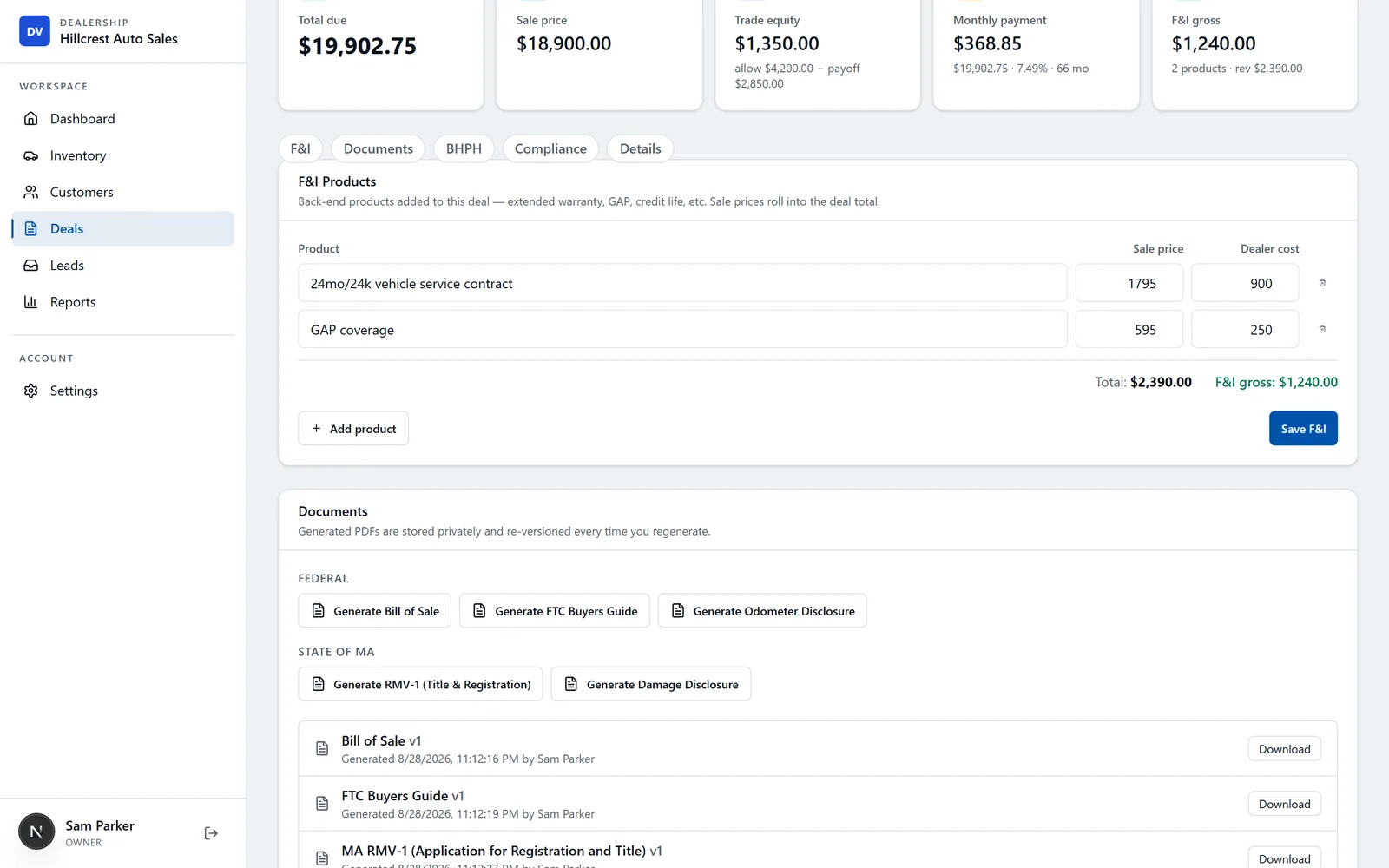
What it doesn't do: track warranty claims or comebacks. Keep a simple log of each comeback repair and its cost, because that log is what your reserve comes from. It's $29 a month flat with unlimited users; see what's included.
Frequently asked questions
Can a used car dealer offer a 30-day warranty?
Yes. A dealer can give its own written limited warranty, such as 30 days or 1,000 miles on named systems. The FTC's Used Car Rule even uses "30 days or 1,000 miles, whichever occurs first" as its example of a warranty duration. You check Limited Warranty on the Buyers Guide, fill in the share of parts and labor you'll pay, the systems covered and the duration, and give the buyer the written warranty terms.
If I give a 30-day warranty, can I still sell the car As Is?
No. Under the Magnuson-Moss Warranty Act, a seller that gives a written warranty can't disclaim implied warranties. With a limited warranty, you may limit how long implied warranties last to the length of your written warranty, if that duration is reasonable and the limit is stated clearly and prominently on the warranty.
What's the difference between a full and a limited warranty on a used car?
A full warranty has to meet federal minimum standards: repairs within a reasonable time and without charge, no limit on how long implied warranties last, a refund or replacement if the car can't be fixed after a reasonable number of attempts, and coverage for anyone who owns the car during the warranty period. Anything less is a limited warranty, which is what most dealer warranties are.
What do I write in the warranty box on the Buyers Guide?
Check Limited Warranty, fill in the percentage of labor and parts you'll pay for covered systems, list the systems covered and the duration, for example 30 days or 1,000 miles, whichever comes first. The FTC's Dealer's Guide says to name the systems rather than use shorthand like "drive train" or "power train."
Do some states require used car dealers to give a warranty?
Yes. Massachusetts, for example, requires a written warranty on most used cars a dealer sells to consumers, from 90 days or 3,750 miles under 40,000 miles down to 30 days or 1,250 miles from 80,000 to under 125,000 miles. New York's used car warranty law sets minimums by mileage too. And the FTC rule says state law that limits or prohibits As Is sales overrides it, so check your state before you choose.
How much does an in-house warranty cost a dealer?
It depends on how many claims you get and what they cost, and there's no reliable published average for small lots. Work it out from your own history: count the comeback repairs you paid for over the last year, divide by cars sold, and set aside that much per car as a reserve before you decide what coverage to offer.
Bottom line
A 30-day limited warranty can be a good selling point, but it ends As Is on that car: implied warranties come back, though you can limit them to the warranty's length if you say so clearly. Check your state first, label it Limited, name the systems and your share on the Buyers Guide, give the buyer the written terms before the sale, and price it from your own comeback history, not a guess.
14-day free trial, then $29/mo · Cancel anytime