A Customer Wants to Return a Car They Bought From Your Lot. What Now?
There's no federal 3-day return on cars, but no isn't always the whole answer. When a buyer has a real right, when to fix it, and when to unwind the deal.
Part of the Compliance, taxes & deal paperwork guide: What goes in a used-car deal jacket: the complete checklist
Switching from another DMS? Compare DealerVLO to DealerCenter, Frazer, or Lot Wizard.
It's three days after delivery and the buyer is back on your lot, or on the phone, saying they want to return the car. Maybe the check engine light came on. Maybe their spouse hates it. Maybe the payment felt different once the first bill showed up. Your first instinct is "all sales are final," and most of the time the law is on your side. But not always, and even when it is, "no" isn't always the cheapest answer.
This is the dealer's playbook for a customer who wants to give a car back: what federal law does and doesn't say, when a buyer has a real right, how to sort a fixable problem from a changed mind, what a goodwill unwind costs you, and why the paperwork comes before the refund. It's general information, not legal advice, and state rules vary, so check yours.
14-day free trial, then $29/mo · Cancel anytime
There's no federal right to return a car
Start with what buyers often believe and usually don't have. The FTC's guide to buying a used car from a dealer says it plainly: "Federal law doesn't require dealers to give you three days to cancel the deal and return the car."
The FTC's Cooling-Off Rule, which is where the "three days to cancel" idea comes from, covers sales made away from the seller's place of business, like a sale at the buyer's home. It also specifically exempts "automobiles, vans, trucks or other motor vehicles sold at auctions, tent sales or other temporary places of business, provided that the seller is a seller of vehicles with a permanent place of business" (16 CFR 429). A sale on your own lot isn't an away-from-business sale in the first place.
The same FTC page adds a caveat worth remembering: "In some states, dealers must give you the right to cancel." Which brings us to the cases where the buyer may be right.
When the buyer may have a real right
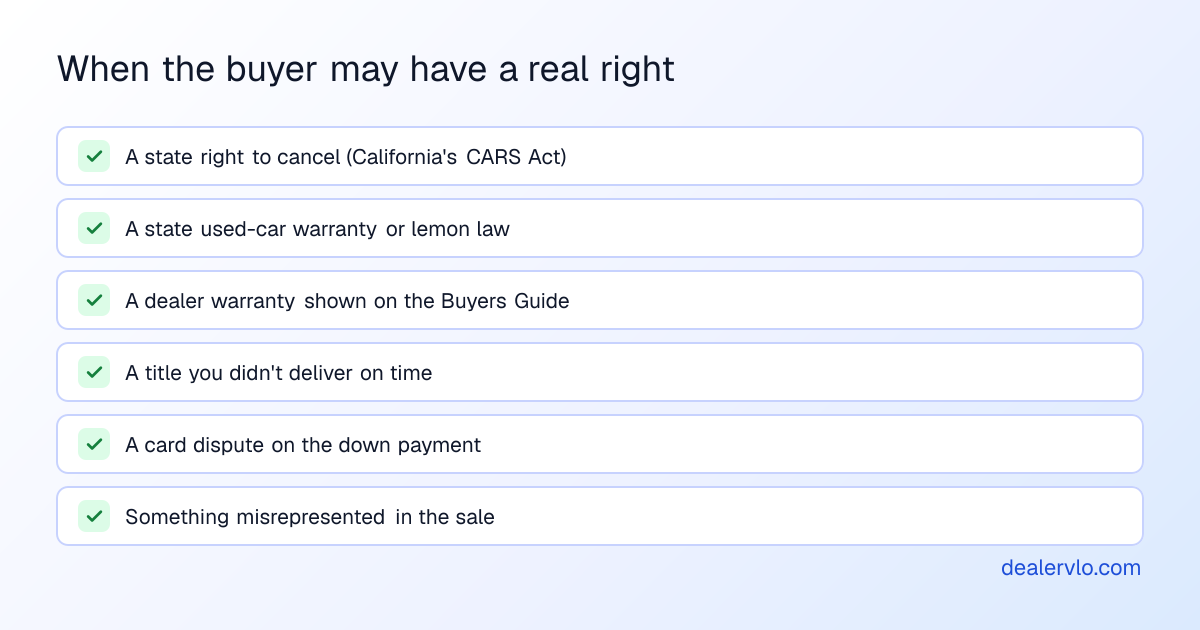
A state right to cancel. California is the big one. Since October 1, 2026, the CARS Act gives buyers of used cars priced $50,000 or less a three-day right to cancel, with a restocking fee of 1.5% of the price (no less than $200 and no more than $600) and no right to cancel if the car has been driven more than 400 miles since signing. Our California 3-day right to cancel guide covers the details.
A state used-car warranty or lemon law. Some states require a warranty no matter what your Buyers Guide says. Massachusetts requires one on most dealer sales to consumers, and after three failed repairs of the same defect, or more than ten business days out of service, the dealer has to refund the price less a per-mile charge (M.G.L. c.90 §7N¼). New York's used car warranty law has its own refund trigger. Our guide to offering a 30-day dealer warranty covers how those laws interact with As Is.
A warranty you gave. The FTC's Used Car Rule says the information on the Buyers Guide "overrides any contrary provisions in the contract of sale" (16 CFR 455.3). If the Guide on the window said Dealer Warranty, that's what you owe, whatever the contract says.
A title you didn't deliver. If the buyer still has no title in their name, some states give them a way out. Ohio, for one, gives the buyer an unconditional right to have the sale rescinded if the title isn't in their name by the fortieth day. Our guide to auction title delays covers the auction side of that problem.
A card dispute. If the down payment went on a credit card, federal law lets the cardholder assert claims and defenses against the card issuer on a purchase over $50 made in their home state or within 100 miles of their address, once they've made a good-faith attempt to resolve it with you (15 U.S.C. 1666i).
Something misrepresented. If the car isn't what you said it was (undisclosed branded title, wrong mileage, a promised repair that never happened), the buyer may have claims that have nothing to do with a return policy. That's a call for your lawyer, and the kind of complaint that can turn into a claim on your dealer bond.
Fixable problem or changed mind?
Most "I want to return it" conversations are really one of two things: something's wrong with the car, or the buyer regrets the deal.
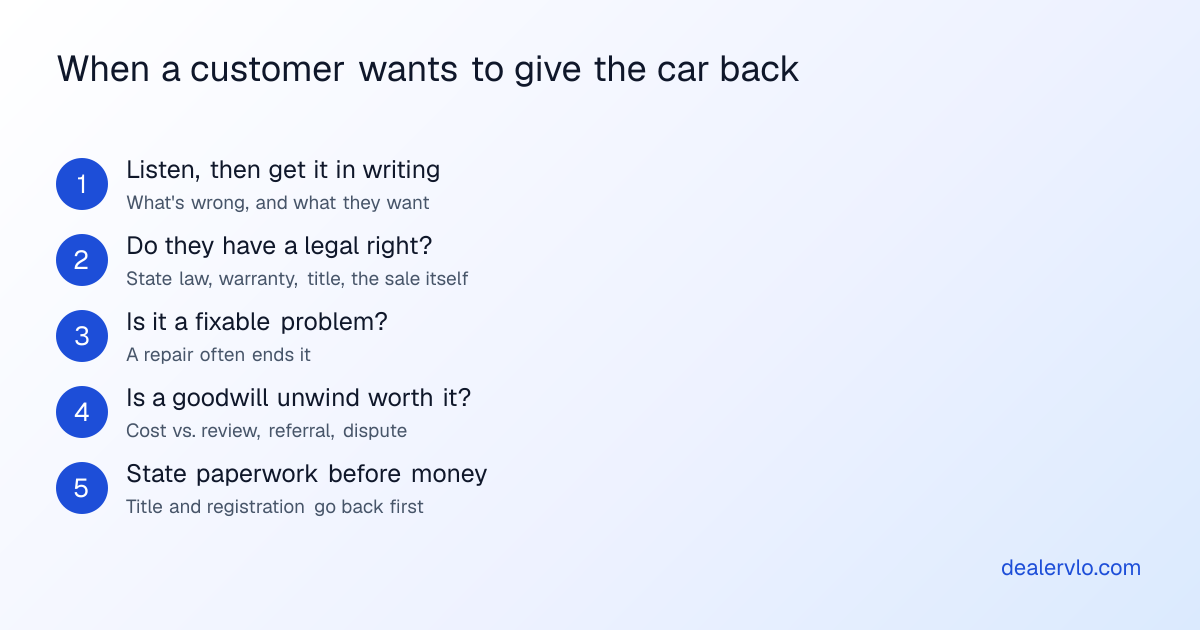
If something's wrong with the car, a repair often ends the conversation, even on an As Is sale. A $300 fix on a car that's three days old buys you a customer who refers people instead of one who posts a one-star review. If you do it, log what it cost against that car so you know what the deal really made. Our guide to the we-owe form covers putting any promised fix in writing.
If it's a changed mind (the payment, the spouse, a better car somewhere else), you're usually not obligated to take it back. Say so politely and in writing, and point to what they signed. Some dealers offer a trade toward another car on the lot instead of a refund, which keeps the sale.
Either way, get the complaint in writing: what's wrong, when it started, and what they're asking for. It helps you decide, and it's what you'll need if this ever goes to a card dispute, a state complaint or your bond company.
What a goodwill unwind actually costs
Sometimes taking the car back is the right business call, even with no legal duty: a buyer with a legitimate grievance, a regular who refers people, a sale you'd rather not defend. Just be honest with yourself about what it costs.
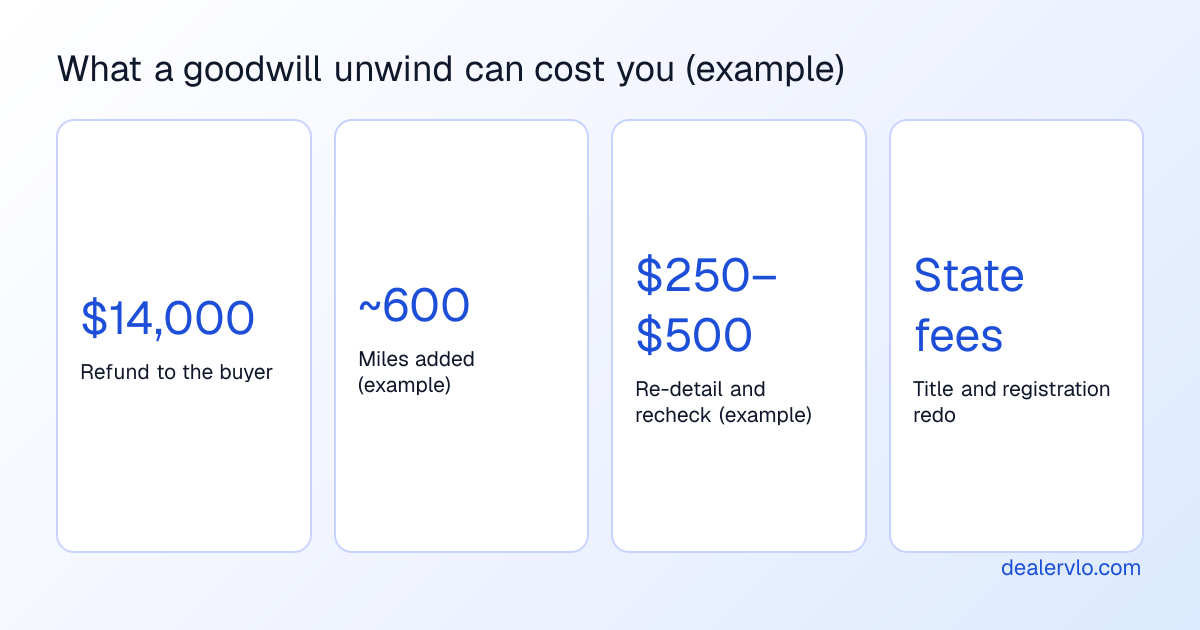
The car comes back with more miles and a wash to redo. Any fees you paid to title and register it may not come back, and putting the title back can cost more fees: California's DMV, for example, lists two transfer fees on a rollback. If there was a trade-in, it has to be returned or settled too. And it's back on your lot, taking a spot and your attention, until you sell it again.
You can attach terms to a goodwill unwind (a mileage limit, a deduction for the miles driven, an exchange instead of a refund), but put them in writing, signed by the buyer, and keep them consistent so your next buyer gets the same deal.
14-day free trial, then $29/mo · Cancel anytime
Paperwork before money
The unwind has to be undone on paper with your state before the refund goes out, because the title and registration have already moved. There's no national procedure. California's DMV, for example, calls it a rollback and lists the forms it wants, including a statement of why the car came back and whether the trade-in and down payment were returned. Your state will have its own version, so check your state's dealer manual or DMV before you hand back money, and get the buyer's signature on whatever it requires.
If a lender funded the deal, call the lender before you do anything else; the contract has to be unwound on their side too. Our deal jacket checklist lists the documents a deal produces, which is roughly the list you'll be reversing.
Where DealerVLO fits, and what it doesn't do
DealerVLO doesn't file your state's rollback paperwork, refund payments, or contact the lender. Here's what it does when a deal comes undone:
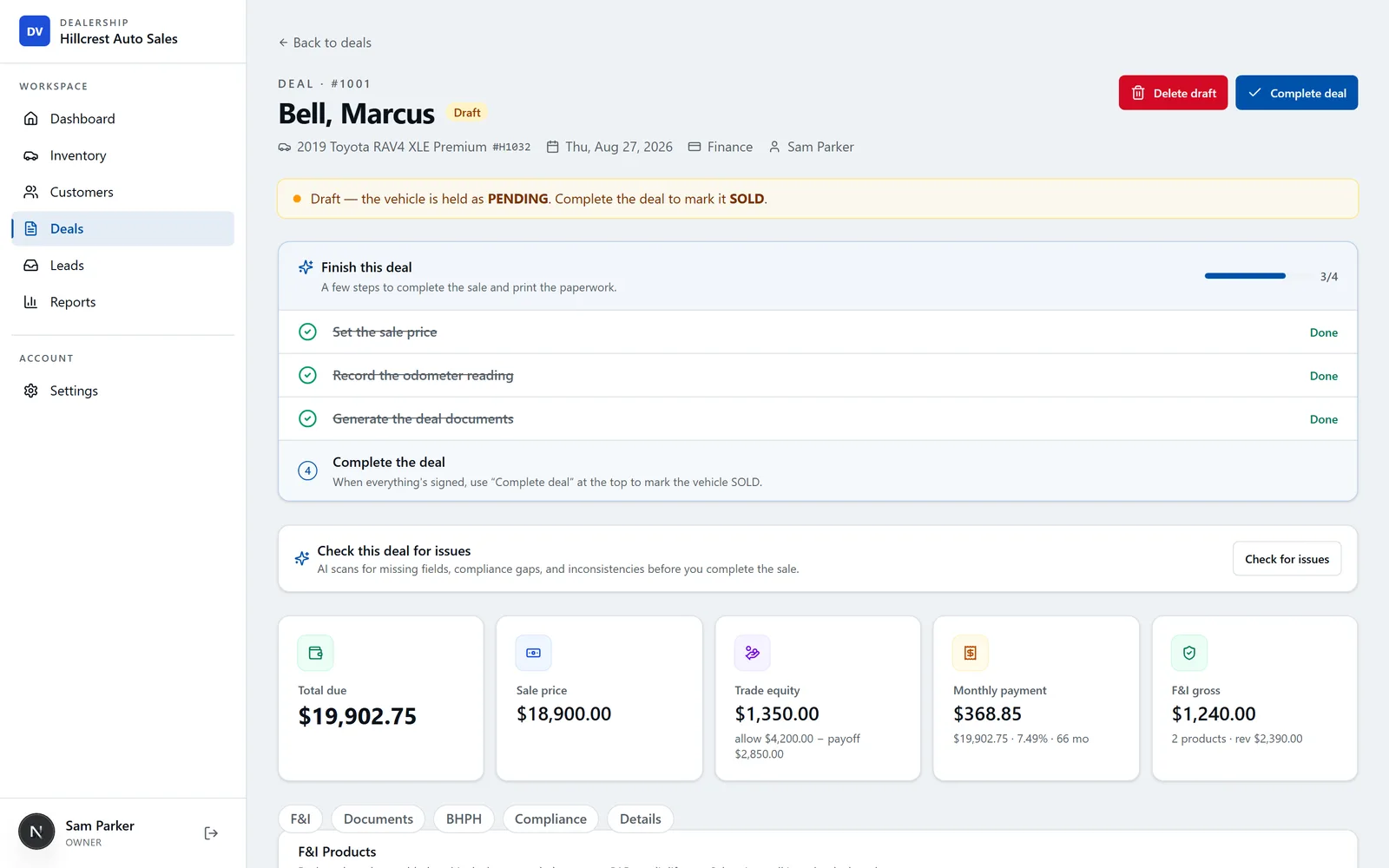
- Void the deal. An owner or admin can void a completed deal. The deal stays on file marked Void, so the history is kept, and the car goes back to Available unless another deal still holds it. A voided deal can't generate new documents or take buy-here-pay-here payments.
- The trade-in comes back off the lot. If the deal's trade-in was added to inventory when the deal was completed, voiding the deal removes it from inventory, or takes it off the lot and your website if it already has photos, leads or deals attached. A trade-in you've already resold is left alone.
- The Buyers Guide on the deal. Each deal records its warranty (As-Is — No Warranty, Implied Warranties Only, or Dealer Warranty) and prints a matching Buyers Guide, so you can see exactly what the buyer was told.
- Re-selling the car. The car's cost lines (vendor, description, cost) are still there, so a re-detail or repair after it comes back goes on the same car and its all-in cost stays honest.
It's $29 a month flat with unlimited users; see what's included.
Frequently asked questions
Can a customer return a used car to a dealer?
There's no general federal right to return a car. The FTC's buyer guidance says federal law doesn't require dealers to give buyers three days to cancel the deal and return the car. But a buyer may have a right under state law (California's CARS Act 3-day right to cancel on used cars priced $50,000 or less, for example), under a warranty you gave or your state requires, or because of a problem with the sale itself such as a title you didn't deliver.
Does the FTC Cooling-Off Rule apply to car sales?
Generally no. The rule covers sales made away from the seller's place of business, like the buyer's home, and it specifically exempts motor vehicles sold at auctions, tent sales or other temporary places of business when the seller has a permanent place of business. A sale on your lot isn't a sale away from your place of business in the first place.
Do I have to take a car back if the customer changed their mind?
In most states, a buyer who simply changed their mind has no right to return a car, unless your state gives one (California does for many used cars since October 1, 2026) or you offered a return policy. Whether to take it back anyway is a business decision: weigh what the unwind costs you against the review, the referral and the chargeback or complaint you might avoid.
Can a customer dispute a car down payment on a credit card?
Yes, in some cases. Under federal law, a cardholder can assert claims and defenses against the card issuer for a purchase over $50 made in their home state or within 100 miles of their address, after a good-faith attempt to resolve it with you. That's another reason to answer a complaint quickly and in writing.
What paperwork do I need to unwind a used car deal?
It depends on your state, because the title and registration have to be put back. California's DMV calls it a rollback and lists its own forms and fees, including two transfer fees. Check your state's dealer manual or DMV before you hand back any money, and get the buyer's signature on whatever your state requires.
Does the Buyers Guide matter if the customer wants to return the car?
It can. The FTC's Used Car Rule says the information on the Buyers Guide overrides anything contrary in the sales contract. If the Guide showed a dealer warranty, that's what you owe, whatever the contract says. If it said As Is and your state allows As Is sales, that's your answer on most mechanical complaints.
Bottom line
There's no federal three-day return on cars, and on most lots a changed mind isn't a legal reason to take one back. But check first whether the buyer has a real right (a state cancel law, a state warranty, the warranty on your Buyers Guide, a late title, a card dispute, or something misrepresented), fix what's fixable, and decide on goodwill unwinds with the real cost in front of you. When you do take one back, the state paperwork and the lender come before the refund.
14-day free trial, then $29/mo · Cancel anytime