A Customer Filed a Claim Against Your Dealer Bond. Here's What Happens Next
Your surety just told you a customer filed against your dealer bond. How the claim works, why you pay it back, what to send, and how to settle it first.
Part of the Starting a used-car lot guide: How to Start a Used Car Dealership: A Step-by-Step Launch Playbook (2026)
Switching from another DMS? Compare DealerVLO to DealerCenter, Frazer, or Lot Wizard.
The letter or email comes from your surety company, not the customer: someone has filed a claim against your dealer bond. Your first thought is probably "that's what the bond is for." It isn't. The bond protects your customers from you. If the surety pays, it comes back to you for the money.
Here's how a dealer bond claim actually works from the dealer's side: who can file, what the surety does, why you end up paying, how it can touch your license, what to send, and how to settle it before it gets that far. It's general information, not legal advice; bond rules are set state by state, so read your own state's statute and talk to your surety and a lawyer about a real claim.
14-day free trial, then $29/mo · Cancel anytime
A dealer bond is not insurance
When you got licensed, you bought a surety bond because the state required it. The surety (the bonding company) guaranteed to the state and the public that you'd follow the rules. You paid a premium, and you signed an indemnity agreement promising to pay back anything the surety pays out.
That's the part dealers forget. Insurance absorbs a loss. A surety bond only fronts it. As Vic Lance of Lance Surety put it in a WardsAuto column on bond claims, "The surety bond is not an insurance policy," and the surety may pay a claim "and later look to you for reimbursement." Treat every claim as money that's coming out of your pocket if it's paid.
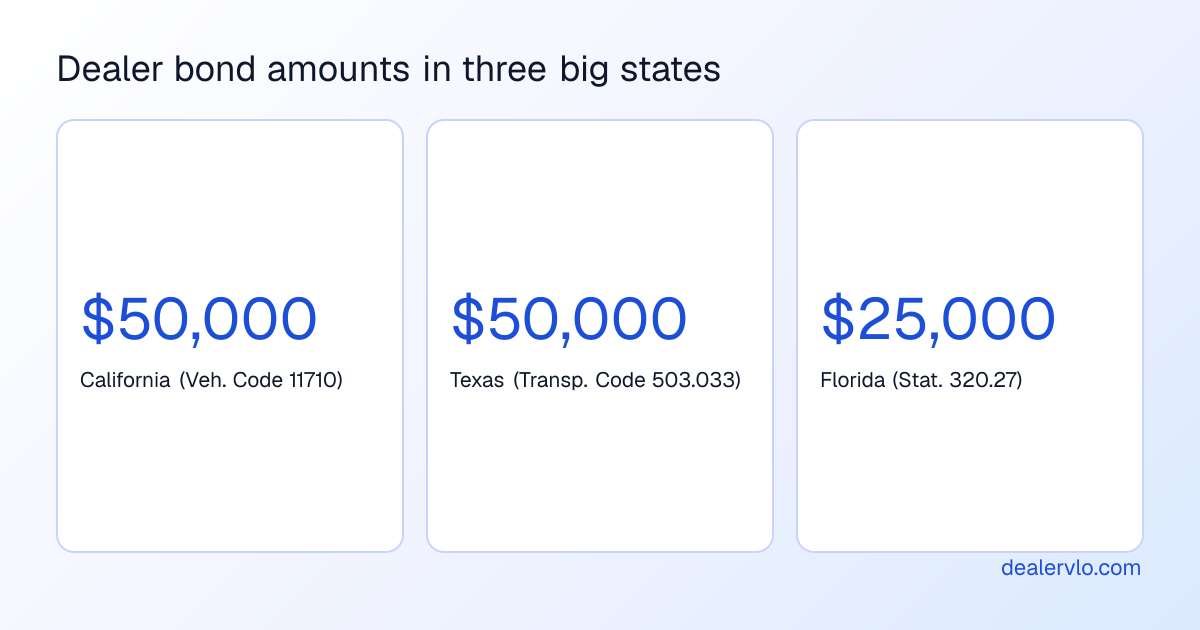
What the bond covers, and who can claim on it, depends on your state's statute:
- Texas conditions the $50,000 bond on two things: paying the checks you write to buy cars, and transferring good title to each car you sell (Transportation Code 503.033).
- Florida's bond runs to any person in a retail or wholesale transaction with the dealer who suffers a loss the statute covers (Statutes 320.27).
- California gives a person harmed by a dealer's fraud or violations of the Vehicle Code a right of action against the dealer and the surety (Vehicle Code 11711).
Claimants aren't always retail buyers, either. Lance lists purchasers, sellers, floor planners and retail lenders among the people who file. A private seller whose check from you bounced, or a lender who never got its lien recorded, can be on the other end.
What happens after a claim is filed
Every surety runs its own process, and the timing varies, but the shape is the same:
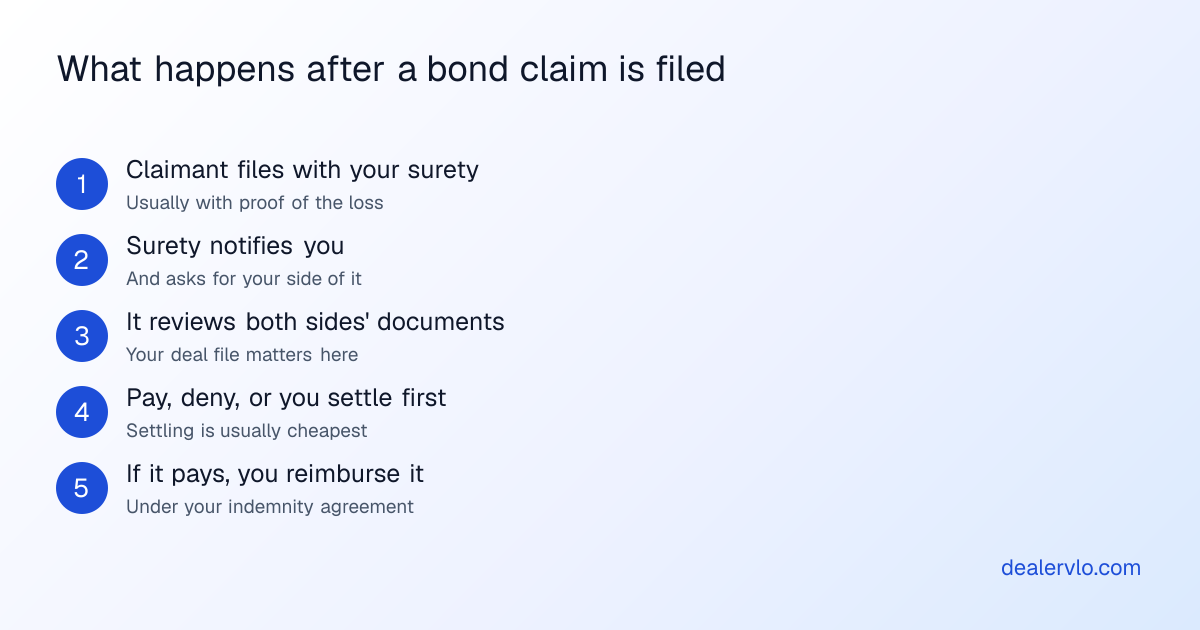
- The claimant files with your surety, usually with paperwork showing the loss.
- The surety notifies you and asks for your side. Lance describes it as both parties getting the chance to tell their side of the story.
- It reviews the documents from both sides.
- It pays, it denies, or you settle directly with the claimant.
- If it pays, you reimburse it under the indemnity agreement.
Some states add a step. In Texas, the claimant recovers against the bond after getting "a judgment assessing damages and reasonable attorney's fees" based on one of the two things the bond covers. In other states the surety can pay without a court judgment. Don't assume your state works like Texas; read your statute or ask your surety.
Why a paid claim can cost more than the claim
Three things can follow a paid claim, and all three cost more than the check:
- You owe the surety. Whatever it paid, plus whatever your indemnity agreement says about its costs.
- Your bond can fall below the required amount. California's Vehicle Code says a dealer's license is "automatically suspended" if the amount of liability under the bond is decreased, or if a final court judgment is outstanding (Vehicle Code 11710). A paid claim reduces what's left on the bond.
- Getting bonded again gets hard. Eric Halsey of JW Surety wrote in another WardsAuto piece that after a paid claim, it can be "nearly impossible" to find a company willing to bond you. No bond, no license.
The surety's liability is capped at the bond's face value; Texas's statute says so directly. That cap protects the surety, not you. A customer whose loss is bigger than the bond can still come after you for the rest.
What to do the day the claim arrives
Call your bond agent or surety right away. Don't let the response deadline in the letter slide. Lance's advice is to keep your bonding agency informed so it can push back on your behalf when the claim is weak.
Pull the whole deal file and send what supports your side. This is where a complete deal jacket earns its keep:
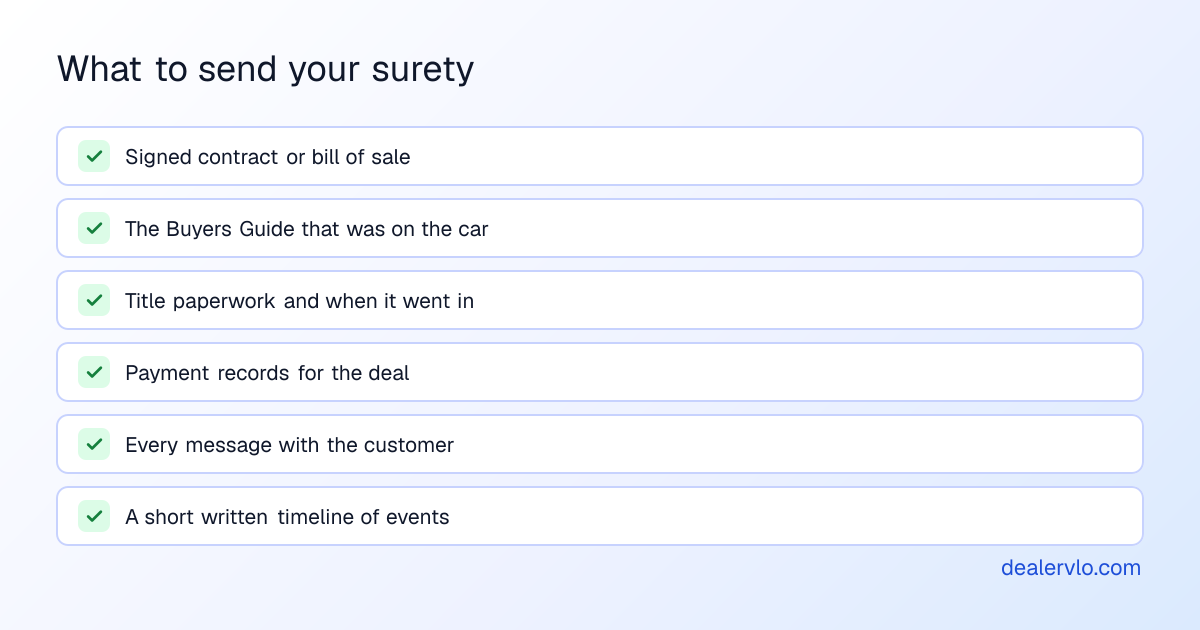
Write the timeline while it's fresh: when the customer bought, what was disclosed, when the title paperwork went in, when they first complained, and what you offered. Keep it to facts you can back with a document. If the claim is about a title, our guide to the documents in a used-car deal jacket shows what a complete file looks like.
Talk to the claimant. Many claims start as a complaint nobody answered. Halsey's advice to dealers is to "be a negotiator and work with the claimant." If the title is late, find out why and give a date. If something was missed, fix it. A settlement you control almost always costs less than a claim the surety pays and bills back to you.
Bring in a lawyer if the claim is large, disputed, or headed to court. That's not a step to save money on.
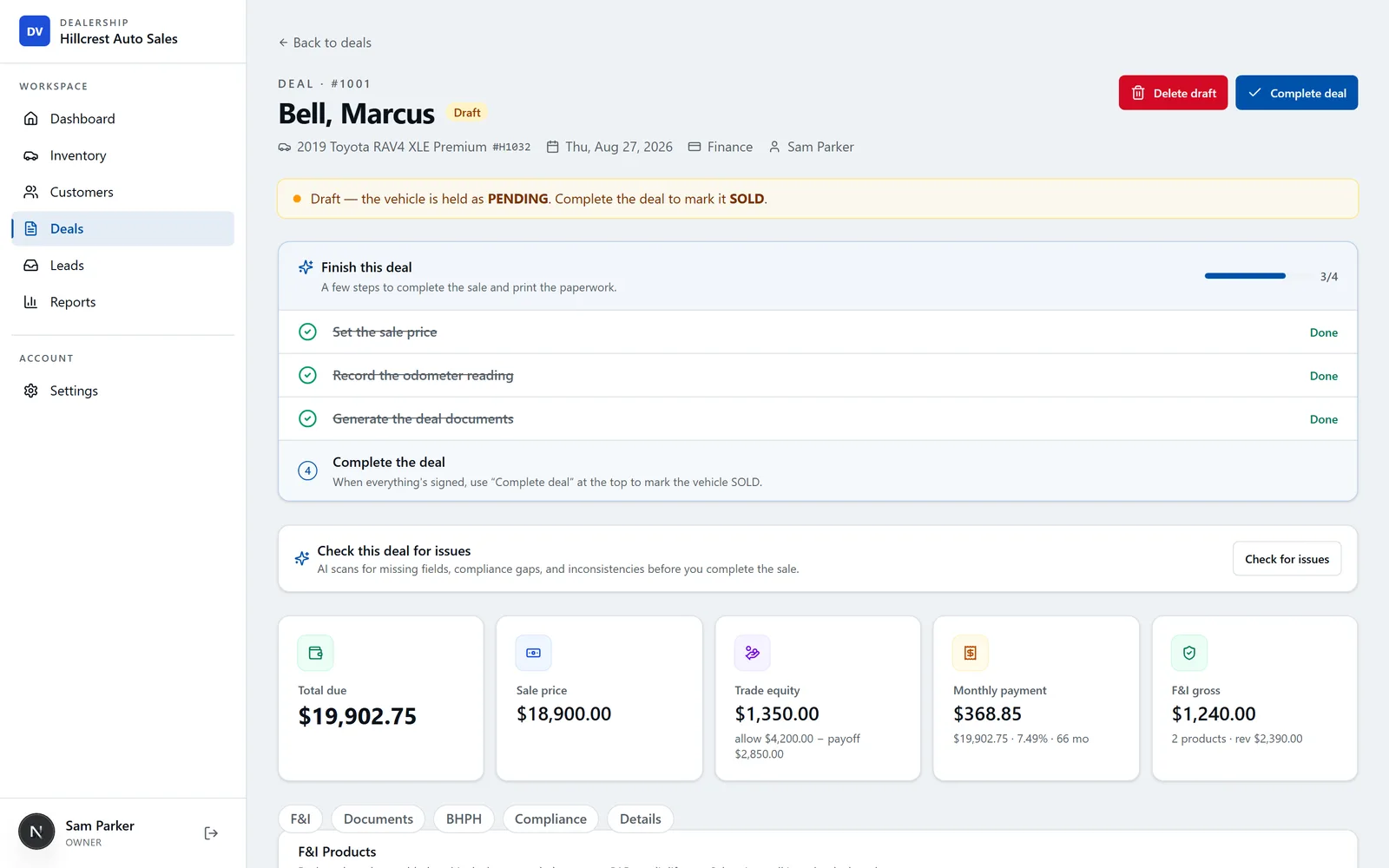
In DealerVLO, the deal jacket is where that file lives: the bill of sale, the Buyers Guide, the odometer statement and your state's title paperwork are generated from the deal, and every e-signed document stays with it. When the surety asks what was signed, you open the deal instead of digging through a filing cabinet.
14-day free trial, then $29/mo · Cancel anytime
How claims usually start, and how to stop them
Look at what bonds are written to cover and you've got the prevention list. Texas's statute is the clearest: checks you write for cars, and good title to the cars you sell.
- Titles. Late or missing title transfers are the classic claim. Know which cars you actually have titles for before you sell them, send title work promptly, and tell the buyer the truth when it's delayed. If you buy at auction, our guide to auction title delays covers what to do when the auction hasn't delivered the title yet.
- Checks and payoffs. Never let a check you wrote to buy a car bounce, and pay off trade-in liens on time. Our guide to negative equity trade-ins covers handling the payoff.
- Disclosure. Put what you know in writing: the Buyers Guide on the window, branded titles disclosed, damage disclosed where your state requires it. Our salvage title disclosure guide covers the branded-title side.
- Complaints. Answer them. A customer who gets a callback rarely files a bond claim. One who's ignored for three weeks goes looking for who else they can call. Our guide to handling a customer who wants to return a car walks through those conversations.
Where DealerVLO fits, and what it doesn't do
DealerVLO isn't a surety, an insurer or a law firm: it doesn't sell, quote or manage bonds, and it doesn't handle claims. Where it helps is the paperwork that keeps claims from starting and answers them when they do:
- Title status on every car. Each car's record has a title status field (In hand, Pending or Lienholder) plus the title number and state, and the title status prints on the bill of sale. A quick look tells you which cars you shouldn't be rushing out the door.
- Paperwork from the deal. The FTC Buyers Guide, bill of sale, odometer disclosure and your state's title and registration paperwork fill from the deal for all 50 states (the official state form where DealerVLO fills the state's PDF, and a print-ready worksheet where the state issues its form through a portal or as controlled paper).
- Trade payoffs on the deal. The trade-in records the payoff owed, the lienholder, the account number and the good-through date, so whoever writes the payoff check has what they need.
- A deal file you can hand over. E-signatures for the buyer, co-buyer and dealer, with the signed documents kept with the deal.
It's $29 a month flat with unlimited users; see what's included.
Frequently asked questions
What happens when someone files a claim against a dealer bond?
The claimant files with your surety company, the surety tells you and asks for your side, and it looks at the documents from both sides. It may deny the claim, pay it, or you may settle directly with the claimant. If the surety pays, you owe it back: the bond is a guarantee of your conduct, not an insurance policy that absorbs the loss.
Do I have to pay back the surety if it pays a claim on my dealer bond?
Yes. When you bought the bond you signed an indemnity agreement, and the surety will look to you to reimburse what it paid. That's the biggest difference between a surety bond and insurance.
Can a dealer bond claim affect my license?
It can. Some states tie the license directly to a full, active bond. California's Vehicle Code says a dealer's license is automatically suspended if the amount of liability under the bond is decreased, which is what a paid claim does, or if a final court judgment is outstanding. A dealer who can't get re-bonded after a claim can lose the ability to keep a license at all.
Can a claim be for more than the bond amount?
The surety's liability is capped at the face value of the bond. In Texas, for example, the statute says a surety's liability may not exceed the face value of the $50,000 bond. But that cap protects the surety, not you: a customer can still pursue you directly for losses beyond it.
Does the customer need a court judgment to collect on my bond?
It depends on the state. In Texas a claimant recovers against the dealer bond after obtaining a judgment assessing damages and attorney's fees, and the Texas bond covers two things: paying the checks you write to buy cars and transferring good title to the cars you sell. Other states handle claims differently, so read your own state's bond statute or ask your surety.
How do I avoid bond claims as a used car dealer?
Most of it is title and paperwork discipline: get titles transferred on time, never let a check you wrote for a car bounce, disclose what you know in writing, and keep a complete deal file. And when a customer complains, try to fix it before they go to your surety.
Bottom line
Your dealer bond protects your customers, not you. Every dollar the surety pays on a claim comes back to you, a paid claim can shrink your bond and in some states suspend your license, and a claim history makes the next bond hard to get. So call your surety the day a claim arrives, send a complete deal file and a factual timeline, and try hard to settle with the claimant first. Then fix the habit that caused it: titles, checks, disclosures, or an unanswered complaint.
14-day free trial, then $29/mo · Cancel anytime
Add up the real first-year cost of getting licensed in your state.
Open the Dealer License Cost Calculator