How to Cancel a DMS Contract When You're Already Auto-Renewed In
How to cancel a DMS contract you're already locked into: what auto-renewal laws cover, what to document, and realistic paths out.
Part of the Choosing dealer software guide: The best car dealership software in 2026: 14 DMS options for independent lots, with real prices
Switching from another DMS? Compare DealerVLO to DealerCenter, Frazer, or Lot Wizard, or see what DealerVLO's car dealer management software includes.
A dealer posted on DealerRefresh that they were three years into a DealerSocket contract when the vendor auto-renewed them for another two years without their noticing — "our fault for not catching it," the dealer wrote, but now the vendor was pushing for the full renewal term. A DealerSocket representative, Hunter Swift, actually responded in that same forum thread and offered to help resolve the dealer's auto-renewal contract dispute directly by phone. If you're reading this because you're in some version of that spot right now, this article is about what actually moves the needle and what's just going to waste your time.
This isn't legal advice. Contract and consumer-protection law varies by state and by the specific language in your agreement — before you send anything formal, have a lawyer read your contract and confirm what applies where you are.
14-day free trial, then $29/mo · Cancel anytime
Why "there's a law against this" usually doesn't apply to you
The instinct when you discover you've been auto-renewed is to look for an auto-renewal law to hide behind. Here's the problem: most state automatic-renewal laws are written to protect consumers — people buying something for personal or family use — not businesses buying software to run a dealership. Several law firms that track this area are explicit that business-to-business contracts generally fall outside these statutes. So a DMS vendor can usually auto-renew a dealership's contract in ways that would be illegal if you were a consumer buying a gym membership.
There are two documented exceptions worth checking if your contract touches them: New York has a long-standing auto-renewal law that applies to business contracts for service, maintenance or repair of property, and requires the vendor to give notice of the renewal in a specific window before it hits — if they didn't, you may not be bound to the renewal term. Wisconsin's law goes further for business equipment and service contracts: an auto-renewal clause can be void unless the vendor gave proper notice and you specifically initialed the renewal clause in the contract. If your agreement's governing-law clause points to New York or Wisconsin, that's worth raising with an attorney immediately — it could be real leverage, not just a talking point.
On the federal side, there's no "click-to-cancel" rule you can point to right now. The FTC's 2024 version of that rule was vacated by a federal appeals court. There's talk of the FTC writing a new rule, but as of today it doesn't exist in a form that helps a dealer walk away from a signed DMS agreement. Don't build your exit strategy around a law that isn't there yet.
What actually helps: the paper trail
Since the law mostly won't bail you out, the leverage you have is contractual and reputational — and it depends on what you can prove. One real dispute shows why, and what dealers tend to miss. In 2013, Tulley Automotive Group signed a Master Services Agreement with ADP Dealer Services (now CDK) for its DMS software, plus a separate equipment lease with ADP Commercial Leasing for the hardware. According to a federal court order in New Hampshire, Tulley allegedly stopped paying under both. CDK sued in federal court in New Jersey for breach of the services agreement, seeking accelerated payments and the return of equipment. Tulley countered that CDK had misrepresented the system to get it to sign, and in 2016 the court let most of those counterclaims go forward instead of dismissing them. Nobody had won anything at that point; it only meant the fight would continue.
Then a second lawsuit arrived. The equipment lease had been sold to Wells Fargo, which sued Tulley separately, saying Tulley owed $84,310.69 after making 27 of 60 monthly payments. Tulley tried to pull CDK into that case too, and the court dismissed the attempt.
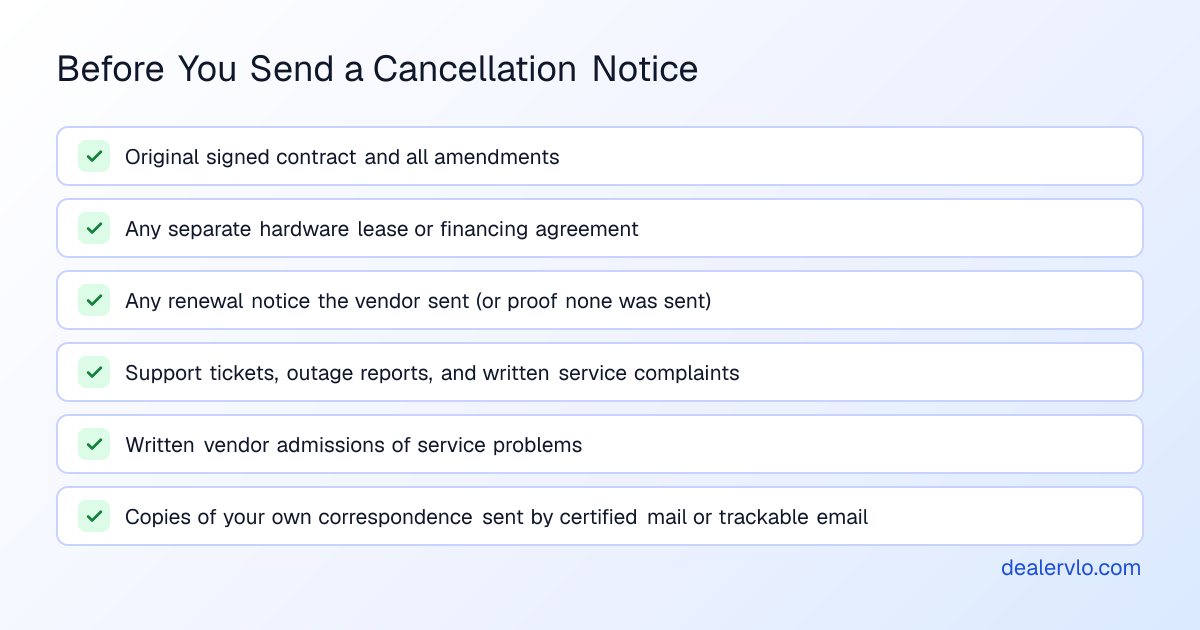
The lesson isn't about who was right. It's that a DMS deal is often more than one contract, with more than one company that can come after you, and every one of them runs on paper. Before you stop paying anything, pull together:
- The original signed contract and every amendment or addendum
- Every separate agreement tied to the system, such as a hardware lease or financing, and who holds it now
- Any renewal notice the vendor sent you (or proof they didn't send one)
- Every support ticket, outage report, and written complaint about service problems
- Any email or letter where the vendor admits a service failure
- Copies of anything you send going forward — by certified mail or a trackable email thread, never a phone call you can't document
If you're trying to figure out which of these documents you're even missing, a DMS contract red flags guide walks through the clauses worth re-reading before you escalate anything — auto-renewal windows, notice requirements, and termination-fee language are usually buried in the same few paragraphs.
Send a formal notice — even if you think it's futile
Whatever else you do, a written, dated, unambiguous termination notice matters more than almost anything else, and it beats simply stopping payment, which is how a dealer ends up as the defendant. Vague complaints to a sales rep don't count. A notice sent to the right contractual address, referencing your account and contract number, stating you intend to terminate and on what date, creates the record that either starts your clock running or forces the vendor to respond in writing — which itself becomes evidence.
If the vendor claims you missed a cancellation window, ask them in writing to point to the specific clause and the specific notice they sent you about the upcoming renewal. In the DealerRefresh case, the dealer admitted the renewal catch was their own oversight — but that doesn't mean the vendor's own notice obligations under the contract were actually met. Make them show you, in writing, not just tell you over the phone.
Know what you're negotiating against
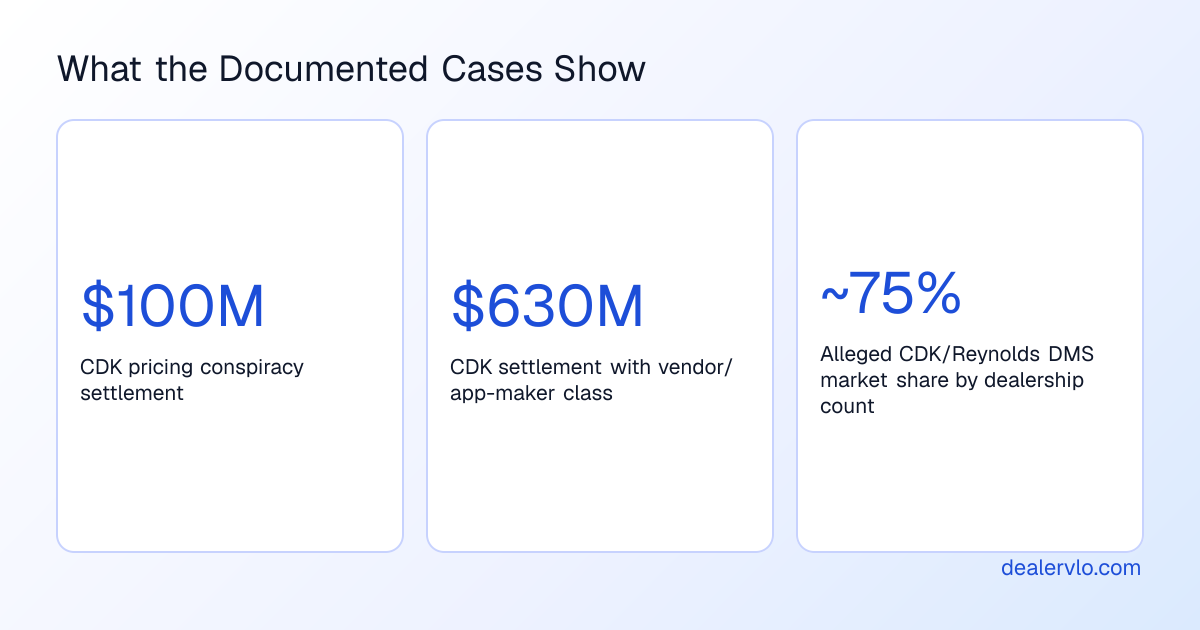
It helps to understand why DMS vendors hold the line so hard on multi-year terms. CDK and Reynolds & Reynolds have faced major antitrust litigation over DMS pricing and data-access practices — CDK agreed to pay $100 million (plus administration costs) to settle dealer claims over an alleged pricing conspiracy, and separately settled with a class of vendor/app makers for $630 million. Tekion has also sued CDK, alleging CDK slowed dealers' access to their own data specifically to make switching harder. One antitrust complaint alleged CDK and Reynolds together control roughly three-quarters of the DMS market by dealership count — though that figure comes from a plaintiff's complaint, not a court finding, so treat it as an allegation, not a settled fact.
None of this gives you a right to break your contract. But it's useful context in a negotiation: you're not a lone dealer being difficult, you're dealing with a market that's already under real regulatory and legal scrutiny for exactly the lock-in behavior you're experiencing. A demand letter that calmly notes the vendor is already the subject of federal litigation over customer lock-in tends to land differently than one that just says "this isn't fair."

While you're stuck: get your data out now, don't wait for the exit
Regardless of how the contract fight goes, start exporting your own data today. Arizona passed a law in 2019 that bars DMS vendors from charging dealers, or the integrators a dealer authorizes, fees to access the dealer's data unless the vendor discloses the charge and backs it with documented costs, and from blocking a dealer from copying, storing or sharing its own data. CDK and Reynolds sued to stop it. In 2021 the Ninth Circuit refused to block the law while the case continued, rejecting the vendors' arguments that it violated their copyrights or took their property. That's an Arizona-specific statute, not a national rule, but it's a sign that lawmakers and courts are willing to treat a dealer's inventory, customer and deal records as the dealer's to take.
Practically: ask your current vendor, in writing, for a full export of your inventory, customers, and deal history, and keep a dated copy of the request whether or not they comply promptly. This matters even if you're months from actually switching — the longer you wait, the more records (sold deals, old customers, historical recon costs) pile up behind a login you may eventually lose access to. In DealerVLO, that export is a button on the Inventory, Customers, and Reports pages — any dealer can pull a CSV of their cars, their customers, and a sales-and-tax CSV any time, no ticket to a vendor required, which is the habit worth building regardless of what system you're currently stuck in.
When you do move, know up front what will and won't carry over. Most DMS switches — DealerVLO included — can import your current inventory and customer lists from a CSV export, but they generally can't import historical deals, signed documents, or buy-here-pay-here payment history from another system; that's a limitation across the industry, not something specific to one vendor. If you're trying to size up what a full switch actually costs in time and money, not just license fees, the real first-year cost of switching dealer software breaks down migration, training, and the lost-days cost that doesn't show up on an invoice.
14-day free trial, then $29/mo · Cancel anytime
What to do differently once you're out
If you do get out — negotiated settlement, contract expiration, or a clean breach finding in your favor — the fix for not ending up here again is boring but it works: know your renewal date, and don't sign another multi-year term with an auto-renewal clause if you can help it. DealerVLO runs month-to-month with no contract and no cancellation fee, specifically so a dealer never has to have this fight twice. If you're comparing what else is out there before you commit to anything, the best DMS options for independent lots in 2026 lays out real prices and terms side by side, and how DMS pricing models actually work explains why flat monthly pricing versus per-user or per-deal fees matters more than the sticker price once you're six months in.
It also helps to simply write your renewal date somewhere your whole team can see — on paper, on a shared calendar, wherever — rather than leaving it buried in a vendor portal nobody opens until something breaks. A dealer running a 20-car lot on a spreadsheet already knows how easy it is for a date like that to slip past when nobody specifically owns it; the same blind spot that let a two-year auto-renewal sneak through is part of why running a lot on a spreadsheet works fine until it doesn't.
If you're genuinely stuck for the remaining term
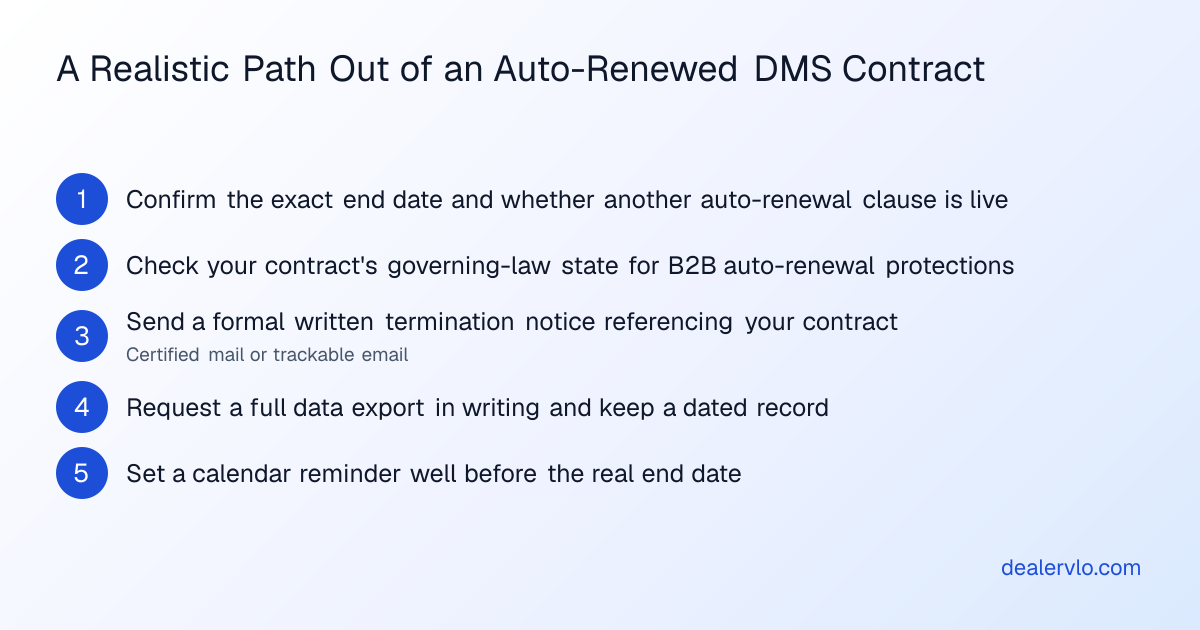
Sometimes the honest answer is that you're going to be paying for the rest of the term whether you like it or not — the contract language is clean, the vendor gave proper notice, and there's no New York or Wisconsin governing-law angle to work. In that case, the move isn't to keep fighting a losing paper battle; it's to minimize the damage and start building toward a clean exit at the real end date:
- Confirm in writing the exact date the current term actually ends and whether another auto-renewal clause is still live for that date.
- Put a calendar reminder well before that date, so you have enough room to miss the first deadline and still catch a second one.
- Start your data exports now, not the week before you leave.
- Document ongoing service issues as they happen, not retroactively — a written complaint sent the day something breaks carries more weight than a summary written six months later.
- Get quotes and demo the alternatives before the window opens, so you're not rushed into a second bad contract the moment you're free of the first.
A sales commission or profit margin calculator won't help you here, but if part of your frustration with the current system is that you can't see your own numbers clearly, it's worth knowing what a DMS should actually be showing you day to day — a plain-English guide to what a DMS does is a good gut-check on whether your next system is solving the right problem.
14-day free trial, then $29/mo · Cancel anytime
What DealerVLO does differently on contracts
To be direct about the product behind this article: DealerVLO is $29 a month, flat, with unlimited users, no setup fee, and no contract — month-to-month, cancel any time from the billing page, no cancellation fee. There's no auto-renewal clause to miss because there's no multi-year term to renew. You also get free CSV export of your inventory, customers, and deals at any time from inside the app, so if you ever do want to leave, there's no fight required to get your own data out.
That doesn't make the contract you're currently stuck in disappear. But it's worth knowing what the alternative actually looks like once you get to the other side of it — a system where the exit process is a button on the billing page, not a demand letter.
Total the real cash to open — license & bond, inventory, the lot, insurance, software, and the working capital most checklists forget.
Open the Used Car Dealership Startup Cost CalculatorFrequently asked questions
Can I cancel a DMS contract that auto-renewed without my approval?
Usually not automatically just because you didn't notice the renewal — most state auto-renewal laws protect individual consumers, not dealerships buying business software, so you can't generally invoke a consumer-protection statute to void the term. Your best path is checking your contract's governing-law clause (New York and Wisconsin have documented business-contract auto-renewal protections), confirming whether the vendor actually sent the renewal notice your contract requires, and sending a formal written termination notice regardless.
Does the FTC's click-to-cancel rule help dealers get out of DMS contracts?
No — the FTC's 2024 version of that rule was vacated by a federal appeals court in 2025, and that version is not currently in effect. There's discussion of a future FTC rulemaking, but nothing a dealer can point to today to exit a signed DMS agreement.
What should I document before trying to cancel a dealer software contract?
Keep the signed contract and all amendments, any renewal notice the vendor sent (or didn't send), every support ticket and outage complaint, any written vendor admission of service problems, and copies of your own correspondence sent by certified mail or a trackable email. Also find every separate agreement tied to the system, such as a hardware lease: in one real case, a dealer group that stopped paying was sued separately over its equipment lease after the leasing company sold it to a bank.
Can my DMS vendor refuse to give me my own data when I leave?
Practices vary by vendor. Arizona has a law that bars DMS vendors from charging dealers fees to access their own data unless the charge is disclosed and backed by documented costs, and a federal appeals court refused to block it when two major DMS vendors challenged it. Even outside Arizona, request a full written data export early and keep a dated record of the request, since recovering old data gets harder the longer you wait.
Is a multi-year DMS contract with auto-renewal normal?
It happens, but it isn't the only way DMS vendors price their product — some, including DealerVLO, run month-to-month with no long-term contract and no cancellation fee. If you're currently locked into a multi-year term, it's worth comparing what other DMS options charge and how their terms work before you sign anything again.
What happens if I just stop paying and switch to a new DMS?
That's risky. In one real case, a dealer group allegedly stopped paying under both its DMS services agreement and a separate hardware lease, and ended up defending two federal lawsuits: one from the DMS vendor seeking accelerated payments and return of equipment, and one from the bank that had bought the equipment lease, claiming more than $84,000. Send a formal written termination notice, check for separate leases, and keep records rather than simply walking away.
Bottom line
If you're locked into an auto-renewed DMS contract, the uncomfortable truth is that most consumer-style auto-renewal laws won't save you, and no federal rule exists right now to lean on either. What actually moves these disputes is a documented paper trail — the renewal notice (or lack of one), your support complaints, and a clean, written termination notice — plus, if your contract is governed by New York or Wisconsin law, a real legal carve-out worth having an attorney check. While you work through it, get your own data out, confirm your actual end date, and start comparing what a no-contract alternative looks like so you're not signing your way into the same fight again. If you want to see what running your lot without a multi-year contract actually feels like, give DealerVLO a look.
14-day free trial, then $29/mo · Cancel anytime