The Real First-Year Cost of Switching Dealer Software: Setup, Migration, Training and Lost Days
The total cost of switching dealer software goes beyond the monthly fee. Here's a line-by-line look at setup, migration, training and lost-day costs.
Part of the Choosing dealer software guide: The best car dealership software in 2026: 14 DMS options for independent lots, with real prices
Switching from another DMS? Compare DealerVLO to DealerCenter, Frazer, or Lot Wizard, or see what DealerVLO's car dealer management software includes.
When a vendor quotes you a monthly price for a new DMS, that number is the easiest part of the whole switch to budget for. The real total cost of switching dealer software shows up after you sign: a data migration fee the sales rep never mentioned, weeks of double-paying two systems during cutover, staff time lost to re-entering deals by hand, and — if you're not careful about the exit terms on the system you're leaving — a bill just to get your own customer and deal history out the door.
None of that is hypothetical scare talk. It's a documented pattern in trade press covering dealer software contracts, and it's the reason "how much does the new system cost a month" is the wrong first question to ask. This post walks through every line item that actually belongs in a first-year switching budget, what's verifiable about each one, and where the honest answer is "it varies — get it in writing before you sign anything."
14-day free trial, then $29/mo · Cancel anytime
Why the "monthly price" comparison misses the real cost
Most dealers shopping a DMS switch compare sticker prices: this system is $99 a month, that one is $129, this one bills annually at a discount. Frazer, for example, publishes $129/month, $387/quarter, or $1,299/year, and is explicit that there's no setup fee and no hidden fees on top of that — a useful baseline because so few vendors in this category state that outright (Frazer pricing page).
That transparency is the exception, not the rule. A broader DMS pricing framework lays out the fuller cost equation most dealers never see until they're mid-switch: subscription fees plus implementation, data migration, integrations, transaction fees, training, hardware, and support — a formula that makes clear the monthly number is maybe half the real annual cost in year one (LiveTechHacks DMS pricing guide).
If you're comparing systems on price alone before you've priced out every one of those categories, you're comparing the wrong number. The guide to DMS pricing models and the full roundup of DMS options for independent lots are good starting points for the monthly-price side of the comparison before you layer the switching costs on top.
| Cost category | What drives it | Where it's quoted upfront? |
|---|---|---|
| Monthly/annual subscription | Vendor's published pricing | Usually yes |
| Setup & implementation | Data cleansing, field mapping, validation | Rarely — ask directly |
| Data migration / exit fee from old vendor | Volume of historical deals, vendor's exit terms | Almost never disclosed proactively |
| Training & cutover productivity loss | Staff size, how different the new UI is | Never quoted; it's your labor cost |
| Parallel-running overlap | Running old + new system simultaneously | Rarely mentioned |
| Third-party integration repointing | Each connected tool (CRM, listing feeds, lender portal) | Vendor-by-vendor, often missed |
Setup and implementation: the fee most vendors don't volunteer
The research here points to a real disclosure gap. Frazer stating plainly that there are "no setup costs or hidden fees" is notable precisely because it's unusual — most vendor pricing pages simply don't address implementation cost at all (Frazer pricing page). A Tier-3 industry pricing guide frames the general shape accurately: migrating existing customer and vehicle data into a new system is rarely free, and the "down time" during staff training is a real operational cost even when no invoice shows up for it (Verifacto DMS TCO guide, 2026).
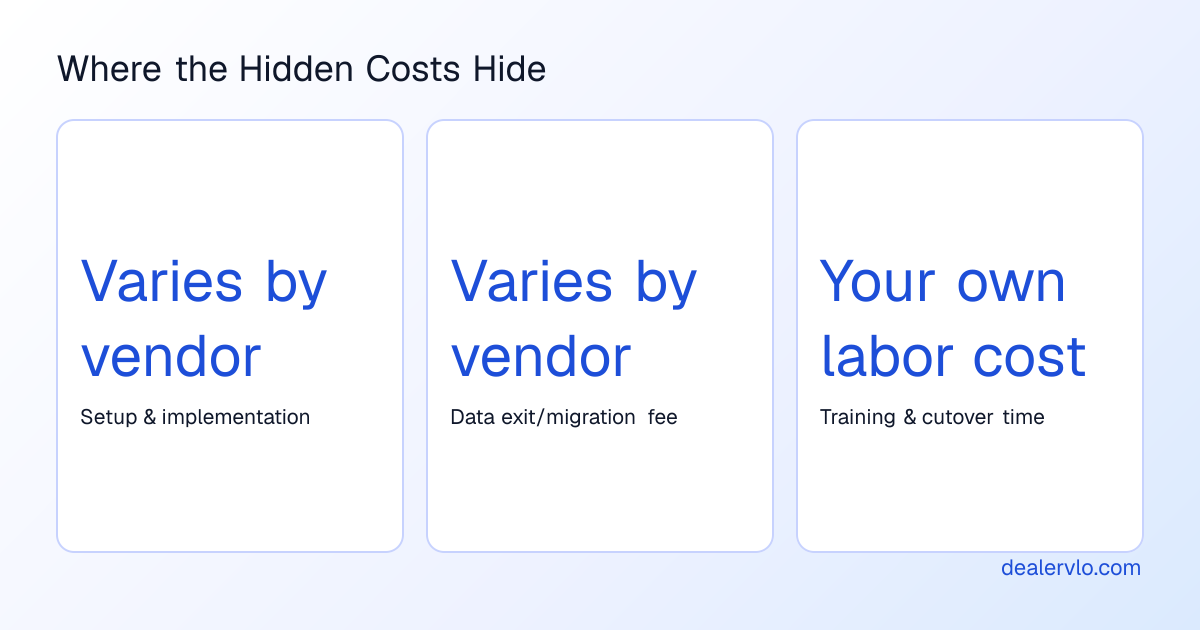
The practical version of that same point: a simple import of current inventory and active customers might be included in onboarding, while anything more — cleaning up duplicate records, mapping custom fields, pulling in years of historical deal data — can trigger a separate implementation charge (LiveTechHacks DMS pricing guide). There's no reliable industry-wide dollar figure for this that's specific to independent used-car dealers, so don't anchor your budget to a number you saw on a blog — ask the new vendor, in writing, exactly what's included and what isn't before you sign.
This is one place DealerVLO's structure genuinely removes a line item rather than disclosing it better: there's no setup fee, and onboarding runs on a self-serve CSV import. The "Add many cars at once" import on the Inventory page takes up to 1,000 rows per file with a valid 17-character VIN per row, and a separate Settings import handles inventory and customer contacts up to 500 rows per file. Neither decodes VINs during import — your export file needs year, make, and model in its columns — and the first import path is the one to use if your old system's export includes acquisition cost, since the Settings path doesn't carry cost over.
Data exit costs: what trade press has actually documented
This is the part of the research that's strongest, and it's worth taking seriously even on a small lot. Multiple named trade publications independently describe the same mechanism: a dealer's own historical data can become leverage for the outgoing vendor. Digital Dealer describes exit barriers where a provider can effectively hold archived data until a dealer pays a fee or re-signs the contract (Digital Dealer, "DMS Data Archiving"). The same article gives one reported, illustrative example — not an industry average — of a dealer being quoted roughly $10,000 upfront to convert their own data, followed by continuing monthly payments to keep that data accessible. Treat that as a single documented case, not a number to plug into your own budget, but as proof the risk is real.
A second named source, writing in Automotive Buy Sell Report, makes the same point from the contract side: dealers should know about fine print that restricts access to their own data and obligates them to future charges, and a properly drafted contract should state plainly that the dealership owns its data and that access won't be restricted after a system change (Sandi Jerome, Automotive Buy Sell Report). A related legal analysis from the same outlet goes further: the data inside a DMS is often worth more than whatever's left on the contract, and without the vendor's cooperation a dealer may not be able to extract it at all — the fix being a written "data access guarantee" alongside any escape clause (Automotive Buy Sell Report, DMS escape clauses).
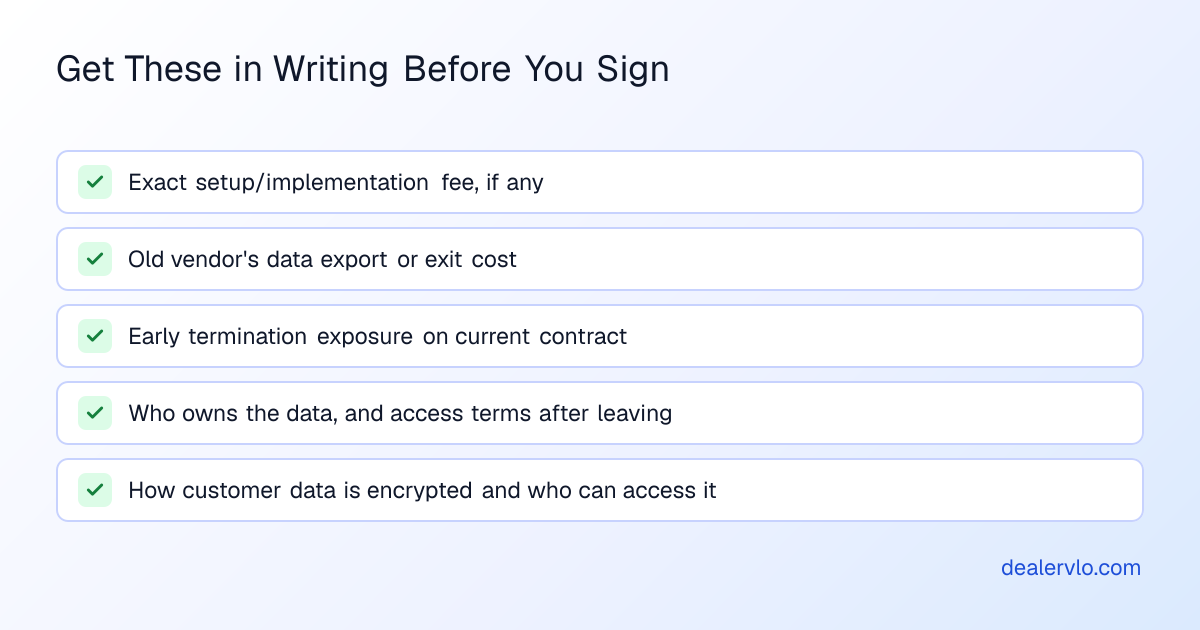
The budgeting takeaway: before you sign with a new vendor, pin down in writing what it costs to get your data OUT of the old one. There's no generic formula across vendors for this, so a quote you get verbally means nothing — get it on paper. On the way out, DealerVLO's own export side is free any time: the Inventory page, Customers page, and Reports page each have their own CSV export, and every customer record has a one-click "Download data" button that pulls everything on file about that customer — deals, terms, trade-in, buy-here-pay-here payment history, and the list of generated documents — as one file. That's the kind of exit term worth asking any vendor to match before you commit.
14-day free trial, then $29/mo · Cancel anytime
Contract lock-in and early termination
If you're switching away from your current system before its term is up, you may also be eating an early termination fee on the way out. General commercial-contract guidance from a law firm specializing in IT services contracts notes that termination-for-convenience clauses commonly require notice within a specified window and a fee tied to a percentage of the fees remaining on the term — the firm's own recommended figure being roughly half (Scott & Scott LLP, termination clauses). The same firm notes such fees have been upheld by courts when they're a reasonable estimate of the provider's lost profit, not a penalty (Scott & Scott LLP, recovering termination fees).
Important caveat: that's general IT-services contract law, not a DMS-specific rule, and no percentage figure here is confirmed as standard across dealer software contracts specifically. What it tells you is the shape of the risk — read your current contract's termination clause before you commit to a switch date, and don't assume you can walk away free just because you found something better. DealerVLO's own terms are the opposite of this risk: it's $29 a month flat, month to month, no contract, and you cancel from the billing page any time with no cancellation fee.
Training time and cutover productivity loss
Nobody invoices you for this one, but it's real money. Every hour your salesperson spends relearning how to pull a deal jacket, or your F&I person spends hunting for where a trade payoff field moved, is an hour not spent closing or following up a lead. The research didn't turn up a reliable industry-wide figure for how many days or what percentage of productivity a typical DMS cutover costs — vendor-published timelines exist for individual platforms, but they don't generalize, so don't let anyone hand you a precise number here. Budget it the way you'd budget any staff training: by your own headcount and hourly cost, over however many days it realistically takes your team to get comfortable.
What shortens that window in practice is how much of the new system is self-explanatory versus how much needs a manual. A dashboard that surfaces what needs attention — new leads awaiting contact, deals missing a price or odometer reading, cars sitting without photos — cuts down the "where do I even start" problem on day one. DealerVLO's dashboard does exactly that: four headline numbers (available inventory, new leads, active deals, cars sold this month) plus a needs-attention list built from your actual data, so a new user isn't guessing at what to check first.
Parallel-running overlap and integration repointing
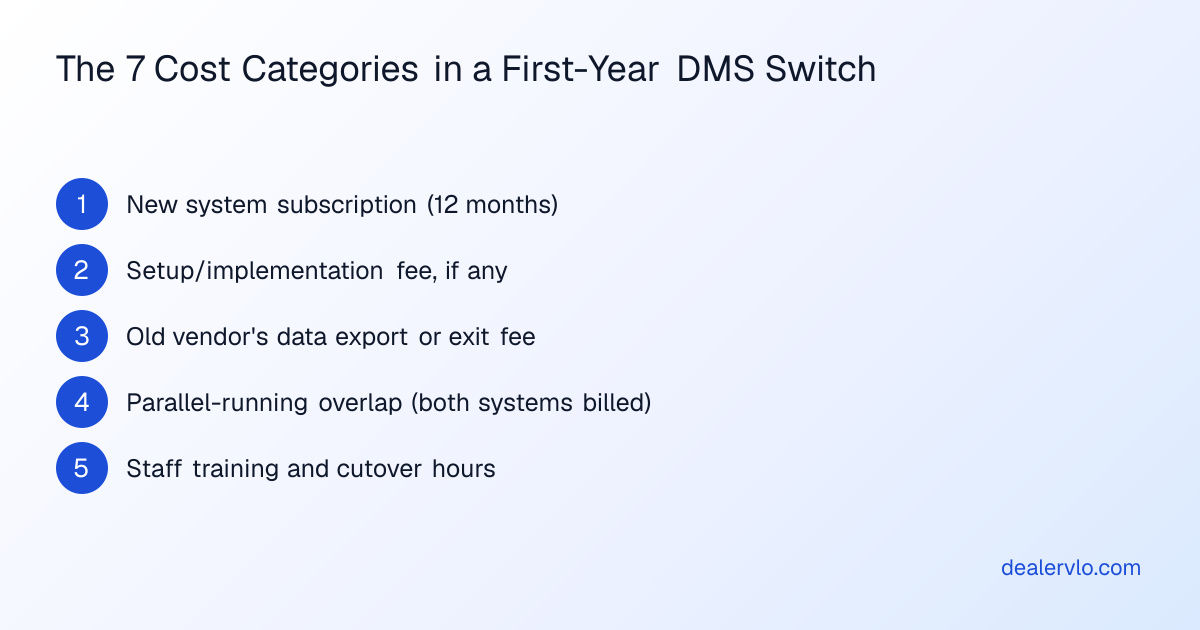
During a transition, a lot of dealers run both systems side by side for a stretch — new deals go into the new DMS, but the old one stays live long enough to close out pending deals, reference history, and make sure nothing falls through the cracks. That overlap means paying for two subscriptions at once for however long it takes, which is a real but often-overlooked dollar cost in the first-year math.
There's also a structural cost specific to dealers running separate point tools instead of one system: every connected tool — your CRM, your listing feeds, your lender portal — has to be repointed at the new DMS, and each of those has its own setup friction. If you're weighing whether to consolidate onto one platform instead of stitching several together again, the breakdown in separate tools vs. an all-in-one system is worth reading before you re-sign with a pile of point solutions. On the listing-feed side specifically, DealerVLO sends daily feeds to CarGurus, Cars.com and Autotrader once you've entered your Dealer ID for each and opted in — you still enroll and pay each site directly, but there's no feed URL to configure or switch over yourself; when you're leaving another system, you ask each listing site to stop the old feed once the DealerVLO feed is live.
A competing DMS vendor's own marketing analysis — worth noting explicitly as a vendor claim, not neutral research — argues that dealers running a patchwork of other systems can lose a meaningful amount annually in fragmented integration fees, based on an average dealership using close to seven separate software tools to complete one sale (Dealertrack integration fee analysis). Take the specific dollar figure with real skepticism since it comes from a competitor selling against that exact fragmentation — but the underlying structural point, that more point tools means more integration seams to pay for and repoint during any switch, holds regardless of who's saying it.
Put a real dollar-a-day number on every unit sitting on your lot.
Open the Holding Cost CalculatorThe compliance step that attaches to any new vendor: Safeguards Rule vendor oversight
This section is informational, not legal advice — confirm your current obligations with the FTC or your compliance counsel.
Switching DMS vendors isn't just an operational decision; it also triggers a vendor-vetting obligation under federal law. Dealerships are generally treated as financial institutions under the Gramm-Leach-Bliley Act and have to comply with the FTC's Safeguards Rule, which requires administrative, technical, and physical safeguards for customer data containing nonpublic personal information (ComplyAuto, FTC Safeguards Rule FAQs). The FTC enforces the rule and can penalize noncompliance (Meriplex, FTC Safeguards overview).
Part of that obligation is specific to the moment you bring on a new vendor: dealers are required to oversee their service providers — choosing ones that can actually safeguard data, requiring safeguards by contract, and reassessing them periodically (Dealsafe, Safeguards Rule checklist). A 2026-dated compliance guide ties this directly to real-world risk, pointing to the 2024 CDK Global incident as a reminder that a dealership's data security is only as strong as its vendor's (Comnexia, FTC compliance 2026 updates). There's a partial carve-out for dealers holding data on fewer than 5,000 consumers, but it doesn't exempt you from the core access-control, encryption, and vendor-oversight requirements (Dealsafe, Safeguards Rule checklist). Practically: before you sign with a new DMS, ask how customer data is encrypted and who can access it — that's a question any Safeguards-Rule-conscious dealer should be asking regardless of which system they pick.
Building your own first-year switching budget
There's no single verified dollar figure anyone can hand you for "the average cost of switching DMS vendors" — every source in this space that tries lands on numbers that are either vendor-specific, single-anecdote, or built on unnamed methodology. The honest way to budget it is to price out each category against your own numbers rather than borrowing someone else's headline figure:
- Your new system's monthly or annual subscription, times 12
- Any implementation/setup fee the new vendor quotes in writing
- The old vendor's data export or exit fee, confirmed in writing before you commit to a switch date
- Weeks of parallel-running overlap, times both subscriptions
- Staff hours for training and cutover, at your own labor cost
- Any early termination exposure left on your current contract
- Integration repointing for every connected tool you're keeping
Once you've got real numbers in each row, you can compare that total against what a year on the new system actually costs — not just its sticker price. If you're thinking specifically about moving off a current platform, the step-by-step guides for switching from AutoRaptor, switching from ProMax, switching from Desk2Deal, and switching from Carsforsale.com walk through the data-move itself in more detail.
14-day free trial, then $29/mo · Cancel anytime
Where DealerVLO fits in that math
A flat $29-a-month price with unlimited users and no contract removes two of the seven line items above outright — there's no setup fee to negotiate and no early-termination exposure to budget for, since it's cancel-any-time from the billing page. The CSV import handles the data-move side for inventory and customer contacts without a professional-services engagement, and free export of inventory, customers, and deals at any time means the "what does it cost to leave" question has an answer before you ever need it. None of that erases the training-time and parallel-running costs every switch involves — but it does mean two of the biggest unknowns in a typical switching budget are fixed numbers instead of open questions. You can see what the deal workflow and paperwork look like day to day on the dealer paperwork software page, or compare it against other options in the used car dealer software roundup.
Frequently asked questions
What is the total cost of switching dealer software, beyond the monthly subscription?
It's the sum of setup/implementation fees, the outgoing vendor's data migration or exit costs, parallel-running overlap while both systems run side by side, staff training and cutover time, any early termination fee left on your current contract, and integration repointing for connected tools. No single verified industry-wide dollar figure covers all of this for independent used-car dealers — budget each category against your own numbers rather than a generic estimate.
Do DMS vendors usually charge a setup or implementation fee?
It varies by vendor, and most don't disclose it upfront. Frazer is one of the few that states plainly on its pricing page that there's no setup cost or hidden fees; broader industry guidance notes that simple imports may be included while more complex data cleansing or historical migration can trigger a separate charge. Always ask in writing before you sign.
Can my old DMS vendor charge me to get my own data out?
Trade press has documented cases where outgoing vendors restrict or charge for access to a dealer's historical data — one reported example involved a large upfront fee plus ongoing monthly charges just to keep the dealer's own data accessible. This isn't universal or an industry-standard fee, but it's common enough that dealers are advised to get exit and data-access terms in writing before signing with any new vendor, not after a problem comes up.
How long does it typically take to switch DMS systems?
There's no reliably confirmed industry-wide timeline for this — it depends on your inventory size, how much historical data you're bringing over, and how different the new system's workflow is from your old one. Budget staff training time based on your own headcount rather than a number from a vendor's marketing page.
Is there an early termination fee if I leave my current DMS contract before it ends?
Possibly — check your contract's termination clause directly, since this varies vendor to vendor and isn't governed by a DMS-specific industry standard. General commercial-contract law allows for termination fees tied to a percentage of remaining contract value when they're a reasonable estimate of lost provider profit, but no figure here is confirmed as typical specifically for dealer software contracts.
Does switching DMS systems trigger any compliance obligations?
Yes — under the FTC's Safeguards Rule, dealerships (treated as financial institutions under the Gramm-Leach-Bliley Act) are required to vet and oversee any vendor that will handle customer data, including a new DMS provider. That means confirming the new vendor's safeguards in writing as part of the switch, not just comparing price and features. This isn't legal advice; confirm your specific obligations with the FTC or your compliance counsel.
Bottom line
The sticker price on a new DMS is the smallest number in a real first-year switching budget. The categories that actually move the total — setup fees, your old vendor's data exit terms, parallel-running overlap, training time, and any termination exposure — rarely get quoted until you ask, and in at least one documented case, "getting your own data back" came with a real bill attached. Price every one of those categories in writing before you sign anything, on either end of the switch. Run the comparison with DealerVLO's flat, no-setup-fee, no-contract pricing as one side of that worksheet.
14-day free trial, then $29/mo · Cancel anytime