Getting off spreadsheets: when a small lot needs real dealer software
Car dealer spreadsheet problems cost more than software. Floor plan errors, audit failures, and compliance risk add up fast—here's when to switch.

The hidden cost of "free" spreadsheets
Excel costs nothing. A dealer management system runs anywhere from $80 to $199 a month. So the math looks simple: stay in the spreadsheet, save the money.
But that comparison ignores what spreadsheets actually cost you. The floor plan interest you don't catch because a formula broke in row 18. The FTC penalty you eat because you had no system to track Buyer's Guides. The three hours a month reconciling inventory mismatches your lender flags during audit. The trade-in lien you missed the deadline on because there was no calendar trigger, and now your buyer's threatening a lawsuit.
I ran my Massachusetts lot on spreadsheets for years, and I can tell you exactly what breaking point feels like: it's the night you discover your floor plan report doesn't match your lender's records by six units, and you have 48 hours to reconcile it before they curtail your line.
This post walks through the documented failure modes—floor plan cost errors, double-entry nightmares, compliance violations—and the math that shows when $99/month is cheaper than "free."
A compliance note before we start: This article touches on federal rules and state deadlines, but it isn't legal advice. The FTC, your state DMV, and the IRS all publish current requirements; confirm yours with the relevant agency before you make compliance decisions.
The five spreadsheet failure modes that cost real money
1. Floor plan cost tracking falls apart
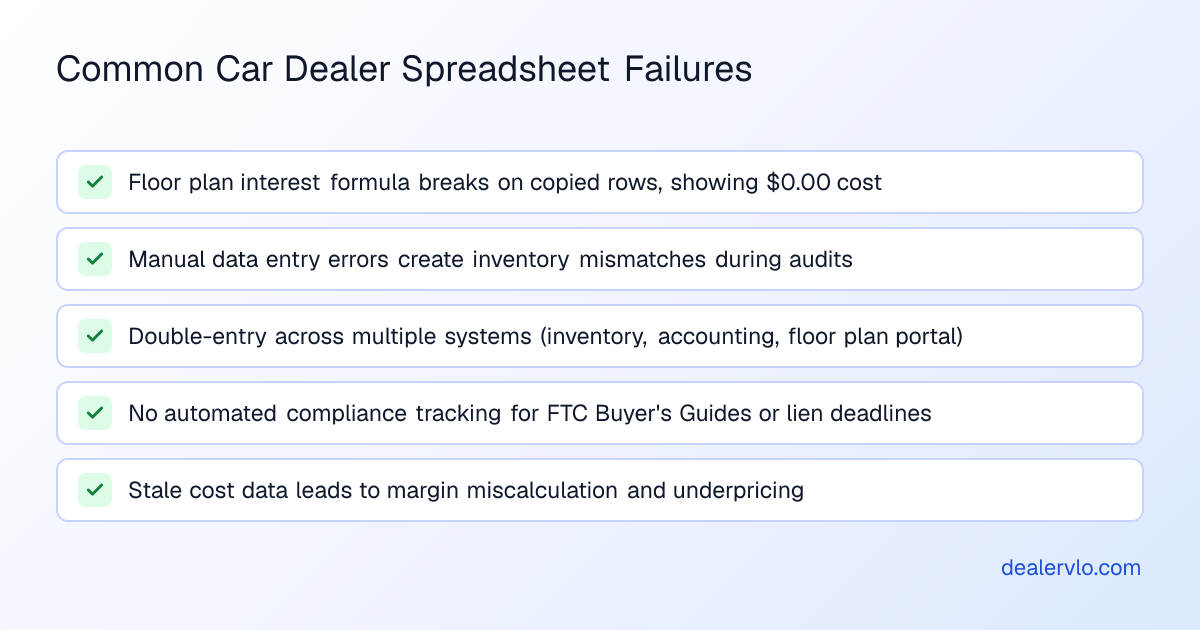
The most common spreadsheet failure is simple: the floor plan interest column shows $0.00 because nobody updated the days-on-lot formula. You copied the row from last month's sheet, the cell reference broke, and now you're looking at a cost figure that's two weeks stale.
When floor plan interest isn't tracked accurately, you either overpay—because you don't prioritize moving aging inventory—or you underestimate the true cost of a unit and destroy your margin calculation. A car you think cost you $9,200 all-in actually cost $9,680 after 45 days of interest, and you just listed it at $10,995 thinking you had $1,800 in gross.
Floor plan accounts should be reconciled at least monthly to catch interest errors, missed payments, or inventory mismatches with your lender. If you're doing that reconciliation by hand, matching your Excel sheet against the lender's portal line by line, you know how long it takes. And if a mismatch shows up during a collateral audit, the lender wants it fixed immediately—or they start talking about curtailment.
We built a dealer floor plan calculator tool that shows you what daily interest actually does to unit cost over 30, 60, 90 days, because most dealers don't realize how fast it compounds. When you see the dollar impact, the case for automated tracking gets a lot clearer.
2. Manual data entry and formula errors
A 2026 survey found that 22% of operations professionals deal with spreadsheet errors every day at work. Of those, 59% said the most common error was manual data entry mistakes, and 46% pointed to broken formulas.
That's not a small-dealer problem. That's an everyone-who-uses-spreadsheets problem. The documented consequences include a $24 million loss from a cut-and-paste error in power transmission hedging contracts and an $11 million severance mistake caused by accidentally adding too many zeros to one employee's payout.
You're not trading power contracts, but the same mechanics apply: you copy a row, the formula doesn't update, you don't notice, and three weeks later your books don't match reality. Or you fat-finger a VIN during data entry, your inventory report has a duplicate, and your lender's audit flags it as a trust violation.
The time cost is harder to measure but just as real. Every time you enter the purchase price in your spreadsheet, then re-key it into your accounting software, then again into your floor plan lender's portal, you create three opportunities for error—and you've just spent six minutes on data entry that should have happened once.
3. Inventory mismatches and audit failures
Accurate inventory reporting is critical for dealer floor plan management, and one of the biggest mistakes is not consistently updating records or providing inaccurate information to your lender. Collateral audits verify that vehicles haven't been sold out of trust and that every unit on the floor plan is accounted for.
When your lender's auditor shows up and your spreadsheet says you have 28 units but they count 26 on the lot, you have a problem. The two missing units might be sold and you forgot to update the sheet. Or they might be at the body shop. Or one might be a typo—a duplicate VIN from a copy-paste error three weeks ago.
Either way, you're now sitting in your office explaining the discrepancy while the auditor makes notes. If you can reconcile it on the spot, you're fine. If you can't, the lender starts asking harder questions about trust compliance, and that conversation can end with curtailment or loss of your line entirely.
A proper DMS flags sold units the moment you mark the deal complete, automatically removes them from floor plan inventory, and keeps an audit trail. A spreadsheet does none of that unless you remember to do it manually, every time.
4. Compliance deadlines you can't track
If you sell more than five used cars in a 12-month period, you must comply with the FTC Used Car Rule, which requires posting a Buyer's Guide on every vehicle. The rule applies in all states except Maine and Wisconsin, which have their own similar regulations. It also applies in the District of Columbia, Puerto Rico, Guam, the U.S. Virgin Islands, and American Samoa.
Dealers who violate the rule face FTC penalties of up to $53,088 per violation. Many states also have their own laws covering the same ground, so a single non-compliant unit can create exposure at both levels.
A spreadsheet can't remind you to print and post a Buyer's Guide. It can't generate one for you. It can't log that you did it. If a customer complains and your state attorney general investigates, you'll need to prove compliance—and "I'm pretty sure I posted them" isn't documentation.
The same problem applies to trade-in lien payoffs. Utah law requires dealers to pay the lienholder within 21 calendar days of the sale date, or within 15 days of receiving payment in full from your buyer, whichever comes first. California has similar requirements, with the dealer required to remit the payoff amount promptly after sale. Miss the deadline and you face DMV penalties, plus the very real risk that your buyer—who just got a stop-sale notice because the lien wasn't cleared—files a lawsuit.
A spreadsheet sitting in row 247 can't send you a calendar alert on day 18 that you have three days left to wire the payoff. A DMS can.
If you're also arranging financing for your buyers, you're classified as a financial institution under federal law, and the FTC Safeguards Rule applies to you regardless of dealership size. The only partial exemption is for businesses maintaining information on fewer than 5,000 consumers, and even they must implement most of the rule's requirements. Storing customer Social Security numbers, credit app data, or bank account information in an Excel file on an unsecured desktop is a direct violation. This isn't a $99-a-month problem—this is existential risk.
The IRS also requires filing Form 8300 for any cash transaction over $10,000, and the filing deadline is 15 days. If that $11,000 cash down payment is buried in row 347 of your spreadsheet with no automated flag, you miss the deadline.
Our automated dealer paperwork by state guide covers how state-specific forms and compliance requirements scale fast once you're past a few deals a month, and a spreadsheet gives you no leverage on any of it.
5. Double-entry across multiple systems
Many tools connect to dealer management systems specifically to avoid double data entry. If you're running a spreadsheet for inventory, a separate accounting system for your books, a floor plan lender portal for draws and payoffs, and maybe a CRM or lead tool on the side, you're entering the same data in four places.
That's not just time—though it is time. It's four chances to fat-finger a number, transpose a VIN, or update one system and forget the others. And when your accountant asks why your inventory valuation doesn't match your floor plan balance, you're doing a manual reconciliation that eats half a day.
The total cost of ownership for a spreadsheet isn't zero. It's your labor cost for double-entry, your reconciliation time, and the dollar cost of the errors that slip through.
The real DMS pricing math
Basic DMS pricing for independent dealers typically starts between $80 and $150 per month. Some platforms, like DealerCenter, publish pricing ranging from $50 to $199 per location per month depending on modules.
The catch is the modular trap: a $99 core system can become $400 or $500 a month once you add desking, credit app integration, accounting sync, and a few other operational modules. So when you're comparing quotes, ask what's included in the base price and what costs extra as you grow.
But even at $150 a month, the true comparison isn't "$150 vs. $0 for Excel." It's:
- $150/month = $1,800/year
versus - Excel + 4 hours/month of double-entry and reconciliation labor (call it $25/hour = $1,200/year) + one $53,088 FTC penalty, or one floor plan curtailment that costs you three deals because you couldn't stock them.
Put that way, the DMS starts looking cheap.
Our guide on dealer software cost: flat fee vs. per-user breaks down how pricing models affect total cost, especially for small lots where per-user fees can spiral if you add your office manager, your part-time porter, and your spouse who answers the phone.
When the breaking point actually happens
Most dealers don't switch because they sat down and did a cost-benefit analysis. They switch because something broke.
Scenario one: You're running 30 cars on floor plan. A copy-paste error breaks the formula on row 18, and your spreadsheet now shows 12 units as paid off when they're still on the line. You report that to your lender. Their auditor shows up, counts inventory, and discovers the mismatch. Now you're facing a curtailment demand—pay down the line immediately—or they pull your floor plan entirely.
Scenario two: You're in Utah, you take a trade-in on September 1 with an $8,000 lien, you write it in your spreadsheet, and you forget to calendar the 21-day payoff deadline. On September 25 your buyer—who bought that trade-in after you reconditioned it—gets a stop-sale notice from the DMV because the lien still shows. Now you have an angry customer, a compliance violation, and potential legal exposure.
Scenario three: You sell six cars a month and assume you're "too small" for the FTC Used Car Rule. A customer complains. Your state attorney general investigates and finds 15 units over 18 months with no Buyer's Guide posted. Even if they only pursue one violation, that's a potential $53,088 penalty. Eighteen months of a $99/month DMS would have cost you $1,782.
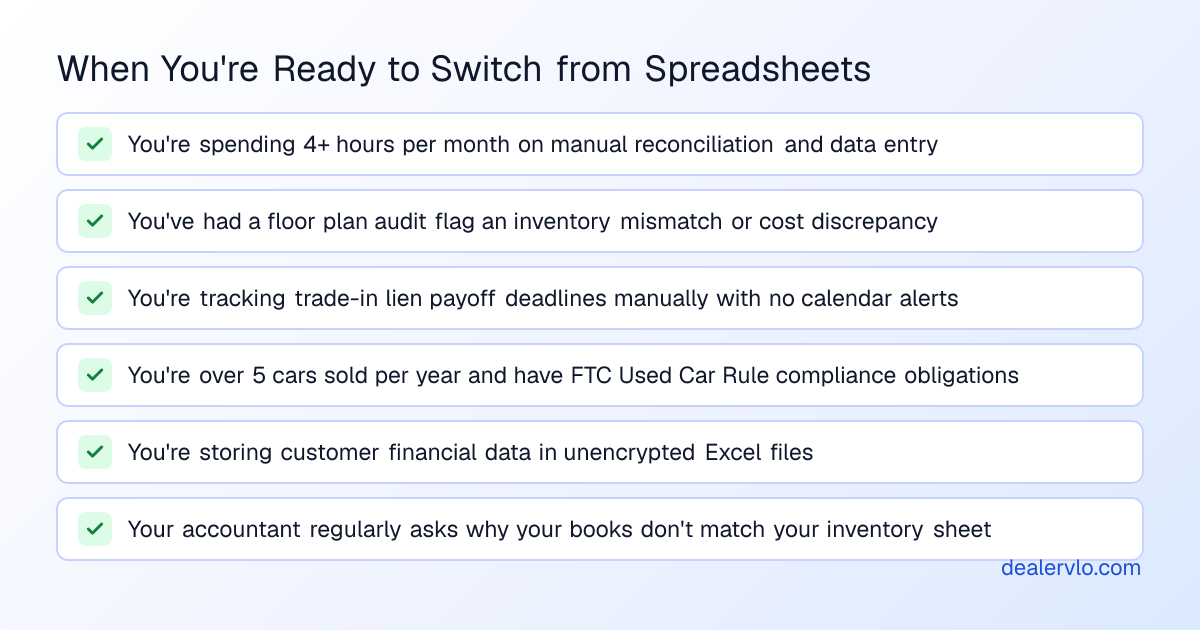
The breaking point isn't always dramatic. Sometimes it's just the third month in a row that your accountant emails you on the 10th asking why your inventory sheet and your floor plan statement don't reconcile, and you realize you spent four hours last weekend fixing it and you're going to spend four hours this weekend doing it again.
At a deal a week, I hit that point on my own Massachusetts lot years ago, and the hourly cost of manual reconciliation was the least of it. It was the stress of knowing that one missed lien deadline or one audit mismatch could cost me my floor plan line. When you're a small lot, you don't have the cushion to survive that.
What switching actually looks like
If you've been in spreadsheets for two years, the idea of migrating data sounds painful. It doesn't have to be.
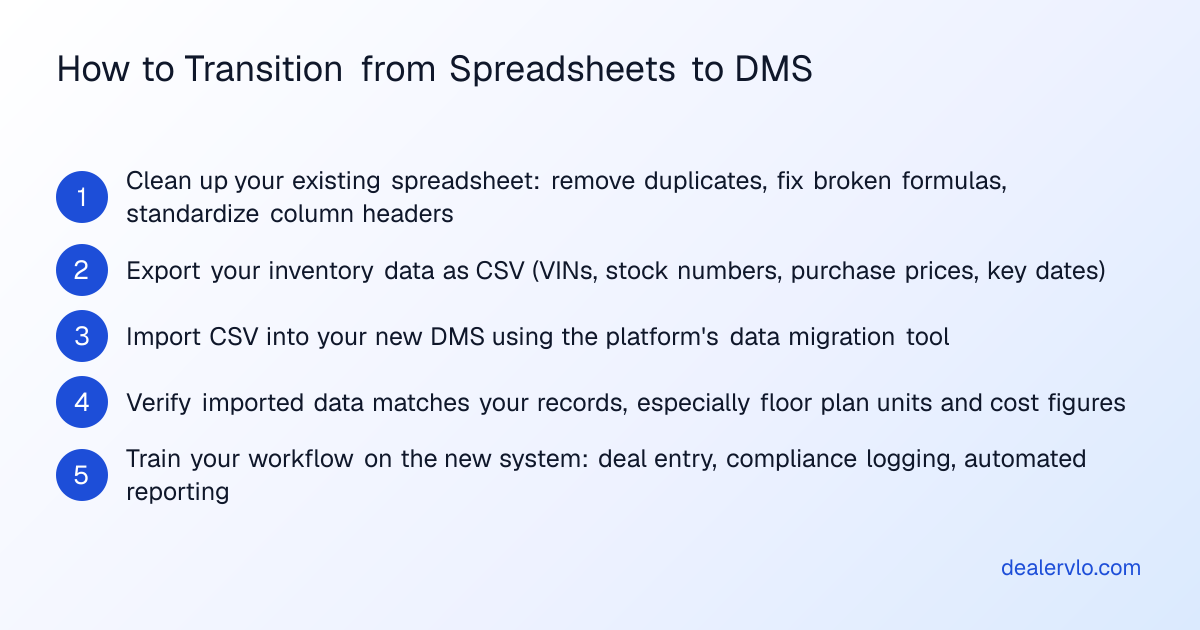
Most modern DMS platforms support CSV import, so your existing inventory data—VINs, stock numbers, purchase prices, sale prices—can move over in an afternoon. Our dealer software CSV import: no onboarding delay guide walks through how that works and what to clean up before you import so you don't carry over broken formulas and duplicate rows.
The bigger adjustment isn't technical—it's workflow. You're moving from a system where you control every cell and every formula to a system that automates posting, tracks compliance, and won't let you skip required fields. That feels constraining for the first week, and then you realize it's the constraints doing the work you used to do manually.
You'll still need to reconcile your floor plan monthly, but instead of matching two spreadsheets by hand, you're exporting a report and comparing it to your lender's portal. You'll still need to track days-on-lot, but the system calculates it automatically and flags aging inventory without you building a formula. You'll still need to produce a Buyer's Guide for every car, but the system generates and logs it when you create the deal jacket.
If you're deciding between an all-in-one platform and stitching together separate tools, our comparison of all-in-one dealer software vs. separate tools covers the trade-offs in detail. The short version: separate tools mean more logins, more integrations that can break, and often no single source of truth for inventory. All-in-one costs more upfront but eliminates most of the reconciliation pain.
For small independent lots specifically, we wrote a detailed guide on choosing the best DMS for independent used car dealers, comparing what different platforms include at their base tier and where the hidden costs show up as you scale.
The bottom line
Spreadsheets don't cost $0. They cost you the hours you spend on double-entry and reconciliation, the margin you lose when cost tracking goes stale, the audit exposure when inventory doesn't match, and the compliance risk when you have no system to track deadlines.
A dealer management system that costs $99/month is $1,188 a year. One missed compliance deadline, one floor plan audit that goes sideways, or one trade-in lien that turns into a lawsuit costs more than that in a single incident.
The breaking point isn't always obvious until you hit it. But if you're spending more than an hour a week reconciling your spreadsheet against other systems, if you've had a lender audit flag a mismatch, or if you're storing customer financial data in an unencrypted Excel file, you're past it.
The question isn't whether you need a DMS. It's whether the cost of staying in spreadsheets is higher than the cost of switching—and for most small lots, it already is.
If you want to see what a purpose-built system looks like for independent dealers, take a look at DealerVLO's used car dealer software. It's what I built after years of running my own lot in Excel, and it's designed around the workflow and compliance requirements of small independent operators who don't have a back-office team to catch the mistakes a spreadsheet won't.
Frequently asked questions
How do I know if I really need dealer software or if a spreadsheet is enough?
If you're selling fewer than three cars a month, tracking everything manually, and not using floor plan financing, a spreadsheet can work—but you still face compliance risk if you're over the five-car threshold that triggers FTC Used Car Rule requirements. Once you're on floor plan, doing more than a deal a week, or juggling trade-in lien payoff deadlines, the cost of manual tracking and reconciliation almost always exceeds the $80 to $150 monthly cost of entry-level dealer software. The real breaking point is usually an audit mismatch, a missed compliance deadline, or realizing you're spending four hours a week on data entry and reconciliation that software would do automatically.
What's the most common mistake dealers make when tracking inventory in spreadsheets?
The most common failure is the floor plan interest column showing $0.00 because a formula broke when someone copied a row or updated the sheet. This leads to understating the true cost of a vehicle, which destroys margin calculations and can cause you to underprice inventory. The second most common mistake is failing to update the sheet immediately when a car sells, which creates inventory mismatches that get flagged during lender audits and can put your floor plan line at risk.
Can I switch to a DMS without losing all my existing inventory data?
Yes—most modern dealer management systems support CSV import, so your VINs, stock numbers, purchase prices, and other core data can migrate over in an afternoon. Before you import, clean up duplicate rows, fix broken formulas, and make sure your column headers match the format the new system expects. The technical migration is usually straightforward; the bigger adjustment is workflow, as you move from manually updating cells to letting the system automate cost tracking, compliance logging, and inventory status updates.
How much does dealer management software actually cost for a small independent lot?
Entry-level DMS pricing for independent dealers typically starts between $80 and $150 per month for core inventory, sales, and customer management tools. Some platforms publish base pricing as low as $50 per location per month, while others range up to $199 depending on included modules. The trap is add-ons: desking, credit integration, and accounting sync are often extra, so a $99 base plan can become $400 to $500 a month as you add features. Ask every vendor what's included in the base price and what costs extra, and compare total cost against your current labor cost for double-entry, reconciliation, and compliance tracking.
What happens if I miss a trade-in lien payoff deadline?
If you miss your state's trade-in lien payoff deadline, you face penalties from your state DMV and potential legal exposure from your customer. For example, Utah requires dealers to pay the lienholder within 21 days of the sale date or 15 days of receiving full payment from the buyer, whichever comes first. If the lien isn't cleared on time, the buyer may receive a stop-sale notice, preventing registration or resale, and they can sue you for damages. Many states have similar requirements, and the consequences range from fines to loss of your dealer license in severe cases, so confirm your state's exact deadline and track it carefully.
Do I really need to worry about FTC compliance if I only sell a few cars a month?
Yes—if you sell more than five used vehicles in a 12-month period, you must comply with the FTC Used Car Rule, which requires posting a Buyer's Guide on every car you offer for sale. The rule applies in all states except Maine and Wisconsin, and violations can result in penalties of up to $53,088 per violation in FTC enforcement actions. Many states also have their own overlapping rules, so a single non-compliant sale can create exposure at both the federal and state level. Even small-volume dealers are subject to the rule, and there is no exemption based on deal count once you cross the five-car threshold.
Estimate your daily floor-plan carrying cost per unit.
Open the Floor Plan Calculator