DMS Contract Red Flags: What to Check Before You Sign (and Before You Try to Leave)
The DMS contract clauses that trap small dealers: auto-renewals, notice windows, exit fees, data export terms and price increases, plus what vendors publish.
Part of the Choosing dealer software guide: The best DMS for independent used-car dealers in 2026 — an honest list from a dealer
Switching from another DMS? Compare DealerVLO to DealerCenter, Frazer, or Lot Wizard.
Most dealers read a DMS contract once: the day they sign it, usually with a salesperson walking them to the signature line. Then they find out what's in it three years later, when they want to leave and learn the agreement already renewed itself, or that getting their own customer list out costs extra.
This post is the checklist for reading a DMS contract before that happens. It covers the clauses that cause the trouble, what a dozen vendors actually publish about their terms, what the law does and doesn't protect, and how to leave a system cleanly. It's not legal advice. If a contract has real money riding on it, have a lawyer read it. But you should know which pages to hand them.
The six clauses that cause the trouble
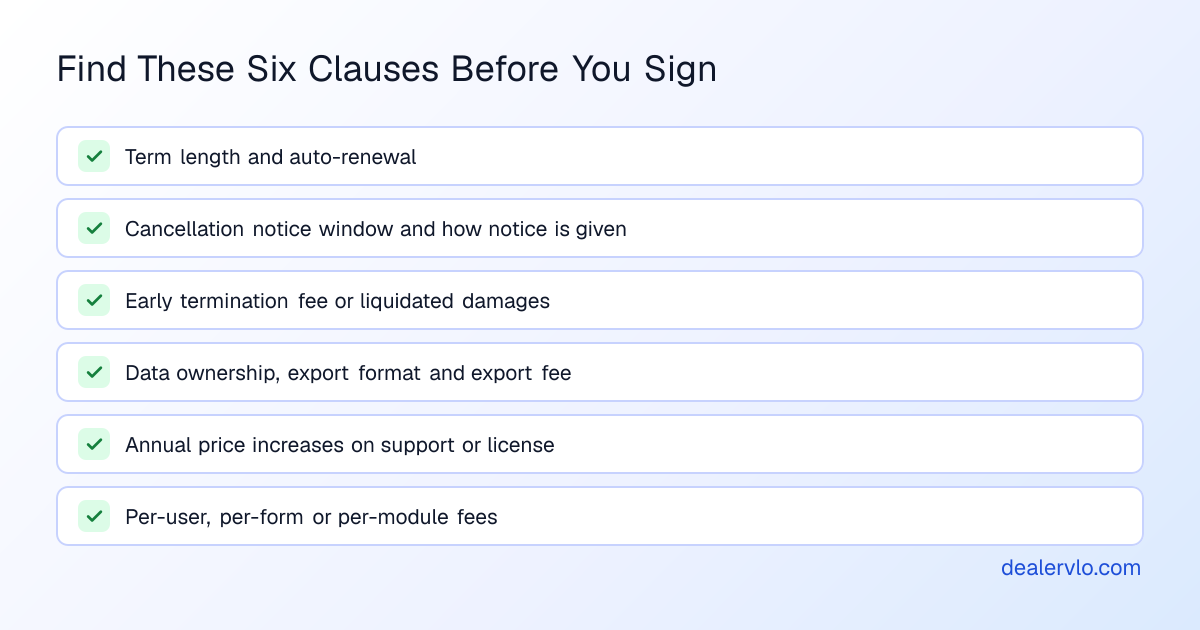
1. Term length and auto-renewal. The first thing to find is how long you're committing and what happens at the end. An evergreen or auto-renewal clause rolls the agreement into another term unless you say otherwise. It isn't a theoretical risk: a dealer on DealerRefresh wrote about a DMS that "after 2 years they auto renewed us, (our fault for not catching it)." Multi-year terms are most common on the franchise side. A DMS consultant and former Reynolds sales executive told Digital Dealer to "only accept a five-year term if the offer has clear financial benefits."
2. The notice window. Auto-renewals almost always come with a window: you have to cancel in writing a set number of days before the end date, not after. Find out exactly how notice must be given (email, certified mail, a portal) and to whom.
3. Early termination. What does it cost to leave before the term ends? Look for an early-termination fee, "liquidated damages," or language making the remaining months due at once. Check what happens if you sell the dealership, too: whether the agreement can be assigned to a buyer, and whether the remaining fees come due when you sell or switch systems.
4. Data ownership and export. The clause that matters most when you leave. Does it say the data is yours? In what format can you export it, and does that cost anything? How long does the vendor keep it after you cancel? Auto Remarketing reported that "some DMS providers will charge either a flat rate or per account fee to provide formatted data to you." Digital Dealer's piece puts it plainly: "Too often dealers ask these questions after signing a contract."
5. Price increases. A low first-year price means little if support goes up every year. Digital Dealer noted that "providers typically increase the cost of support every year." Look for a cap on annual increases, or the absence of one.
6. Per-user, per-form and per-module fees. The headline price is rarely the bill. Check whether you pay per user, per form, per credit pull or per add-on module, and what happens to the bill when you hire a second salesperson. Our vendor pricing breakdowns show how much of a DMS bill can sit outside the base price.
One more trap on bigger systems: hardware. Digital Dealer reported that some agreements "include an automatic +60-month term renewal when you purchase updated hardware." Buying a new printer or server from the vendor shouldn't restart your contract clock, so read anything you sign during the term, not just the original agreement.
What DMS vendors publish about their contracts
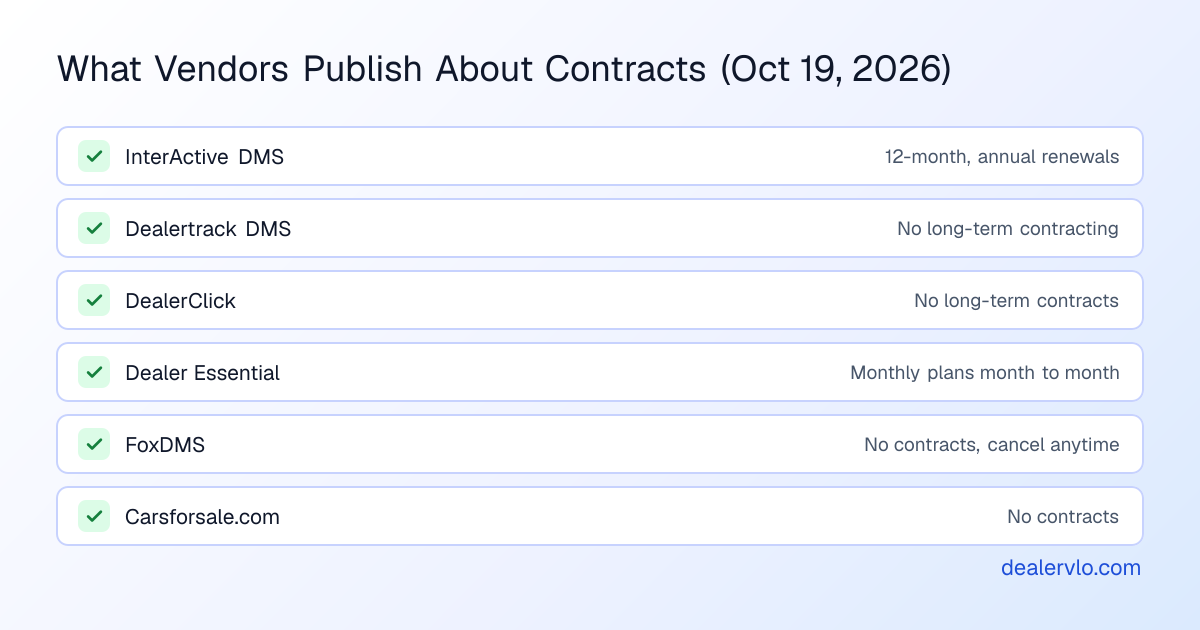
Some vendors put their terms on their pricing pages. Here's what each said when we checked on October 19, 2026, in their own words:
| Vendor | What the vendor publishes |
|---|---|
| InterActive DMS | "12-month agreement with annual renewals, no setup fees" |
| Dealertrack DMS | "no long-term contracting" and "We don't hold your data hostage." |
| DealerClick | Never locks you "into long-term contracts"; keeps your data "for 90 days after cancellation" |
| Dealer Essential | "Monthly plans are month-to-month — cancel anytime." |
| FoxDMS | "No contracts, no setup fees… pay monthly, cancel anytime" |
| Frazer | "no setup costs or hidden fees"; contract length not published |
| Carsforsale.com | "no contracts, setup costs, or hidden fees" |
| DealerCenter | Lists modules and per-use fees; contract term and cancellation not published |
For DealerSocket, CDK, Reynolds, ProMax, AutoManager and Lot Wizard, we found no contract term, termination or data-export language on a public pricing page. That doesn't mean their terms are bad. It means you'll only see them in the agreement, so ask for the full contract (not a summary) before the demo turns into a signature. Vendor-by-vendor detail is in our breakdowns of InterActive DMS, FoxDMS and Dealer Essential pricing.
DealerVLO's terms, for comparison: $29 a month flat, unlimited users, no setup fee and no contract. It's month to month, and you cancel from the billing page with no cancellation fee. Your inventory, customer list and sales report each export to CSV from their own page whenever you want them, not only when you're leaving.
14-day free trial, then $29/mo · Cancel anytime
Your data: the clause you'll care about most when you leave
The data clause is where small dealers get hurt, because it's invisible until the day you switch. A few things worth knowing:
- This has been fought over in court. In the dealer class action over DMS data access, Reynolds settled for $29.5 million (approved January 22, 2019, per CDK's SEC filing), and CDK agreed to pay $100 million to US dealerships that bought a CDK or Reynolds DMS between September 1, 2013 and August 15, 2024. Neither company admitted wrongdoing.
- Some states have stepped in. Arizona passed a dealer data law in 2019 that bars DMS providers from limiting a dealer's ability to protect, store, copy, share or use its own data. CDK and Reynolds challenged it. The Ninth Circuit affirmed the denial of their preliminary injunction in October 2021, and both suits were later dismissed. Oregon passed a dealer data bill in 2019 as well.
- The contract still controls in most places. If your state hasn't passed a law like that, your agreement's data clause is what you've got.
What to get in writing before you sign: that the data is yours; that you can export inventory, customers, deals and payment history in a standard format such as CSV; what an export costs, if anything; and how long the vendor keeps your data after you cancel.
And before you leave, export everything. A new DMS usually can't import every record you have. DealerVLO, for example, imports inventory and customer lists by CSV, but not past deals, signed documents or buy-here-pay-here balances and payment history. Keep those as an archive from the old system. Our DealerCenter switching playbook walks through what moves and what doesn't.
What the law does and doesn't protect
The FTC's click-to-cancel rule won't help you. The FTC announced the rule on October 16, 2024, and it would have covered business-to-business sales too. But the Eighth Circuit vacated the rule in its entirety on July 8, 2025, days before its main compliance deadline. In March 2026 the FTC asked for public comment on whether to revisit it. That's a question, not a rule.
A few states limit auto-renewals in business contracts. Wisconsin and New York, for example, have laws that can make an automatic-renewal clause in certain business service contracts unenforceable if the vendor didn't send a written reminder before the renewal. Whether one covers your DMS agreement depends on the state and the contract, so it's a question for a lawyer, not a blog.
Everywhere else, assume the clause means exactly what it says.
How to leave a DMS cleanly
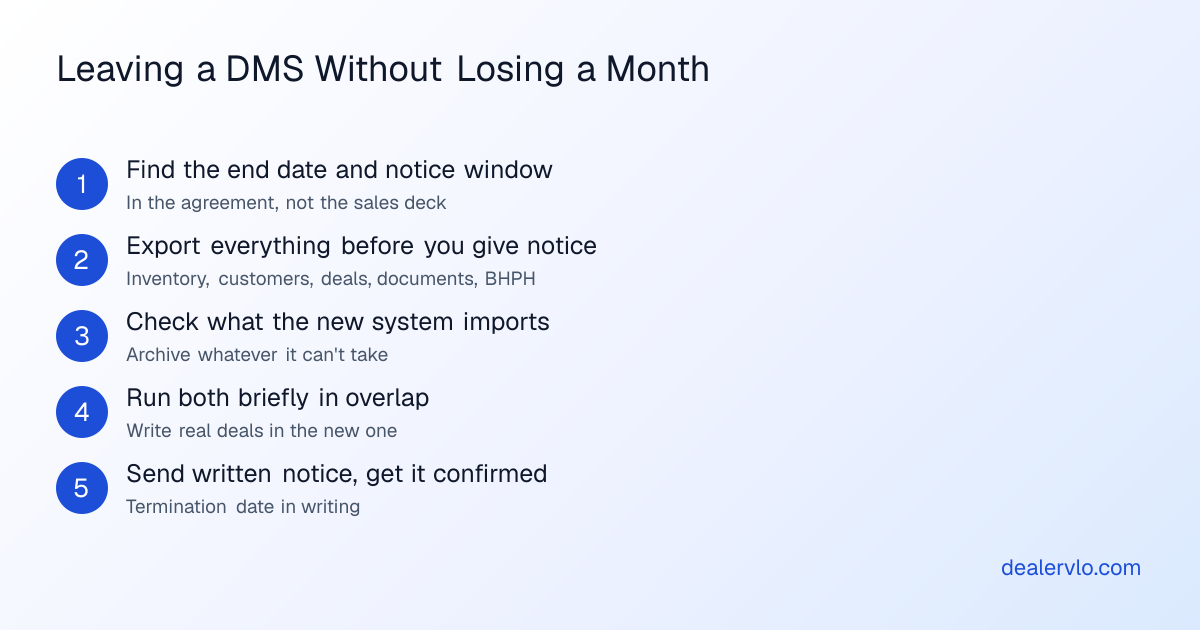
- Find the end date and notice window in the actual agreement. If you're past the window, it costs nothing to ask the vendor for a negotiated exit; just get any change in writing.
- Export everything before you give notice. Inventory, customers, deals, documents and any buy-here-pay-here payment history. Don't count on access after the termination date.
- Check what the new system imports. Bring over what it takes, and keep a spreadsheet or PDF archive of the rest for taxes, collections and title questions.
- Run both briefly. Write a few real deals in the new system before you shut off the old one.
- Send written notice and get the termination date confirmed in writing. Then watch the next statement to make sure the billing actually stopped.
On my own lot, I ran an old Windows desktop DMS with a USB-dongle login before I built DealerVLO. That's a big part of why DealerVLO is month to month and exports your lists whenever you ask: a dealer should stay because the software works, not because the contract says so. Moving in is mostly a CSV import of your inventory and customers, plus setting up your dealer info and doc fee once.
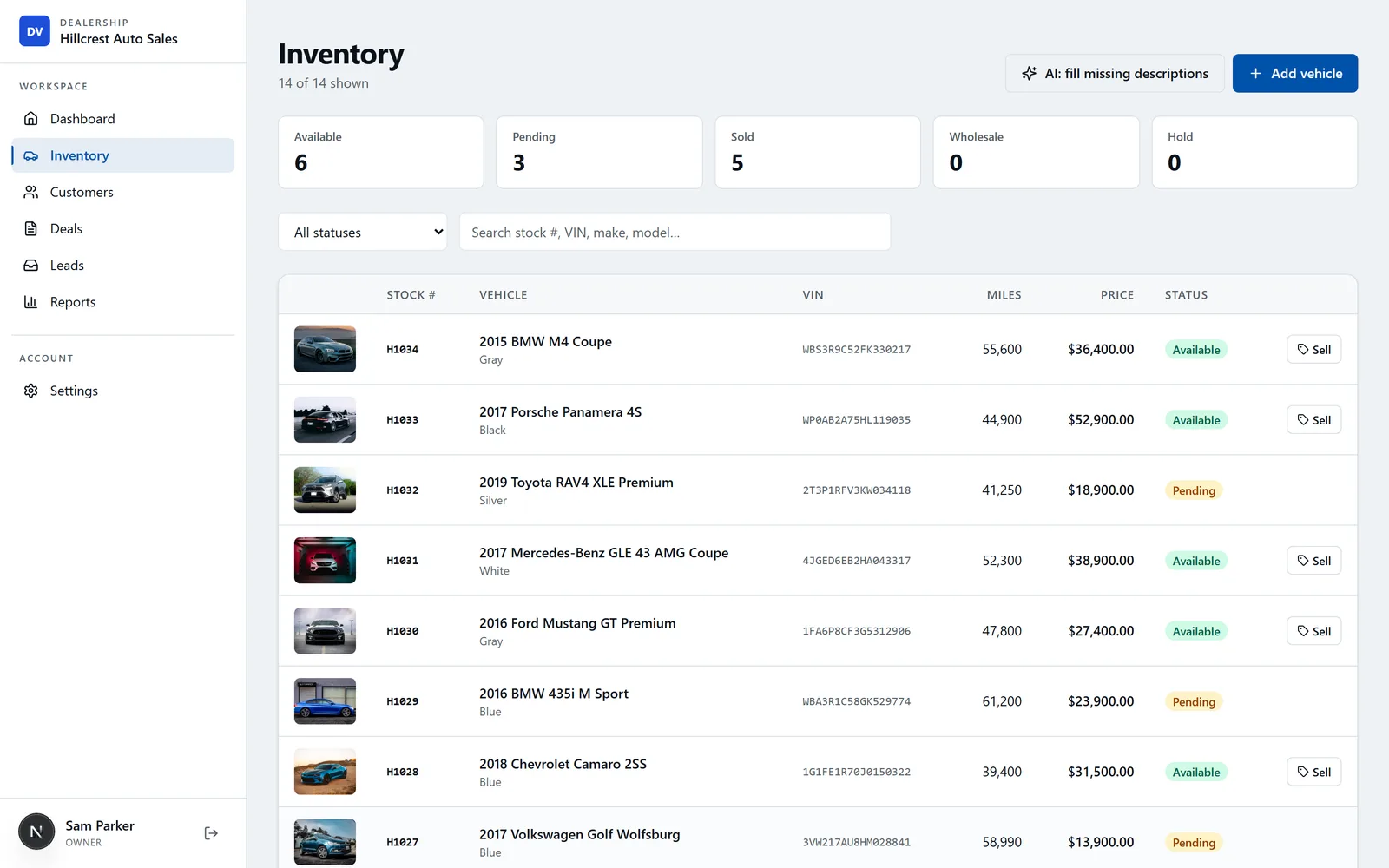
If you're comparing systems, our guide to the best DMS for independent used car dealers covers the field, and what a DMS actually does covers what you should expect any of them to handle.
14-day free trial, then $29/mo · Cancel anytime
Frequently asked questions
Can I get out of my DMS contract early? It depends entirely on your agreement. Look for the term length, the renewal clause, the notice window and any early-termination or liquidated-damages language. Many month-to-month systems let you cancel any time; a multi-year agreement may require paying out the remaining term. If the contract is unclear or the money is big, have a lawyer read it before you stop paying.
How long are DMS contracts? It varies by vendor. Some independent-dealer systems publish month-to-month plans, some publish a 12-month agreement with annual renewals, and franchise-oriented systems have historically used multi-year terms; Digital Dealer quoted a consultant advising dealers to accept a five-year term only with clear financial benefits. Many vendors don't publish their term at all, so ask for it in writing before you sign.
What is an auto-renewal clause in a DMS contract? A clause that renews the agreement for another term unless you give written notice inside a set window before the end date. Miss the window and you can be committed to another full term. Find the end date and the notice window the day you sign and put both on your calendar.
Does the FTC click-to-cancel rule protect dealers from DMS auto-renewals? No. The FTC announced its click-to-cancel rule in October 2024 and it would have covered business-to-business sales, but the Eighth Circuit vacated the whole rule on July 8, 2025. The FTC has since asked for public comment on whether to revisit it, but no replacement rule exists. A few states, such as Wisconsin and New York, have their own laws on automatic renewals in some business service contracts; ask a lawyer whether one applies to you.
Do I own my dealership's data in a DMS? Read the data clause. Your contract should say the data is yours, that you can export it in a usable format, what the export costs, and how long the vendor keeps it after you cancel. Trade press has reported vendors charging for formatted data exports, and Arizona passed a law in 2019 limiting how DMS providers can restrict a dealer's use of its own data. Get the export terms in writing before you sign, not when you're leaving.
How do I switch DMS providers without losing data? Export everything before you give notice: inventory, customers, deals, documents and any buy-here-pay-here payment history. Check what the new system can actually import (many import only inventory and customers by CSV), keep an archive of the rest, run both systems briefly in overlap, and get written confirmation of the old account's termination date.
Bottom line
The DMS contract matters most on the day you want to leave, so read it like that day is coming. Find the term, the renewal clause and its notice window, the exit cost, the data clause and the price-increase language before you sign. Get anything a salesperson promised into the agreement. And whatever system you're on, export your data while you're on good terms with the vendor, not after.
If you'd rather not sign a contract at all, DealerVLO is $29 a month, month to month, with unlimited users and no setup fee. Start your 14-day free trial and see if it runs your lot.
Paste a VIN, the buyer, and the price — see the title & registration form filled in for 50 states, free, no signup.
Open the State Form Auto-Fill