Manheim Buyer Fees Explained: What You Actually Pay Beyond the Hammer Price
Manheim buyer fees vary by auction and sale channel — here's what's confirmed about the Simulcast fee, late penalties, and storage charges.
Part of the Choosing dealer software guide: The best DMS for independent used-car dealers in 2026 — an honest list from a dealer
Switching from another DMS? Compare DealerVLO to DealerCenter, Frazer, or Lot Wizard.
If you've ever called your Manheim rep asking what the buyer fee on a specific unit is going to be and gotten a shrug or a different answer than last time, you're not imagining it. Manheim doesn't run one national buyer-fee table. The fee depends on which physical auction you bought from, whether you bought in the lane or on Simulcast, and sometimes on surcharges a specific seller tacked onto that specific unit. Manheim's own help documentation admits as much — Simulcast's fee is described as being added "in addition to the normal buyer's fee charged by each Manheim auction," which is Manheim's own way of saying every location sets its own number.
That unpredictability is exactly why dealers end up guessing. A forum thread from a frustrated independent dealer summed up the common experience: a rep couldn't give a straight formula, and the fee seemed to move around for no obvious reason. This post pulls together what Manheim has actually published — in its own help pages and policy documents — so you can budget a bid with real numbers instead of a guess.
14-day free trial, then $29/mo · Cancel anytime
Why there's no single "Manheim buyer fee" number
Manheim operates dozens of physical auction locations across the country, and each one sets its own buyer fee schedule, loading fees, and storage policy. On top of that, individual sellers running a sale through a given auction can add their own surcharges — a charity fundraiser add-on, a seller-specific fee, whatever that consignor wants to charge on their units. None of that shows up until you're looking at the final invoice.
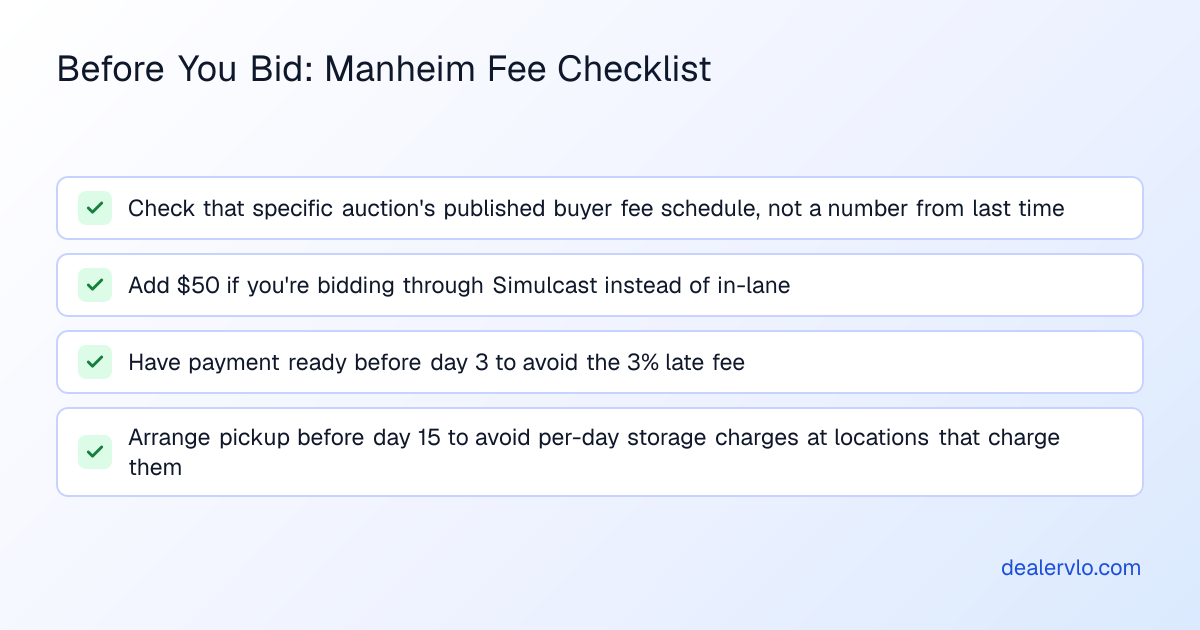
This is the root of the "it varies with no formula" complaint from dealers: there isn't a formula to give, because the answer depends on which auction, which sale, and sometimes which seller. The only way to know the exact buyer fee before you bid is to check that specific auction's published fee schedule for that specific sale — not to rely on a flat number carried over from the last lot you bought.
If you're trying to decide what to bid in the first place, run the numbers through DealerVLO's
Work out the most you can bid at the lane and still hit your target margin.
Open the Auction Profit CalculatorThe one fee that is standard: Simulcast's $50 add-on
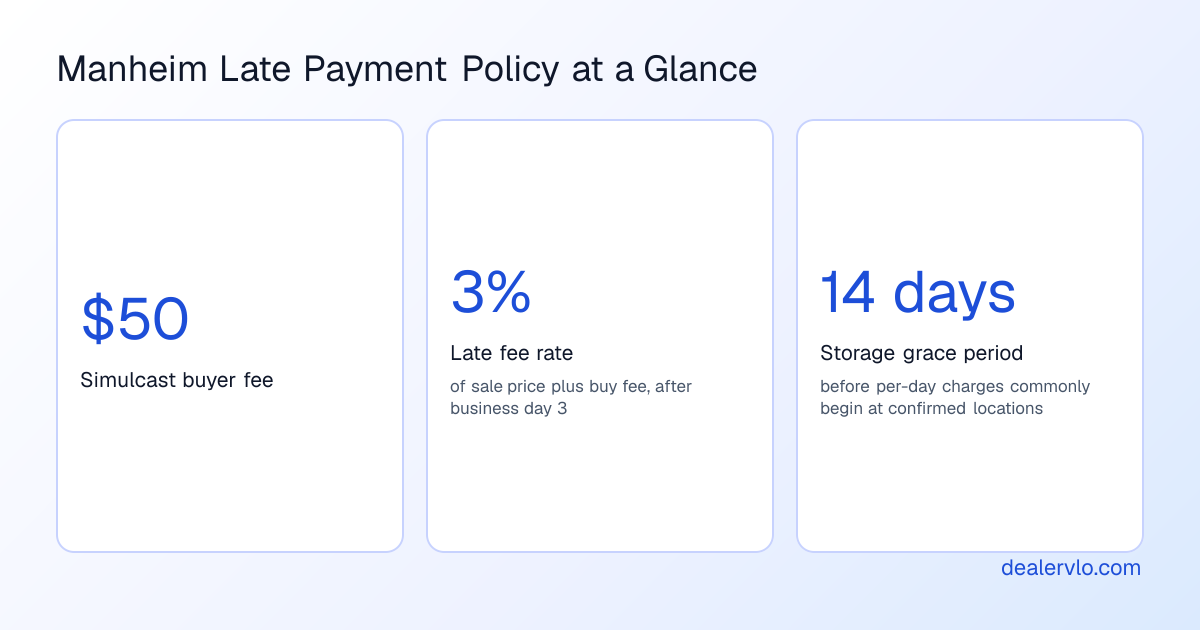
There's exactly one piece of Manheim's buyer-fee structure that is confirmed as a flat, standard number across the board: bidding through Simulcast (Manheim's online bidding platform) adds a standard $50 buyer fee on top of whatever that host auction's own in-lane buyer fee already is. Manheim states this directly on its own Simulcast help page.
That's worth sitting with for a second: Simulcast fees are additive, not a replacement for the in-lane fee. You're paying the local auction's buyer fee plus the $50 Simulcast charge, not one or the other. A lot of small dealers who buy remotely because driving to the physical lane isn't worth the time don't realize that $50 stacks on top until the invoice shows up.
One dealer on a trade forum, asked how they budget for unpredictable fees, said they just plan on roughly $500 all-in per unit and it's usually close enough — but that's one dealer's personal rule of thumb, not a published rate, and it will be wrong on lower-value units or auctions with lighter fee schedules. Don't treat it as a number you can rely on; use the published Simulcast $50 plus your specific auction's own buyer fee schedule instead.
Late payment: a real penalty with a published formula
This is one area where Manheim has put a specific, current policy in writing. Under Manheim's Late Payment Policy (effective December 4, 2022), payment is due the day of purchase. If payment isn't received by the end of business day 3 of aging, a 3% late fee gets assessed, calculated on the sale price plus the buy fee and any other charges added to the vehicle (things like PSI inspection fees or DealShield), with a floor of $40 and a ceiling of $400. If payment still isn't resolved, buying privileges get suspended after business day 4.
For Canadian purchases, the structure is similar but the numbers are different — a 2% late fee with a CAD$5 minimum and CAD$150 maximum. If you've seen an older figure floating around citing a 2% fee with a $5–$150 range for U.S. purchases, that's an outdated number from a pre-2022 version of Manheim's terms; the current U.S. policy is 3%, $40–$400.
The practical takeaway: have the funds or your floor-plan draw ready before you bid, not after. Say you buy a unit for $15,000 all-in with the buy fee included — a 3% late penalty on that is real money, and it's calculated on top of the buy fee too, not just the hammer price. That's a cost worth avoiding on purpose rather than discovering on the invoice.
Storage fees: location-specific, but a pattern shows up
Storage isn't charged the moment you buy — Manheim gives a grace period, and several individual auction location pages (Birmingham, Jacksonville, Central Florida, Mississippi, Orlando, St. Pete, and Fort Myers, specifically) confirm the same structure: vehicles left on the lot more than 14 days past the purchase date get hit with a storage fee starting on day 15. At those specific locations, standard cars are charged $10 per day; specialty or heavy truck units can run higher — Jacksonville's page lists $25 per day for those.
That $10/day-after-day-15 structure is confirmed at those specific Florida/Alabama/Mississippi locations named above — it is not confirmed as a blanket rate at every Manheim auction nationwide, and you should not assume your local lane matches it. Check the specific auction's own location page or ask before you budget a storage number into your plans.
Loading or gate fees are separate from storage and also set locally — Birmingham charges $45 per vehicle to load it onto your transport, while Central Florida and Mississippi charge $40. Both get added straight to your buyer account.
The fix here is simple and has nothing to do with Manheim's fee schedule: get the unit picked up fast. A car sitting at the auction racking up a daily storage charge is a car that should already be on your lot getting reconned. A lot of small lots never put a number on what a day of storage at the auction actually costs them versus a day on their own lot — the honest answer is both cost something, and neither is free, so the fastest fix is simply arranging pickup before the grace period runs out rather than trying to calculate which location is cheaper to sit at.
14-day free trial, then $29/mo · Cancel anytime
DealShield: optional, and its exact fee isn't published
DealShield, Manheim's optional return-protection product, is often confused with a standard buyer fee — it isn't one. It's an add-on you choose. The DS360 guarantee gives a 21-day, 360-mile return window (upgradeable to 30 days/500 miles) on eligible vehicles, and if you return the car, you get reimbursed the full guaranteed amount plus the buy fee — check Manheim's current DealShield terms for which other costs, if any, are covered. On vehicles priced above $35,000, a 1.5% surcharge applies to the amount over that threshold.
What's not published anywhere is a flat dollar "Product Fee" for coverage, which means it varies deal to deal and you won't know it until you're checking out. Don't budget a specific DealShield number into your bid math; treat it as a line you confirm at purchase, not before.
Building these fees into your actual deal math
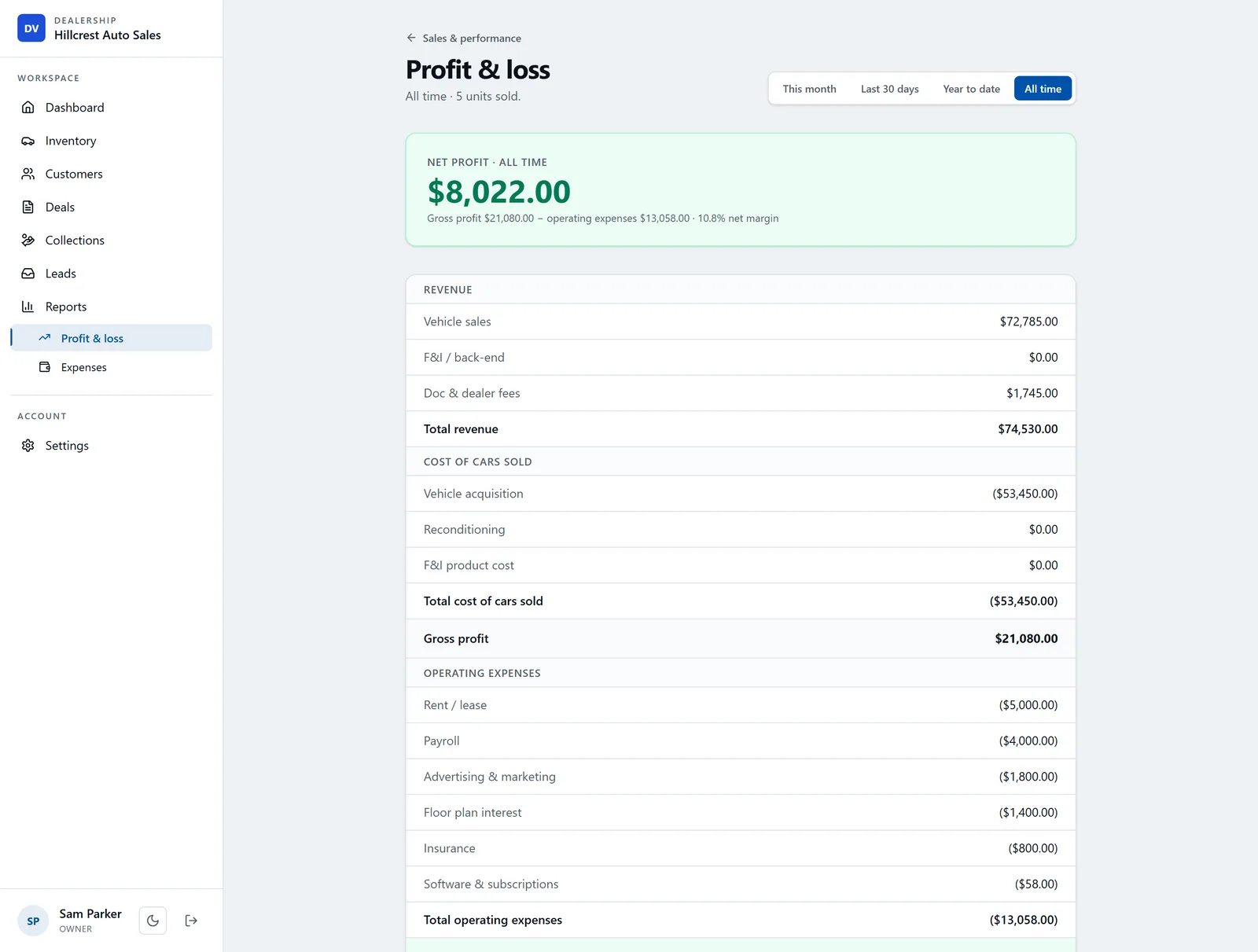
Here's the part that matters more than memorizing Manheim's fee schedule: however much you end up paying in buyer fee, Simulcast add-on, late penalty (if you're slow), and loading charge, all of it belongs in that car's acquisition cost — not buried as a general expense. If you're tracking recon and acquisition costs loosely or on a side spreadsheet, these auction fees are exactly the kind of charge that gets forgotten by the time you're pricing the car to retail.
In DealerVLO, each car's reconditioning cost list isn't limited to shop work — you can log the auction buy fee, the transport charge, and a history report as their own labeled lines on that specific car, each with a vendor and amount. Every one of those lines rolls into that car's all-in cost automatically, so the gross you see on the sales report and the
Should you even run Simulcast for everything you buy?
If you're buying remotely because it saves a drive, the extra $50 per unit adds up fast across volume — on a lot doing a handful of units a month it's a rounding error, but on a higher-volume operation it's real money stacked on every single purchase. Weigh that against what driving to the physical lane costs you in time, and decide deal by deal whether the in-lane trip is worth skipping the add-on. There's no universal right answer here; it depends on your volume and how far the physical auction is from your lot.
Whichever way you buy, the fee discipline that actually protects your margin is the same: know your target gross before you bid, not after. Running the math through DealerVLO's
Work out the most you can bid at the lane and still hit your target margin.
Open the Auction Profit Calculator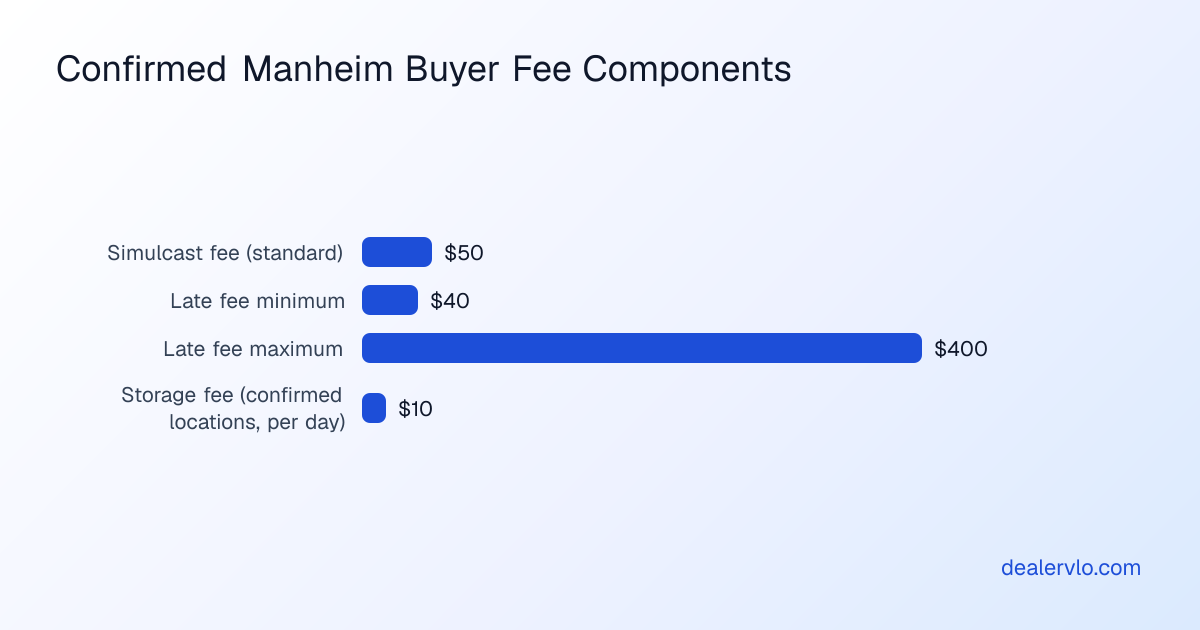
Getting the paperwork and cost tracking right once the car's yours
Once you've paid for the unit and it's on your way to your lot, the auction fees become part of your cost basis, and everything downstream — your asking price, your retail gross, your tax calculation — should be built on that real number. If you're adding this car to inventory by hand, DealerVLO's VIN decode on the
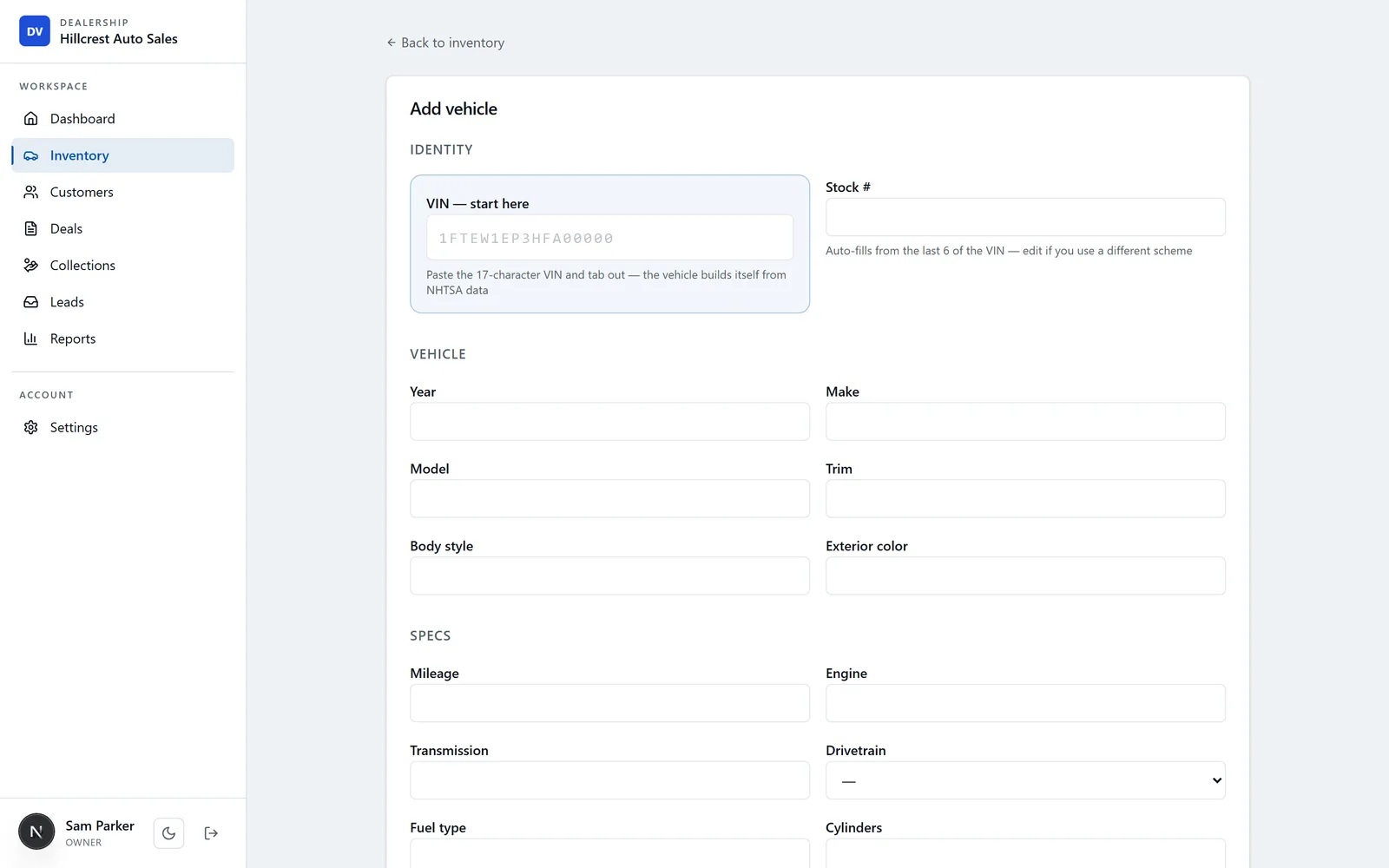
If you're bringing in a batch of units from a recent sale, the "Add many cars at once" import on the Inventory page reads cost straight from your file's columns (up to 1,000 rows per upload, every row needs a valid 17-character VIN), which is the import to use when your auction export already includes what you paid — a cleaner way to get a stack of post-sale units into inventory than typing each one in separately.
14-day free trial, then $29/mo · Cancel anytime
If you're weighing Manheim fees against what it actually costs to run your back office day to day, DealerVLO's dealership software ROI breakdown walks through when a DMS pays for itself, and the best DMS for independent used-car dealers guide covers what to look for if you're shopping options. And if floor-plan is part of how you're financing these buys, the floor plan curtailment guide explains how that schedule and cost actually work.
Frequently asked questions
What is Manheim's standard buyer fee?
There isn't one single standard buyer fee across all of Manheim — each physical auction location sets its own buyer fee schedule, and individual sellers can add surcharges on top. The one confirmed flat, standard charge is the $50 Simulcast fee, which applies in addition to whatever that auction's own in-lane buyer fee is.
How much is the Manheim Simulcast fee?
Manheim's own help documentation confirms a standard $50 Simulcast buyer fee on each vehicle purchased through Simulcast, on top of the host auction's regular buyer fee. It isn't a range or a percentage — it's a flat $50 add-on specific to buying online rather than in the physical lane.
What happens if I'm late paying for a Manheim purchase?
Under Manheim's Late Payment Policy effective December 4, 2022, payment is due the day of purchase, and if it isn't received by the end of business day 3, a 3% late fee is assessed on the sale price plus the buy fee and any other added charges, with a $40 minimum and $400 maximum. Buying privileges get suspended after business day 4 if it's still unresolved, so it's worth having funds or a floor-plan draw lined up before you bid.
Does Manheim charge storage fees if I don't pick up my vehicle right away?
Several specific Manheim auction locations (Birmingham, Jacksonville, and several Florida/Mississippi locations) give a 14-day grace period after purchase before storage fees start, then charge $10 per day for standard cars at those confirmed locations starting on day 15. This is confirmed location by location, not as one universal company-wide rate — check your specific auction's own posted policy rather than assuming your lane matches.
Is DealShield the same thing as a Manheim buyer fee?
No — DealShield is an optional return-protection product you choose to add, not a standard buyer fee everyone pays. Its surcharge structure (for example, a 1.5% surcharge on amounts over $35,000 for DS360 coverage) is published, but the exact flat "Product Fee" for some DealShield products isn't published anywhere.
Why does my Manheim rep give me a different fee answer every time I ask?
Because the fee genuinely does vary by auction location, by sale channel (in-lane versus Simulcast), and sometimes by seller-specific surcharges on that particular unit — there's no single national formula to quote. The only reliable way to know the exact fee is to check that specific auction's published fee schedule for that specific sale rather than relying on a number from a previous purchase.
Bottom line
Manheim's buyer fees aren't random, but they also aren't one number you can memorize and apply everywhere — they're set per auction location, with a confirmed $50 flat add-on for Simulcast, a published 3% late payment penalty ($40–$400) if you miss the payment window, and storage charges confirmed at $10/day after a 14-day grace period at several specific locations (don't assume it's universal). The fix isn't guessing better; it's checking the specific auction's published schedule before you bid and then making sure every dollar you actually paid — buy fee, Simulcast charge, loading, storage — gets logged against that car so your retail price is built on real cost, not just the hammer price. Give DealerVLO a try on your next auction buy and see what your real margin looks like once every fee is accounted for.
14-day free trial, then $29/mo · Cancel anytime