Dealership Software ROI: When Does a DMS Actually Pay for Itself?
A real payback-math framework for dealership software ROI — what a DMS costs, what it saves, and how to work out your own break-even timeline.
Part of the Choosing dealer software guide: The best DMS for independent used-car dealers in 2026 — an honest list from a dealer
Switching from another DMS? Compare DealerVLO to DealerCenter, Frazer, or Lot Wizard.
Most dealers don't buy a DMS because they ran a spreadsheet. They buy one because the old way is costing them something — time, a missed form, a car that sat too long because nobody noticed. The question that actually matters isn't "what does it cost a month," it's "how fast does it pay for itself." That's dealership software ROI in one sentence: cost versus what you get back, measured in a timeframe you can actually point to.
This isn't a pricing comparison post and it isn't a contract-terms post — those exist elsewhere. This is the math itself: what goes in the denominator, what goes in the numerator, and how to build your own break-even number instead of trusting someone else's marketing slide.
14-day free trial, then $29/mo · Cancel anytime
What a DMS actually costs (the denominator)
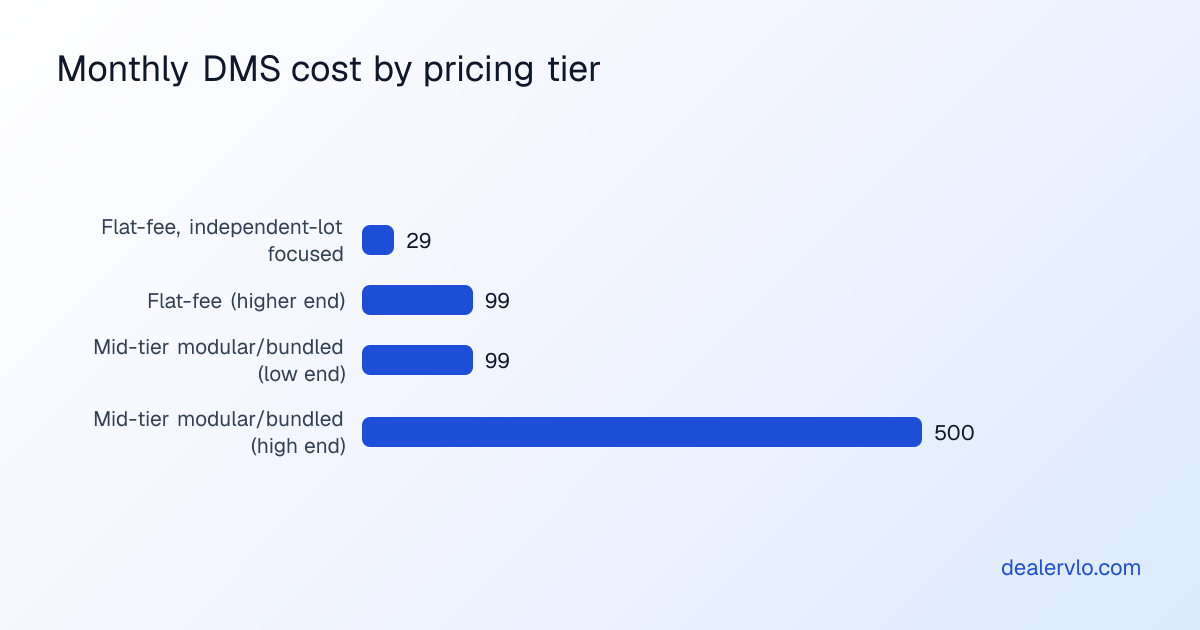
Before you can calculate payback, you need an honest number for what you're spending. Flat-fee systems built for independent lots run roughly $29 to $99 a month. Mid-tier modular platforms that bundle a website, CRM, and BHPH tracking tend to land somewhere between $99 and $500-plus a month depending on which modules you turn on. At the high end, desking and CRM platforms built more for larger or subprime-heavy operations have been estimated by third parties in the $750–$1,500 a month range — those figures aren't published by the vendors themselves, so treat them as directional rather than confirmed. Some systems charge per user instead of flat, which matters a lot once you add a second salesperson or a part-time title clerk, since the real cost scales with headcount rather than staying fixed.
| Pricing tier | Typical monthly range | Notes |
|---|---|---|
| Flat-fee, independent-lot focused | ~$29–$99/mo | Usually unlimited users |
| Mid-tier modular/bundled | ~$99–$500+/mo | Price depends on which modules (website, BHPH, accounting) you add |
| Larger CRM/desking platforms | ~$750–$1,500/mo (third-party estimate, unconfirmed) | Aimed at bigger or subprime-heavy operations |
| Per-user pricing | Scales with staff count | Published entry points exist starting around $98/user/month |
That table is your denominator. If you're comparing systems, how dealer software pricing actually breaks down is worth reading before you run any ROI math, because a per-user system that looks cheap with two logins can get expensive fast.
What you're actually buying back (the numerator)
Here's where a lot of ROI pitches get sloppy: they invent a precise "hours saved per week" number with no source behind it. We're not going to do that. What's true, and defensible, is that a DMS buys back time and reduces the odds of specific, nameable mistakes. The honest way to build your numerator is to list the actual tasks it touches and put your own hours against them — not a borrowed industry average.
Think through a single deal: pulling the title form, filling the buyer's guide, writing a bill of sale, chasing a trade payoff, double-checking the odometer reading matches across three documents. Every one of those is a place where a manual process burns minutes and a software process doesn't. That kind of hand-written paperwork process adds up across a deal, so don't anchor to a number you can't verify for your own shop.
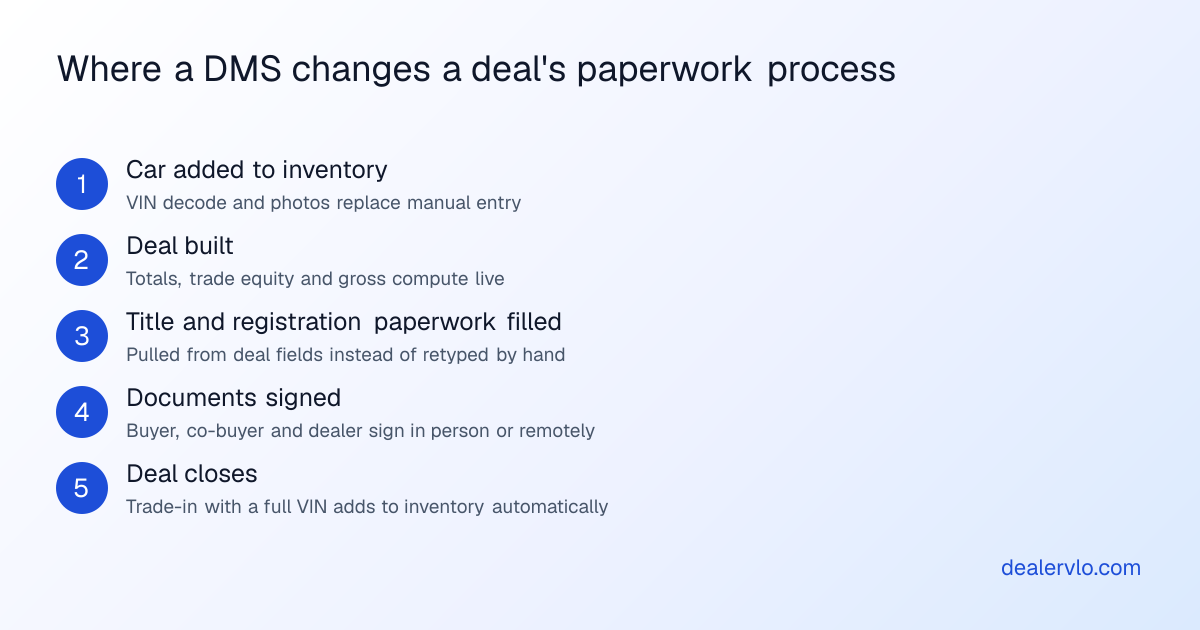
That's not a claim about hours saved industry-wide; it's a description of which steps move from manual to automatic, so you can time your own process and compare.
The errors-avoided side of the ledger
The other half of ROI is risk you didn't take. The clearest, best-documented example here is the FTC's Used Car Rule — the federal requirement that used-car dealers post a Buyers Guide on vehicles for sale. Dealers who sell more than a handful of used vehicles a year are expected to comply, and the FTC's own published penalty ceiling for a violation currently sits at $53,088 per violation, a figure the Federal Register confirmed is unchanged for 2026. (1) That's a ceiling, not a typical fine — the FTC doesn't routinely seek the maximum — but it tells you the exposure is real, not theoretical, and a forgotten Buyers Guide on a single car is an easy thing to let slip when paperwork lives in loose folders.
This isn't legal advice — confirm current requirements and penalty structures with the FTC and your state's dealer authority before you rely on anything here for compliance purposes.
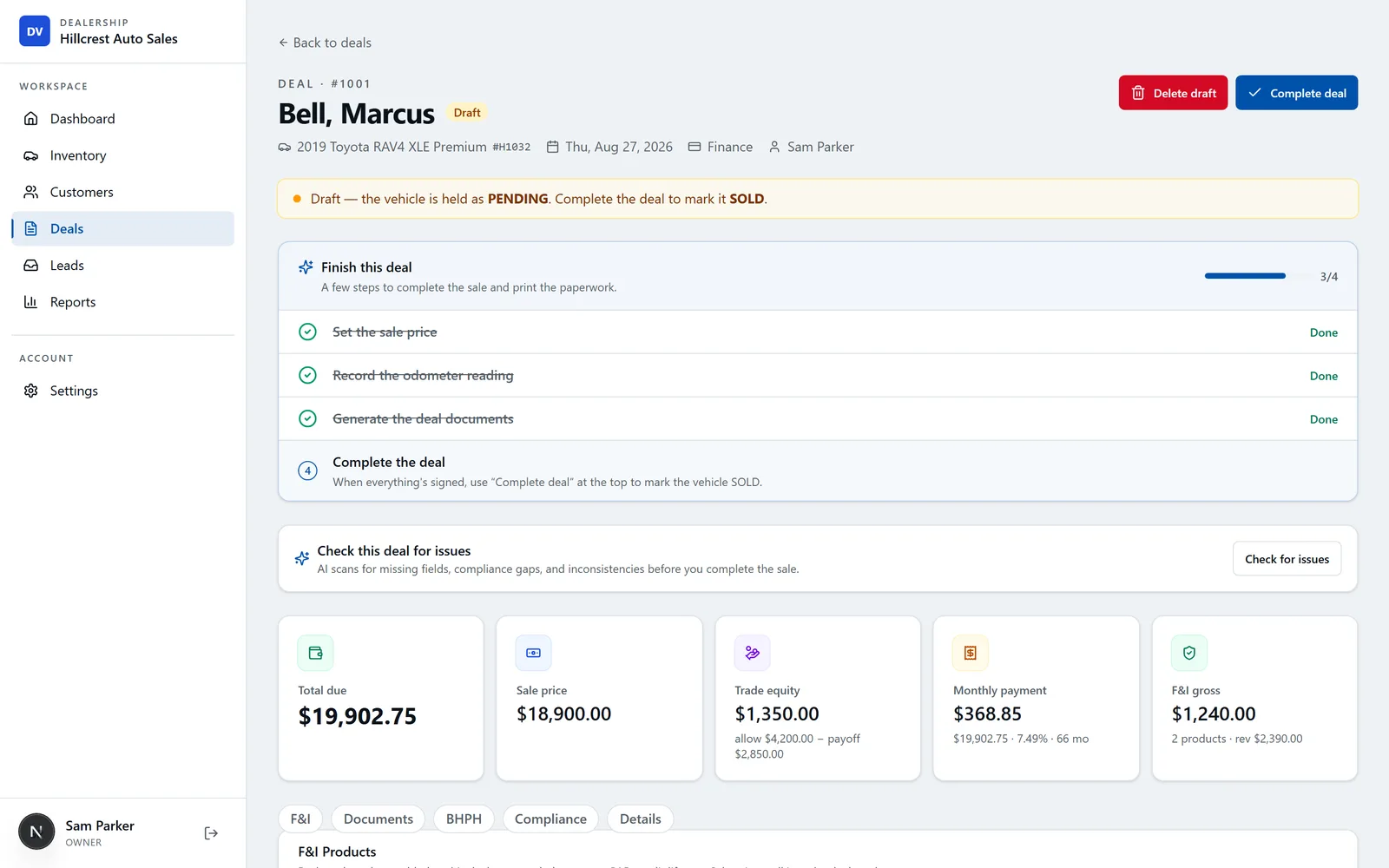
A DMS doesn't eliminate that risk by itself, but it changes where the gap can open. In DealerVLO, the FTC Buyers Guide prints straight from a vehicle's record before any deal exists, so it can hang on the car the day it hits the lot rather than getting created at sale time (or not at all). Each deal also records the warranty language — As-Is, Implied Warranties Only, or Dealer Warranty — and the Buyers Guide heading prints to match, which closes one of the more common mismatch errors: a windshield sticker that says one thing and a bill of sale that says another.
Title paperwork is the other place errors get expensive, just in time and goodwill rather than fines. California's DMV, for example, publishes a clear deadline: transfer fees are due within 10 days of a sale, with a late penalty kicking in after 30 days. (2) Every state runs its own version of that clock, and missing it usually means a customer calling you asking where their plates are. The fix isn't a specific number memorized for every state — it's a process that doesn't let a deal's paperwork sit untouched.
14-day free trial, then $29/mo · Cancel anytime
The "closed faster" angle — and why to be careful with it
A lot of DMS and digital-retailing marketing leans on "deals close X% faster" claims. Be skeptical of precise percentages here, including ones in this article's research. The best-documented data on this comes from Cox Automotive's consumer buyer-journey research, and it's worth being specific about what it actually measures: it's about digital retailing tools — the customer-facing parts of building a deal online — not back-office DMS software, and Cox sells retailing software itself, which is worth knowing when weighing the research. Cox's 2023 survey of dealers found a large majority reporting that digital retailing had a positive effect on time spent on the deal, among other areas of the business. (3) That's a real, named, dated data point — but it's dealer perception of digital retailing broadly, not a measured DMS-adoption outcome, and it shouldn't be repackaged as "a DMS saves you X minutes per deal."
The more honest version for an independent lot: anything that lets you quote a price, build an out-the-door number, or get a buyer signing documents without three trips back to the desk removes friction from the deal. If you want to see roughly where a deal's price lands before the customer sits down, run the numbers through the out-the-door price calculator first — it's a free tool that doesn't touch your inventory, just the math. And once the deal is agreed, DealerVLO's e-signature option lets the buyer, co-buyer and dealer each sign from their own link, in person or remotely, instead of waiting on everyone to be in the same room with a pen.
Paste a VIN, the buyer, and the price — see the title & registration form filled in for 50 states, free, no signup.
Open the State Form Auto-FillBuilding your own break-even number
Here's the actual framework, worked through with a hypothetical lot so you can see the shape of it — these are example numbers, not benchmarks:
- Start with your real monthly cost. Say you're paying $29/mo flat. That's $348 a year, full stop, no per-user surprises.
- Estimate your own time cost per deal — not an industry figure, your own. If pulling and double-checking paperwork by hand takes a chunk of time you can clock with a stopwatch on your next three deals, multiply that by what an hour of your time (or your finance manager's) is actually worth to the business.
- Add the errors-avoided side as a probability, not a certainty. You're not pricing in a $53,088 fine as a given — you're pricing in the odds of a missed Buyers Guide or a mismatched warranty disclosure times how bad that outcome would be, which is a judgment call, not a formula.
- Divide monthly cost by (time saved value + error-risk reduction). If your $29/mo saves even one hour of staff time a month at a modest hourly rate, you've already cleared the cost.
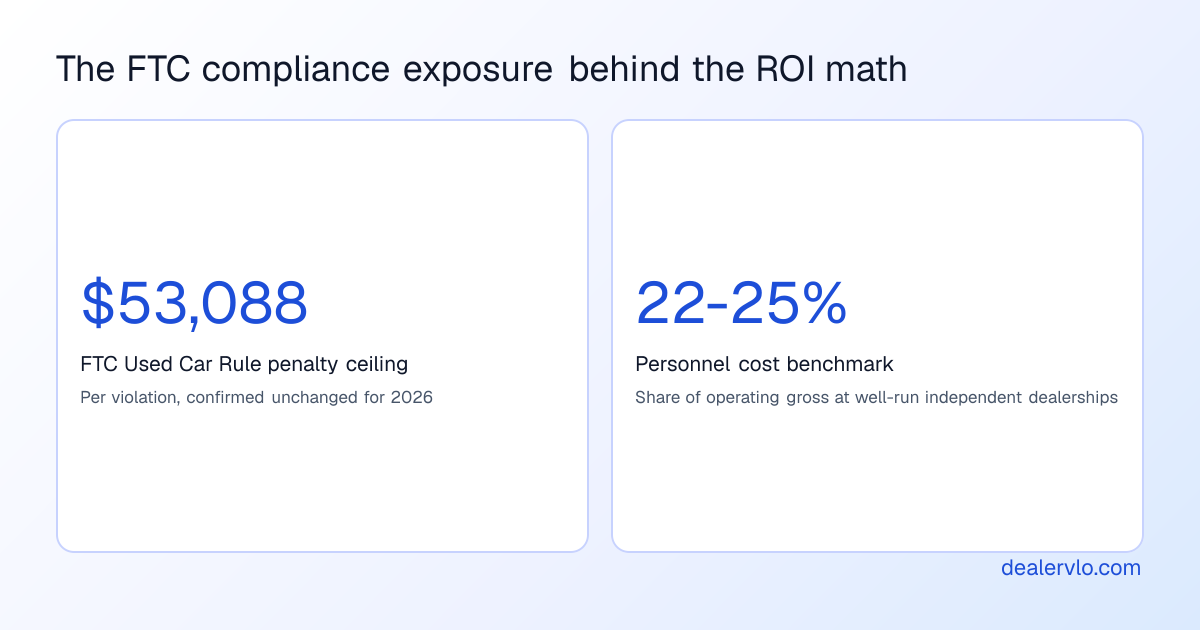
Where this gets more interesting is a BHPH lot. Personnel and direct operating costs commonly run in the low-to-mid 20s as a percentage of operating gross, according to NIADA's published financial benchmarks. (4) If your collections process lives in a spreadsheet and a filing cabinet, the time a collections clerk spends reconciling who's past due is a real labor cost sitting inside that percentage. DealerVLO's BHPH tracking builds a payment schedule automatically from the amount financed, term, frequency and first payment date once you turn it on for a deal, and the dashboard's collections panel shows active notes, what's due today, and what's past due in one place — which doesn't replace a collections process, but it does mean nobody's rebuilding that list by hand every morning.
14-day free trial, then $29/mo · Cancel anytime
Where the math changes by lot size and system
A single-deal-a-week lot and a 30-car-a-month lot don't hit payback the same way. On a small lot, the biggest line item is usually your own time — you're the buyer, the finance person, and the one filling out the title form, so every minute a system saves comes straight back to you rather than to a payroll line. On a bigger lot with a dedicated title clerk or F&I manager, the math shifts toward headcount: a per-user DMS that looked affordable with three logins can get expensive once you add a fourth, which is exactly the trap in the un-bundling tax of running separate tools for inventory, CRM, and a website — three subscriptions, each with its own per-user creep, usually costs more than one flat system that does all three.
If you're actively comparing systems rather than just running the math on one, the honest list of DMS options for independent used-car dealers and the plain-English explanation of what a DMS actually is are both useful starting points before you commit to a payback estimate for any one vendor.
What ROI math won't tell you
No payback formula captures everything. It won't tell you whether a system's support answers the phone, whether the import process from your old system goes smoothly, or whether your team will actually use the new workflow instead of falling back on old habits. Those are real costs — they're just not expressible as a dollar figure, so don't let a clean-looking spreadsheet talk you out of due diligence on the vendor itself. If you're coming from another system, look at what a switch actually involves before assuming day one looks like your spreadsheet projected.
Frequently asked questions
How long does it take for a DMS to pay for itself?
It depends almost entirely on your own time cost and deal volume, not a fixed industry number. A higher-tier per-user system with multiple logins needs a much bigger time or error savings to clear the same bar than a flat-fee system does.
What counts as "ROI" for dealer software beyond saving time?
Beyond time, the other real ROI line is reduced compliance exposure — a missed FTC Buyers Guide or a mismatched warranty disclosure carries real penalty risk, even though the odds of any single mistake triggering enforcement are low. The honest way to value that is as a risk reduction, not a guaranteed dollar recovery.
Does a cheaper DMS always have better ROI than an expensive one?
Not necessarily — a cheap per-user system can cost more than a flat-fee one once you add staff, and a pricier bundled system might replace two or three separate subscriptions you're already paying for. Compare total monthly cost at your actual headcount, not the advertised starting price.
Can I trust "X% faster deals" claims from DMS vendors?
Be skeptical of precise percentages unless they're tied to a named, dated study and clearly describe what was measured. Most of the credible research on deal-speed improvements (like Cox Automotive's buyer-journey studies) measures customer-facing digital retailing tools, not back-office DMS software specifically, so a vendor applying that stat to their own product is stretching it.
How do I estimate the FTC compliance risk a DMS reduces?
Look at the FTC's own published Used Car Rule penalty ceiling, currently $53,088 per violation and confirmed unchanged for 2026, as a guide to what's at stake — not as a number you'll pay, since the FTC doesn't routinely seek maximum penalties. (1) Treat it as the size of the downside you're insuring against, and weigh it against how likely a missed Buyers Guide or disclosure actually is on your lot.
Should a BHPH lot calculate ROI differently than a retail-only lot?
Yes — add collections labor to the equation. Personnel costs commonly run in the low-to-mid 20s as a share of operating gross, and manual payment tracking and past-due reconciliation is a real chunk of that on a BHPH lot, so software that builds the payment schedule and surfaces past-due accounts automatically has a bigger numerator than it would on a cash-only lot.
Bottom line
Dealership software ROI isn't a number a vendor hands you — it's a formula you run with your own time, your own deal volume, and your own tolerance for compliance risk. The defensible version looks at real monthly cost on one side, and honestly estimated time savings plus error-risk reduction on the other, not a borrowed industry percentage. For most small independent lots, even a modest flat monthly fee clears its own cost fast once you count the paperwork hours it actually removes. Try running your own numbers against DealerVLO's deal jacket and paperwork workflow and see where your break-even point actually falls.
14-day free trial, then $29/mo · Cancel anytime