Floor Plan Insurance Requirements: Loss-Payee, Garagekeepers, and the Coverage Gap Dealers Miss
What floor plan lenders require for insurance — loss payee, open lot coverage, garagekeepers — and the gap dealers miss.
Part of the Floor plan financing guide: How dealer floor plans actually work — and where they quietly eat your gross
Switching from another DMS? Compare DealerVLO to DealerCenter, Frazer, or Lot Wizard, or see what DealerVLO's car dealer management software includes.
Every floor plan lender makes you carry insurance before they'll advance a dollar against your inventory — and most dealers read that requirement as a box to check, not a number to think about. The box-checking usually works out fine. It's the gap between what the lender requires and what it would actually take to replace your lot after a bad night that trips dealers up.
This post walks through the three kinds of coverage a floored dealer typically needs, what "loss payee" actually means for your claim check, and the specific coverage percentage detail that's easy to miss: lenders generally only require enough insurance to protect their own exposure, not your full inventory value. This isn't legal or insurance advice — insurance requirements and minimums vary by state and by lender, so confirm the specifics with your insurance agent and your floor plan provider before you bind a policy.
14-day free trial, then $29/mo · Cancel anytime
The three coverages a floor plan lender cares about
If you're floor planning inventory, you're almost certainly carrying — or being asked to carry — three distinct types of coverage, and they protect three different things:
| Coverage | What it protects | Who usually requires it |
|---|---|---|
| Garage liability | Third-party bodily injury and property damage claims from your dealership operations | State licensing authority (minimums vary by state) |
| Dealer open lot (a.k.a. Dealer Inventory Coverage / Dealer Physical Damage) | Your own inventory — the cars sitting on your lot, floored or not | Your floor plan lender, as a condition of the line |
| Garagekeepers | Customer vehicles in your care, custody, or control — trade-ins awaiting title work, cars in for service, appraisal vehicles | Required if you take in or service customer vehicles |
Garage liability is the one your state licensing authority checks at application and renewal — Florida, for example, publishes a specific minimum combined single limit for bodily injury and property damage plus a personal injury protection minimum, confirmed directly through its Department of Highway Safety and Motor Vehicles. Other states set their own minimums and their own structure, so don't assume your neighbor's state number applies to you — check with your state's motor vehicle regulator before you bind a policy.
Dealer open lot is the one that matters most for floor plan purposes, because it's the coverage your lender is actually underwriting against. If a flooded lot or a lot fire takes out twenty cars, this is the policy that pays — and it's also the coverage where the "loss payee" language lives.
Garagekeepers gets missed by a lot of small lots because it only becomes relevant the moment you start taking trade-ins or doing your own reconditioning work. If you've never serviced a customer's vehicle, you may not have thought about it; if you do take in trades or run appraisals on-site, a garagekeepers gap means a customer's car getting damaged on your property comes out of your own pocket, not an insurer's.
For a fuller walkthrough of how these three policies differ and where small lots commonly get the coverage wrong, see the dedicated guide on used car dealer insurance.
What "loss payee" actually means for your claim
Naming your floor plan lender as loss payee on your dealer open lot policy isn't a formality — it changes who the insurance company cuts the check to. Federal bank examiners treat this as a core underwriting question for any bank doing floor plan lending: examiners specifically check whether the bank requires the dealer to maintain floor plan property damage insurance with the bank named as loss payee, and whether that coverage is periodically reviewed for adequacy. That's not industry custom — it's safety-and-soundness guidance from the Office of the Comptroller of the Currency, which is why essentially every floor plan lender, bank-funded or not, builds the same requirement into its dealer agreement.
Mechanically, here's what it means: if a floored unit is stolen or totaled, the claim proceeds go to your lender first, applied against the outstanding advance on that specific car. You don't get a check to spend on a replacement unit — the lender gets made whole on what they're owed, and whatever's left (if anything) comes to you. This is standard across the major floor plan lenders independent dealers work with, including NextGear Capital and Automotive Finance Corporation; Ally, by contrast, primarily floor plans franchised new-vehicle dealers rather than independent used-car dealers. Most dealers set this up once with their insurance agent using a standard insurance-industry certificate naming the lender, and it rarely comes up again until a renewal or a lender switch.
A lot of small lots keep this straight by tying their insurance review to the same records they use to run deals — knowing exactly what's floored, what's owned outright, and what each unit cost helps the conversation with your agent go faster. In DealerVLO, every car's record holds its acquisition cost, and per-car recon lines roll into that car's all-in cost, so you've got a real number for each unit on the lot rather than a rough guess when it's time to size a policy.
If you're planning to switch floor plan lenders or add a second line, re-pointing loss payee status on your policy is one of the easier line items — but it's also one that's easy to forget until a claim gets held up because the wrong lender is still listed. Put it on your switch checklist.
The coverage percentage most dealers never ask about
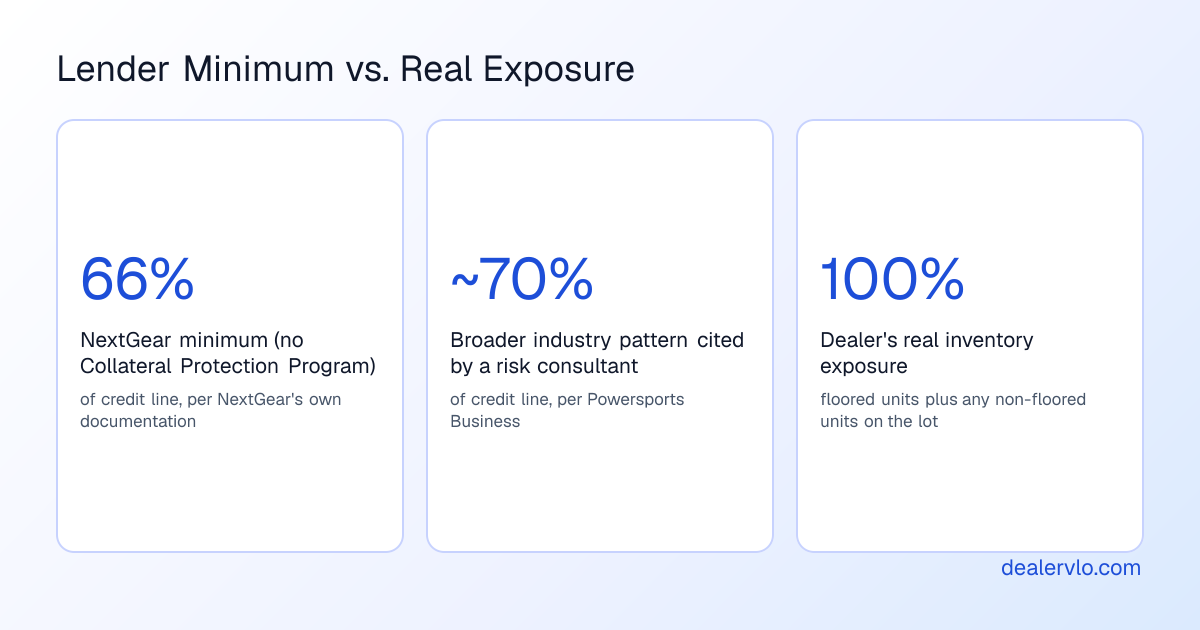
Here's the detail that actually costs dealers money, and it's not a secret — it's just rarely spelled out plainly. Floor plan lenders don't typically require you to insure 100% of your credit line. NextGear Capital's own dealer documentation states that, absent enrollment in its Collateral Protection Program, it requires evidence of physical damage coverage equal to at least 66% of your credit line, with NextGear listed as loss payee. A commercial property and casualty risk consultant quoted in trade press describes the pattern more broadly: floor plan companies often require only a portion of the total credit line insured, commonly cited around 70% — and he's explicit that this minimum protects the lender's exposure, not the dealer's.
Think through why that number is set below 100%. A lender's real exposure at any moment is what they've advanced against inventory, not the full retail value of every car on your lot — and dealers are rarely floored to the absolute max of their line at every moment, so a lender covering somewhere under the full ceiling is still covering their realistic worst case. But that same math doesn't protect you. If your open lot policy is set to the lender's required minimum and you lose a meaningful chunk of inventory, you can be left owing the lender on cars that are gone and the insurer refusing to pay full replacement value because your coverage limit was lower than your actual exposure. That's a co-insurance penalty, and it applies whether or not you technically satisfied your lender's requirement — compliance with the floor plan agreement and adequate coverage for your own risk are two different things.
The fix is straightforward even if it costs a little more: size your open lot coverage to your actual total inventory exposure — floored units, cars you own outright, and anything else sitting on the lot — not to the lender's stated minimum. If you've got non-floored or paid-off units sitting on the same lot, they're part of your real exposure even though they're not part of your credit line.
Estimate your daily floor-plan carrying cost per unit.
Open the Floor Plan CalculatorWhere DealerVLO fits — and where it doesn't
DealerVLO isn't an insurance product and it doesn't shop, quote, or bind any policy — that part is squarely between you and your agent. What it does help with is keeping the inventory numbers straight that your insurance conversation depends on. Every car's record in DealerVLO holds its acquisition cost, and that cost rolls up with per-car recon lines into an all-in cost figure, so when you're talking to your agent about what your lot is actually worth to insure, you're working from real numbers instead of a guess. DealerVLO also flags each car at 60+ days on the lot and shows a dashboard count of aging units — it's not built as an insurance tool, but knowing which units have been sitting the longest is useful context when you're walking through what's actually on your lot at any given moment.
14-day free trial, then $29/mo · Cancel anytime
If you're building out or revisiting your floor plan arrangement generally, the how dealer floor plans actually work guide is the place to start — it covers how the line gets structured and where it quietly eats into your gross beyond just insurance. If you're sizing a new line, the floor plan financing requirements guide walks through what lenders look for on approval and how big a line a small lot can realistically expect.
State garage liability minimums vary — check yours directly
Garage liability minimums are set state by state, and they're not consistent. Florida, as one directly confirmed example, requires a specific combined single limit for bodily injury and property damage plus a personal injury protection minimum, verified through its own Department of Highway Safety and Motor Vehicles. Other states publish their own figures through their own motor vehicle or insurance regulators, and some insurance brokers cite different minimums for states like Texas — but broker-reported figures aren't the same as a confirmed state regulation, and minimums can change. Don't rely on a number you saw on an insurance broker's site or in an old blog post; call your state's licensing authority or your agent and confirm the current minimum before you bind a policy or renew.
This matters for floor planning specifically because most lenders require proof of garage liability as a condition of the line, separate from the open lot coverage discussed above — so a lapse or an underinsured garage liability policy can hold up your floor plan approval even if your open lot coverage is fine.
What happens if coverage lapses
Every lender-side source describes the same consequence pattern for a lapse in required coverage: your credit line can get frozen, the lender can force-place their own coverage at a rate you don't control (typically higher than what you'd pay on your own policy), or they can demand immediate payoff of your floor plan balance. None of the sources behind this article give a verified dollar figure for what force-placed coverage actually costs — treat any specific premium number you see elsewhere as a sales pitch, not a fact, and don't let a lapse happen in the first place.
The practical habit that prevents this: put your policy renewal date on a calendar the same way you'd track a floor plan audit or a curtailment deadline, and confirm with your agent a few weeks ahead rather than the week it expires. A lender finding out about a lapse during an unannounced audit is a much worse conversation than a renewal reminder on your own calendar.
A simple way to check your own exposure
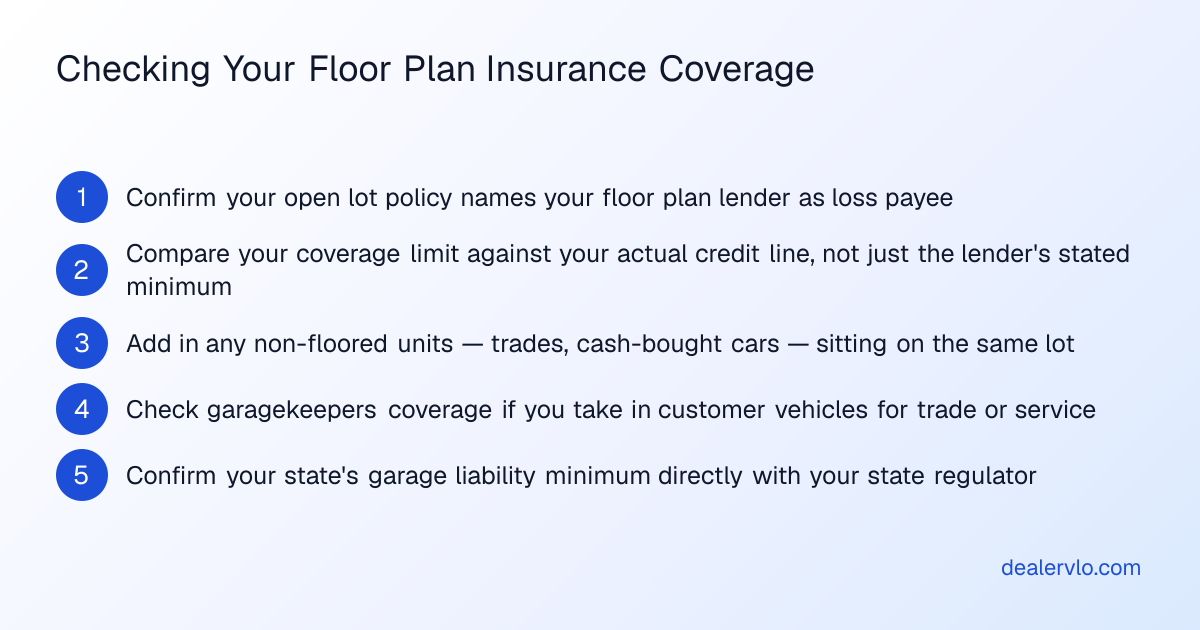
You don't need an actuary to sanity-check this. Pull your current floor plan credit line limit and compare it against your open lot policy's coverage limit — if the policy sits right at your lender's stated minimum (66% at NextGear absent their protection program, or the roughly 70% pattern described more broadly across the industry), you likely have a real gap between what's insured and what you'd need to replace a significant loss.
Then separately total up anything on your lot that isn't floored at all — trade-ins you're holding, units you paid cash for, anything sitting there waiting on title work. If you're running a mixed lot where some units are floored and some aren't (a common pattern once you start taking trade-ins or private-party buys outside the auction lane), those non-floored units still need to be part of your open lot coverage limit even though they're invisible to your lender's minimum requirement.
Frequently asked questions
What does "loss payee" mean on a floor plan insurance policy?
Loss payee means that if your insured vehicle is stolen, totaled, or damaged beyond repair, the insurance company pays your floor plan lender first, applied against what you still owe on that unit, rather than paying you directly. Federal bank examiner guidance treats this as a standard requirement for any bank doing floor plan lending, and it's standard across major floor plan lenders serving independent dealers, such as NextGear Capital and Automotive Finance Corporation (Ally's floor plan business, by contrast, primarily serves franchised new-vehicle dealers, not independent used-car dealers).
How much insurance coverage does a floor plan lender actually require?
It varies by lender, but the pattern runs below full value. NextGear Capital's own documentation requires at least 66% of your credit line insured if you're not enrolled in its Collateral Protection Program, while a commercial risk consultant quoted in trade press describes a broader industry pattern of floor plan companies requiring around 70% of the credit line. Either way, that minimum is sized to protect the lender's exposure, not necessarily your full inventory value.
Is garagekeepers insurance the same as dealer open lot coverage?
No — they cover different things. Dealer open lot (also called Dealer Inventory Coverage or Dealer Physical Damage) covers your own inventory, while garagekeepers covers customer vehicles in your care, custody, or control, such as trade-ins awaiting paperwork or cars in for service. Most floor plan lenders require open lot coverage; garagekeepers becomes necessary once you're taking in or servicing customer vehicles.
What happens if my floor plan insurance lapses?
Lenders describe a consistent set of consequences for a lapse: they can freeze your credit line, force-place their own coverage at a rate you don't control, or demand immediate payoff of your outstanding floor plan balance. No verified dollar figure exists for force-placed premium costs, so the safest move is to track your renewal date closely and never let coverage lapse in the first place.
Does my state set a minimum garage liability requirement?
Most states do, but the minimums vary and aren't universal. Florida, for example, has a confirmed minimum combined single limit plus a personal injury protection requirement set by its Department of Highway Safety and Motor Vehicles — but other states set different numbers through their own regulators, so confirm your state's current minimum directly with your state's motor vehicle authority or your insurance agent rather than relying on a figure from another state.
Bottom line
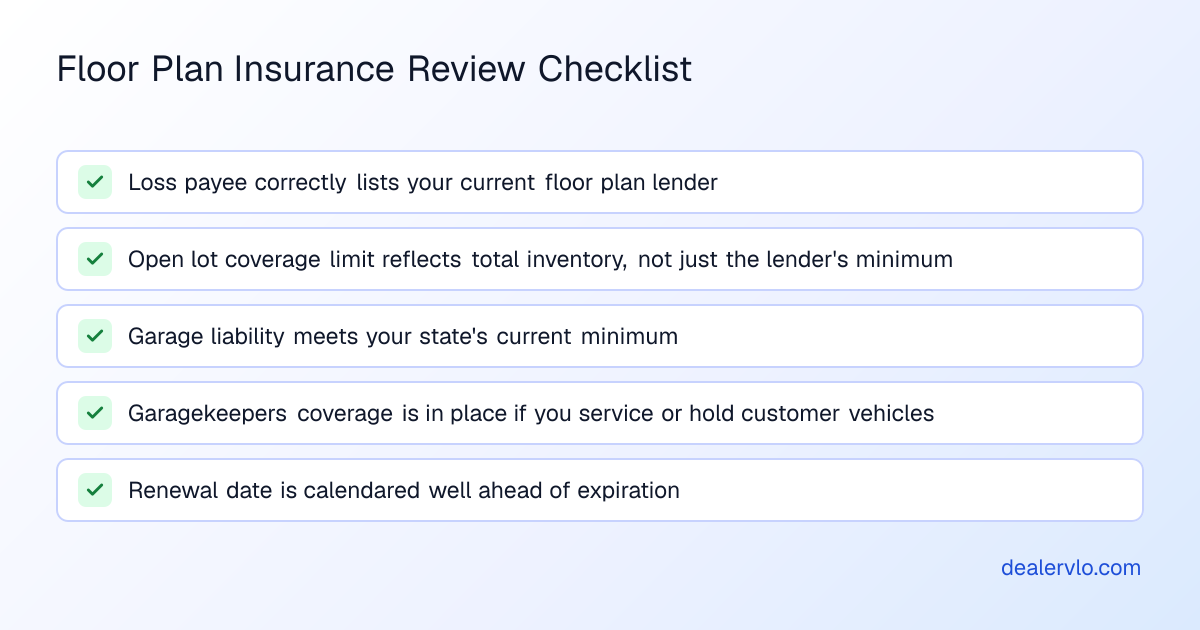
Floor plan lenders require insurance as a condition of the line, and most of them require a lot less of it than your actual inventory is worth — that gap between the lender's minimum and your real exposure is yours to close, not theirs. Confirm your open lot coverage against your total inventory exposure, not just your lender's stated percentage, keep garage liability current against your state's minimum, and add garagekeepers if you're taking in customer vehicles at all.
14-day free trial, then $29/mo · Cancel anytime