The Stocking Report — November 2026: Best Used Cars for Dealers to Buy This Month
The best used cars for dealers to buy in November 2026, per Manheim, gas prices, and iSeeCars data — and what to pass on.
Part of the Buying & sourcing inventory guide: How to buy at dealer auctions without getting buried
Switching from another DMS? Compare DealerVLO to DealerCenter, Frazer, or Lot Wizard, or see what DealerVLO's car dealer management software includes.

Wholesale prices firmed back up in October after a rough September, gas just hit a price it has never hit in November before, and dealers are telling Cox Automotive the same thing in different words: buyers want a lower payment, not a bigger car. Put those three things together and the best used cars for dealers to buy in November 2026 are the ones that are cheap to run, already liquid at retail, and not the kind that depreciates hard the moment diesel or electricity gets expensive.
This is the November edition of our monthly stocking report — same format as October and September: what the wholesale data says, what to actually run the paddle on, and what to leave for someone else's floor plan.
14-day free trial, then $29/mo · Cancel anytime
What the Manheim Index is telling you right now
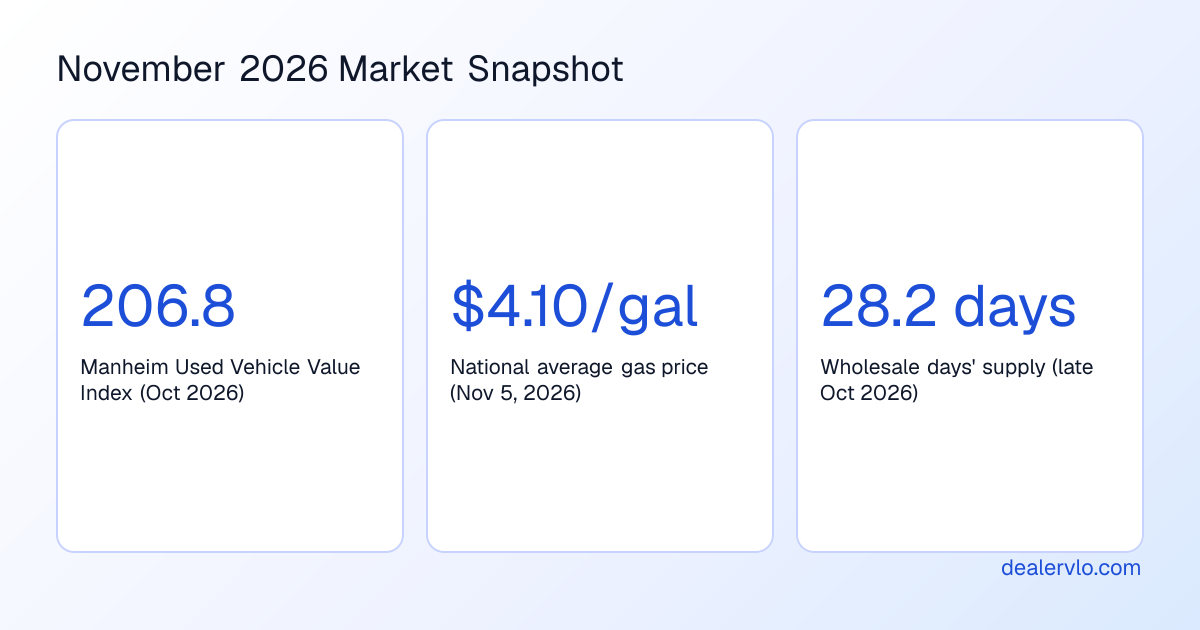
The Manheim Used Vehicle Value Index came in at 206.8 for October 2026, up 0.5% from September and up 2% year over year, according to Cox Automotive's own release. That's a real bounce — September had been ugly, with the index falling 1.1% to 205.9 and landing 0.6% below September 2025, the first full-month year-over-year decline of the year. Cox cut its full-year forecast after that, from an expected 2% annual gain down to just 0.2%, which would make this the third straight year of essentially flat pricing.
The reason October rebounded matters more than the bounce itself. Trade press covering Cox's mid-month check (the index hit 207.4 in the first fifteen days of October, a separate and earlier read than the official monthly number) was explicit that the move was driven by leaner auction supply, not stronger dealer demand. Wholesale days' supply tightened to 28.2 days at the end of the period from 28.7 at the end of September — supply got a little tighter, not that buyers got more aggressive. Meanwhile used retail days' supply is sitting just under 50 days, close to the long-term average for this week of the year, so retail isn't flooded and it isn't starved either.
Practically: if supply is what's propping prices up, that window won't stay open forever. A tightening market argues for buying sooner rather than waiting for a "better" month, especially on units that are already moving fast at retail. Whatever you bring in this month, the days-on-lot clock should start the moment the car is logged — on DealerVLO, that count begins automatically the day a car is added, so you're never guessing how long a unit has actually been sitting.
Gas prices are doing real work on what sells
AAA reported the national average for regular gas at $4.10 a gallon on November 5, 2026 — down 12 cents from the week before, but still the highest the national average has ever been for this time of year, and more than a dollar above where it sat a year earlier. That follows a record September at the pump, averaging $4.33 for the month, roughly 50 cents above the prior September record set in 2023.
Cox Automotive's own commentary on the wholesale side ties this straight to vehicle values: diesel is a small share of units on the ground — just over 3% — but valuations are falling and diesel days' supply is rising fast as diesel prices hit record highs. On the flip side, EV days' supply has been falling as sustained high gas prices push more buyers toward efficient used vehicles. That's not a theory — it's showing up in the same Manheim data release.
What iSeeCars is seeing at retail
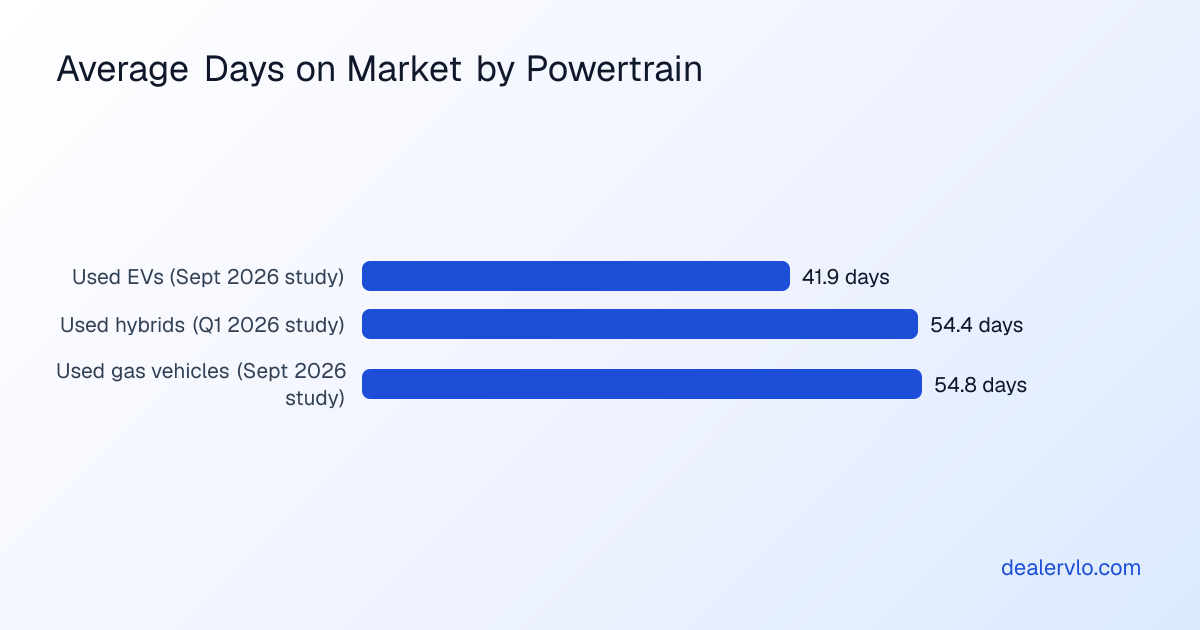
The most recent iSeeCars study (model years 2021–2025, sales through September 2026) found the average used EV now sells in 41.9 days, down from 46.6 a year earlier, while the average gas vehicle slowed from 45.7 days to 54.8. That's roughly a 13-day gap, and it's the freshest, best-corroborated "efficient powertrain sells faster" number available right now — lean on it over anything older.
Within that EV set, specific nameplates separate hard. The Audi Q4 Sportback e-tron sells in 29.8 days (third-fastest of any used vehicle, any powertrain, in the study), the Toyota bZ4X in 33.3, the Lexus RZ 300e in 34.3, the Honda Prologue in 35.0, and the standard Audi Q4 e-tron in 35.8. Those are liquid units. On the other end, a used Chevrolet Equinox EV moves in 36.7 days, but a Silverado EV takes 89.1 — nearly two and a half times as long — and the Cadillac Escalade IQ is the slowest-selling used EV in the whole study at 128.7 days. Six of the ten slowest-selling used EVs in that study are GM products, and the electric Dodge Charger (80.1 days) is also near the bottom.
One nuance worth flagging before you chase "efficient = fast": a separate iSeeCars release comparing Q1 2025 to Q1 2026 found used hybrid market share growing faster than used EV share, but that growth hasn't translated into faster turn — hybrids' average days on market actually rose from 40.1 to 54.4 days in that period, essentially tied with gas vehicles at 54.1. Hybrids are gaining share. They are not, on this data, selling noticeably faster than gas right now. Buy them for the fuel-cost story a shopper is telling themselves, not for a turn-rate edge that isn't showing up yet.
What dealers themselves are saying
Cox Automotive's Q3 2026 Dealer Sentiment Index shows sentiment softening — used-vehicle sales scored 43 against a long-term average of 51, and used-vehicle inventory scored 43 against a long-term average of 40 (so inventory is actually a little better stocked than typical, even as sales sentiment lags). The report's own behavioral note backs that up — dealers consistently flagged stronger demand for lower-priced vehicles as shoppers stay focused on the monthly payment, and dealers say they're still struggling to source affordable used stock.
That sourcing problem is the opening. Cox's own Q3 2026 sales forecast commentary notes that affordable new-vehicle segments — compact SUVs and compact cars under roughly $40K — are down this year, and that high new-vehicle prices may be pushing those budget-conscious shoppers into the used market instead. If you're hunting inventory, that's exactly where the traffic is headed. If you want a feel for where your own asking prices sit against that payment-focused shopper, the out-the-door price calculator is a quick way to check what a car actually costs a buyer once tax, doc, and title are folded in — before you set the sticker.
There's also a certified pre-owned gap worth knowing about if you run any CPO-eligible stock: Cox's 2026 CPO Vehicle Study found 46% of in-market shoppers qualify as high-potential CPO buyers, but certified units account for only about 12% of retail used sales. Part of that gap is that a lot of shoppers simply don't understand what certification means or why it's worth paying for. If you carry anything CPO-eligible, that's a sign to explain the coverage plainly on the lot, not assume the badge sells itself — the warranty section of each DealerVLO deal lets you spell out the actual coverage description so it prints on the FTC Buyers Guide instead of leaving a shopper to guess what "certified" means.
Before you authorize the work: see whether a repair earns back its cost plus the holding days it adds.
Open the Recon ROI CalculatorBuy list for November 2026
1. Fast-turning compact/mainstream electric crossovers. The Q4 e-tron family, bZ4X, RZ 300e, and Prologue are all turning in the low-to-mid 30-day range per iSeeCars — that's real liquidity, not a guess. Stick to mainstream trims with the standard equipment package for the model year; these are the ones a retail shopper can finance and insure without sticker shock, and parts/service support is established.
2. Affordable, fuel-efficient compact cars and crossovers generally. With gas sitting at a record for November and dealers telling Cox they're seeing stronger demand at the lower end of the price range, anything with genuinely good real-world fuel economy in a mainstream compact or small-crossover body is in the sweet spot shoppers are actually asking for. This is less about one hot model and more about a lane — look for well-equipped mid-trims (the ones with the options a retail buyer expects standard, not a stripped base trim that's hard to finance or a loaded top trim that's hard to recoup).
3. Late-model, low-mileage mainstream units that are realistically CPO-eligible (even if you don't formally certify them). With new-vehicle average sticker prices pushing past $50K and shoppers actively looking for alternatives, a clean 2-4-year-old mainstream car or crossover with a tight history and low miles hits the exact want Cox identified — brand familiarity, a near-new feel, and a payment that doesn't require explaining a certification badge.
4. Buy the gap now, before supply tightens further. October's wholesale bounce was driven by leaner auction supply, not more buyers at the lane — wholesale days' supply dropped from 28.7 to 28.2 in the same stretch. If you've got units you were planning to source anyway, this is a better month to do it in than to wait for a softer lane that may not show up again before year-end.
Pass for now: large diesel trucks and SUVs, and full-size electric trucks/SUVs. Cox's own data shows diesel values falling and diesel days' supply rising fast as diesel prices hit records — that's a depreciating asset class right now, not a value play. And on the EV side, the slow sellers are almost all heavy, full-size units: Silverado EV at 89.1 days, Escalade IQ at 128.7, the electric Charger at 80.1 — against a 41.9-day EV average. Six of the ten slowest-selling used EVs in the iSeeCars study are GM products. These aren't bad vehicles; they're just sitting, and sitting costs you money every single day whether or not a sale ever happens.
For the full year-round framework behind these calls — how to weigh generation changes, standard equipment, and liquidity rather than chasing a single hot model — see our evergreen guide to the best used cars to stock, and for the mechanics of buying right at the lane, our dealer auction buying guide covers bid discipline beyond just this month's list.
The run list for your lot — current Manheim wholesale data and demand studies turned into specific units to buy, first thing each month. No spam, unsubscribe anytime.
Turning this list into a bid ceiling
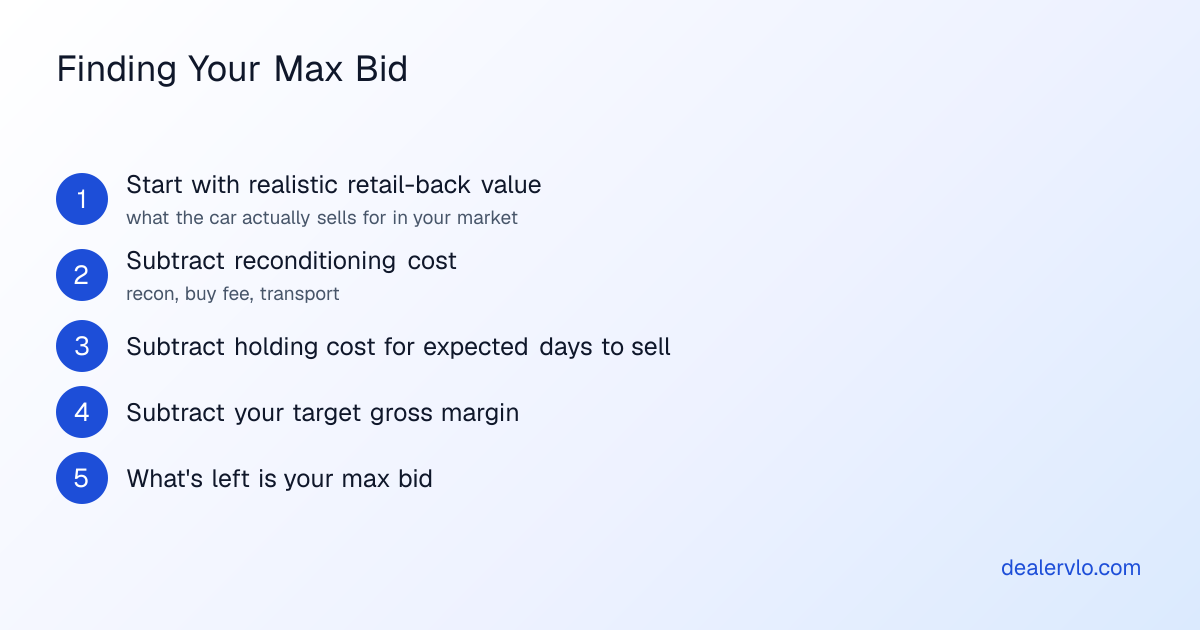
None of this matters if you overpay. The segments above tell you where the demand is; they don't tell you what to bid on a specific car in front of you at the lane or in a wholesale lot visit. That's a mechanical question: take your realistic retail-back number, subtract recon, subtract the days you expect to hold it times your real daily carrying cost, subtract your target gross, and what's left is the most you can pay.
Say you're looking at a compact crossover you think retails at $19,500. You figure $900 in recon, a couple hundred in buy fee and transport, and you'd want it gone in 25 days or less. Run those labeled, hypothetical numbers through the math before you raise your hand — the free Auction Profit Calculator takes your buy price, buy fee, transport, reconditioning estimate, floor-plan rate, days to sell, and target margin, and works out the max bid that still hits your number, along with the break-even resale price.
Once a car's actually on your lot, the same math needs to stay visible car by car, not buried in a spreadsheet you update once a month. DealerVLO tracks each car's reconditioning line by line — vendor, description, cost — and rolls it into that car's all-in cost automatically, so the gross you see on the sales report matches what the car actually cost you to get retail-ready, not just what you paid at the lane.
14-day free trial, then $29/mo · Cancel anytime
Watching how fast your buys actually move
Deciding to stock the Q4 e-tron family or a compact fuel-sipper because iSeeCars says it's turning in 30-some days is one thing; confirming it turns that fast on your lot is another. Every car added to DealerVLO shows its days in inventory automatically, and anything sitting 60 days or more gets flagged on the dashboard so it doesn't quietly become the car you forgot about. The Reports page also shows an inventory aging report bucketed into 0-30, 31-60, 61-90, and 90+ day windows, with the average days in stock across what's currently available — useful for checking, a month or two from now, whether this month's buy list actually behaved the way the national data predicted. If a unit does stall, the inventory turn calculator and wholesale vs. retail calculator are both worth running before you decide whether to keep holding it or cut it loose at auction.
A word on waiting versus buying now
It's tempting to sit out a month when the index has been bouncing around — down in September, up in October, forecast cut to basically flat for the year. But the October bounce was explicitly a supply story: auction lanes got a little thinner, not that buyers suddenly got aggressive. Used retail days' supply is sitting close to its long-term average, which means retail isn't glutted — there's room to move the right car. Waiting for a dramatically better buying month isn't obviously supported by anything in the current data; the better play is being selective about segment (efficient over heavy, mainstream over niche) rather than timing the whole market.
14-day free trial, then $29/mo · Cancel anytime
Frequently asked questions
What are the best used cars for dealers to buy in November 2026?
Based on current wholesale and retail data, the strongest buys are fast-turning compact electric crossovers like the Toyota bZ4X, Lexus RZ 300e, and Audi Q4 e-tron family (all selling in the low-to-mid 30-day range per iSeeCars), plus affordable fuel-efficient compact cars and crossovers broadly, and late-model low-mileage mainstream units that fit the near-CPO profile shoppers are asking for. Avoid large diesel trucks/SUVs and full-size electric trucks and SUVs, which are both showing falling values or slow turn in the current data.
Is the used car wholesale market up or down this month?
The Manheim Used Vehicle Value Index stood at 206.8 in October 2026, up 0.5% from September and up 2% year over year, per Cox Automotive — a rebound after September's 1.1% monthly decline. Cox attributes the October bounce mainly to tightening auction supply rather than stronger buyer demand, and has cut its full-year forecast to just a 0.2% increase.
Why are used EVs selling faster than gas cars right now?
iSeeCars' most recent study found the average used EV sells in 41.9 days versus 54.8 days for the average gas vehicle, and Cox Automotive's own wholesale commentary ties this to sustained high gas prices pushing more buyers toward efficient vehicles. Not every EV benefits equally, though — large, heavy EVs like the Silverado EV and Escalade IQ are among the slowest-selling used vehicles in the same study.
Should dealers stock used hybrids this month?
Hybrids are gaining retail market share faster than EVs are, according to iSeeCars' Q1 2025 vs. Q1 2026 comparison, but that same data shows hybrid days on market actually rose from 40.1 to 54.4 days — essentially tied with gas vehicles, not faster. Stock hybrids for the fuel-savings pitch and growing demand, but don't expect a turn-rate edge over gas right now.
How do rising gas prices affect what I should stock?
AAA reported the national average at $4.10 a gallon in early November 2026, the highest it's ever been for that month, following a record-setting $4.33 average in September. That kind of fuel cost pressure is already visible in wholesale data — diesel values are falling as diesel days' supply rises fast, while EV days' supply is shrinking — so efficient, affordable vehicles are the better bet heading into winter.
How do I figure out my max bid on a car before I buy it?
Work backward from a realistic retail price: subtract your expected reconditioning cost, your estimated holding cost for the days you expect to carry it, and your target gross, and what's left is the most you should pay. The free Auction Profit Calculator runs that math for you and gives you a break-even resale price alongside the max bid, so you can see your floor before you raise your hand.
Bottom line
November's data points in a pretty consistent direction: wholesale prices firmed up on tighter supply, gas is the most expensive it's ever been for this time of year, dealers say buyers want a lower payment, and the retail data backs efficient, mainstream vehicles over anything large or thirsty. Build this month's buy list around liquid compact EVs, affordable fuel-efficient mainstream stock, and near-CPO-eligible late-model units — and be deliberate about passing on diesel and full-size EV trucks until the data says otherwise. Run the bid math before you commit, track the car's all-in cost from the day it lands on your lot, and let the days-on-lot numbers tell you if this month's picks are actually moving the way the national data predicted. Build your buy list, run the bid math, then put the car in DealerVLO so its cost and gross are tracked from day one.
14-day free trial, then $29/mo · Cancel anytime