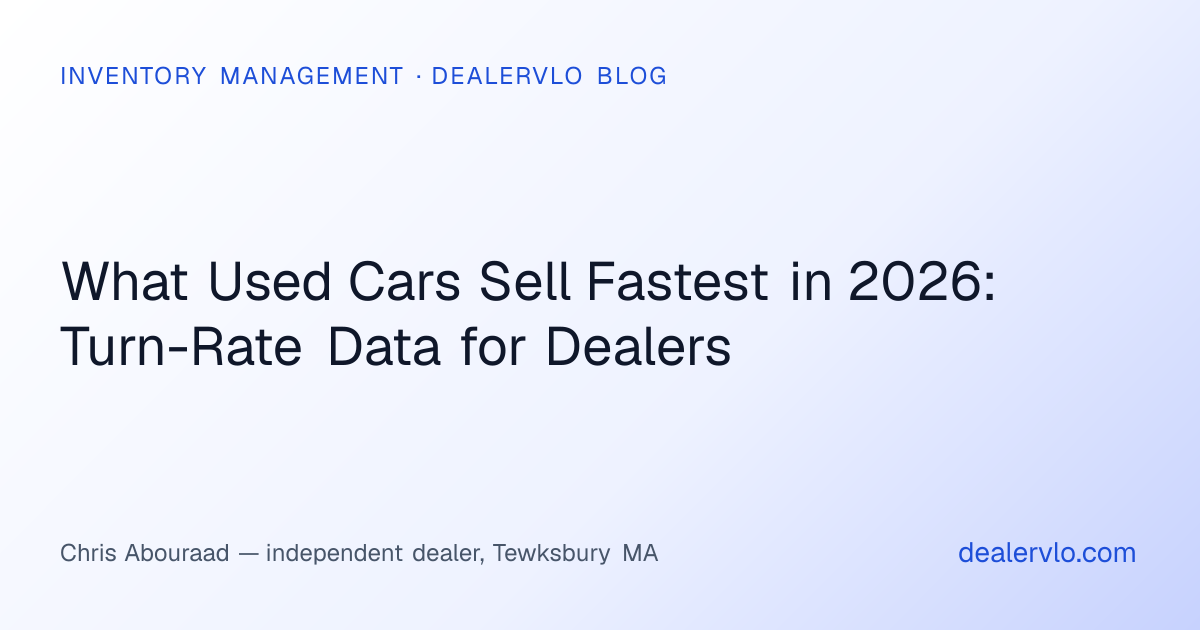
What Used Cars Sell Fastest in 2026: Turn-Rate Data for Dealers
Tesla Model X turns in 22.6 days; sub-$10K cars move in 25 days vs. 44 for $50K+ units. Real turn-rate data to guide what you bid on at auction.
Part of the Buying & sourcing inventory guide: How to buy at dealer auctions without getting buried
Switching from another DMS? Compare DealerVLO to DealerCenter, Frazer, or Lot Wizard.
The fastest selling used cars in 2026 aren't necessarily the ones that make you the most money per unit — but when inventory turns twice as fast, the same lot space and the same floorplan dollars generate twice the annual gross. A Tesla Model X averaged 22.6 days to find a buyer in February 2026, while the average 1- to 5-year-old used car sat on lots for 53 days. More important for most independent dealers: vehicles priced between $5,000 and $10,000 turned in just 25 days in Q2 2026, nearly half the 44 days it took to sell a used vehicle priced above $50,000. That's not a margin call — it's a turn-rate call, and turn rate is how a small lot compounds gross.
This guide walks through the February 2026 turn-rate data by model and by price tier, what it means at auction, and how to stock for speed when supply is tight and holding costs are real.
14-day free trial, then $29/mo · Cancel anytime
What the February 2026 turn-rate data shows
iSeeCars analyzed more than 960,000 used-car transactions in February 2026 and ranked the fastest-selling models. The overall market average sat at 53.0 days, up 40.6% from 37.7 days a year earlier. That slower market makes turn-rate data critical — a car that sits 75 days instead of 45 costs you a month of floorplan interest, a month of depreciation, and a month of opportunity cost on the next car that slot could have turned.
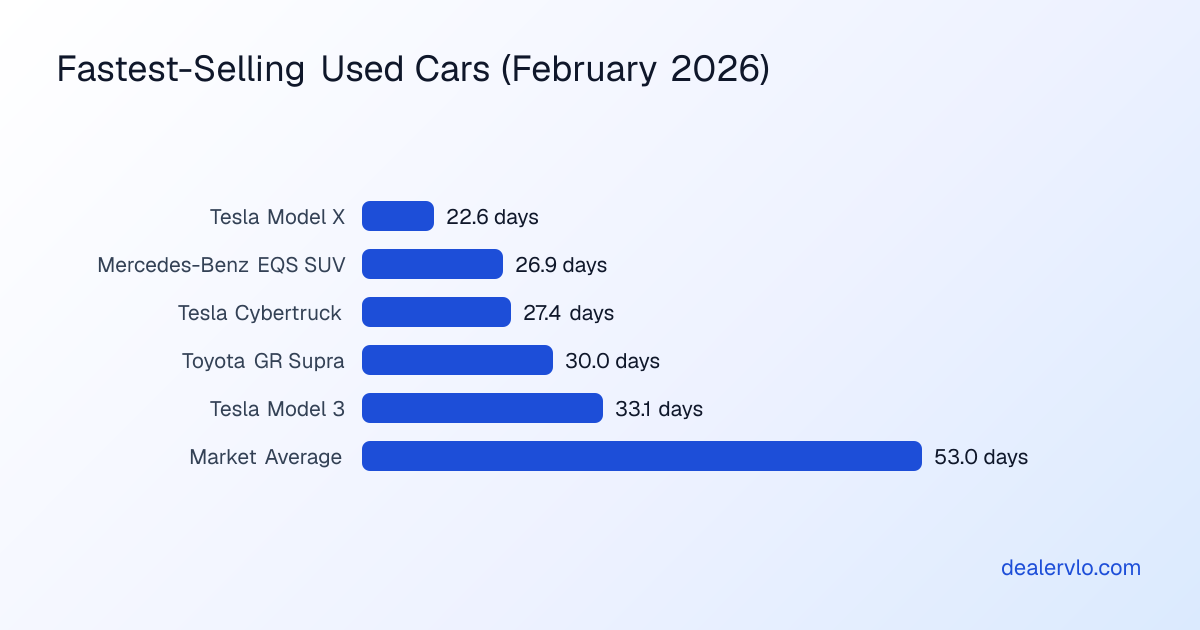
The top tier was dominated by Tesla models and luxury EVs, but affordable compact SUVs and sedans appeared consistently in regional and segment data. Here's what moved fastest at the national level in February 2026:
| Model | Days to Sell | Speed vs. Average |
|---|---|---|
| Tesla Model X | 22.6 | 0.43x |
| Mercedes-Benz EQS (SUV) | 26.9 | 0.51x |
| Tesla Cybertruck | 27.4 | 0.52x |
| Mazda MX-5 Miata RF | 29.3 | 0.55x |
| Toyota GR Supra | 30.0 | 0.57x |
| Genesis G90 | 30.4 | 0.57x |
| Rivian R1S | 30.8 | 0.58x |
| Toyota GR Corolla | 31.1 | 0.59x |
| Hyundai Kona Electric | 31.4 | 0.59x |
| Volkswagen Golf R | 31.8 | 0.60x |
Used electric vehicles overall sold at 47.4 days in February 2026, faster than the 53-day market average but not dramatically. Tesla models are outliers within the EV segment — the Model X at 22.6 days and the Model 3 at 33.1 days both turned in under half the time of a typical used car. The problem for most independent dealers is sourcing: late-model Teslas in clean condition don't show up reliably at the lanes you're bidding, and when they do, everyone else sees the same turn-rate data.
Honda HR-V, Hyundai Santa Fe, and Toyota Corolla all appeared in multiple 2026 fastest-selling lists, though national February turn figures weren't published for those models. Regional iSeeCars data showed the HR-V turning in 28.7 days in Louisiana and 24.1 days in Washington, and the Corolla at 25.7 days in Mississippi. These are bread-and-butter models most independent dealers can actually source and stock — they don't make headlines, but they turn inventory slots into cash flow every 30 days instead of every 60.
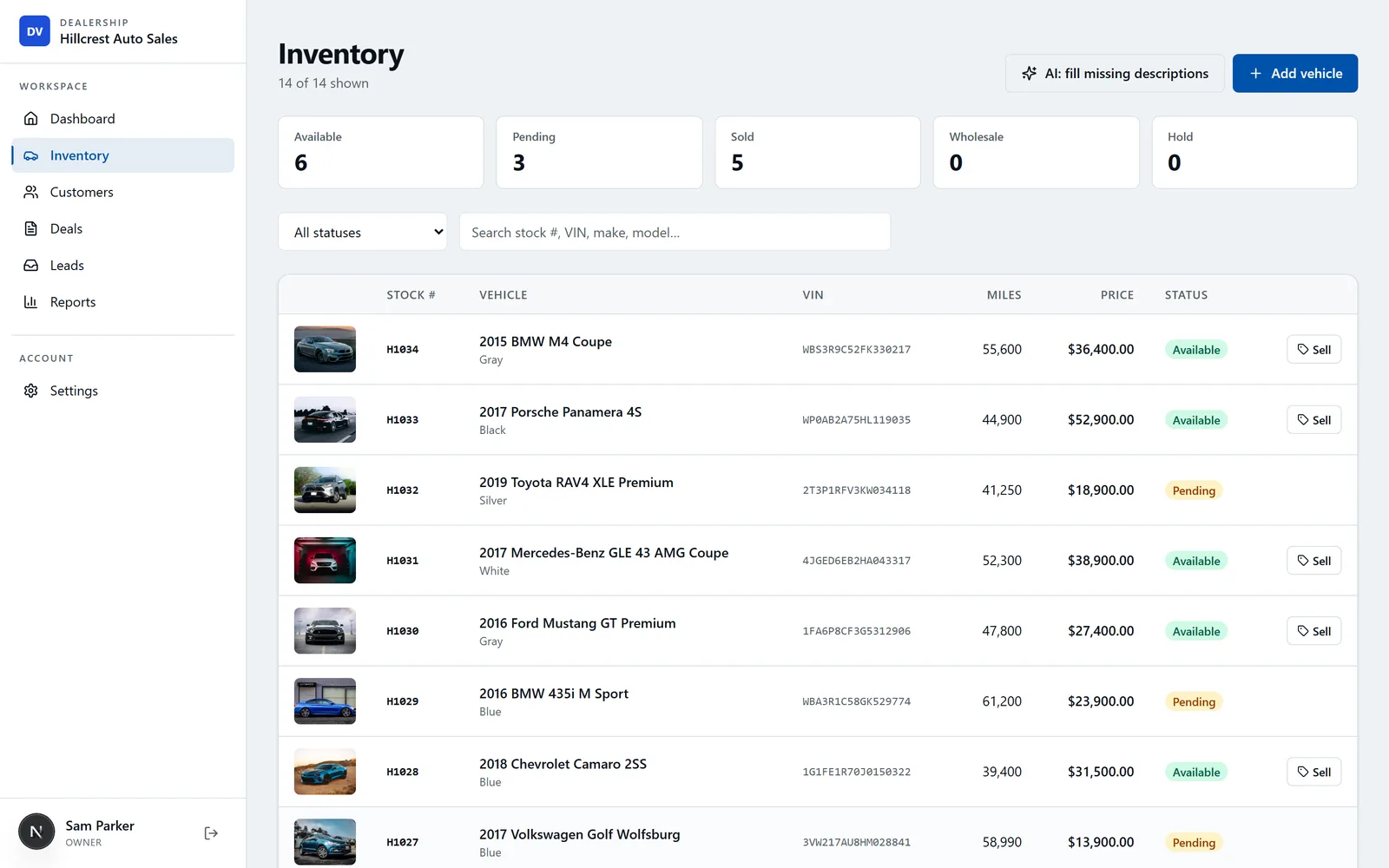
In DealerVLO, every car on your inventory list shows its days on the lot, and the dashboard flags any unit that hits 60+ days. You see aging before it becomes a problem, and you can price or wholesale accordingly before floorplan interest and depreciation eat the gross you thought you had locked in.
Price tier matters more than brand right now
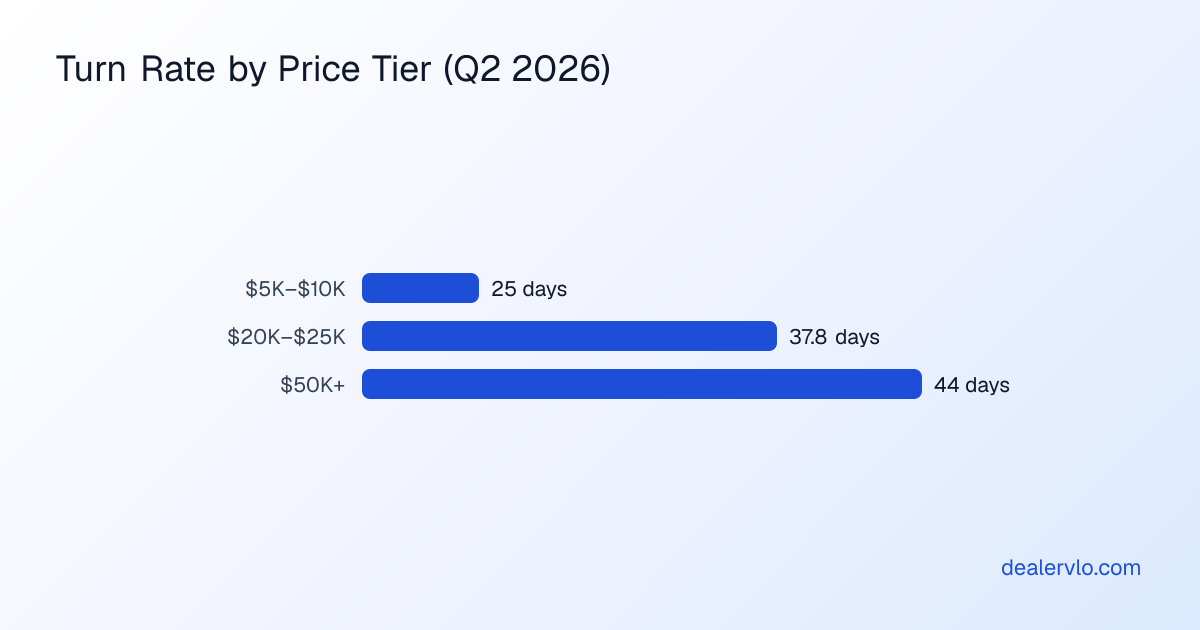
Edmunds' Q2 2026 data tells a clearer story for dealers stocking inventory from auction: vehicles sold between $5,000 and $10,000 spent an average of just 25 days on dealer lots, the fastest of any price range and well ahead of the 44 days it took to sell a used vehicle priced above $50,000. That's a nearly 2x speed advantage, and it compounds. If you average $1,800 gross per car and turn a sub-$10K unit every 25 days, that inventory slot generates about $26,000 in annual gross. The same slot holding a $50K+ unit at 44 days generates $15,000, even if you're making $2,200 per sale.
Here's how Q2 2026 turn rates broke down by price band:
| Price Range | Avg. Days on Lot |
|---|---|
| $5,000–$10,000 | 25 |
| $20,000–$25,000 | 37.8 |
| $50,000+ | 44 |
The catch: supply is scarce. The share of vehicles sold for under $15,000 dropped from 31.6% to 17.8% year over year, while the share priced $50,000 and above nearly quadrupled from 2.3% to 8.3%. Translation: affordable cars sell fast, but you're bidding against every other dealer who read the same report. Vehicles priced under $15,000 carried just 32.2 days supply in July 2026 against a 46-day market average, and supply in that band fell 20% year over year.
If you can source clean inventory in the $5K–$15K range, it will turn in 25–32 days vs. 44+ days for $50K+ units. Stock for speed, not margin per unit. A $10K Honda Civic that nets you $1,600 and turns in 28 days beats a $38K Jeep Grand Cherokee that nets you $2,800 and sits 52 days — the Civic slot generates $21,000 annual gross, the Jeep slot generates $19,000, and the Civic ties up a quarter of the floorplan dollars.
14-day free trial, then $29/mo · Cancel anytime
What to bid on at auction for speed
Fast turn starts at the lane. Here's what the 2026 data suggests you should be looking for when you're walking the rows or scrolling online auctions:
Affordable compact sedans and SUVs
Honda HR-V, Toyota Corolla, Mazda CX-5, Honda Civic, and Subaru Legacy all appeared in multiple fastest-selling lists for 2026. Affordable compact cars gained 7.6% at wholesale in mid-2026, while mainstream SUVs stayed nearly flat at +0.3%. If you can find a clean HR-V or Corolla in the $8K–$12K range, it will turn in under 30 days in most markets. The auction profit calculator lets you work backward from your target margin and expected resale to see the most you can bid and still hit your number — punch in the buy fee, transport, a recon estimate, and the days you expect it to sit, and you'll see your max bid before you raise the card.
Sub-$15K inventory, any model
Supply is tight at about 45 days nationally, and anything under $15,000 is scarce enough that dealers bid against each other for it. Under-$15,000 cars averaged 27 days supply in mid-2026 vs. a 46-day market average. If the car is clean, priced right, and fits your market, it will move. The risk is overpaying at auction because six other dealers see the same opportunity — run the numbers before you bid, and walk if the lane pushes you past your max.
I've found that stocking for turn instead of margin per unit keeps cash moving through the lot. On a small lot where you're turning one deal a week on a good week, sitting on a $35K SUV for 60 days costs you two sales you could have made in the same slot with faster inventory. DealerVLO tracks each car's all-in cost — acquisition plus every recon line — so when you pull up a car that's been sitting 50 days, you see exactly what it owes you and what the depreciation and floorplan interest have done to your margin.
Avoid $35K+ units unless you can move them in under 30 days
Recent Cox Automotive data put used inventory priced above $35,000 at more than a 50-day supply, while vehicles under $20,000 turned at roughly 31 days. One large dealer group's internal benchmark is that 100% of $35K+ inventory should be gone by day 30, and 65% should leave by day 21. If you can't consistently move higher-priced units in three weeks, don't stock them — the shopper pool has compressed, and holding cost will eat whatever extra gross you thought you'd make.
Tesla models are outliers — but hard to source
The Tesla Model X turned in 22.6 days in February 2026, less than half the market average. The Model 3 came in at 33.1 days. Both are fast sellers, and if you can source a late-model Tesla at auction in clean condition, bid on it — they move. The problem is most independent dealers can't reliably find them. Teslas at auction tend to be high-mileage, older models, or cars with accident history, and the clean ones get bid up fast because everyone sees the turn-rate data. If you have a relationship with a wholesaler who can source them, or you're buying from a platform like ACV or OPENLANE, watch for them. Just don't build your stocking strategy around a model you can't consistently buy.
Used EVs overall gained 12% at wholesale in mid-2026, leading all segments. EVs as a category sold at 47.4 days in February, faster than the 53-day average but not dramatically. Tesla is the exception, not the rule. If you're considering stocking used EVs, the turn-rate advantage is real, but so is the reconditioning cost — battery reports, software updates, and the fact that many independent service shops won't touch them. Stock them if you have the infrastructure and the buyer base; skip them if you don't.
The cost of slow turns
Turn rate isn't just a nice-to-have metric — it's the difference between making money and losing it. A $25K unit can carry roughly $150–$300 per month in floorplan interest plus $100–$200 per month in depreciation. By day 60, that same $25K car can carry a true cost near $26,200, which quietly erases gross you assumed was locked in when you bought it. Most used vehicles depreciate $100–$200 monthly, though trucks and SUVs during spring and summer can depreciate faster, and electric vehicles and luxury segments often depreciate even more aggressively.
The return on inventory investment is straightforward: gross profit per vehicle multiplied by annual turns. If you average $2,500 gross per used vehicle and turn inventory 10 times per year (roughly 36 days), you're generating $25,000 annual gross per inventory slot. A competitor averaging the same $2,500 gross but turning 6 times per year (60 days) generates only $15,000 per slot. That's the compounding effect of speed.
Industry benchmarks put a strong turn rate at 12–15 turns per year, or about 30–45 days average. Top-performing dealers turn inventory in about 45 days, while many competitors sit at 75+ days. Elite dealers hit 12–15 turns; some high-volume operations average 22 turns. For most independent lots, 8–12 turns per year (30–45 days average) is good. If you're sitting past 60 days on more than a handful of units, you're paying to store cars that should have been repriced or wholesaled weeks ago.
DealerVLO's dashboard shows a count of units aged 60+ days under "Needs attention," and every car on the inventory page shows its days on lot. You don't have to pull a report to see which cars are aging — it's visible every time you open the app. When a car hits 60 days, you see it, and you can decide whether to drop the price, wholesale it, or hold and eat the cost. Most of the time, the right call is to move it and put something faster in that slot.
14-day free trial, then $29/mo · Cancel anytime
What benchmarks to aim for in 2026
The February 2026 market average of 53 days is not the benchmark you should be targeting — it's the number you should be beating. A small independent lot can't afford to turn inventory at the same speed as a dealer sitting on 200 units with deeper pockets. Here's what to aim for:
30–45 days average: This is the sweet spot for most independent dealers. It keeps floorplan interest manageable, minimizes depreciation, and compounds gross. If you're averaging 40 days and making $2,000 per car, you're generating about $18,000 annual gross per inventory slot.
60+ days is a problem: Anything sitting past 60 days is costing you money every day it stays on the lot. A car at 75 days has likely depreciated $200–$400, cost you two months of floorplan interest, and blocked a slot that could have turned two faster cars. The inventory turn calculator shows you what your current turn rate is and what the same inventory could generate at a faster pace.
Repricing at day 45: If a car hits 45 days without serious interest, drop the price or wholesale it. The market has told you it's priced wrong or it's the wrong car for your lot. Holding it another 30 days hoping for the right buyer usually costs you more than the discount you're trying to avoid.
DealerVLO flags cars at 60+ days, but you don't have to wait that long. If you're checking the inventory list every few days, you'll see which cars are creeping past 40 and 50 days, and you can act before they become aged inventory. The wholesale vs. retail calculator helps you decide whether to dump a slow car at auction now or retail it — it compares the two nets and finds the break-even day where wholesaling makes more sense than holding.
How DealerVLO tracks turn rate and aging
Turn rate is only useful if you can see it without pulling a report. DealerVLO shows days on lot on every car, right on the inventory list. You don't have to calculate it or remember when you added each car — it's there. The dashboard counts how many units are aged 60+ days under "Needs attention," so you see the problem before it costs you. When a car hits 60 days, it gets an "aging, consider repricing" flag.
Every car also shows its all-in cost: the acquisition cost you entered when you added it, plus every recon line you logged. When you're deciding whether to drop the price on a slow car, you see exactly what it owes you, what you've already spent, and what gross is left if you cut the price by $800. The deal jacket shows front-end and F&I gross live as you build the deal, so you know whether a discount still pencils before you offer it.
The sales report shows gross per deal and total revenue for the period, and the P&L rolls in your overhead so you see net profit, not just gross. Recon costs logged on each car roll into the all-in cost and lower that car's margin on the sales report. If you're running a pack, add it as a cost line on each car — it counts the same way and lowers gross the same way.
If you're stocking inventory from auction, the auction profit calculator works out the most you can bid and still hit your target margin. Punch in the buy price, the auction fee, transport, a recon estimate, the floorplan APR, the days you expect it to sit, and your expected resale. It shows your all-in cost, net gross, margin, and the max bid for your target margin at that resale. Run it before you bid, and you'll know your walk-away number before the lane starts moving.
Stocking for speed in a tight market
The 2026 market is stratified: sub-$15K inventory is scarce and turns fast, $20K–$35K inventory moves at a reasonable pace, and $35K+ inventory sits unless it's exactly the right car. The dealer who stocks for turn rate instead of margin per unit will compound more gross over the year than the dealer chasing an extra $1,000 per sale on slower cars.
Here's the stocking playbook the data supports:
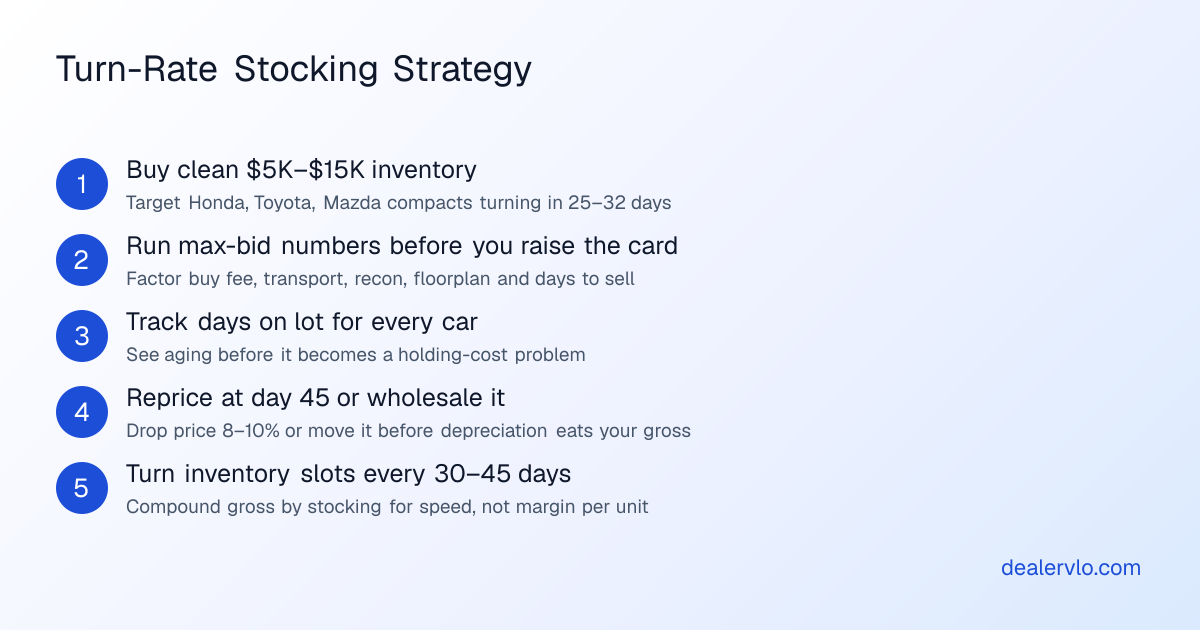
Buy clean cars in the $5K–$15K range. They turn in 25–32 days, and even if you're making $1,500 per car, you're generating $20K+ annual gross per slot. The supply is tight, so you'll be bidding against other dealers who see the same opportunity — run your numbers first and walk if the lane pushes you past your max.
Stock Honda, Toyota, Mazda, and Subaru compacts. HR-V, Corolla, CX-5, Civic, and Legacy all moved fast in 2026. They're not flashy, but they turn every 30 days and buyers can afford them. If you're at a regional auction like America's Auto Auction Houston or Chicago, watch for clean examples in the $8K–$14K range.
Avoid $35K+ unless you can move it in three weeks. The data shows a 50+ day supply above $35K, and one large dealer group's internal rule is that 100% of $35K+ inventory should be gone by day 30. If you can't consistently hit that, don't stock it. The shopper pool has compressed, and holding cost will eat the extra gross.
Bid on Teslas if you can source them, but don't count on it. Model X at 22.6 days and Model 3 at 33.1 days are legitimate fast sellers. The problem is most independent dealers can't reliably find clean late-model Teslas at auction. If one shows up and the numbers work, bid — but don't build your stocking strategy around it.
Reprice at day 45, wholesale before day 60. If a car hits 45 days without serious interest, the market has told you something. Drop the price by 8–10%, or call your wholesaler and move it. Holding it another month hoping for the right buyer usually costs you more than the discount you're avoiding.
Turn rate is how a small lot compounds gross. The guide to buying at dealer auctions walks through the full buying process, from reading condition reports to setting your max bid, and the best used cars to stock in 2026 covers which models are holding value and which are depreciating fast.
Get your annual turn rate and days' supply — and see what the same inventory could make at a faster turn.
Open the Inventory Turn CalculatorFrequently asked questions
What used cars sell fastest in 2026?
Tesla Model X led iSeeCars' February 2026 data at 22.6 days, followed by Mercedes-Benz EQS SUV at 26.9 days and Tesla Cybertruck at 27.4 days. For mainstream models most independent dealers can source, Honda HR-V turned in 24–29 days in regional data, Toyota Corolla at 25.7 days in Mississippi, and Mazda MX-5 Miata RF at 29.3 days nationally. The overall market average sat at 53 days in February 2026.
Do cheaper used cars sell faster than expensive ones?
Yes, substantially. Vehicles priced between $5,000 and $10,000 spent an average of 25 days on dealer lots in Q2 2026, while vehicles priced above $50,000 took 44 days, according to Edmunds. That's a nearly 2x speed advantage. The problem is supply: the share of vehicles sold under $15,000 dropped from 31.6% to 17.8% year over year, so you're bidding against other dealers who see the same turn-rate data.
What's a good turn rate for a used car dealer in 2026?
A strong benchmark is 12–15 turns per year, or about 30–45 days average. Elite dealers hit 15+ turns; top-performing independents turn inventory in about 45 days. The February 2026 market average of 53 days is not the target — it's the number you should be beating. Anything sitting past 60 days is costing you money in floorplan interest and depreciation every day it stays on the lot.
How much does it cost to hold a car for 60 days?
A $25,000 unit can carry roughly $150–$300 per month in floorplan interest (depending on your rate) plus $100–$200 per month in depreciation. By day 60, that car can carry a true cost near $26,200, which quietly erases gross you assumed was locked in. Trucks, SUVs in peak season, and EVs often depreciate faster, so the real cost of slow inventory is higher than the floorplan statement shows.
Should I stock Teslas or other EVs to turn inventory faster?
Used EVs overall sold at 47.4 days in February 2026, faster than the 53-day market average but not dramatically. Tesla models are outliers — Model X at 22.6 days, Model 3 at 33.1 days — and if you can source a clean late-model Tesla, bid on it. The problem is most independent dealers can't reliably find them at auction, and when they do, they get bid up fast. Stock EVs if you have the infrastructure, the buyer base, and a consistent source; skip them if you don't.
When should I reprice or wholesale a slow car?
If a car hits 45 days without serious interest, the market has told you it's priced wrong or it's the wrong car for your lot. Drop the price by 8–10%, or wholesale it. By day 60, you've likely spent $250–$500 in floorplan and depreciation, and holding it another 30 days hoping for the right buyer usually costs more than the discount you're trying to avoid. The rule one large dealer group uses: 100% of $35K+ inventory should be gone by day 30.
Bottom line
The fastest selling used cars in 2026 are the ones priced under $15,000 and the handful of Tesla models most independent dealers can't reliably source. The actionable takeaway is price tier: sub-$10K inventory turns in 25 days, $20K–$25K inventory takes 37 days, and $50K+ inventory sits for 44 days or more. Stock for speed, not margin per unit, and turn inventory slots into cash flow every 30 days instead of every 60. Run your auction bids through the numbers before you raise the card, watch days on lot for every car, and reprice or wholesale anything that hits 45 days without serious interest. Turn rate is how a small lot compounds gross, and DealerVLO shows you days on lot and all-in cost on every car so you can act before aging inventory costs you money.
14-day free trial, then $29/mo · Cancel anytime