How to Cancel a CarGurus, Autotrader, or Cars.com Contract Without Getting Burned
How to cancel CarGurus, Autotrader, or Cars.com contracts: notice windows, certified-mail mistakes, and escalation steps that work.
Part of the Listings, photos & merchandising guide: Where to list your cars for leads — and how to be on every site at once
Switching from another DMS? Compare DealerVLO to DealerCenter, Frazer, or Lot Wizard, or see what DealerVLO's car dealer management software includes.
You've already decided the listing site isn't worth the money. Now comes the annoying part: actually getting out of the contract without eating another month — or two — of charges because a letter went to the wrong address or a rep "forgot" to process the request. This isn't a buy-vs-stay post. It's the mechanics of sending a cancellation that sticks.
The short version: these are ordinary B2B advertising contracts, not consumer agreements, so there's no regulator who's going to step in for you. Your leverage is the notice clause in your own signed agreement, proof that you sent it the way the contract requires, and a paper trail if a rep drops the ball. Here's how to do each part right.
| Platform | Known cancellation notice | Source confidence |
|---|---|---|
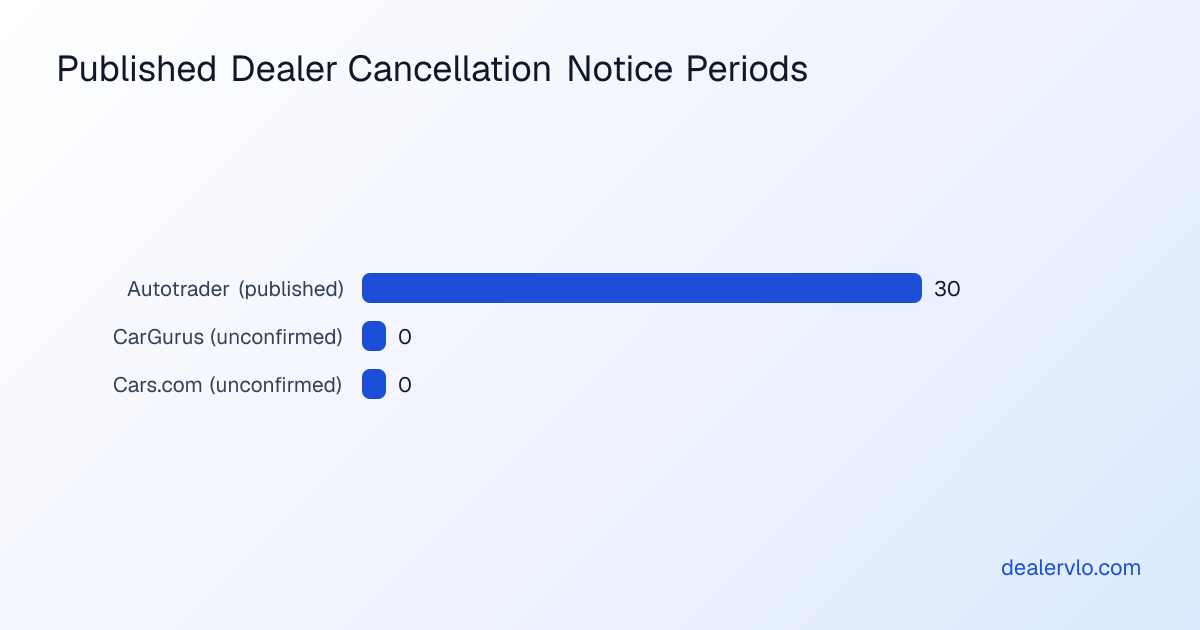
| Autotrader | Email notice at least 30 days before the cancellation date; takes effect at the end of a subscription term | Cox Automotive's standard Master Agreement (your order form can override it) |
| CarGurus | Unconfirmed — no current published figure | Only a dated, non-primary source exists; don't rely on a number |
| Cars.com | Unconfirmed — no dealer contract terms could be found published | Cars.com's site lists consumer "Sell Your Car" terms; dealer-side terms couldn't be confirmed |
14-day free trial, then $29/mo · Cancel anytime
What the contracts actually say (and what's unconfirmed)
Autotrader is the one platform where there's a real paper trail. Autotrader is sold by Cox Automotive, and Cox publishes the standard Cox Automotive Master Agreement that its Autotrader advertiser terms build on. Under that standard agreement, a subscription renews automatically for the same length of term unless your order form says otherwise. Either side can cancel by sending Email Notice — an email to the notice address Cox lists for the product — at least 30 days before the cancellation date. And the part that bites dealers: cancellation only takes effect at the end of a subscription term. Cox's own example is that on a month-to-month plan, notice given on the 15th doesn't cancel until the end of the following month. Email notice counts as given when it's received, and any unpaid fees become due immediately when the subscription ends. So the practical math: a notice sent mid-month on a monthly plan still leaves you paying about a month and a half, and a notice that never arrives never started the clock at all.
CarGurus is murkier. CarGurus doesn't publish a dealer cancellation window that we could find, so don't plan around a specific day count for CarGurus — pull your own signed agreement and read the termination clause yourself.
Cars.com is murkier still. The cancellation terms Cars.com publishes on its site are for its separate consumer "Sell Your Car" product (private-seller listings), which is not the same contract a dealer signs for inventory syndication. We could not confirm the terms of the dealer-side agreement. Again: your own insertion order is the only authority that matters here.
If you're still trying to decide whether any of these three is worth keeping before you go through the cancellation process, that's a separate question covered in our comparisons of CarGurus vs. Autotrader vs. Cars.com, plus our dedicated looks at whether Autotrader is worth it and whether CarGurus is worth it for a small lot. If cost is the real issue and you haven't checked whether you've crept into a higher pricing tier, read how listing-site pricing tiers jump as inventory grows before you pull the trigger on canceling rather than just downgrading.
Before you send anything, it's worth knowing what each of these sites is actually earning you per car. A lot of small lots pay for three or four listing feeds and have no real sense of which ones produce. DealerVLO's lead inbox records each lead's source — the website form it came through, or whatever source you pick when you add one by hand — so if you're deciding which contract to cancel first, you can at least see which channel is generating the leads you're tracking, even though it won't total cost or ROI by channel for you; that math is on you, which is exactly what a marketing ROI tool is for.
Step 1: pull your actual signed contract, not the general policy
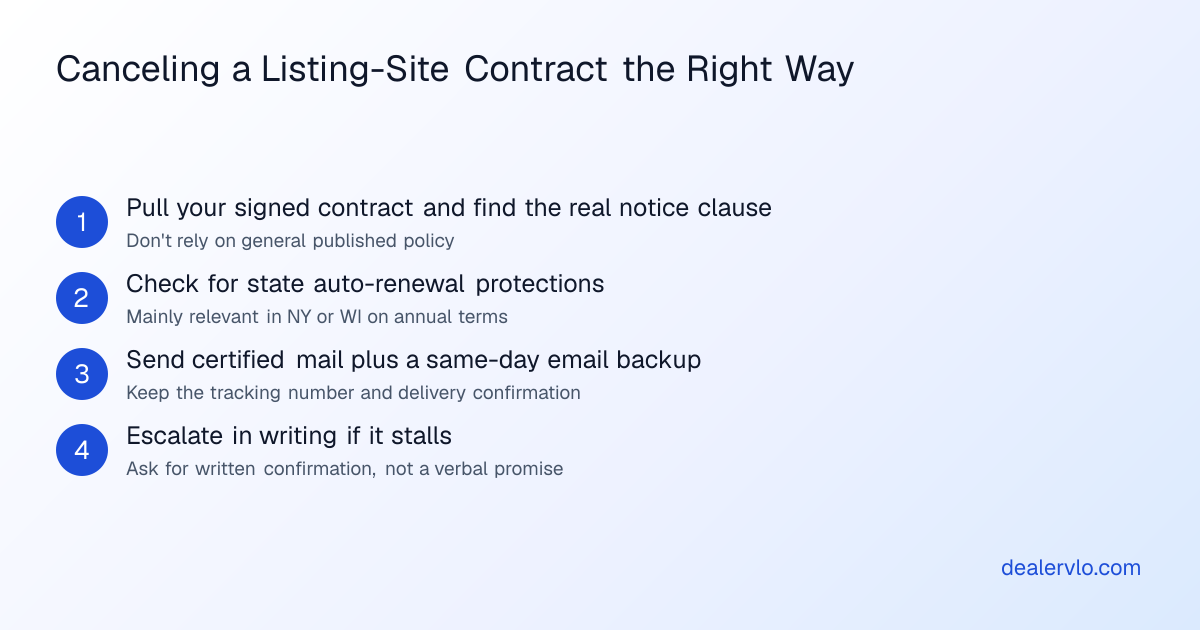
Don't assume the published standard terms apply word-for-word to your account. Individual dealer insertion orders get negotiated — longer initial terms, different notice windows, different auto-renewal language — so the number that matters is whatever is in the document you signed, not what a vendor's public terms say in general. Cox's own agreement says the order form wins when the two conflict. Find the termination/cancellation section, find the notice address, and find whether there's a minimum term that hasn't expired yet.
This is also where a lot of dealers get bitten on broader software contracts, not just listing sites — long minimum terms, auto-renewal clauses buried in an addendum, and notice windows that only open for a few days a year. If any of that sounds familiar, our DMS contract red flags guide walks through the same clauses to check before you sign anything else. DealerVLO itself runs month to month with no contract to cancel in the first place — you cancel from the billing page whenever you want, which is worth knowing if you're evaluating what to switch to once you're done untangling the old vendor.
Step 2: know your renewal window before you send anything
A small number of states regulate auto-renewing business contracts specifically, and it's worth a quick check if your agreement runs annual or multi-month terms with evergreen renewal language. New York and Wisconsin both have B2B auto-renewal rules that can make a renewal unenforceable if the vendor didn't give proper advance written notice before the renewal deadline — but both generally exclude short, month-to-month arrangements. Colorado's amended auto-renewal law took effect February 16, 2026, and some law firms, including Perkins Coie, read it as likely reaching business subscriptions too, though that isn't settled. This is not a nationwide right. If you're in New York, Wisconsin, or Colorado and your contract has annual evergreen language, it's worth having someone check whether the renewal notice was handled correctly; otherwise, don't count on a state law to bail you out of a contract you didn't cancel on time.
Step 3: send the notice the way the contract actually requires
The usual way a cancellation goes wrong isn't a refusal to cancel. It's a notice that didn't land the way the contract requires. General best practice for any written cancellation, borrowed from standard contract-cancellation and F&I compliance guidance, applies directly here:
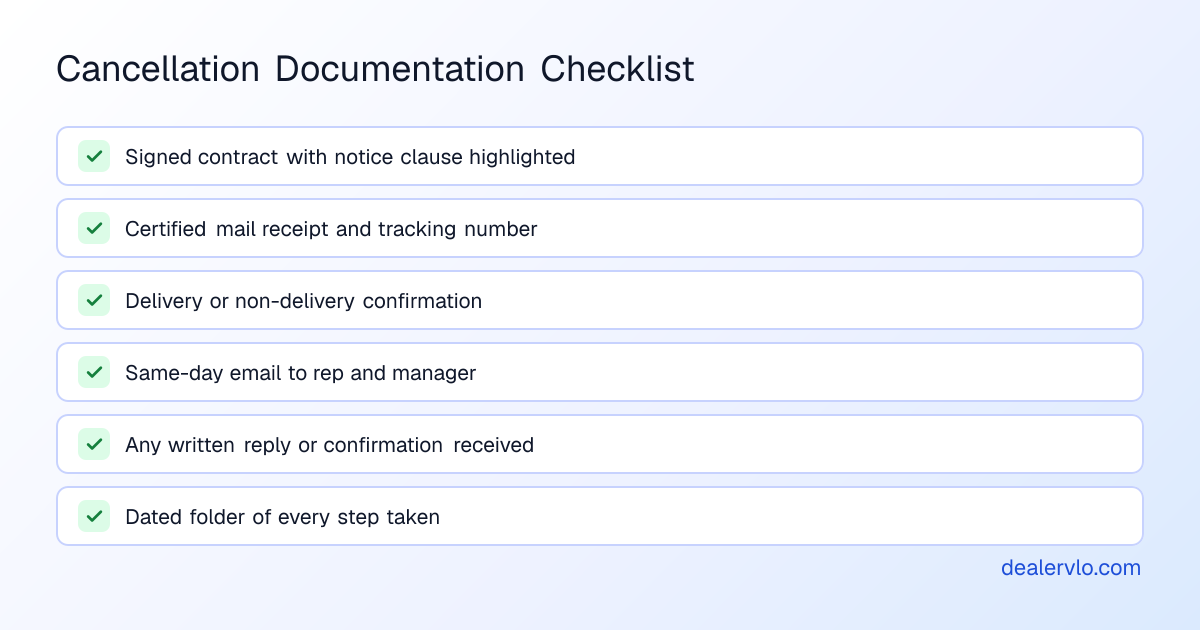
- Send it by certified mail with return receipt requested, to the exact notice address printed in your contract — not the regional sales office, not the address on an invoice.
- Keep the certified mail tracking number and the delivery (or non-delivery) confirmation. When a contract ties notice to receipt or delivery, proof of delivery — or proof that delivery failed — is your evidence either way.
- For Autotrader specifically, Cox's standard terms make the cancellation notice an email to the notice address Cox lists for the product, so check your order form for that address, send the email there, and keep the delivery receipt. A certified letter on top doesn't hurt, but don't let it replace the email the contract asks for.
- On the same day, email your account rep and their manager with the same cancellation language, stating the date and that a certified letter was also sent. This doesn't replace the certified letter; it's a second channel so there's no "we never got it" gap.
- Keep copies of everything — the letter, the mailing receipt, the email, and any reply — in one folder. If this turns into a billing dispute three months later, you want the full sequence in one place, not scattered across your inbox.
Even a letter mailed to the address printed in your agreement can come back undeliverable if the vendor has moved offices, which is exactly why the certified-mail-plus-email approach matters: it gives you proof of the attempt either way, instead of a silent gap where the vendor's system just shows no cancellation on file.
Step 4: if it stalls, escalate in writing, not just by phone
Layer your channels instead of relying on one phone call to a local rep. If an email goes unanswered, call; if a call goes nowhere, send the original notice and the email thread to the main office. And if a rep tells you there's a specific formal process, ask them to put it in writing so you know exactly what counts as notice.
The practical version of this for CarGurus, Autotrader, or Cars.com:
- If you haven't heard confirmation within a week of your certified letter being delivered, call the rep and ask for a written cancellation confirmation by email.
- If that doesn't produce anything, go up a level — ask for the request to go to whoever handles account cancellations or a regional manager, and put the ask in writing.
- If you get billed anyway, dispute it in writing immediately, referencing your certified mail delivery date and the notice clause in your contract, rather than waiting and hoping it resolves itself on the next invoice.
Plan for the possibility that a rep says "you're all set" and never actually submits the cancellation, leaving the account active and billing for another term. That doesn't mean anyone's doing it on purpose; it means a verbal promise from a rep isn't enough on its own. Get the confirmation in writing.
14-day free trial, then $29/mo · Cancel anytime
What to do with your listings while you're canceling
Don't let the cancellation process create a gap where your inventory disappears from everywhere at once. If you're moving off one site but staying on others, or switching your whole feed setup to a new system, line up the new source before the old one goes dark. DealerVLO's dealer website pushes inventory to CarGurus, Cars.com, Autotrader, and the Carfax.com feed (through its partner Vast) three times a day as part of the flat monthly price, with no extra per-site fee from DealerVLO — you still pay whatever that listing site charges you directly, and you still enroll with each site and enter your dealer ID where one's required. If you're leaving a site, DealerVLO can't cancel that account for you, but the practical sequencing is to get your new feed live and confirmed first, then ask the listing site to stop its old feed, rather than canceling the old one before the replacement is actually running. If this cancellation is part of a bigger move off another DMS entirely, switching your listing feeds without going dark walks through that handoff in more detail.
If the real goal is consolidating — fewer vendors, one dashboard, one flat bill — it's worth looking at the cheapest way to get onto CarGurus and at where else to list your cars for leads before you decide which contracts to keep versus cancel. And if you're also sitting on an old DMS contract with its own auto-renewal clause, the mechanics are nearly identical — see how to cancel a DMS contract when you're already auto-renewed in.
Why this keeps happening: no regulator, no form, no deadline reminder
It's worth saying plainly: there's no government body tracking whether CarGurus, Autotrader, or Cars.com processed your cancellation correctly. This is pure commercial contract law — the notice clause you signed, general business-contract principles, and (in a handful of states, including New York, Wisconsin, and possibly Colorado since its amended law took effect February 16, 2026) a B2B auto-renewal statute that mostly doesn't apply to month-to-month deals anyway. That means the burden of proof sits entirely with you. A dealer who mails a letter and assumes it worked, with no tracking number and no second channel, has nothing to point to if the vendor's billing system just shows the account as active. A dealer with a certified mail receipt, a dated email to two people, and a folder of everything has something to fight with.
This is the same discipline that matters any time you're trying to exit a vendor contract with auto-renewal language buried in it — check for it before you sign, not after. Our DMS contract red flags guide covers the clauses worth flagging up front on any software or advertising contract, listing site or otherwise. For what it's worth, the P&L inside DealerVLO records your advertising spend as a recurring overhead category, so once you've sorted out which listing contracts you're keeping, you can at least see that total next to gross profit for the period instead of guessing at it from invoices.
Turn your ad spend into a cost per car sold and a real ROI — and see how many units the spend has to produce just to break even.
Open the Marketing ROI CalculatorOnce you've trimmed back to the listing sites that are actually earning their keep, it's worth running the numbers on what's left rather than guessing.
Frequently asked questions
How do I cancel my Autotrader contract?
Pull your signed order form first; it overrides the standard terms. Autotrader is sold by Cox Automotive, and Cox's standard Master Agreement says either side can cancel a subscription by emailing notice to Cox's notice address at least 30 days before the cancellation date, that cancellation takes effect only at the end of a subscription term, and that any unpaid fees become due immediately. Email notice counts as given when it's received, so keep the delivery receipt, and copy your rep and their manager the same day.
How long does it take to cancel a CarGurus contract?
There's no current, confirmed notice period published by CarGurus, so don't assume a specific number of days. Pull your own signed insertion order or contract and read the termination clause directly — that document controls, not a general industry figure.
Does Cars.com have the same 30-day cancellation rule as Autotrader?
We could not confirm the terms of Cars.com's dealer (B2B) advertising contract. The cancellation terms Cars.com publishes on its site are for its separate consumer "Sell Your Car" private-seller product, which isn't the same agreement a dealer signs for inventory listings. Check your own signed Cars.com contract for the actual notice period.
What happens if my cancellation letter gets returned as undeliverable?
Keep the returned letter and the mailing receipt as proof you attempted delivery on time — this matters because notice clauses can tie the effective date to when the notice is received or delivered, not when you sent it (Cox's standard terms for Autotrader, for example, count an email notice as given on receipt). Re-send immediately to a verified current address, and follow up the same day by email to your rep and their manager so there's a second, time-stamped channel showing you tried to cancel.
Can I just stop paying instead of sending a formal cancellation?
No — these are ordinary commercial contracts, and simply stopping payment usually just leaves you in breach while the vendor's system still shows the account active and billing you. Follow the contract's actual notice procedure, document every step, and dispute any charge in writing that comes after your documented cancellation date rather than withholding payment beforehand.
Is there a government agency that enforces listing-site cancellation rules?
No. This is business-to-business contract law, not a consumer protection area, so there's no dedicated regulator policing how CarGurus, Autotrader, or Cars.com handle dealer cancellations. Your protection is your own documentation — certified mail, email backups, and a clear paper trail — not a hotline to call.
Bottom line
Canceling a listing-site contract isn't legally complicated, but it's easy to botch procedurally — the wrong address, no tracking number, a rep who says "you're all set" with nothing in writing. Pull your actual signed contract, send notice the way it requires with proof of delivery, back it up in writing on a second channel, and keep everything in one folder in case a bill shows up after you thought you were done. Do that and you've done everything in your control; the rest is just following up until you have written confirmation. If you're rebuilding your lead and listing setup while you sort this out, DealerVLO's dealer website and feeds can keep your inventory visible on the sites you're keeping without adding another per-site fee to track.
14-day free trial, then $29/mo · Cancel anytime