Your BHPH Payment Ledger: What to Record on Every Note, and When a Spreadsheet Stops Being Safe
What a BHPH ledger spreadsheet should track on every note, why posting errors cause bad calls and wrong payoffs, and when to upgrade.
Part of the BHPH, financing & F&I guide: How to Run a Buy Here Pay Here Dealership: The Whole Loop, From Approval to Payoff
Switching from another DMS? Compare DealerVLO to DealerCenter, Frazer, or Lot Wizard, or see what DealerVLO's car dealer management software includes.
If you're running BHPH paper on a spreadsheet, the question isn't whether it can hold the data — a spreadsheet can hold anything you type into it. The question is whether it stops you, or anyone else touching it, from posting a payment wrong, missing one, or quoting a payoff off a balance that's three weeks stale. A bhph ledger spreadsheet works fine for a handful of notes. Past a certain point, the thing that made it easy to set up is the same thing that makes it easy to break.
This post covers what belongs on every account's record, why a wrong entry turns into a bad phone call or a wrong payoff quote, and the specific points where a spreadsheet-based system tends to come apart — even when nobody did anything obviously careless. It doesn't cover your follow-up cadence for late accounts (that's here) or a general spreadsheet-vs-DMS decision (covered separately here) — this is just the record-keeping layer underneath both.
14-day free trial, then $29/mo · Cancel anytime
What belongs on every note's record
A note ledger — spreadsheet or software — needs to answer two questions at a glance for any account: what does this customer owe right now, and are they current. Everything below exists to support one of those two answers.
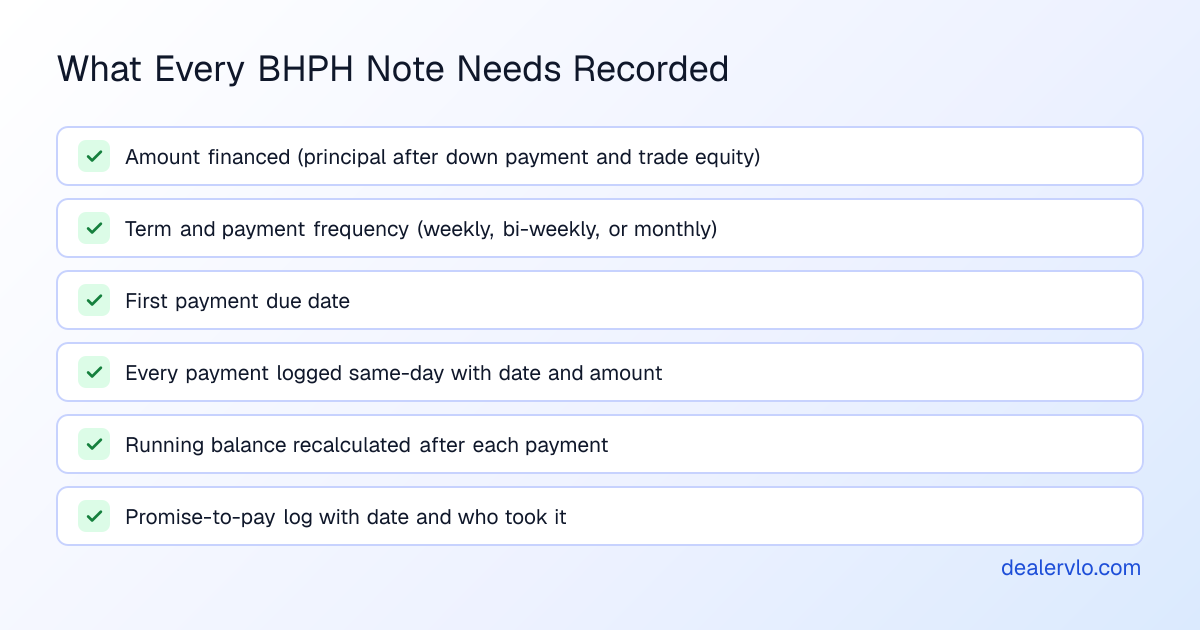
- Amount financed — the actual principal on the note after down payment and trade equity, not the sale price.
- Term and payment frequency — how many payments, and whether they're weekly, bi-weekly, or monthly. This matters more than it sounds like it should (see below).
- First payment due date — the anchor date every other due date is calculated from.
- Every payment, logged the day it's taken — date, amount, and ideally who took it. Not "caught up on Friday." The day it happened.
- Running balance — recalculated after each posted payment, not estimated from the schedule.
- Days past due — calculated from the actual due date, not guessed.
- Promises to pay, and who logged them — if a customer says "I'll have it Thursday," that note needs a date and an initials, because the next person to look at the account needs to know someone already talked to this customer this week.
None of this is a federal mandate — there's no single required ledger format spelled out in federal rule for BHPH notes, and no recordkeeping requirement at all in the FTC's Used Car Rule (the Buyers Guide rule); it genuinely only governs disclosures, not what you keep on file afterward. What drives this list is simpler: these are the fields you need to answer "what does this account owe, and when did they last pay" without having to reconstruct it from memory or a stack of receipts.
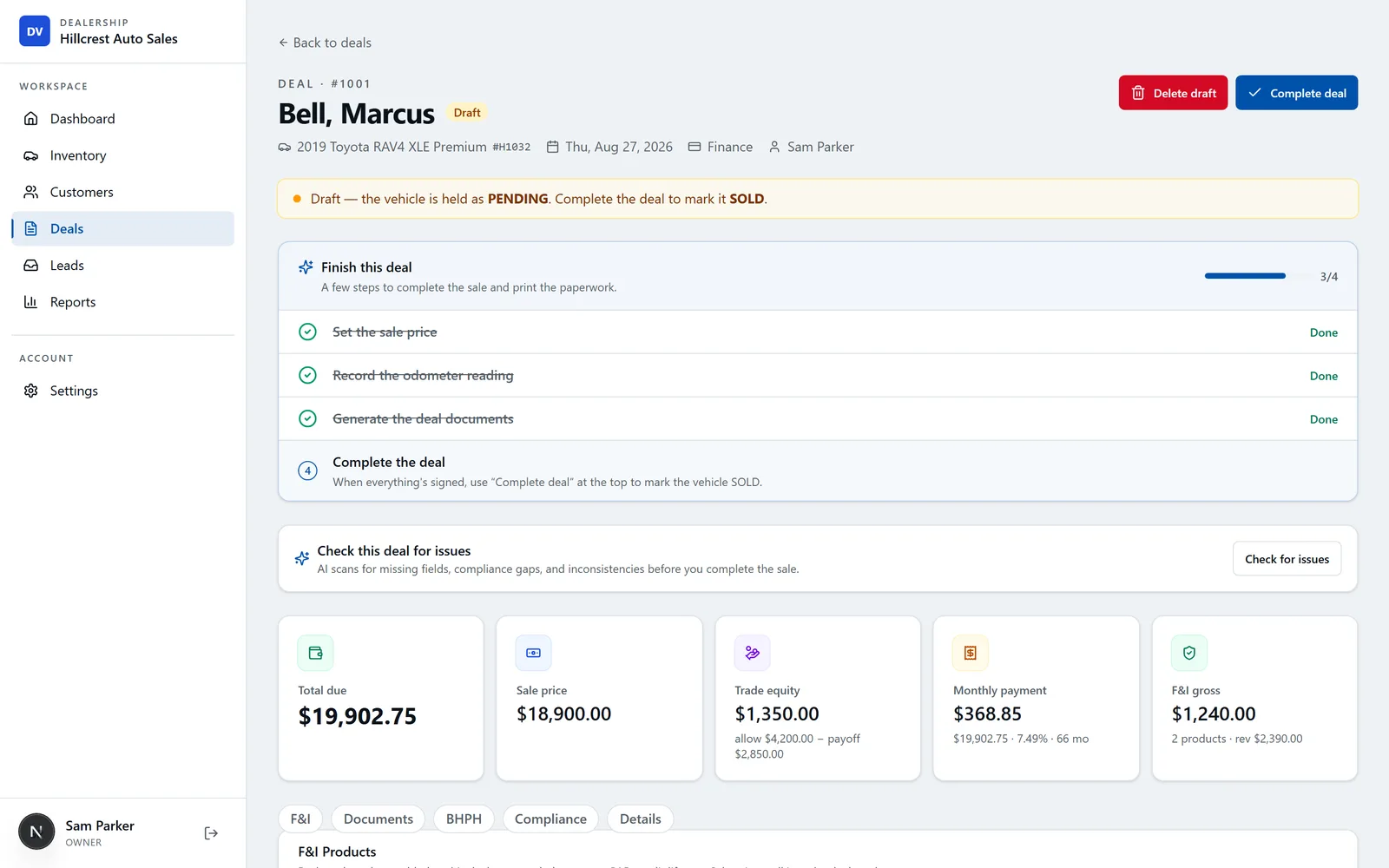
In DealerVLO, several of these fields stop being something you have to build yourself: turning on buy-here-pay-here for a deal builds the payment schedule from the amount financed, the term, the payment frequency, and the first payment date, so the anchor date and every due date that follows it are calculated once, correctly, instead of typed into a spreadsheet row by hand.
One field worth calling out separately: if you're mixing weekly and bi-weekly schedules in the same spreadsheet, the due-date math has to be right for each row individually. A formula built for a monthly schedule and then copied down a column that also has weekly accounts is a common way balances quietly drift wrong — the spreadsheet doesn't error out, it just calculates a due date that's off by a week or two, and nobody notices until a customer disputes it.
Why a posting error is worse than it looks
The failure mode isn't abstract. If a payment gets posted to the wrong account, logged a day late, or just never entered, two things happen: you call a customer who already paid, or you quote a payoff that's wrong.
Both of those are documented, recurring problems in auto finance — not hypothetical. The CFPB's own supervisory work has repeatedly flagged exactly this pattern at auto servicers: incorrect amounts listed as past due, inaccurate dates for when a borrower actually fell behind, and payoff statements that listed a wrong total amount due because of how a payment or rebate wasn't applied correctly. In one case the agency pursued against a servicer handling accounts for a buy-here-pay-here dealer, the servicer admitted that programming, system, and human errors led it to disable financed vehicles thousands of times when the customer wasn't actually in default or had made a promise to pay that wasn't recorded. That's a servicer-level breakdown, not a one-lot spreadsheet — but the mechanism is identical to what happens on a small lot's ledger when a payment doesn't get posted same-day: the balance on file stops matching reality, and every decision made off that balance (a late call, a payoff quote, whether to send someone to collect) is wrong until someone catches it.
On a 10-note lot you'll probably catch it fast because you know every account by name. On 40 or 100 notes, you're relying on the spreadsheet to tell you what you no longer remember — and a spreadsheet only tells you what got typed into it, correctly, on the day it happened.
Quote a payoff on an in-house note — current balance plus per-diem interest, good through a date.
Open the BHPH Payoff CalculatorFor a full walk-through of payoff math itself — early payoff, a trade-in on a note still owed, or what's left after a repossession — see how to calculate a BHPH payoff. The ledger discussed here is what feeds that calculation; get the ledger wrong and the payoff math is wrong no matter how carefully you do the arithmetic.
When a spreadsheet stops being safe
A spreadsheet isn't unsafe because it's a spreadsheet. It's unsafe at the specific points where more than one thing can happen to the same cell at the same time, or where the math depends on something the sheet can't check for itself.
More than one person takes payments. The moment a second person — a part-time office hire, a family member covering the counter — starts posting payments into the same file, you need to know who posted what, not just that it got posted. Two people editing the same spreadsheet without a locked structure is how duplicate entries and overwritten rows happen. It's also worth knowing that if your lot extends or arranges financing, the FTC's Safeguards Rule (part of its Gramm-Leach-Bliley implementation) applies to you as a non-bank financial institution, and the FTC has specifically clarified how it reaches auto dealers — which is a separate reason access to customer payment data should be controlled and attributable to a specific person, not just a shared file anyone can open and edit.
Weekly and bi-weekly schedules mixed in one sheet. As noted above, due-date formulas built for one cadence and copied across rows with a different cadence is one of the most common ways a balance silently goes wrong.
Payoffs quoted from a balance that isn't today's balance. If the "balance" column only updates when someone remembers to run the formula, or if a payment sits in an "unposted" pile for a few days before someone gets to it, every payoff quoted in that window is wrong. This is the exact failure pattern the CFPB has called out at the servicer level — payoff statements built off a balance that didn't reflect payments or credits that had already happened.
No daily list of who's actually late. A spreadsheet can show a balance per account, but "run a filter on the past-due column" is a step someone has to remember to do, every day, before making calls. If that step gets skipped on a busy day, you're calling people based on yesterday's — or last week's — picture. This is one piece DealerVLO handles directly: lots carrying BHPH notes get a collections panel showing active notes, the outstanding balance, payments due today, and past-due accounts, and the account owner also gets a daily email listing what's past due and due today, most overdue first — so the "remember to pull the list" step turns into something that shows up on its own.
14-day free trial, then $29/mo · Cancel anytime
None of this means you need a full DMS at 10 notes. It means watch for these four conditions specifically, because they're the ones where a well-kept spreadsheet turns into a quietly wrong one — not through carelessness, but through the normal wear of running a lot that's gotten busier than when the sheet was built.
How this works in DealerVLO
This is one of the places where turning on a purpose-built BHPH module removes manual steps rather than just digitizing them. From there, payments get tracked against that schedule with the collections panel and daily past-due email described above, instead of a running balance someone has to recalculate by hand after every payment.
A few things it deliberately doesn't do, worth saying plainly: it doesn't send payment reminders to the customer — that's still a call or a text you make yourself, and the cadence for those calls is covered separately in keeping BHPH accounts current. And if you're moving off a spreadsheet, DealerVLO doesn't import existing BHPH balances or payment history from another system — you're re-entering or manually carrying forward each account's current balance when you switch, which is worth planning for rather than discovering mid-migration.
If you're still deciding whether a spreadsheet or a dedicated system is the right call for where your lot is right now, when to switch from spreadsheet to DMS walks through that decision more generally — including size thresholds and workflow signs beyond just the ledger. And if your underwriting itself — how you size the note, the down payment, the term — needs a second look before you worry about tracking it, BHPH underwriting and approval criteria is the companion piece on that side.
14-day free trial, then $29/mo · Cancel anytime
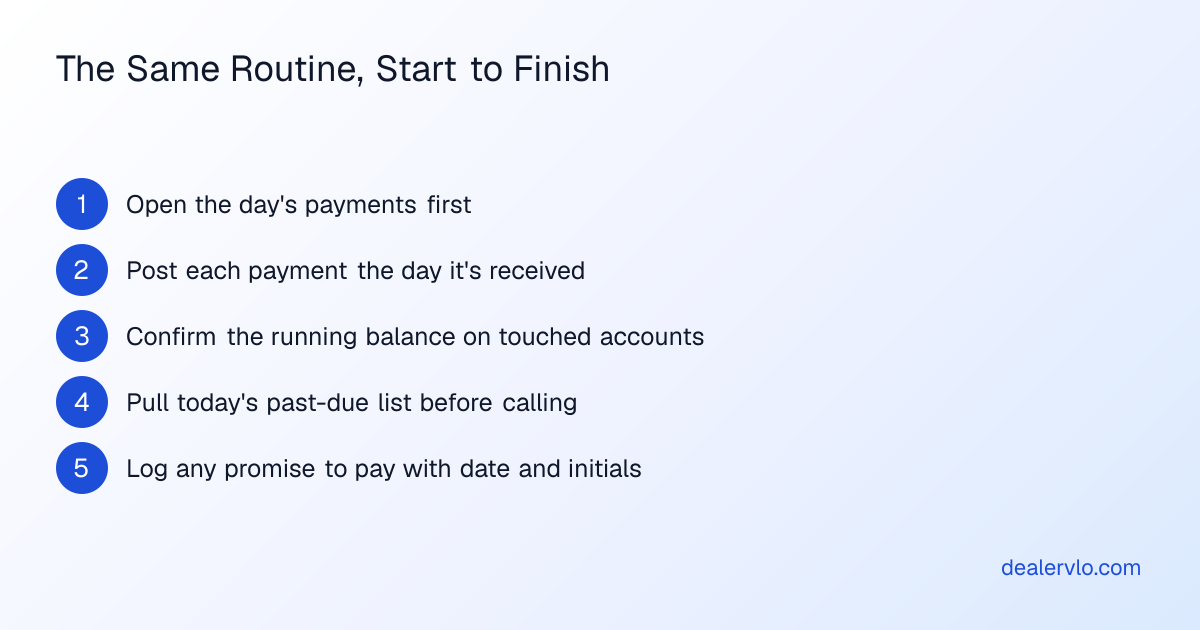
A daily posting routine, regardless of what you use
Whatever system holds the ledger, the daily habit matters more than the tool. A workable routine looks like this:
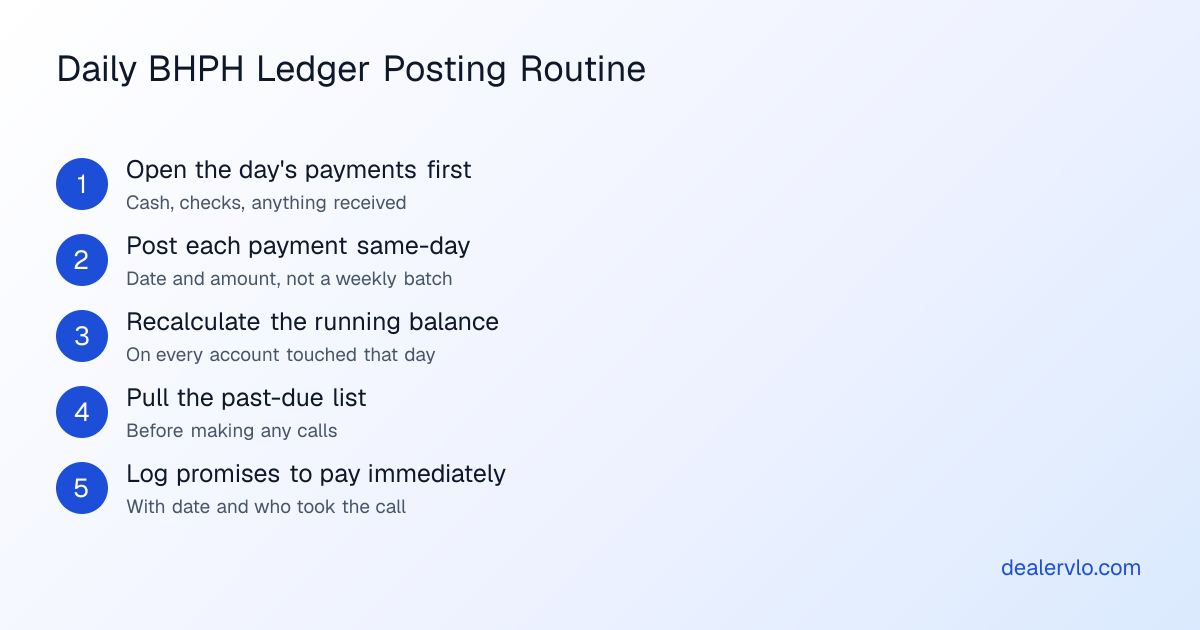
- Open the day's payments first — cash drawer, mailed checks, anything that came in — before touching anything else.
- Post each payment the same day it's received, with the date and amount, not a batch at the end of the week.
- Recalculate or confirm the running balance on every account touched that day.
- Pull the past-due list before making any calls, so you're working off today's picture, not an old one.
- Log any promise to pay immediately, with a date and who took the call, so the next person who opens that account isn't duplicating a conversation that already happened.
Frequently asked questions
Is there a federal rule requiring a specific BHPH record-keeping format?
No. The Used Car Rule's Buyers Guide requirement doesn't come with any recordkeeping obligation attached to it, and a separate FTC rule that would have imposed a specific multi-year recordkeeping requirement (the CARS Rule) was vacated by a federal appeals court and formally withdrawn — it never took effect and isn't current law. What's described in this article is a documentation practice for running the business safely, not a cited legal mandate.
Does the FTC Safeguards Rule apply to a small BHPH lot?
If your lot extends or arranges financing for customers, FTC guidance treats you as a non-bank financial institution under its Safeguards Rule, which requires measures to protect customer information. The FTC issued specific FAQ guidance in 2025 clarifying this reaches auto dealers; it's a reason to control who can access and edit your payment ledger, not just a formality.
How many notes before a spreadsheet becomes unsafe?
There's no fixed number — it depends on how many people are posting payments, whether you're mixing weekly and bi-weekly schedules, and how disciplined the daily posting routine is. The warning signs are specific: more than one person entering payments with no way to see who posted what, due-date formulas that don't match every account's actual cadence, and payoffs quoted from a balance that isn't recalculated the same day.
What's the single biggest risk of a bad BHPH ledger entry?
Calling a customer who already paid, or quoting a payoff off a stale balance. CFPB supervisory findings on auto servicers have repeatedly documented exactly this pattern — incorrect past-due amounts, wrong delinquency dates, and payoff totals that didn't reflect a payment or credit that had already posted.
Can DealerVLO replace my BHPH spreadsheet?
It can take over the schedule-building and past-due tracking: turning BHPH on for a deal builds the payment schedule from the amount financed, term, frequency, and first payment date, and lots carrying notes get a collections panel plus a daily email of what's past due and due today. It won't import your existing balances or payment history from a spreadsheet or another system, so a migration means re-entering or carrying forward each account's current balance by hand.
Does DealerVLO text or call customers about late payments?
No. It builds the schedule and surfaces who's past due, but it doesn't send payment reminders to customers — those calls or texts are still made by the dealer. The cadence for making those calls effectively is covered in a separate article on keeping BHPH accounts current.
Bottom line
A BHPH ledger doesn't need to be fancy, but it does need to be current, consistent, and attributable — the right fields, posted the same day, with one person's name on every entry and every promise to pay. A spreadsheet can do that at low volume with a disciplined routine; it stops being safe exactly where more hands touch it, more schedules get mixed in, and the daily past-due pull becomes a step someone skips. Whether you stay on a spreadsheet a while longer or move the ledger into DealerVLO, the habits in this post are the ones that keep a wrong balance from turning into a bad call or a wrong payoff.
14-day free trial, then $29/mo · Cancel anytime