AI-Written Listing Descriptions: Where They Create Legal Risk on Condition and Mileage Claims
AI generated car listing risk is real when copy overstates condition or misstates mileage — here's a review process to catch it first.
Part of the Compliance, taxes & deal paperwork guide: What goes in a used-car deal jacket: the complete checklist
Switching from another DMS? Compare DealerVLO to DealerCenter, Frazer, or Lot Wizard, or see what DealerVLO's car dealer management software includes.
If you're running listing descriptions through ChatGPT or some other AI tool to save time on 20 or 30 cars a month, the words it produces are still your words once they're published. That's the whole problem with ai generated car listing risk: nobody checks whether "meticulously maintained, no issues" matches what's actually in your Buyers Guide or your odometer disclosure before it goes live on your website and three listing sites at once. The FTC doesn't care which tool typed the sentence — it cares whether the sentence is true.
This isn't a hypothetical. The FTC has been actively going after dealer advertising practices, and when it launched its 2024 sweep on deceptive AI practices, its then-chair said "there is no AI exemption from the laws on the books." Add in a federal odometer-disclosure law that doesn't care whether a human or a script typed a wrong mileage, and "as-is" language that doesn't protect you from a listing that contradicts it, and you've got a real exposure sitting in a tool most lots treat as a time-saver, not a compliance decision. This isn't legal advice — if you're worried about a specific listing or a state's rule, talk to your attorney or your state's consumer protection regulator.
14-day free trial, then $29/mo · Cancel anytime
Why AI-drafted copy creates risk that hand-typed copy usually didn't
When you wrote your own listings, you were describing a car you'd actually looked at, usually from memory of walking around it that morning. An AI prompt doesn't know the car. It knows whatever you fed it — a VIN decode, a few bullet points, maybe nothing but "write me an exciting description for a 2019 Accord." Left to fill gaps, it fills them with enthusiasm: "immaculate condition," "fully inspected," "runs and drives perfectly." None of that is grounded in anything you can point to if someone asks.
Nothing in federal advertising law carves out copy a machine drafted. The FTC Act's ban on deceptive practices applies to the ad, not to the process that produced it, and the FTC said as much when it announced Operation AI Comply in September 2024: "there is no AI exemption from the laws on the books." That sweep was aimed at companies selling AI products, not dealers, but the point carries over. If a listing says "fully inspected" and your file has no inspection record, "the AI wrote it" isn't a defense. The copy you write doesn't stop being your advertising when a feed carries it to a third-party site. If your AI-drafted description goes out to CarGurus, Cars.com, and Autotrader, treat all three copies as yours, not just the one on your own site.
The Buyers Guide is the document your AI copy has to match
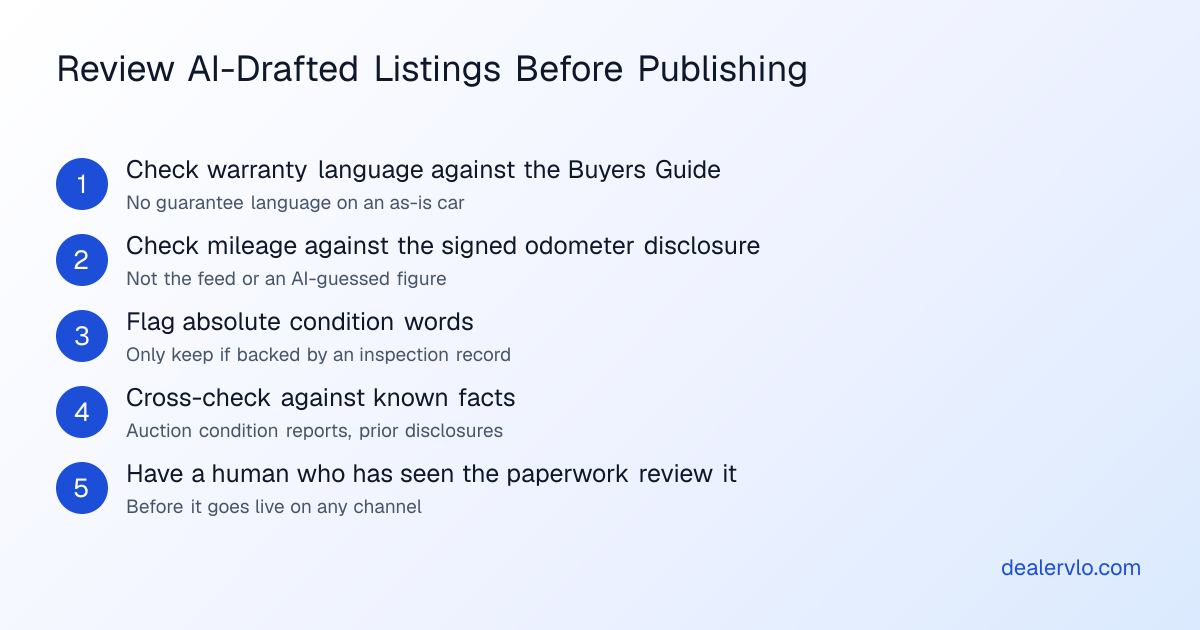
The FTC Used Car Rule requires a Buyers Guide posted in every used car you offer, and another copy handed to the buyer at sale. That Guide is where the car's actual warranty status lives — "As Is," implied warranties only, or a dealer warranty with the coverage terms spelled out. The rule treats that Guide as part of the deal: its information is incorporated into the contract of sale and overrides contrary provisions in the contract, and a separate section of the rule (16 CFR 455.4) bars dealers from making oral or written statements that alter or contradict the Guide's disclosures. So if the Guide says "as is" but your listing says "backed by our 90-day guarantee" or implies the manufacturer's warranty is still active, you've published a statement that contradicts your own Buyers Guide.
This is the single most common failure mode in AI-drafted copy, because the model doesn't know what warranty box you checked. It writes whatever sounds good to a shopper. In DealerVLO, each deal records the vehicle's warranty as As-Is, Implied Warranties Only, or Dealer Warranty with a free-text coverage description, and the Buyers Guide prints from that same record with the matching heading — so the warranty status exists as one fact in the system you can check your listing copy against before you publish, instead of trusting memory. It's also worth running your vehicle-page listing text against the How to Write Used-Car Listing Descriptions template, which is built around describing what's actually true rather than what sounds best.
Mileage is the sharpest exposure, because it's federal law, not just advertising law
Condition language is governed by FTC deception standards. Mileage is governed by a federal odometer disclosure law enforced through NHTSA's regulations, and it's written in plainer, harder terms. The rule requires you to state the mileage at transfer of ownership, and if you know the odometer reading doesn't reflect actual mileage, you have to say so. The underlying statute (49 U.S.C. 32705) also bars giving the buyer a false statement in making that disclosure.
The disclosure turns on what you, the transferor, know about the reading. Strictly, that law governs the signed disclosure at transfer, not your ad copy. But if your AI tool pulls a stale mileage from an old feed export, rounds a number down because it looks cleaner, or invents a plausible-sounding figure when the data field was blank, and that number later turns out to differ from the signed odometer disclosure on the deal, you now have a published mileage claim that disagrees with a federally required document in your own deal file — the kind of mismatch that invites questions about what you knew. The fix is mechanical: the mileage in your listing description has to come from the same number that's going on the signed disclosure, every time, not from whatever the AI prompt guessed.
"As-is" doesn't protect you from a listing that oversells the car
A lot of dealers assume that because a car is sold as-is, the exact wording of the listing doesn't matter much — the disclaimer covers them. As a general rule in many states, that's wrong: an as-is clause disclaims implied warranties, but it typically doesn't disclaim fraud or misrepresentation, because those claims are about what the seller said or hid, not about the car's condition. The details vary by state, so treat this as the general shape and ask your attorney how your state handles it. A published, timestamped AI-written listing claiming "no issues, fully inspected" on a car marked as-is is a stronger piece of evidence against you than a verbal sales pitch ever was, because it's in writing with a date on it.
If your AI prompt doesn't know the car came off a rental fleet, it's not going to mention it — and silence plus glowing language is exactly the fact pattern these cases target.
Paste a VIN, the buyer, and the price — see the title & registration form filled in for 50 states, free, no signup.
Open the State Form Auto-FillThis is also where a mismatch between your auction condition report and your published listing gets dangerous. If the report you bought the car on flagged prior damage and your AI-generated description calls the same car "flawless," you've got two documents in your own file that disagree with each other. Reading the condition report correctly before it ever reaches a listing prompt is covered in Dealer Auction Condition Reports: How to Read Between the Lines.
Two real cases where condition and mileage claims became the enforcement target
This isn't theoretical risk. In July 2024, the FTC announced a $1 million settlement with online used-car retailer Vroom over, among other things, its claims that it thoroughly inspected vehicles before listing them; the FTC said many vehicles hadn't received the advertised inspections. Vroom didn't admit wrongdoing. That's a marketing claim about condition and inspection becoming the basis for federal action, independent of what tool produced the copy. And in January 2026, the New Jersey Attorney General's office announced a judgment of more than $840,000, including a $793,500 civil penalty, against BM Motor Cars in Rahway, for what the state described as years of misrepresenting and failing to disclose the true condition and mileage of the vehicles it sold — with failures to provide signed odometer disclosure statements among the alleged violations. Neither case hinged on whether AI wrote the words. Both hinged on whether the published claim matched the actual car. That's the exact gap an unreviewed AI prompt opens.
State attorneys general and consumer protection offices are a parallel enforcement channel to the FTC on exactly this kind of claim, under their own state laws. A mismatched AI-written description isn't just a compliance risk sitting in a file somewhere — it's a written, dated exhibit if a buyer or a regulator ever comes asking.
14-day free trial, then $29/mo · Cancel anytime
A review process that catches this before publishing, not after a complaint
The fix isn't to stop using AI to draft copy — it's to put one human checkpoint between the draft and the "publish" button, and make that checkpoint fast enough that it actually happens on every car. A workable version looks like this:
- Check the warranty language against the Buyers Guide. If the Guide says As-Is, the listing can't use words that imply a guarantee, remaining manufacturer coverage, or a promise of future repairs.
- Check the mileage against the signed odometer disclosure, not against the feed, the VIN decode, or whatever number the AI tool pulled. If they don't match exactly, stop and find out why before publishing anything.
- Flag absolute condition words. "Flawless," "perfect," "no issues," "fully inspected" should only survive if you can point to an actual inspection record or condition report that backs the claim.
- Cross-check against anything you already know. If an auction condition report, a prior owner's disclosure, or your own tech flagged frame damage, prior accident history, or flood exposure, the listing can't contradict it by omission.
- Have a person who has actually seen the disclosure paperwork review the listing before it goes live on any channel — your own site, a listing feed, or a Facebook Marketplace post.
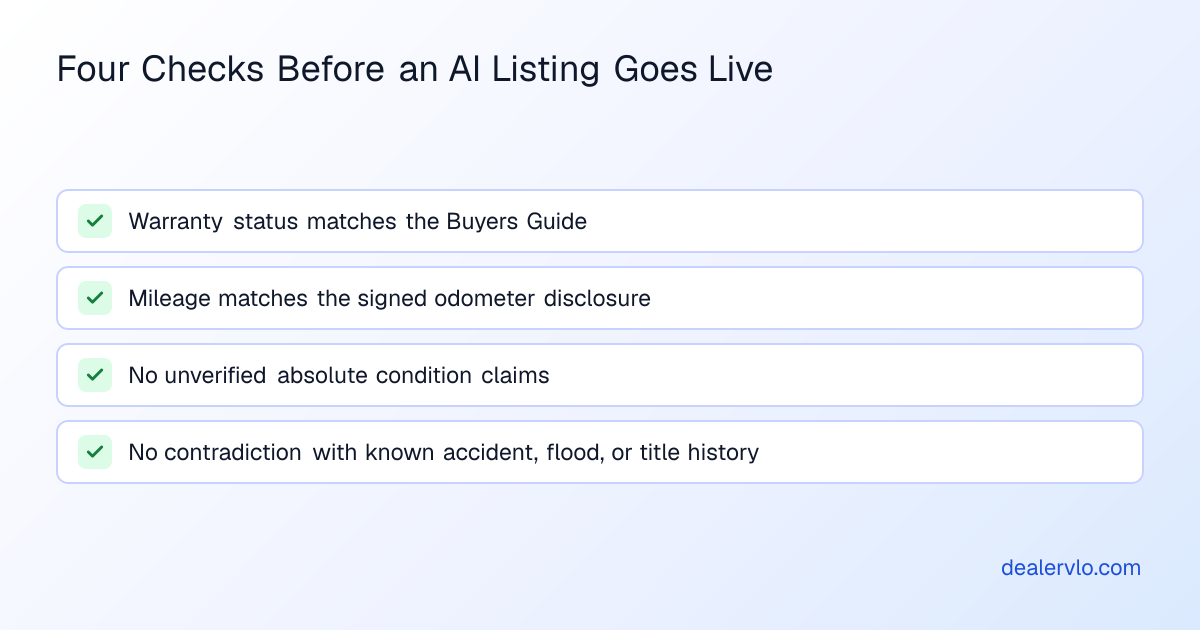
That last step is the one that actually matters: the copy is yours on every channel it reaches, so a review that only covers your own website and skips the feed version isn't a review. If you're pushing listings out through multiple sites, see Where to List Your Cars for Leads for how those feeds actually work, and keep the review step upstream of all of them rather than per-site.
On a small lot doing a deal or two a week, this review takes a few minutes per car, not a new hire. The point isn't to slow down your listing process — it's to put the one checkpoint in that catches a small problem before it becomes a very expensive one. If you're using AI for more than listing copy — appraisal language, follow-up emails, lead responses — the same "verify before publish" habit applies broadly; 40+ ChatGPT Prompts for Car Dealers covers where AI genuinely saves time versus where it needs a human check.
Where DealerVLO fits — and where it doesn't
DealerVLO doesn't write or review your listing copy, and it won't catch a bad AI-generated sentence for you — that's still a human job. What it does is give you one set of facts to check that copy against instead of hunting across folders. Every deal records the vehicle's warranty status as As-Is, Implied Warranties Only, or Dealer Warranty with a coverage description, and the FTC Buyers Guide prints from that same record with the matching heading — so before you publish a listing, you can pull up the car's actual Buyers Guide language in seconds rather than guessing. None of that replaces the review step above; it just makes the review step faster to actually do.
The used-car deal jacket checklist is a good companion read here — it covers what documents should exist for every deal, which overlaps heavily with what your listing copy needs to stay consistent with. And if your lot is in California, the added CARS Act disclosure requirements change what has to be consistent across your paperwork too — see California CARS Act Dealer Compliance for what changed when it took effect.
Frequently asked questions
Does using ChatGPT to write my listings change my liability under the FTC Used Car Rule?
No. When the FTC announced its Operation AI Comply sweep in September 2024, then-Chair Lina Khan put it plainly: "there is no AI exemption from the laws on the books." That sweep targeted companies selling AI products, not car dealers, but the principle carries over: a claim in your listing still has to be true and match your records, and you're responsible for what gets published no matter which tool drafted the sentence.
Can an AI-written description override my Buyers Guide's "as-is" status?
No, and that mismatch is itself a risk. Under the FTC Used Car Rule, the Buyers Guide's information is incorporated into the sales contract and overrides contrary provisions in it, and the rule bars dealers from making oral or written statements that contradict the Guide's disclosures. A listing that implies a warranty on an "as-is" car doesn't fix the Guide; it puts you in conflict with it.
What happens if an AI tool generates a mileage figure that doesn't match my odometer disclosure?
Federal odometer law bars giving a false statement in the required mileage disclosure at transfer, and the disclosure turns on what the transferor knows about the reading — not on who or what typed a number into an ad. If your AI-drafted listing states a mileage that differs from the signed disclosure for that car, treat it as a discrepancy to resolve before publishing, not a rounding error to ignore.
Does marking a car "as-is" protect me if my AI-generated listing overstates its condition?
Generally, no. In many states, an "as-is" clause disclaims implied warranties but does not shield a dealer from fraud or misrepresentation claims; how that plays out depends on your state's law, so ask your attorney about your situation. Glowing AI-generated language that contradicts a car's known condition can be used as evidence of misrepresentation even when the car is properly marked as-is.
Who actually enforces condition and mileage claims in used car listings?
The FTC enforces deceptive advertising claims under the FTC Act and the Used Car Rule, NHTSA's regulations govern mileage disclosure at transfer, and state attorneys general run a parallel enforcement track under their own consumer protection laws — as seen in a January 2026 New Jersey judgment of more than $840,000 against a Rahway used car dealership that the state said misrepresented and failed to disclose vehicles' true condition and mileage.
Should I stop using AI to draft listing descriptions entirely?
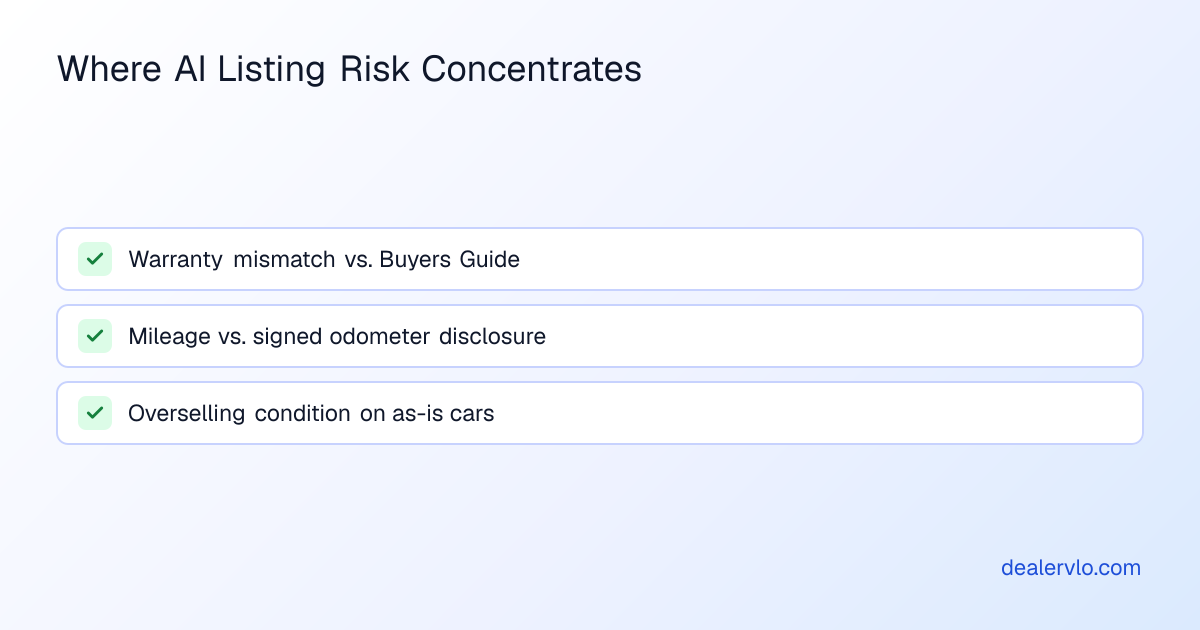
Not necessarily — the issue isn't the tool, it's publishing without a human check against your actual disclosure paperwork. A short review step before every listing goes live — checking warranty status, mileage, and condition language against the Buyers Guide and odometer disclosure — lets you keep the time savings without the exposure.
Bottom line
AI-drafted listing copy isn't risky because a machine wrote it — it's risky because nobody's checking it against the Buyers Guide, the odometer disclosure, and what you actually know about the car before it goes live on three or four sites at once. To the FTC, under federal odometer law, and to state attorneys general, the published claim and the signed paperwork are yours, whoever drafted them. Build the five-minute review step into your process, keep your warranty and mileage facts in one place you can check fast, and the AI tool stays a time-saver instead of a liability. Run your next listing — and the deal behind it — through DealerVLO.
14-day free trial, then $29/mo · Cancel anytime