Selling GAP as a Used-Car Dealer: Waiver vs. Insurance, What You Can Charge, and the Refunds That Get Dealers in Trouble
Dealer GAP for independent lots: waiver vs. insurance, what dealers charge and earn, state price caps, and the refund rules regulators enforce.
Part of the BHPH, financing & F&I guide: How to Run a Buy Here Pay Here Dealership: The Whole Loop, From Approval to Payoff
Switching from another DMS? Compare DealerVLO to DealerCenter, Frazer, or Lot Wizard, or see what DealerVLO's car dealer management software includes.
GAP is the easiest back-end product to explain to a customer. If the car's totaled or stolen, insurance pays what the car was worth, and that's often less than what's still owed on it. GAP covers the difference. On a used car with taxes, fees and maybe some negative equity rolled into the note, that difference can be real money.
It's also the product regulators look at hardest when they look at dealers. Not because GAP is bad, but because of how it gets sold and what happens to the money when the loan ends early. This post covers how GAP actually works on an independent lot, what dealers charge and earn, the state rules that cap it, and the refund mistakes that have cost lenders and dealers millions.
Waiver vs. insurance: what you're actually selling
Many dealers don't sell a GAP insurance policy at all. They sell a GAP waiver: an addendum to the retail installment contract where the creditor agrees to cancel the remaining debt after a total loss. The CFPB describes GAP products as credit products "offered to help pay off the loan if the car is totaled or stolen" (CFPB Supervisory Highlights, Issue 35, Oct 2024).
That difference matters for licensing. Several states with GAP waiver laws say outright that waivers "are not insurance," including Virginia (Va. Code ch. 64) and West Virginia (W. Va. Code §33-4-23). New York has gone the other way: a 2002 opinion from its insurance regulator treated making a GAP waiver as doing insurance business unless it fits an exemption (NY DFS opinion, 2002). Wisconsin's regulator says dealerships can sell GAP waivers "when the dealership is a creditor in the transaction" (Wisconsin DFI).
So before you sell your first one, settle two questions with your GAP administrator and, ideally, an attorney who works with dealers: is what you're selling a waiver or a policy in your state, and does anyone at your store need a license to sell it.
What dealers charge, and what they make
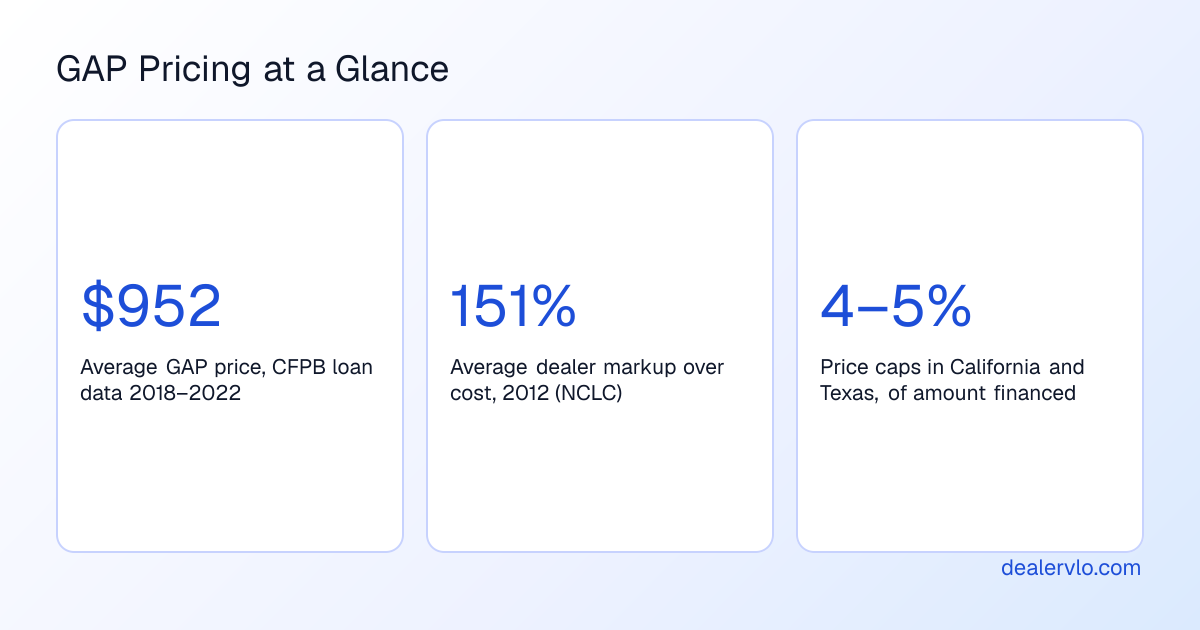
The best current price data comes from the CFPB. Looking at loan-level data, it found "the average cost of GAP products during this period was $952" for loans from 2018 through 2022, up from $897 in early 2018 (CFPB servicemember auto finance report, Jan 2025).
On margin, the most-cited figure is older. A National Consumer Law Center analysis of 1.8 million transactions found that in 2012 the average GAP markup was 151%, about $378 over an average dealer cost of $251 (NCLC report, 2017). That's 2012 data from a consumer advocate, so treat it as a picture of how wide the margin can be, not a benchmark for your store. NCLC also points customers to insurers and credit unions, which it says typically price GAP below dealer pricing (NCLC add-on tips). Expect a sharp customer to have already priced it there.
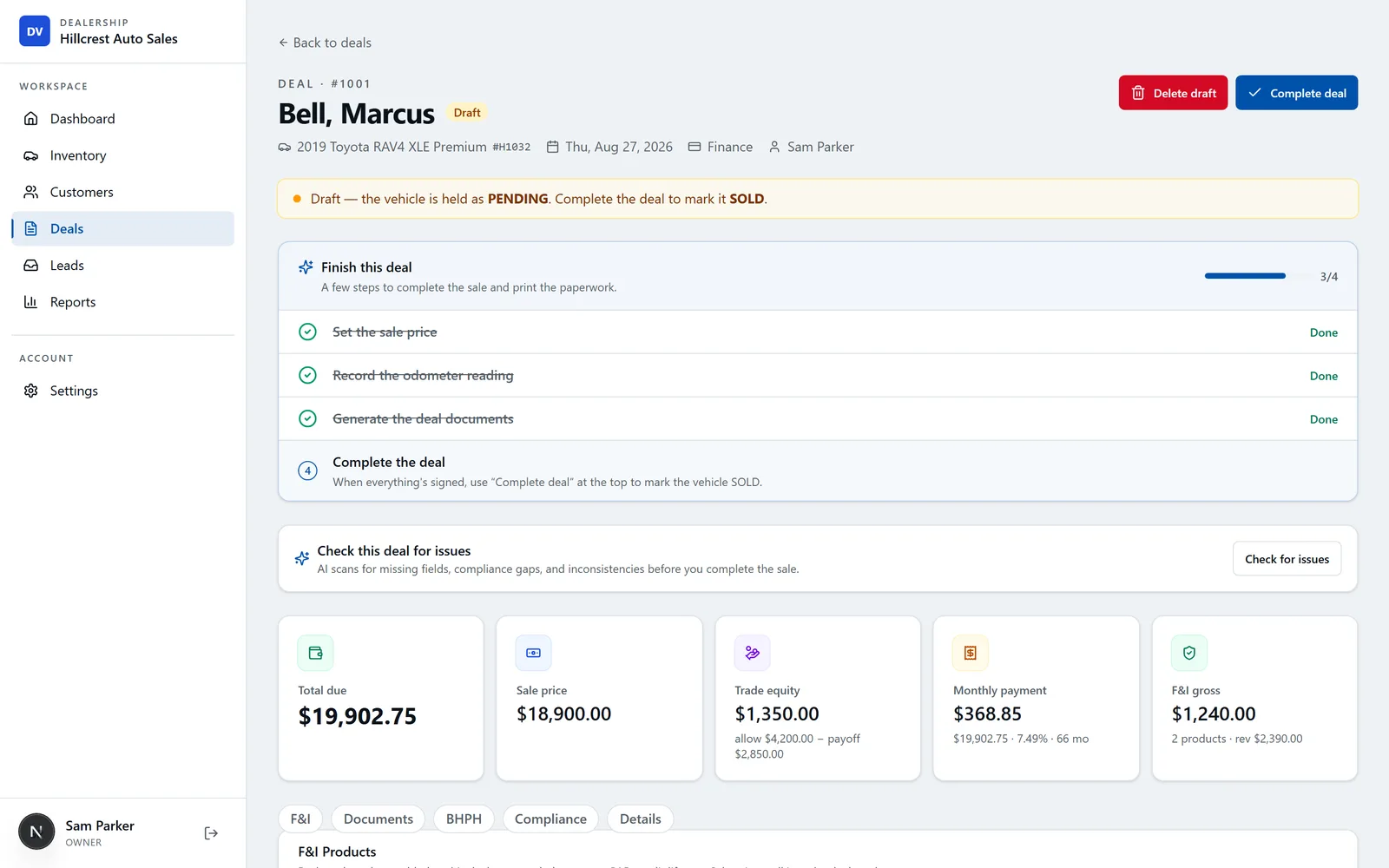
When you do sell it, track it like the profit line it is. In DealerVLO, GAP goes on the deal as an F&I product with its sale price and your cost. The price rolls into the deal total, and the difference shows as back-end gross on the deal, on the sales report next to front-end gross, and in the P&L, where F&I revenue and F&I product cost each get their own line. Then you know what GAP actually earned you this month, not what you think it earned.
14-day free trial, then $29/mo · Cancel anytime
State price caps and loan-to-value limits
Not every state caps GAP, but the ones that do take it seriously. Two big ones, as of November 2026:
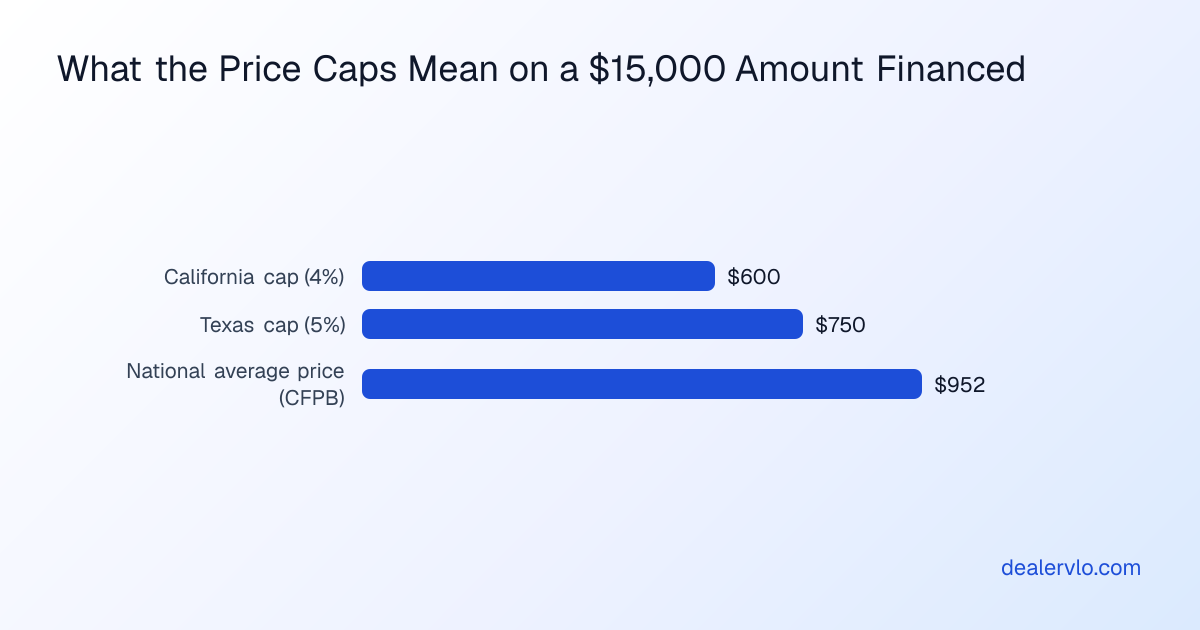
- California caps a GAP waiver at 4% of the amount financed. It bars selling GAP when the amount financed is under 70% of the car's value (for a used car, the average retail value in a pricing guide), and when the loan-to-value is above the maximum the waiver covers, unless that limit is disclosed and acknowledged. The contract needs a boxed notice that GAP is optional (Cal. Civ. Code §2982.12).
- Texas caps the fee for a debt cancellation agreement at 5% of the amount financed, requires a notice that the agreement isn't required to get credit, and gives the buyer 30 days to cancel for a full refund if there's been no loss (Tex. Fin. Code ch. 354). Check with your administrator which Texas contracts that chapter covers.
Here's what those caps look like on a typical deal, using a $15,000 amount financed as the example: California's cap is $15,000 × 4% = $600, and Texas's is $15,000 × 5% = $750. Both sit below the national average price.
The loan-to-value side cuts the other way, and it catches small lots. Every GAP program has a maximum loan-to-value it will cover. Sell GAP on a deal above that limit and the product may not pay, which is exactly the claim that turns into a complaint. If you're rolling negative equity, taxes and a service contract into the note, check the program's limit before you quote GAP. We walk through building the payment from the customer's budget in how to structure a deal from the monthly payment.
Optional means optional
This is where dealers get burned, and the FTC's case against the Napleton dealer group is the one to read. The complaint described a customer who told the salesperson he didn't want GAP and had it added anyway, and a salesman telling another buyer that a $900 GAP policy "was required for the financing company to approve his loan" (FTC and Illinois AG complaint, 2022). The settlement was a $10 million judgment, with $9.95 million going back to consumers (FTC press release, Apr 2022).
The FTC's CARS Rule, which would have added federal add-on disclosure rules, was vacated by the Fifth Circuit in January 2025 (NADA v. FTC). That didn't change the basics. State GAP laws still require GAP to be optional: California's boxed notice, Texas's required notice, Florida's rule that a lender can't require GAP as a condition of the loan (Fla. Stat. §520.07), and Virginia's ban on conditioning credit on a GAP purchase. And misrepresenting a product as required is a deceptive practice with or without the rule.
On a buy-here-pay-here deal, the temptation is real, because you're the one taking the loss on a totaled car. Don't solve it by making GAP mandatory. Solve it with your down payment and your approval criteria (see BHPH underwriting criteria), and present GAP as the optional product it is.
The refunds: where the real money is
Most GAP trouble isn't the sale. It's the refund when the loan ends early. In the CFPB's October 2024 auto finance report, examiners found servicers that:
- financed GAP that was void from the start because the car's title history already showed a total loss;
- didn't make sure customers got refunds of unearned GAP when they paid off early, in every state;
- took an average of 84 days after a repossession sale to apply the refund, one taking 423 days;
- kept collecting payments after they knew GAP would cover the balance.
The CFPB's position is that on an early payoff "the full amount of the refund should go to the borrower," and after a default the refund goes first to any deficiency (CFPB Supervisory Highlights, Issue 35).
States enforce it too. Colorado's attorney general had recovered more than $19 million in unpaid GAP refunds from lenders by early 2022 (CBS Colorado, 2022). State laws set the mechanics. California requires a pro-rata refund, with the refund due within 60 business days and no cancellation fee. Florida requires the buyer to ask within 90 days and caps the admin fee you can deduct at $75. Wisconsin bars a processing fee and requires refund math at least as favorable as the rule of 78s (Wisconsin DFI).
If you carry your own paper, the refund is your job. Every payoff, trade-in and repo on a deal with GAP should trigger the question: is there unearned GAP to refund, and has it gone out? When a customer asks for a payoff on a BHPH note, our BHPH payoff calculator gets you the balance. Work out the unearned GAP refund separately with your administrator's formula.
On your own paper, the risk is yours
When you sell a GAP waiver on a deal you finance yourself, you're the creditor, so when a car's totaled, the debt you cancel is your money. That's why dealers who sell GAP on their own paper usually buy a contractual liability or reimbursement insurance policy through a GAP administrator, so a claim is paid by the policy, not out of your pocket. Some states require it: West Virginia says a dealer "shall insure its guaranteed asset protection waiver obligations," and Virginia has the same requirement for retail sellers.
Before you sign with an administrator, get answers in writing to three questions: does the program cover deals you finance yourself, what's its maximum loan-to-value, and how are refunds calculated on early payoff and repossession. Then use their contract forms. In DealerVLO you can upload the administrator's fillable PDF as a custom form. DealerVLO maps the fields, fills the buyer, co-buyer, vehicle and dealer details from the deal, and the form can go out for e-signature with the rest of the deal's paperwork.
For a wider look at the other products on the menu, see our guide to F&I products for independent dealers.
Work backward from a customer's monthly payment to the highest vehicle price you can structure. Enter the trade allowance and the payoff separately and negative equity comes off the budget.
Open the Deal Structuring Calculator14-day free trial, then $29/mo · Cancel anytime
Frequently asked questions
Can a used-car dealer sell GAP insurance?
Yes. Many dealers sell GAP as a waiver, a debt cancellation addendum to the retail installment contract, rather than as an insurance policy. Several states' GAP laws say a waiver is not insurance, though New York's insurance regulator has treated waivers as insurance unless they meet an exemption. Check your state's rules and your GAP administrator's requirements before you sell it.
How much do dealers charge for GAP?
The CFPB's loan-level data put the average GAP price at $952 for loans from 2018 through 2022. Some states cap it: California at 4% of the amount financed and Texas at 5% for agreements its debt cancellation chapter covers. Older data from consumer advocates found an average dealer markup of about 151% over cost in 2012.
Do I have to refund GAP if the customer pays off the loan early?
In most states with a GAP law, yes: the unearned portion goes back to the customer, and some states set deadlines and cap the fee you can deduct. The CFPB has said that on an early payoff the full refund should go to the borrower, and it has criticized servicers that didn't make sure refunds were paid in every state.
Can I require GAP to approve a buy-here-pay-here deal?
No. State GAP laws, including California's, Florida's, Texas's and Virginia's, require GAP to be optional, and the FTC's case against the Napleton dealer group included a salesperson telling a buyer GAP was required for loan approval. Present it as optional, in writing, every time.
Who pays the GAP claim on a deal I finance myself?
On a waiver you sell on your own paper, you're the creditor, so the debt you cancel is yours. That's why dealers usually buy a contractual liability or reimbursement policy through a GAP administrator, and some states, including Virginia and West Virginia, require a dealer to insure its GAP waiver obligations.
Bottom line
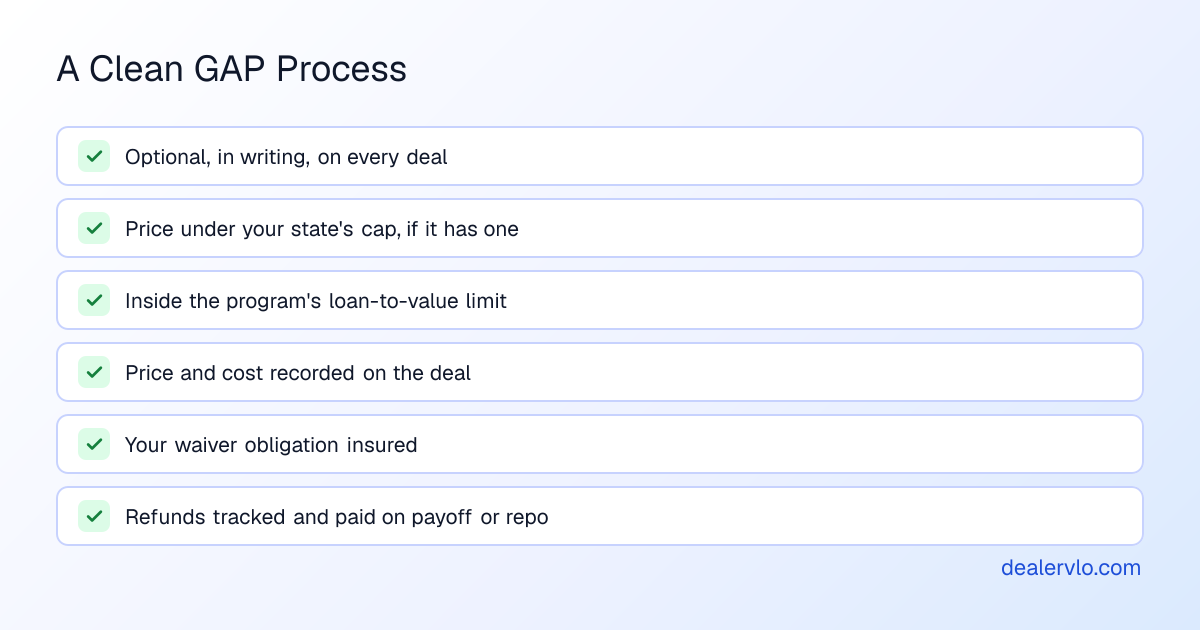
GAP is a product most financed customers should at least hear about, and it can be a clean source of back-end gross for an independent lot. The dealers who get in trouble aren't the ones selling it. They're the ones who made it sound required, sold it on deals it couldn't cover, or sat on the refund when the loan ended early. Keep it optional, keep it under your state's cap and the program's loan-to-value limit, insure your obligation if you carry the paper, and pay refunds on time. To track GAP and the rest of your back-end on every deal, start a free 14-day DealerVLO trial at /signup.