How Much Commission Does a Car Salesman Make? Per-Car Math From the Dealer's Side
How much commission does a car salesman make per car? The mechanics of pack, mini, and F&I splits, worked with a hypothetical deal.
Part of the Selling & your sales team guide: The In-Person Used-Car Sale: From Test Drive to Close on an Independent Lot
Switching from another DMS? Compare DealerVLO to DealerCenter, Frazer, or Lot Wizard.
If you've searched "how much commission does a car salesman make," you've probably noticed the answer online is either a suspiciously precise number ("25% of gross, $300 pack") or total silence. Neither is useful. We couldn't find government or trade-association data that isolates commission rates for used-car salespeople, and that's no accident: every independent lot sets its own plan.
What actually exists is a well-documented mechanism: a percentage of front-end gross, reduced by a pack, floored by a mini, sometimes stacked with a back-end split, volume bonuses, spiffs, and a draw. The percentage and dollar amounts are whatever your pay plan says — not a fixed industry number. This post walks through that mechanism with a labeled hypothetical deal and month so you can see exactly how the arithmetic works on your own numbers, then covers what you need to be tracking to pay it correctly in the first place.
14-day free trial, then $29/mo · Cancel anytime
Why there's no single commission percentage to quote
The U.S. Bureau of Labor Statistics tracks "Retail Salespersons" as an occupation and "Automobile Dealers" as an industry, but it reports total wages in dollars — not the percentage structure of a pay plan, and not a commission rate. Its most recent figures put the May 2025 median for retail salespersons across all industries at $17.03/hour, with the lowest 10% earning less than $13.08/hour and the highest 10% earning more than $23.02/hour.
On the same BLS page, retail salespersons working at automobile dealers had a median of $22.08 an hour in May 2025, well above the all-industries figure. But BLS reports total pay: none of these numbers say how much of it came from commission versus salary, bonus, or draw. Treat them as general wage context, not a stand-in for what a salesperson's commission check looks like.
None of this is commission-rate data, and none of it is independent-used-car-lot data. The National Automobile Dealers Association runs an annual Dealership Workforce Study — built from a large volume of payroll records — but it's drawn from NADA-member franchised new-car dealerships. Its sales-consultant compensation figures show a real gap between luxury and non-luxury stores, but that's franchise-store pay, tracked at a scale no equivalent study covers for independent used-car lots. If you run a small independent lot, there simply isn't a published benchmark that describes you.
How commission actually gets figured
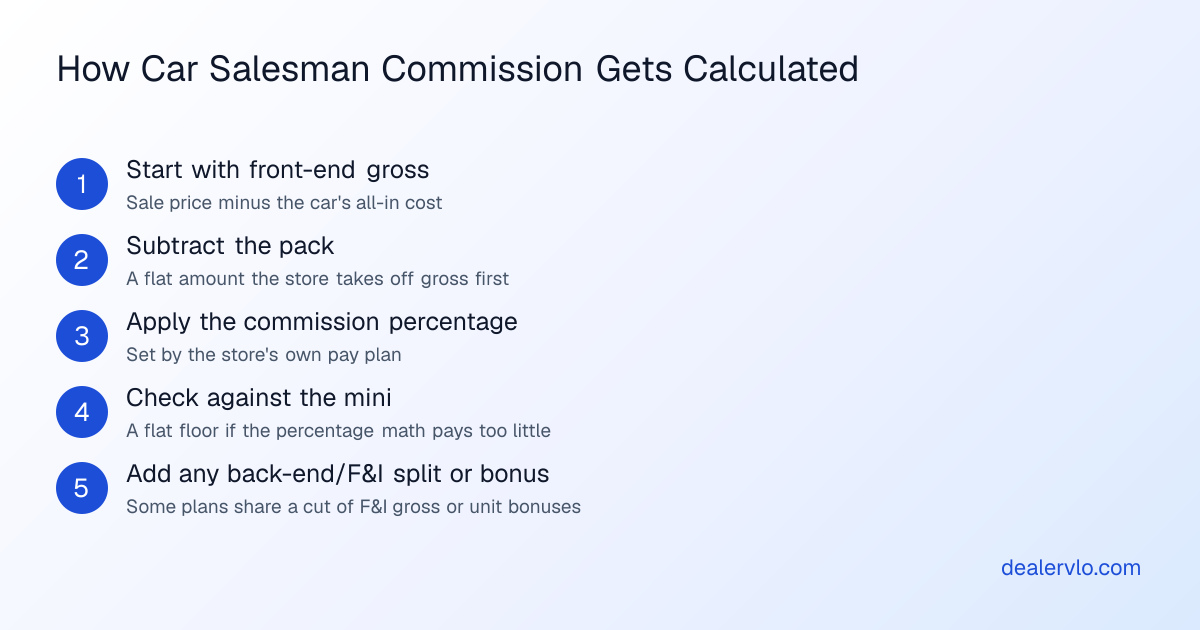
Strip away the vendor blog numbers and the mechanics that are consistently described (without a verified industry-standard percentage attached) look like this:
- It's a percentage of front-end gross, not the sale price. Front-end gross is the selling price minus your all-in cost in the car — what you actually have invested, not the sticker. A $20,000 sale on a car that cost you $19,000 all-in pays commission on $1,000, not $20,000.
- A pack comes out first. Many stores subtract a flat amount from gross before applying the commission percentage — a built-in cushion for overhead that also means the salesperson's percentage is applied to a smaller number than the full gross.
- A mini protects thin deals. When the percentage math on a skinny gross would pay almost nothing, a flat minimum commission ("mini") kicks in instead.
- Back-end/F&I gross is sometimes split in too. Some plans give the salesperson a smaller cut of finance and insurance product profit on top of the front-end commission; others keep F&I pay separate or don't share it with sales staff at all.
- Volume bonuses and spiffs stack on top. A flat bonus at a unit threshold for the month, or a one-off incentive for moving a specific unit, are both common add-ons layered over the base commission structure.
- A draw is an advance, not extra pay. A draw guarantees a minimum amount each pay period, reconciled against commissions actually earned. If earned commission comes in under the draw, what happens to the shortfall — carried forward, forgiven, or deducted later — depends entirely on the store's own policy. Commission pay plans also still have to clear a federal wage floor, enforced by the U.S. Department of Labor, regardless of how the percentage math works out.
Every percentage, pack amount, mini, and split above is something your pay plan defines, not a number the industry has agreed on. If you're building that plan from scratch, the mechanics of how to set each piece are covered in detail in our guide to building a used-car sales pay plan that doesn't leak gross — this post is about understanding the math once the plan exists, not designing one.
A worked example — hypothetical numbers only
None of the figures below are industry averages. They're made up to show the arithmetic clearly; plug in your own plan's numbers and they'll move accordingly.
Say a salesperson closes a deal with:
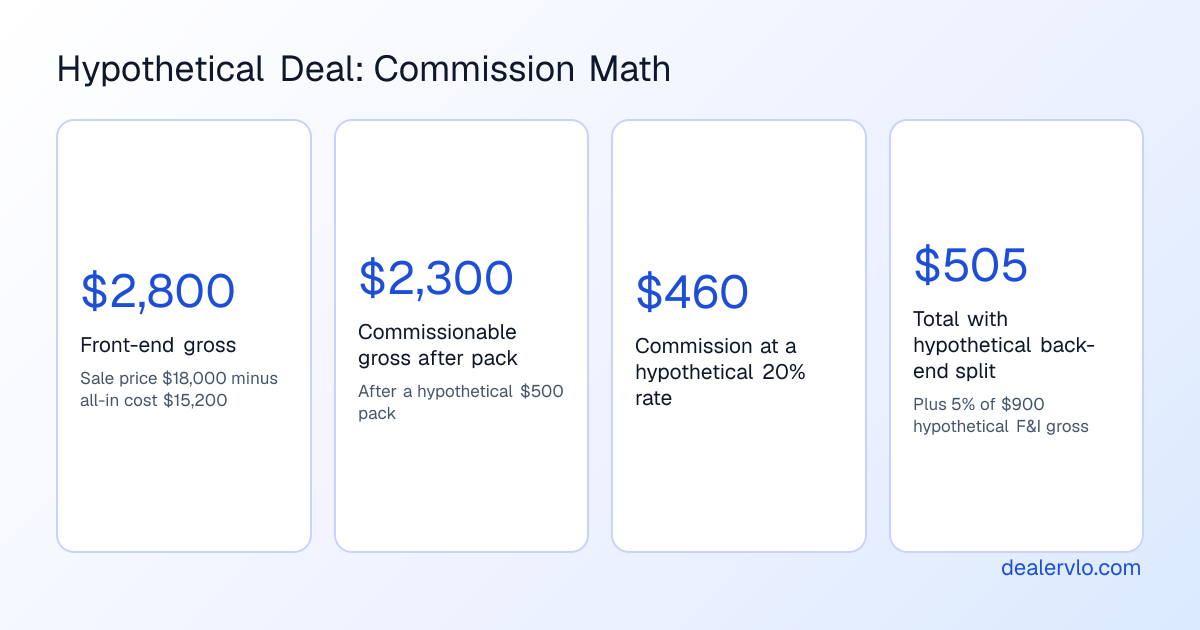
- Sale price: $18,000
- All-in cost of the car (acquisition plus recon and fees): $15,200
- Front-end gross: $18,000 − $15,200 = $2,800
- Pack (hypothetical store policy): $500 taken off gross before commission
- Commissionable gross: $2,800 − $500 = $2,300
- Commission rate (hypothetical plan): 20% of commissionable gross
- Commission earned: 20% × $2,300 = $460
- Mini (hypothetical plan floor): $150 — not triggered here since $460 is well above it
- Back-end split (hypothetical plan): 5% of $900 in F&I gross on this deal = $45
- Total commission on this one deal: $460 + $45 = $505
Now run a hypothetical month. If that salesperson closes 10 units at an average commission similar to the example above, plus a hypothetical $300 volume bonus for hitting a 10-unit threshold:
- 10 × $505 average per-deal commission ≈ $5,050
- Plus $300 volume bonus
- Hypothetical month total: $5,350
Again — every number in that math is a labeled placeholder. A thinner front gross, a bigger pack, a lower rate, or no back-end split at all would change the result substantially. The sales commission calculator below runs this same structure (rate, pack and mini) against your own deal numbers instead of these hypotheticals.
Work out a salesperson's commission on a deal — rate, pack, and mini — and what's left for the house.
Open the Sales Commission Calculator14-day free trial, then $29/mo · Cancel anytime
Why independent-lot pay looks different from franchise-store pay
There's a structural reason independent-lot commission plans and franchise-store commission plans don't match, even in general shape. Franchise new-car dealerships are large enough, and numerous enough, that a trade association can aggregate a large volume of payroll records into an annual study and publish a benchmark. That creates pressure toward standardized, benchmarked pay plans at franchise stores — managers can see where their plan sits relative to a regional or national distribution.
Independent used-car lots don't have that equivalent. There's no comparable national study of independent-lot commission structures, which means every independent dealer is setting pack, percentage, mini, and bonus thresholds store-by-store, based on their own margins and their own read on what keeps a salesperson motivated without giving away gross they need to stay open. A lot running on a one- or two-person sales staff also just operates differently day to day than a large floor at a franchise store — fewer formal shifts, more cross-training between sales and other jobs, and pay plans that get adjusted ad hoc rather than through a formal annual review cycle. Neither approach is wrong; they're answering different problems.
What you need to track to pay commission correctly
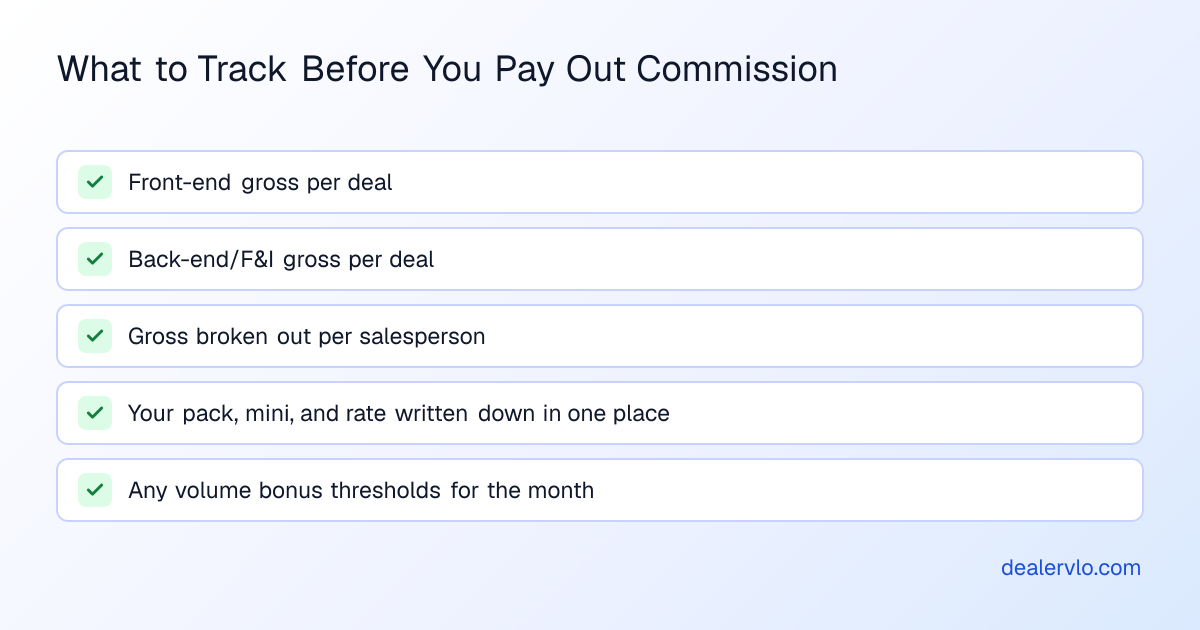
Whatever your plan says the percentage, pack, and mini are, you can't apply any of it without two numbers for every deal: front-end gross and back-end gross. Get those wrong — or have to reconstruct them from memory at the end of the month — and you'll either overpay, underpay, or spend an afternoon untangling a dispute with a salesperson who (correctly) wants to know exactly what they're owed.
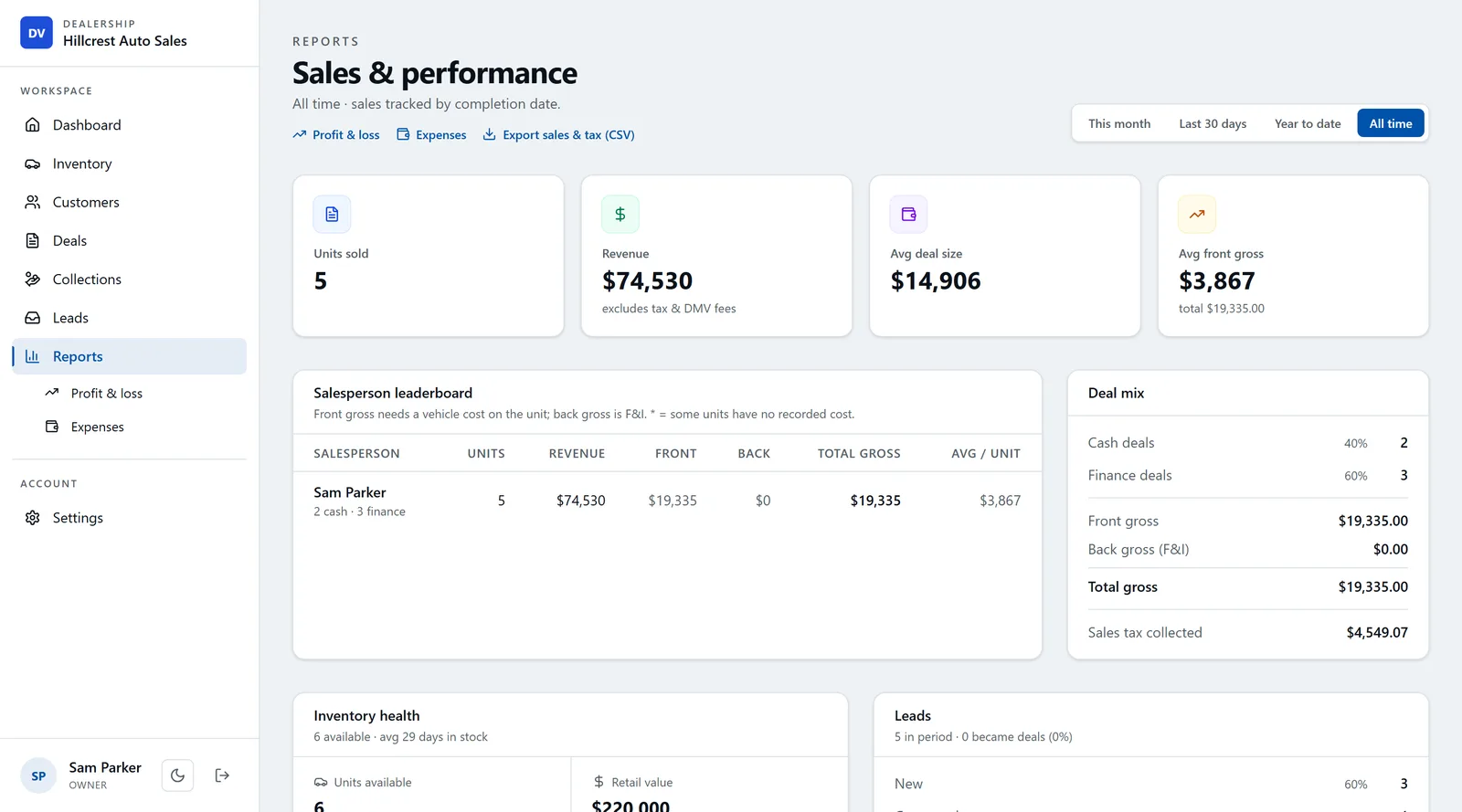
In DealerVLO, every deal jacket computes front-end and F&I gross live as the deal is built, from the sale price and the car's all-in cost (acquisition cost plus every reconditioning and fee line logged against that car). The sales report then breaks that gross out per deal and rolls it into a salesperson leaderboard, so you can see exactly what each closed deal paid in front and back gross without rebuilding the math by hand. That's the number your commission percentage, pack, and mini get applied to from your own pay plan — you still do that math yourself, using whatever plan your store runs. DealerVLO doesn't calculate commission or run payroll; it hands you the gross figures your own plan's math runs on.
If you're setting up commission for the first time — maybe you just brought on your first hire — it's worth reading hiring your first salesperson at a used-car lot before you lock in a plan, since the pay structure and the hiring timeline tend to get decided together. It also helps to look at your own profit margin and run numbers through the profit margin calculator before setting a rate, since a pay plan that looks generous on paper can eat more of your gross than your margins can support.
14-day free trial, then $29/mo · Cancel anytime
Tracking gross doesn't replace designing the plan
Everything above assumes the plan — the percentage, the pack, the mini, whether there's a back-end split — already exists. Picking those numbers for your own store, and deciding whether a draw makes sense for a new hire's first few months, is a separate decision that depends on your margins, your market, and how many units you expect a salesperson to close. That design work is covered step by step in our guide to building a used-car sales pay plan. Once the plan is set, the only remaining job is making sure gross per deal is tracked accurately and consistently enough that nobody has to argue about it at payout time — and that part, DealerVLO's sales report is built for.
Frequently asked questions
How much commission does a car salesman make per car?
There's no fixed industry number — it depends entirely on the store's pay plan: the percentage applied to front-end gross, whether a pack is subtracted first, whether a mini floor applies, and whether a back-end F&I split is included. A salesperson at one lot and a salesperson at another lot can be paid very differently on an identical sale price if their underlying gross or plan terms differ.
What percentage of gross does a car salesman typically get?
We couldn't find a verified industry-standard percentage to cite: the ranges you see quoted online (like "20-30%") don't trace back to a named trade or government source we could check. The percentage is set by each dealership's own pay plan, which is why this post walks the math with a hypothetical rate instead of asserting a universal one.
Is car salesman commission based on the sale price or the profit?
It's based on front-end gross profit — the sale price minus the dealer's all-in cost in that specific car — not the sticker price itself. That's why two deals with the same sale price can pay very different commissions if the underlying cost (and therefore the gross) is different.
What is a "pack" in car sales commission?
A pack is a flat amount many stores subtract from a deal's gross before applying the commission percentage, effectively reducing the gross the salesperson is paid on. The exact amount is set store by store; there's no verified industry-standard pack figure.
What's a "mini" and why does it matter?
A mini is a flat minimum commission a pay plan guarantees on a deal, used when the percentage math on a thin-gross sale would otherwise pay very little. It protects a salesperson's pay on deals the store still wanted to close even at low margin.
Does DealerVLO calculate commission for me?
No. DealerVLO's sales report shows front-end and back-end gross per deal and per salesperson — the numbers your commission percentage, pack, and mini get applied to — and you apply your own pay plan's math to that gross yourself.
Bottom line
There's no single answer to "how much commission does a car salesman make" because the percentage, the pack, the mini, and the back-end split are all decisions your own pay plan makes — not numbers set by the industry. What every plan needs, regardless of the percentages you pick, is accurate front-end and back-end gross on every deal, visible per salesperson, so the commission math is never a guess at month-end. If you want to see that gross tracked automatically instead of rebuilt by hand from a spreadsheet, give DealerVLO a look.
14-day free trial, then $29/mo · Cancel anytime