How Many People Use Facebook Marketplace to Buy Cars? The Numbers Meta Has Actually Published
Facebook Marketplace car buyer numbers for dealers, sourced: what Meta, Pew, Cox Automotive and the FTC published, and which viral stats have no source.
Part of the Listings, photos & merchandising guide: Where to list your cars for leads — and how to be on every site at once
Switching from another DMS? Compare DealerVLO to DealerCenter, Frazer, or Lot Wizard, or see what DealerVLO's car dealer management software includes.
Every pitch for a Marketplace posting tool opens with a big number: "1.2 billion users," "a billion shoppers," "the #1 place car buyers start." When I went looking for where those numbers come from, most of them led back to statistics roundup sites quoting each other, not to Meta.
So this post is just the numbers a dealer can actually stand on: what Meta itself has said about Marketplace and vehicles, what Pew Research and Cox Automotive measured about US shoppers, and what the FTC reports about scams that start on Facebook. Each one is linked and dated, and there's a list at the end of the figures I couldn't trace to anyone. If you're deciding whether Marketplace is worth your time, the companion post on Marketplace's real cost per car sold puts these to work.
14-day free trial, then $29/mo · Cancel anytime
How many people use Facebook Marketplace?
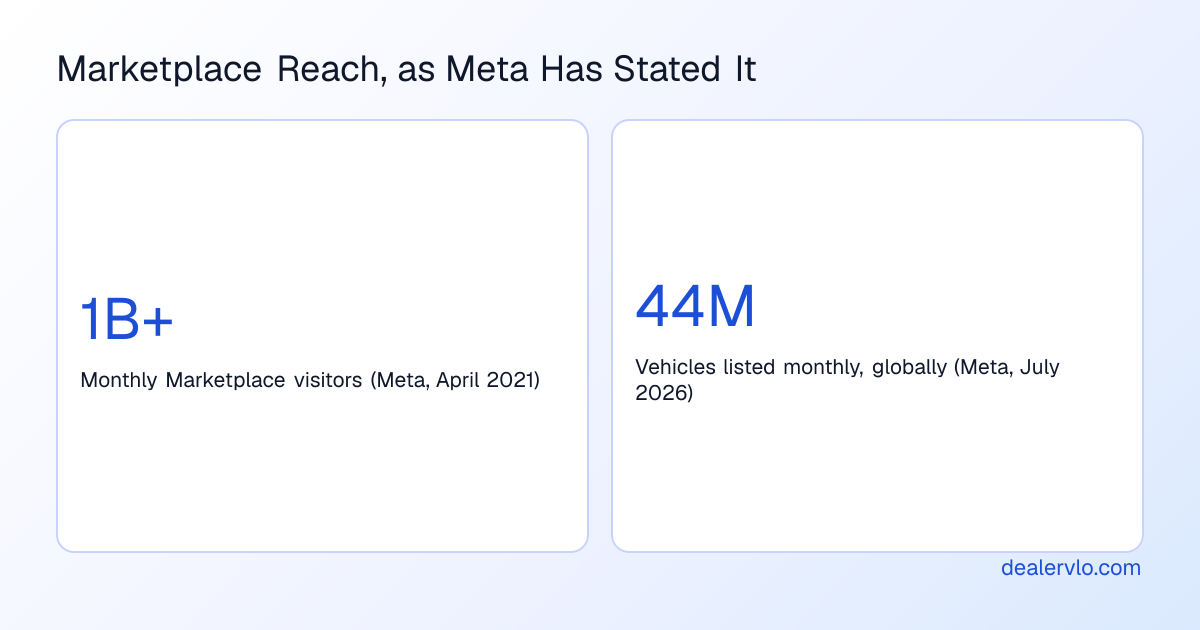
The most-quoted figure is real but old. On Facebook's first-quarter 2021 earnings call, Mark Zuckerberg said "more than 1 billion people visit Marketplace each month" (call transcript, April 28, 2021). That's global, and it's visitors, not buyers.
Meta hasn't given a newer Marketplace user count since. Its earnings reports now give daily users across all its apps combined, not Marketplace or even Facebook alone. So when a site says Marketplace has "1.2 billion users in 2026," ask where the number came from. I couldn't find Meta saying it.
The older US figure is from 2018, when Meta said more than one in three people on Facebook in the US use Marketplace every month. Useful as history, too old to quote as today's reach.
How many cars are on Facebook Marketplace?
This is the freshest number Meta has published, and the one most relevant to a dealer. In July 2026, Meta wrote that "every month, there are 430 million items and 44 million vehicles listed on Facebook Marketplace globally".
Two things to keep in mind about it. It's global, not US. And it counts listings, which include every private seller, every relist, and plenty of cars that never sell. What it does tell you is the scale of the competition: your car isn't the only one in that feed, which is why the listing itself (photos, price, an honest description) matters as much as getting it posted.
Meta has also said, going back to 2018, that "vehicles is one of the most popular categories for Marketplace globally". In November 2025 it said cars are among the top five searches for young adults on Marketplace, and that one out of four young-adult daily users of Facebook in the US and Canada comes to Marketplace. In the July 2026 post it put it another way: one in three young adults on Facebook in the US uses Marketplace daily. Those two young-adult figures measure different things, so quote each the way Meta worded it.
How many US car shoppers are on Facebook?
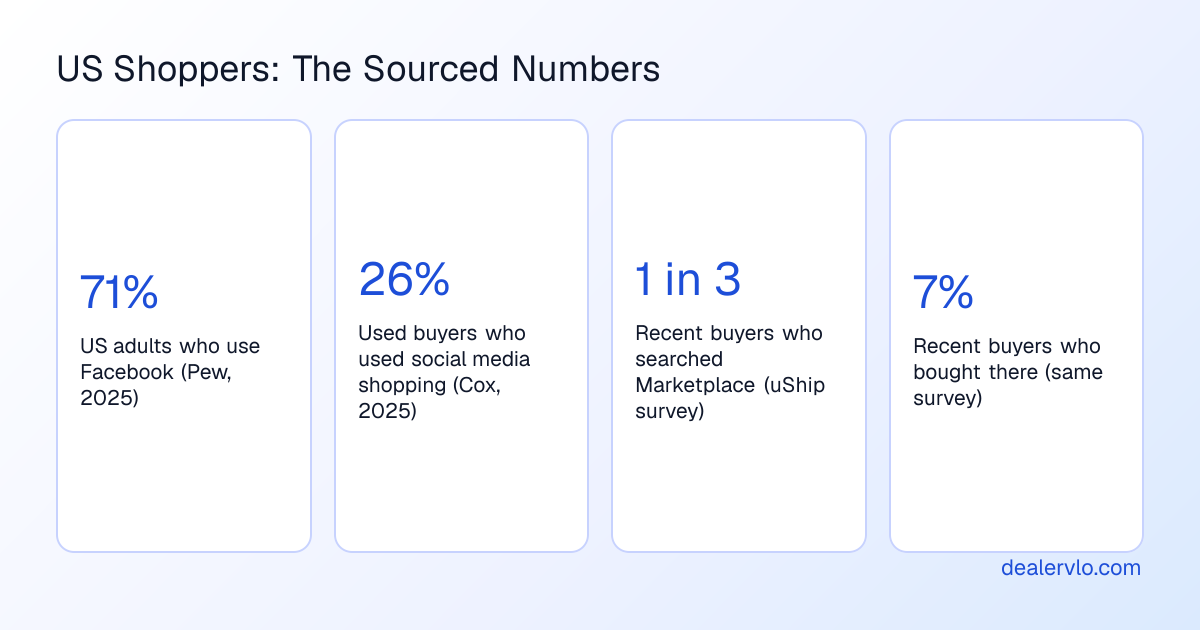
For the US, the best independent data isn't about Marketplace specifically, but it sets the size of the audience:
- Pew Research Center, 2025: "Most Americans (71%) also report using Facebook", and 37% of US adults say they visit it several times a day. That's a survey of 5,022 US adults, run February to June 2025. Whatever your local buyers do, most of them open Facebook.
- Cox Automotive's 2025 Car Buyer Journey: 26% of used-vehicle buyers used social media during their shopping (Cox Automotive, published January 2026). Cox doesn't break out Marketplace, so this is social media in general, not Marketplace listings.
- A uShip-commissioned survey, 2026: "1 in 3 buyers searched Facebook Marketplace, but only 7% bought there". uShip, a vehicle-shipping company, had UserTesting ask 426 recent US car buyers in April 2026. It's a small, vendor-paid sample, so don't treat 7% as a national share. But the shape of it rings true: plenty of shoppers look on Marketplace, far fewer buy there.
That last gap is the practical takeaway for a lot. Marketplace is very good at getting a car seen and much less reliable at closing it. The work in between, answering fast, having a clean listing, getting the shopper to the lot, is on you.
In DealerVLO, the posting part is the quick part. Every car has a Post to marketplace kit with all its photos in one download and each field Facebook asks for ready to copy. With the free DealerVLO Chrome extension on a computer, a Post to Facebook button opens Facebook's "Sell a vehicle" form with that car's photos and details filled in, and you answer condition and title and click Publish yourself.
What the FTC says about scams that start on Facebook
There's a reason some shoppers are wary of buying a car they found on Facebook. The FTC reported that people lost $2.1 billion to scams that started on social media in 2025, and that "people reported losing more money to scams that started on Facebook than on any other social media platform" (April 2026). The FTC's figures cover shopping and every other kind of scam, not cars specifically.
For a real dealer, that's an opening. A shopper who's heard about Marketplace scams is reassured by things a scammer can't fake: a real business address, a phone that a person answers, a dealer website with the same car at the same price, and paperwork done properly at the lot. If your Marketplace listing points to a website that's slow or doesn't show the car, you've lost the trust edge you had. Check a car page on your own site:
Paste one car page: see its mobile speed against Google's published lines, and whether shoppers can find and reach you.
Open the Dealer Website CheckIn DealerVLO, every car you stock is on your included dealer website automatically, at the same price the listing feeds use, and drops off the moment you mark it sold. A shopper who checks your site after messaging you on Marketplace finds the same car, the same price, and your address. Leads from the website's forms land in your lead inbox, and you can add Marketplace leads by hand with the source Facebook, so you can see which channel produced the buyers.
14-day free trial, then $29/mo · Cancel anytime
Marketplace stats with no source I could find
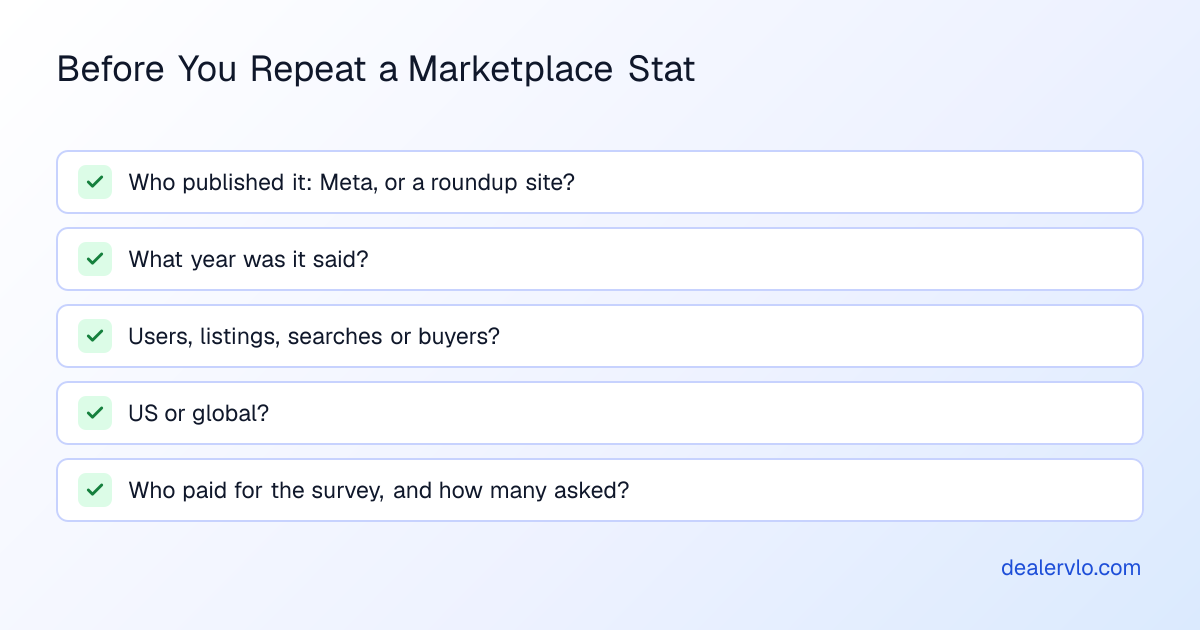
These show up again and again in posting-tool marketing and stats roundups. I couldn't trace any of them to Meta or to a published study with a method:
- "1.2 billion Marketplace users." Credited to a shopping-extension company on roundup sites, not to Meta.
- "800 million," "1.1 billion monthly shoppers," "1.23 billion." Same roundup sites, different numbers, no Meta source.
- "Marketplace is the starting point for 23% of used-car buyers." Appears on a vendor's blog with no survey method.
- "Over half of Marketplace car shoppers contact dealers after hours." No published source I could find.
- "7% of used-car buyers use Facebook to shop." This one came from a real survey, but it's undated and appears to be about a decade old.
- Daily listing caps like "10 a day." Not a number from Meta's policies; our auto-poster post covers where those come from.
If a vendor's pitch rests on one of these, ask them for the source. If they have one, great. If not, their sales deck is built on the same roundups.
What these numbers mean for a small lot
Put the sourced numbers together and the picture is simple. Most of your local buyers use Facebook. Vehicles are one of Marketplace's biggest categories, and 44 million listings a month means plenty of competition for attention. Lots of shoppers look on Marketplace, and a smaller share buy there.
So the question isn't whether buyers are on Marketplace; they are. It's whether your lot can turn Marketplace attention into sold cars at a reasonable cost in time. That depends on three things the stats can't tell you:
- How fast you answer. Marketplace makes messaging effortless, for you and for the next seller.
- How good the listing is. Real photos, an honest price, a description written for that car. Our guides on listing photos that sell and listing descriptions apply.
- Whether you measure sales. Count cars sold from Marketplace, not messages, and compare it to your other listing channels.
Where DealerVLO fits
DealerVLO doesn't add buyers to Marketplace, and it doesn't post there through a feed, because Meta ended free dealer feeds in 2021 and business-Page vehicle listings in January 2023. What it does:
- Makes each listing fast and accurate. The Post to marketplace kit on every car, and the Chrome extension that fills Facebook's vehicle form from the car's record, one car per click. You review it and click Publish. It never posts on its own or in bulk.
- Gives the shopper somewhere to check you out. Your included dealer website shows every car you stock, and the same cars go to CarGurus, Cars.com, Autotrader and Carfax.com through daily feeds once you enroll with each site.
- Shows which channel sells. A lead inbox with each lead's source, follow-up dates, and a Converted status, so Marketplace's sold cars sit next to your other channels'.
It's $29 a month, with no per-car or per-user fees.
Frequently asked questions
How many people use Facebook Marketplace? The last user number Meta gave was in April 2021, when Mark Zuckerberg said more than 1 billion people visit Marketplace each month. Meta hasn't updated that figure since; its later earnings reports give totals across all its apps instead. Treat any newer "Marketplace users" number you see without a Meta source as unverified.
How many cars are listed on Facebook Marketplace? Meta said in July 2026 that every month there are 44 million vehicles listed on Facebook Marketplace globally, out of 430 million items. That's a global figure and counts listings, not buyers or sales.
Do car buyers actually use Facebook Marketplace? Yes. Meta has called vehicles one of Marketplace's most popular categories since 2018, and in 2025 it said cars were among the top five searches for young adults on Marketplace. A 2026 survey of 426 recent US car buyers, commissioned by the vehicle-shipping company uShip, found one in three had searched Facebook Marketplace and 7% bought there. That survey is small and vendor-commissioned, so read it as a sign of reach, not a precise share.
How many Americans use Facebook? Pew Research Center found in 2025 that 71% of US adults say they use Facebook, and 37% of US adults say they visit it several times a day. Facebook is still the second most-used platform in Pew's survey, behind YouTube.
Is the "1.2 billion Marketplace users" figure real? Not from Meta. That number, along with figures like 800 million and 1.1 billion "monthly shoppers," circulates on statistics roundup sites without a Meta source. Meta's own last stated number is more than 1 billion monthly visitors, from April 2021.
Bottom line
The numbers you can actually source say Marketplace is big: more than a billion monthly visitors as of 2021, 44 million vehicles listed every month as of 2026, and a US audience where 71% of adults use Facebook. They also say looking and buying aren't the same thing. Most of the precise-sounding stats in posting-tool pitches don't trace back to Meta at all.
DealerVLO gets each car onto Marketplace in a couple of minutes, keeps the same car on your own website and the big listing sites, and tracks which leads buy, all for $29 a month. Start your 14-day free trial at /signup.
14-day free trial, then $29/mo · Cancel anytime