How to fill out the MVT 5-13 in Alabama
A field-by-field walkthrough of the Alabama MVT 5-13 (Power of Attorney) for licensed used car dealers — what goes in every section, who signs what, and the documents you attach. Verified against the official form as of October 2026.
Filing these every week? Upload the MVT 5-13 to DealerVLO once and it fills from every deal you enter, $29/month flat. See pricing
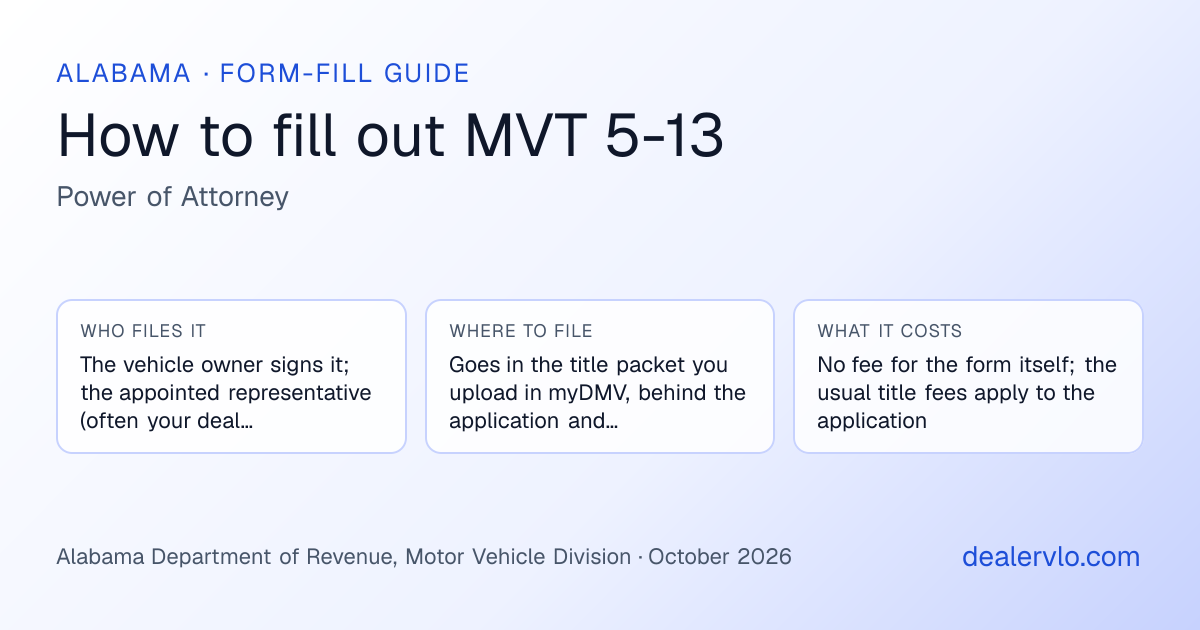
Filling out the AL MVT 5-13 after a sale:
- What it is
- ALDOR's general power of attorney for vehicle title, lien, and registration work
- Who completes it
- The vehicle owner signs it; the appointed representative (often your dealership) signs too
- Where to file it
- Goes in the title packet you upload in myDMV, behind the application and the title
- Processing time
- None of its own. It rides with the title application, due within 10 calendar days
- Cost
- No fee for the form itself; the usual title fees apply to the application
This guide is informational and does not replace the official Alabama instructions. Always confirm the current form and procedure with Alabama Department of Revenue, Motor Vehicle Division before you file.
The MVT 5-13 is one car's paperwork. A 20-second read on your lot, and the tax-and-fee math for the whole deal — built for dealers, no signup. Free calculators dealers actually use — no signup, no email.
Upload the fillable Alabama MVT 5-13 to DealerVLO once. It maps the fields, then fills the form from every deal — buyer, co-buyer, the vehicle you sold, and your dealership already in place. $29/month, free to try — cancel any time.
What the MVT 5-13 is and why it matters
The MVT 5-13 is the Alabama motor vehicle power of attorney form: the Alabama Department of Revenue's power of attorney for vehicle title, lien, and registration work. On a dealer deal it fixes one problem: someone who has to sign isn't there to sign. A co-owner is out of town, a business bought the car and an officer can't come in, or the buyer wants your title clerk to finish the title work for them. The owner fills in the vehicle and their own name, appoints a representative, checks what the representative may do, and signs. The representative signs too. ALDOR's form says it isn't valid without the appointee's signature.
The form is short, and most of the trouble comes from three habits: correcting a mistake with a strikeover (any alteration voids it), sending a copy or fax when an original is required, and using the MVT 5-13 when the deal actually needs the secure MVT 8-4 for the odometer. This guide walks the form in order and shows which one each situation calls for.
Alabama has two motor vehicle powers of attorney, and dealers mix them up. The MVT 5-13 is the general one: a vehicle owner appoints someone (often your dealership) to handle title, lien, or registration work for them. The MVT 8-4 Secure Power of Attorney is the odometer one. Alabama's rule 810-5-75-.63 requires it when the owner can't sign the odometer disclosure on the title because a lienholder is holding the title or the title has been lost, and the form itself says it may only be used in those cases. Federal odometer law requires that kind of power of attorney to come from a secure printing process, which a plain photocopy of a PDF isn't. Use the wrong one and the title packet comes back.
Documents to have before you start
Gather these before you complete the MVT 5-13. A missing attachment is the number-one reason the Alabama Department of Revenue, Motor Vehicle Division bounces a title application back.
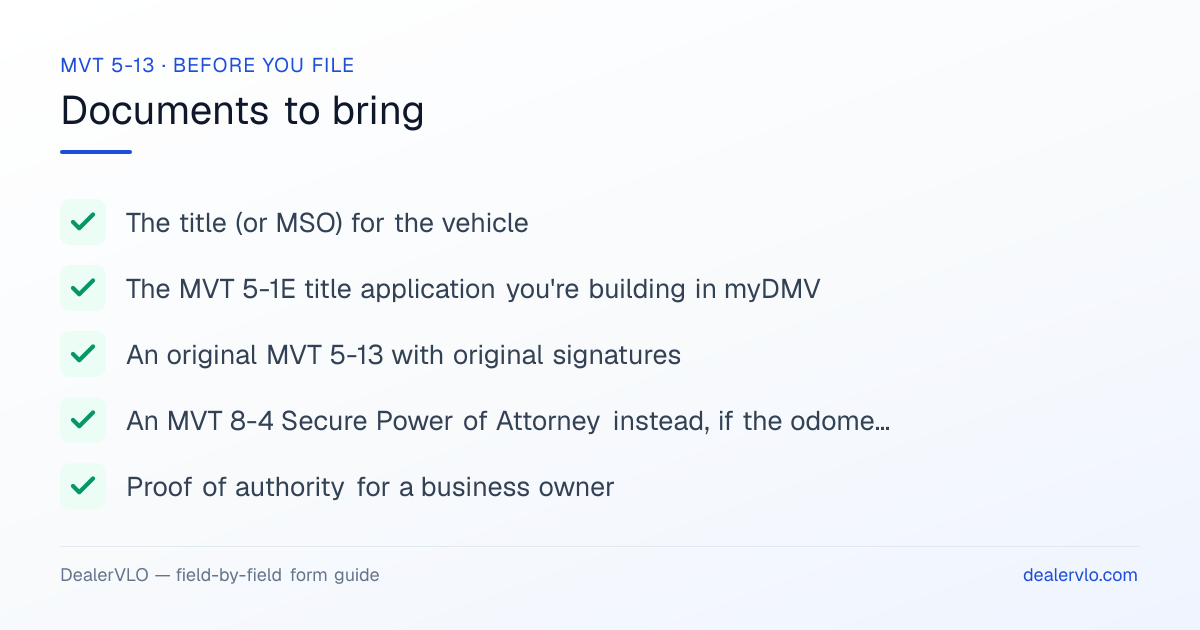
- The title (or MSO) for the vehicle — The VIN, year, and make on the power of attorney should match it exactly, and so should the owner's name.
- The MVT 5-1E title application you're building in myDMV — The power of attorney is a supporting document in that packet, uploaded after the application and the surrendered title. See the MVT 5-1E guide for the application itself.
- An original MVT 5-13 with original signatures — The form states that original signatures are required. At least one county title office (Shelby County) says a state MVT 5-13 must be the original form and signature, not a fax.
- An MVT 8-4 Secure Power of Attorney instead, if the odometer can't be disclosed on the title — Required by rule 810-5-75-.63 when a lienholder is holding the title or the title is lost. It must be a secure-printed form.
- Proof of authority for a business owner — If a company owns the vehicle or is appointed, the person signing must be an authorized representative of that company.
MVT 5-13, section by section
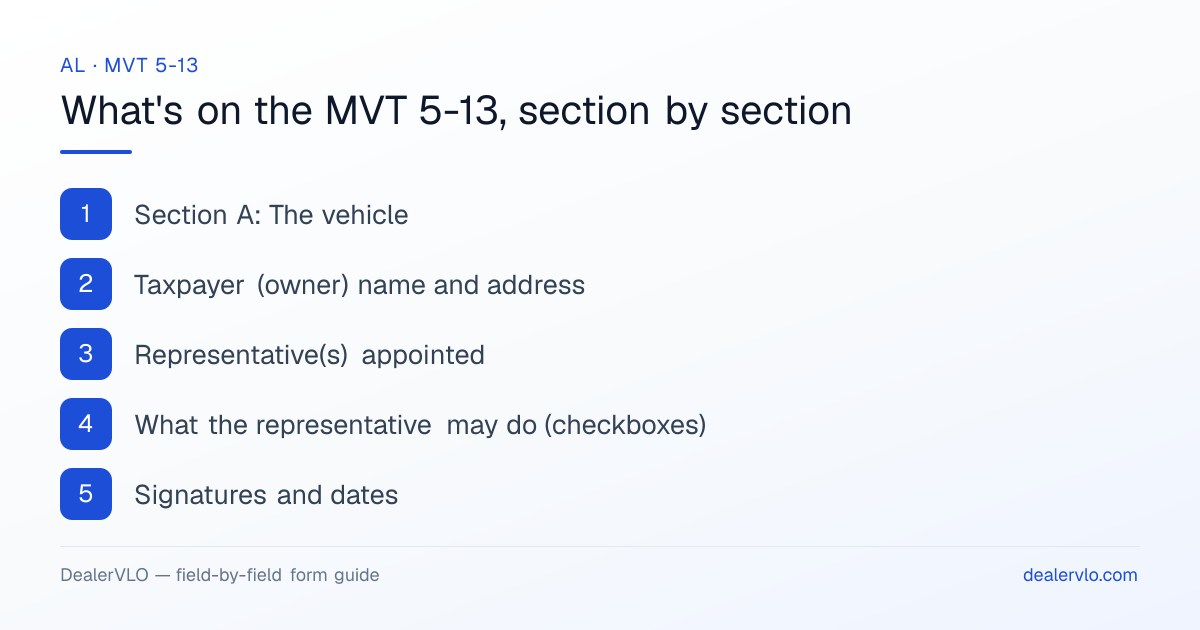
Section A: The vehicle
Section A ties the power of attorney to one vehicle: VIN, year, make, model, body type, and the license plate number and state if it's registered. Copy these from the title, not from memory or the window sticker. A power of attorney for the wrong VIN is a power of attorney for nothing. The form notes that Section A isn't required when the purpose is a title service provider appointment, which doesn't apply to a retail deal.
| Field | Who fills it |
|---|---|
VIN All 17 characters, copied from the title. | You (dealer) |
Year, make, model, body type Should agree with the title. | You (dealer) |
License plate number and state If the vehicle is currently registered. | You (dealer) |
Taxpayer (owner) name and address
This is the person or business granting the power: the vehicle's owner, whom the form calls the taxpayer. On a sale that's usually your buyer. On a trade-in where the customer can't sign, it's the customer as owner of the trade. Use the name exactly as it appears on the title, including middle initials and suffixes. ALDOR rejects title applications when owner names don't agree across the documents. Add the address, phone, and email.
| Field | Who fills it |
|---|---|
Taxpayer name(s) The vehicle owner, exactly as on the title. | Buyer |
Address, phone, email | Buyer |
Representative(s) appointed
Here the owner names who may act for them. When your dealership is the appointee, use the dealership's legal business name and address, not a salesperson's personal name. When the form appoints a business, the person who signs for it later must be an authorized representative of that business. If a co-owner is appointing the other co-owner, name that person.
| Field | Who fills it |
|---|---|
Representative name Your dealership's legal name, or the person being appointed. | You (dealer) |
Representative address, phone, email | You (dealer) |
What the representative may do (checkboxes)
The owner checks the transactions the representative may handle. For a dealer deal, "Title application, transfer or lien filing" is the box that matters. Add "Register and purchase license plate(s)" only if your store will also handle registration for the buyer. IFTA is fuel-tax reporting for commercial carriers, and the title service provider box is for TSP businesses, so neither applies to a retail sale. Use "Other" only with a clear written description. The blank for additions or restrictions lets the owner narrow the power, for example to this one sale.
| Field | Who fills it |
|---|---|
Title application, transfer or lien filing The box a dealer deal needs. | Buyer |
Register and purchase license plate(s) Only if you'll handle registration too. | Buyer |
IFTA / Title service provider / Other Not used on a normal retail sale. | Buyer |
Specific additions or restrictions Optional. Limiting it to this transaction is common. | Buyer |
Signatures and dates
The owner signs and dates as taxpayer. The appointee signs and dates as well; the form says it is not valid without the appointee's signature. If the appointee is a business, its authorized representative signs. Sign in ink on the original. The form warns that any alteration or strikeover voids it, so if someone writes the wrong VIN or date, start a clean form instead of correcting it. ALDOR's form doesn't print a notary block, but some county offices ask for a notarized power of attorney in certain situations. If you're unsure, notarizing costs little and removes the question.
| Field | Who fills it |
|---|---|
Taxpayer signature and date Original signature. No strikeovers anywhere on the form. | Buyer |
Appointee signature and date Required. The form isn't valid without it. | You (dealer) |
When to use the MVT 8-4 Secure Power of Attorney instead
Odometer disclosure is where the MVT 5-13 stops. Under Alabama rule 810-5-75-.63, the MVT 8-4 Secure Power of Attorney must be used for the odometer certification when the title is held by a recorded lienholder or the original title is lost. That's the classic trade-in with a loan payoff. The customer signs the MVT 8-4 at your desk, disclosing the mileage, so you can complete the assignment when the lender releases the title. The odometer reading in the title assignment must match the reading on the secure power of attorney exactly. Federal odometer rules require this power of attorney to come from a secure printing process, so use ALDOR-approved secure stock rather than a photocopy. Odometer disclosure applies to model year 2011 and newer vehicles until they're 20 years old. As of 2026, model year 2010 and older vehicles are exempt.
| Field | Who fills it |
|---|---|
Title held by a lienholder (trade-in with a payoff) Use the MVT 8-4, not the MVT 5-13, for the odometer disclosure. | Buyer |
Title lost (replacement title needed) Use the MVT 8-4. | Buyer |
Odometer reading Must match the title assignment exactly. | Buyer |
Keep a copy for 5 years Federal rule for dealers on odometer powers of attorney. | You (dealer) |
Common MVT 5-13 mistakes that cause rejections
The form says any alteration or strikeover voids it. If the VIN, name, or date is wrong, void that copy and fill out a clean one. Don't use white-out or write over it.
Original signatures are required on the MVT 5-13. Get the owner's original signature on paper before you build the packet, and keep the original with the deal jacket.
The form isn't valid without the appointee's signature. When your dealership is appointed, an authorized person at the store signs and dates it before it goes in the packet.
When the trade's title is with the lienholder or lost, rule 810-5-75-.63 calls for the secure MVT 8-4, and the odometer reading on it must match the title assignment exactly. The general MVT 5-13 doesn't do that job.
ALDOR rejects title applications when names disagree across the documents. Copy the owner's name from the title exactly, suffix included, onto the power of attorney and the application.
Common questions
Where do I get the Alabama motor vehicle power of attorney form?+
From the Alabama Department of Revenue. The MVT 5-13 Power of Attorney is posted as a fillable PDF on ALDOR's power of attorney forms page, linked at the top of this guide. The MVT 8-4 Secure Power of Attorney, used for odometer disclosure when a lienholder holds the title or it's lost, must be a secure-printed form.
What is the Alabama MVT 5-13 form?+
The MVT 5-13 is the Alabama Department of Revenue's Power of Attorney for motor vehicle transactions. A vehicle owner uses it to appoint a representative, such as a dealership, to handle title applications, transfers, lien filings, or license plate registration for one vehicle. Both the owner and the appointee sign it, and it goes in the title packet uploaded through myDMV.
Does an Alabama vehicle power of attorney need to be notarized?+
ALDOR's MVT 5-13 doesn't print a notary block. The form's own requirements are original signatures, the appointee's signature, and no alterations or strikeovers. Some county offices do ask for a notarized power of attorney in certain cases, such as a co-owner who can't be present to sign. If you're not sure what your office will accept, notarizing is cheap insurance.
What's the difference between the MVT 5-13 and the MVT 8-4?+
The MVT 5-13 is the general power of attorney for title, lien, and registration work. The MVT 8-4 is the Secure Power of Attorney for odometer disclosure. Alabama rule 810-5-75-.63 requires it when the title is held by a lienholder or has been lost, and it has to be a secure-printed form. A trade-in with a loan payoff is the usual dealer case for the MVT 8-4.
Can a dealer sign the title application for the buyer in Alabama?+
Only with authority. If the owner appoints your dealership on an MVT 5-13 and checks the title application, transfer or lien filing purpose, your authorized representative can act as attorney-in-fact on that transaction. Without a valid power of attorney, the owner or owners sign. Both owners sign if the names are joined by AND.
Can I use a faxed or emailed MVT 5-13?+
Don't count on it. The MVT 5-13 states that original signatures are required, and at least one county title office (Shelby County) says the state MVT 5-13 must be the original form and signature. Get the original signed and keep it in the deal jacket.
Which vehicles need an odometer disclosure on a power of attorney?+
Under the federal odometer rule, model year 2011 and newer vehicles need an odometer disclosure until they are 20 model years old. As of 2026, model year 2010 and older vehicles are exempt. When disclosure is required and the title is with a lienholder or lost, use the secure MVT 8-4.
Is there software that fills out the MVT 5-13 automatically?+
Yes. The Alabama MVT 5-13 is a fillable PDF, so dealer management software like DealerVLO can fill it for you: upload the blank form once, DealerVLO detects its fields and suggests a mapping you confirm, and from then on it fills from every deal you enter — the buyer, co-buyer, the vehicle you sold, and your dealership's details already in place. It's $29/month flat with a 14-day free trial, and the same deal also generates your federal documents (Bill of Sale, FTC Buyers Guide, odometer disclosure) and your state title paperwork.
Stop filling out the MVT 5-13 by hand.
Upload the fillable AL MVT 5-13 once. DealerVLO detects its fields, you confirm the mapping, and every deal after that prints it with the buyer, co-buyer, vehicle, and your dealership already in place. $29/month. 14-day free trial, cancel any time.
Curious how it works? See how DealerVLO auto-fills every dealer document — bill of sale, FTC Buyers Guide, odometer disclosure, and state title & registration forms for all 50 states, from one deal.
Bond amounts, fees, and form rules change. Get a short email when your state does. No spam, unsubscribe anytime.