How to fill out the MVR-3 in North Carolina
A field-by-field walkthrough of the North Carolina MVR-3 (Certification of Repossession) for licensed used car dealers — what goes in every section, who signs what, and the documents you attach. Verified against the official form as of October 2026.
Don't waste another second filling out the North Carolina MVR-3.
Let DealerVLO fill out every form for you instantly.
Filing these every week? DealerVLO fills the MVR-3 from the deal you already entered, $29/month flat. See pricing
Switching from another DMS? Compare DealerVLO to DealerCenter, Frazer, or Lot Wizard.
Filling out the NC MVR-3 after a sale:
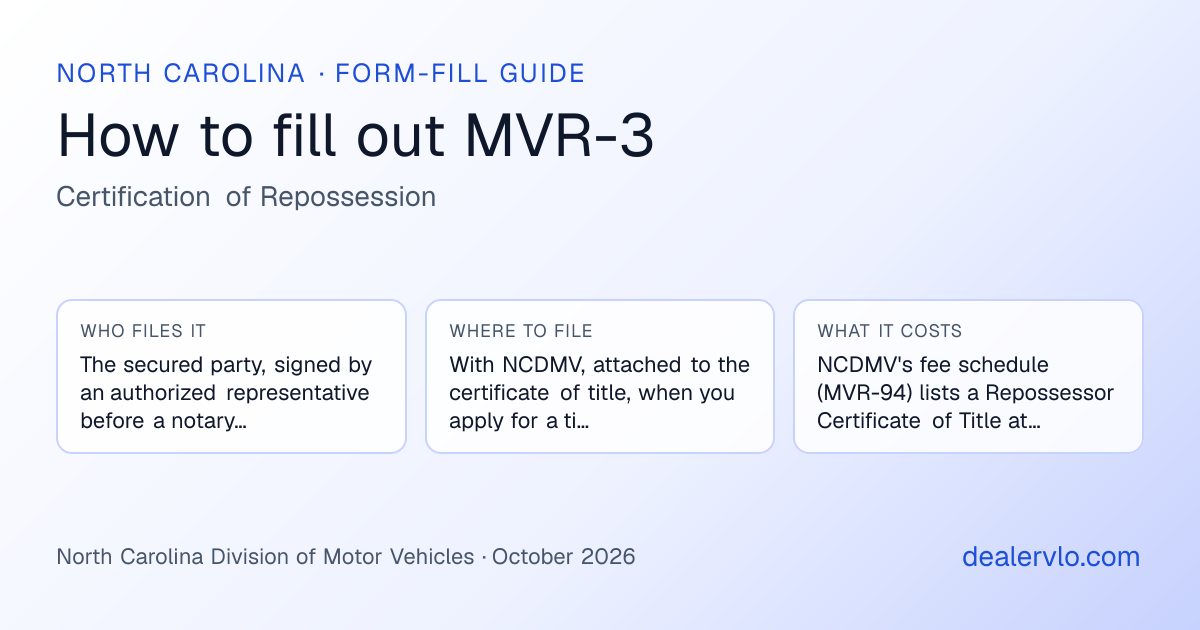
- What it is
- NCDMV's Certification of Repossession: the secured party's notarized statement that it repossessed the vehicle on the lien shown on the title
- Who completes it
- The secured party, signed by an authorized representative before a notary. On a BHPH note, that's your dealership
- Where to file it
- With NCDMV, attached to the certificate of title, when you apply for a title after the repossession
- Processing time
- None of its own. It travels with the title application
- Cost
- NCDMV's fee schedule (MVR-94) lists a Repossessor Certificate of Title at $25.50
This guide is informational and does not replace the official North Carolina instructions. Always confirm the current form and procedure with the North Carolina Division of Motor Vehicles before you file.
The MVR-3 is one car's paperwork. A 20-second read on your lot, and the tax-and-fee math for the whole deal — built for dealers, no signup. Free calculators dealers actually use — no signup, no email.
DealerVLO fills the official North Carolina MVR-3 straight from your deal: the defaulting owner (buyer and co-buyer) with the buyer's street, city, state, ZIP and county; the date of lien (the sale date); your dealership as secured party with its address, in the top block and over the BY line; and the year, make, body style, series/model and VIN. It prints from the servicing section of a BHPH deal where your dealership carries the note, for when you've taken a car back, not on every deal. The date of repossession, State Issued, title number, current odometer reading, the BY signature, the date/county/state line and the notary block stay blank. $29/month, free to try — cancel any time.
What the MVR-3 is and why it matters
MVR-3 is NCDMV's Certification of Repossession. The secured party signs it to certify that it repossessed the vehicle "because of the failure of the former owner to meet his obligation" on the lien shown on the attached title. If you sold the car on a buy-here-pay-here note and took it back, your dealership is the secured party.
This guide covers the paperwork once the car is back: each box on the form, who signs, the notary block, and what goes with it. It doesn't cover when or how you may repossess. NCDMV's forms page says to contact NCDMV for information on when or how to use its forms, so call them with anything the form doesn't answer.
The PDF is titled "Certification of Repossession" and NCDMV's forms page lists it as "Certificate of Repossession (MVR-3)." Same form. When people search for an "NC repossession affidavit," this is it. The current revision is MVR-3 (Rev. 1/06). It's one page: the defaulting owner, the security interest, the vehicle, the secured party's signature, and a notary block.
Documents to have before you start
Gather these before you complete the MVR-3. A missing attachment is the number-one reason the the North Carolina Division of Motor Vehicles bounces a title application back.
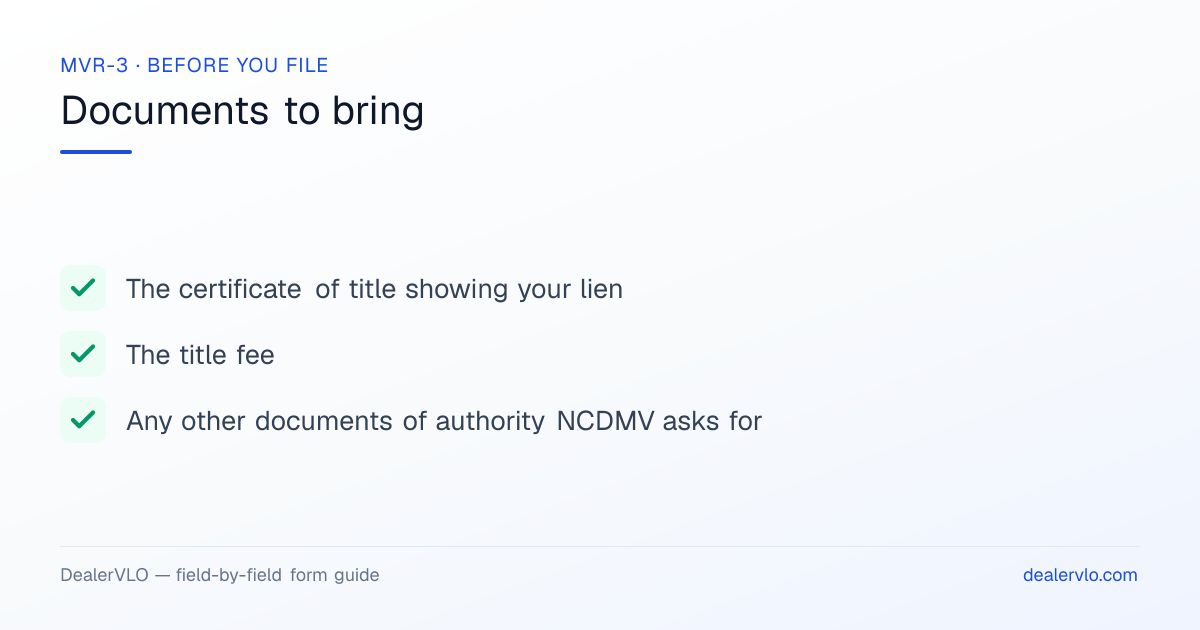
- The certificate of title showing your lien — The certification refers to "the lien described on the face of the attached certificate of title." G.S. 20-77(a), printed on the form, calls for the last certificate of title, if available.
- The title fee — NCDMV's fee schedule (MVR-94, Rev. 9/26) lists a Repossessor Certificate of Title at $25.50.
- Any other documents of authority NCDMV asks for — G.S. 20-77(a), quoted on the form, also calls for "such instruments or documents of authority" as may be required by law to evidence the transfer. Ask NCDMV if you're unsure what applies.
MVR-3, section by section
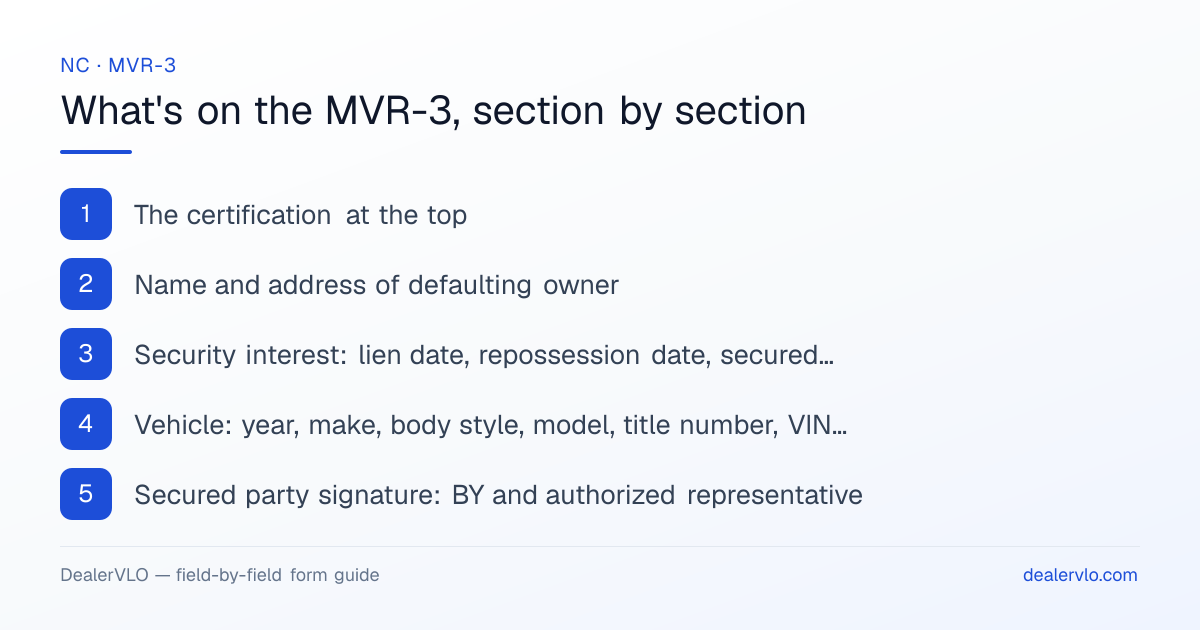
The certification at the top
Read the paragraph before you fill anything in. By signing, the secured party certifies three things: that it repossessed the vehicle because the former owner didn't meet the obligation on the lien shown on the attached title; that "No suit is now pending in court concerning this repossession"; and it warrants title "to be free from all indebtedness" and agrees to defend it against all claims. There's nothing to fill in here. It's what your signature at the bottom attests to.
| Field | Who fills it |
|---|---|
Certification and warranty of title (printed) Nothing to fill; your signature below covers it. | You (dealer) |
Name and address of defaulting owner
The defaulting owner is the person you repossessed from: your BHPH buyer, plus the co-buyer if there was one. Use the names as they appear on the title. The address row takes the street address (number and street, or RFD and box number), city, state, ZIP code, and county.
| Field | Who fills it |
|---|---|
Name of Defaulting Owner Buyer and co-buyer, as on the title. | You (dealer) |
Street address, City, State, ZIP Code, County | You (dealer) |
Security interest: lien date, repossession date, secured party
This block describes your lien. The date of lien is the date of the lien shown on the title. The date of repossession is the day the vehicle came back. "State Issued" is the state that issued the title carrying the lien. Then the secured party's name and address. On a BHPH note, that's your dealership's legal name, as it appears as lienholder on the title.
| Field | Who fills it |
|---|---|
Date of Lien | You (dealer) |
Date of Repossession | You (dealer) |
State Issued The state on the title that carries your lien. | You (dealer) |
Name of Secured Party, Address of Secured Party Your dealership, as on the title. | You (dealer) |
Vehicle: year, make, body style, model, title number, VIN, odometer
Copy the vehicle description from the title: year, make, body style, series/model, title number, and the full VIN. The last box is the current odometer reading. Read it off the car once it's back on your lot, not from the sale paperwork.
| Field | Who fills it |
|---|---|
Year, Make, Body Style, Series Model | You (dealer) |
Title Number From the title you're attaching. | You (dealer) |
Vehicle Identification Number All 17 characters. | You (dealer) |
Current Odometer Reading Read it off the vehicle. | You (dealer) |
Secured party signature: BY and authorized representative
Below the G.S. 20-77(a) text, the form prints the name of the secured party and a "BY:" line for the authorized representative. Put your dealership's name on the secured-party line. Whoever is authorized to sign for the dealership signs on the BY line. Then the date, county, and state where it's signed.
| Field | Who fills it |
|---|---|
Name of Secured Party | You (dealer) |
BY: Authorized Representative Sign in front of the notary. | You (dealer) |
Date, County, State | You (dealer) |
The notary block
The notary certifies that the signer "personally appeared before me this day" and acknowledged signing voluntarily, for the purpose stated, in the capacity indicated. The notary enters the name of the person who appeared, signs, prints their name, adds the commission expiration date, and applies the seal. Bring the form unsigned and sign in front of the notary.
| Field | Who fills it |
|---|---|
Name(s) of principal(s) The notary completes this block. | You (dealer) |
Notary Signature, Printed or typed name, Commission expires, Seal The notary completes this block. | You (dealer) |
Common MVR-3 mistakes that cause rejections
The notary certifies the signer personally appeared and acknowledged signing. Sign in front of the notary.
The box asks for the current reading. Read it off the vehicle after it's back.
The certification refers to the lien on the attached certificate of title. Attach the title.
Use your dealership's legal name exactly as it's recorded as lienholder on the title.
If two people are on the title, list both as the defaulting owner.
Common questions
What is the North Carolina repossession form?+
It's NCDMV Form MVR-3, Certification of Repossession. NCDMV's forms page lists it as "Certificate of Repossession (MVR-3)." The secured party certifies it repossessed the vehicle on the lien shown on the attached title. The current revision is Rev. 1/06.
Does the MVR-3 have to be notarized?+
Yes. The form has a notary block where the notary certifies the signer personally appeared and acknowledged signing it voluntarily.
What does the MVR-3 certify?+
That the secured party repossessed the vehicle because the former owner didn't meet the obligation on the lien shown on the attached title, and that no suit is pending in court about the repossession. The secured party also warrants the title to be free from all indebtedness and agrees to defend it against all claims.
How much is a repossessor title in North Carolina?+
NCDMV's fee schedule (MVR-94, Rev. 9/26) lists a Repossessor Certificate of Title at $25.50.
What goes with the MVR-3?+
The certificate of title showing your lien. G.S. 20-77(a), printed on the form, says the new owner applies for a new title with the fees, the last certificate of title if available, and any documents of authority required by law to evidence the transfer.
Who signs the MVR-3 for a dealership?+
An authorized representative of the secured party, on the BY line under the secured party's name, in front of a notary.
Is there software that fills out the MVR-3 automatically?+
Yes. Dealer management software like DealerVLO fills the official North Carolina MVR-3 from the deal you already entered: the defaulting owner (buyer and co-buyer) with the buyer's street, city, state, ZIP and county; the date of lien (the sale date); your dealership as secured party with its address, in the top block and over the BY line; and the year, make, body style, series/model and VIN. It prints from the servicing section of a BHPH deal where your dealership carries the note, for when you've taken a car back, not on every deal. The date of repossession, State Issued, title number, current odometer reading, the BY signature, the date/county/state line and the notary block stay blank. Signatures stay blank for ink. It's $29/month flat with a 14-day free trial, and the same deal also generates your federal documents (Bill of Sale, FTC Buyers Guide) and your state title paperwork.
- Affidavit of repossession forms by state
- Vehicle lien release form by state
- How to fill out NC Form MVR-1
- North Carolina used car dealer license
- North Carolina dealer plates
- E-signatures and e-titling for North Carolina dealers
- North Carolina lienholder affidavit (MVR-46D)
- North Carolina odometer disclosure (MVR-180)
- North Carolina damage disclosure (MVR-181)
- Title application forms in every state
- How much is a dealer's license? Cost in every state
Stop filling out the MVR-3 by hand.
DealerVLO fills the official NC MVR-3 straight from your deal jacket: the defaulting owner (buyer and co-buyer) with the buyer's street, city, state, ZIP and county; the date of lien (the sale date); your dealership as secured party with its address, in the top block and over the BY line; and the year, make, body style, series/model and VIN. It prints from the servicing section of a BHPH deal where your dealership carries the note, for when you've taken a car back, not on every deal. The date of repossession, State Issued, title number, current odometer reading, the BY signature, the date/county/state line and the notary block stay blank. $29/month. 14-day free trial, cancel any time.
Curious how it works? See how DealerVLO auto-fills every dealer document — bill of sale, FTC Buyers Guide, odometer disclosure, and state title & registration forms for all 50 states, from one deal.
Bond amounts, fees, and form rules change. Get a short email when your state does. No spam, unsubscribe anytime.