How to fill out the MVR-181 in North Carolina
A field-by-field walkthrough of the North Carolina MVR-181 (Damage Disclosure Statement) for licensed used car dealers — what goes in every section, who signs what, and the documents you attach. Verified against the official form as of October 2026.
Filing these every week? Upload the MVR-181 to DealerVLO once and it fills from every deal you enter, $29/month flat. See pricing
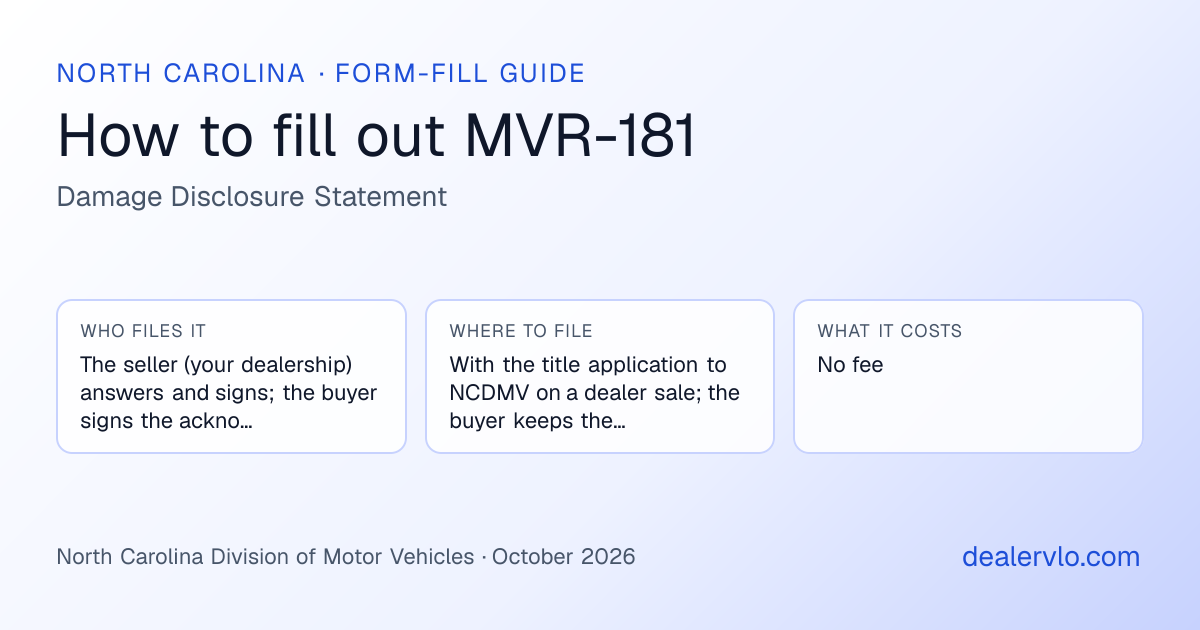
Filling out the NC MVR-181 after a sale:
- What it is
- North Carolina's written damage, salvage, flood, and reconstructed disclosure (G.S. 20-71.4)
- Who completes it
- The seller (your dealership) answers and signs; the buyer signs the acknowledgment
- Where to file it
- With the title application to NCDMV on a dealer sale; the buyer keeps the information, and dealers keep a copy for 4 years
- Processing time
- None of its own. It goes with the title paperwork
- Cost
- No fee
This guide is informational and does not replace the official North Carolina instructions. Always confirm the current form and procedure with the North Carolina Division of Motor Vehicles before you file.
The MVR-181 is one car's paperwork. A 20-second read on your lot, and the tax-and-fee math for the whole deal — built for dealers, no signup. Free calculators dealers actually use — no signup, no email.
Upload the fillable North Carolina MVR-181 to DealerVLO once. It maps the fields, then fills the form from every deal — buyer, co-buyer, the vehicle you sold, and your dealership already in place. $29/month, free to try — cancel any time.
What the MVR-181 is and why it matters
MVR-181 is North Carolina's Damage Disclosure Statement. G.S. 20-71.4 makes it unlawful to transfer a vehicle without disclosing in writing, before the transfer, that it was damaged past 25% of its fair market retail value (for vehicles five model years old or newer), or that it is or was a flood, reconstructed, or salvage vehicle (any age). A violation is a Class 2 misdemeanor, and a buyer can sue under G.S. 20-348 for the greater of three times actual damages or $1,500, plus attorney fees, when the seller acted with intent to defraud.
The form itself is five Yes/No questions, a seller's declaration, and the buyer's acknowledgment. The work is in answering the questions right, especially the 25% test and the model-year count. This guide walks every box and the record-keeping rule that catches dealers on audits.
The current revision is MVR-181 (Rev. 04/2026). NCDMV lists it among the documents for a title application on a vehicle purchased from a dealer, alongside the title, bill of sale, MVR-1, and MVR-180. The PDF is fillable, so you can upload it to DealerVLO once under Settings → Forms: the year, make, body style, VIN, and your dealership's address fill from every deal. Two quirks in the state's PDF: the Question 1 parts line and the Question 4 parts line are the same field, so typing in one fills both; and each Yes/No pair is two separate checkboxes, so nothing stops both from being checked. Leave the parts lines and the Yes/No answers to fill by hand. They're your sworn statement about this car.
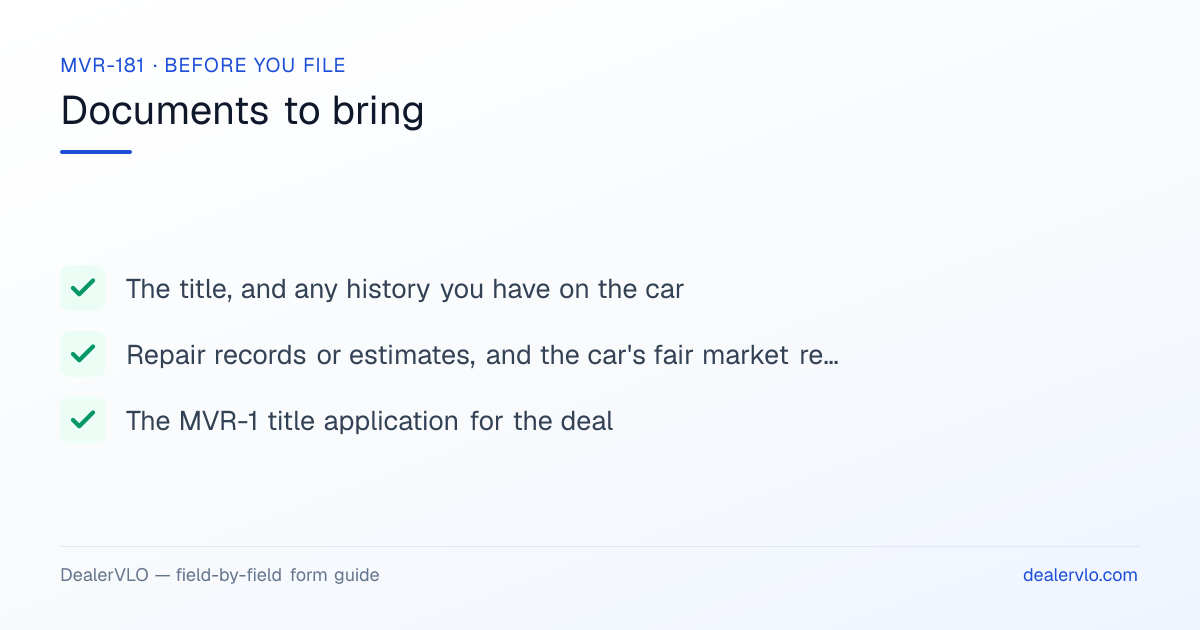
Documents to have before you start
Gather these before you complete the MVR-181. A missing attachment is the number-one reason the the North Carolina Division of Motor Vehicles bounces a title application back.
- The title, and any history you have on the car — The salvage, flood, and reconstructed questions apply at any age, and North Carolina carries brands from other states. Run a title-history report before you answer.
- Repair records or estimates, and the car's fair market retail value — Question 1 compares repair cost (excluding airbag replacement) to 25% of fair market retail value at the time of the damage.
- The MVR-1 title application for the deal — NCDMV lists MVR-181 with the documents for a vehicle purchased from a dealer. See the MVR-1 guide.
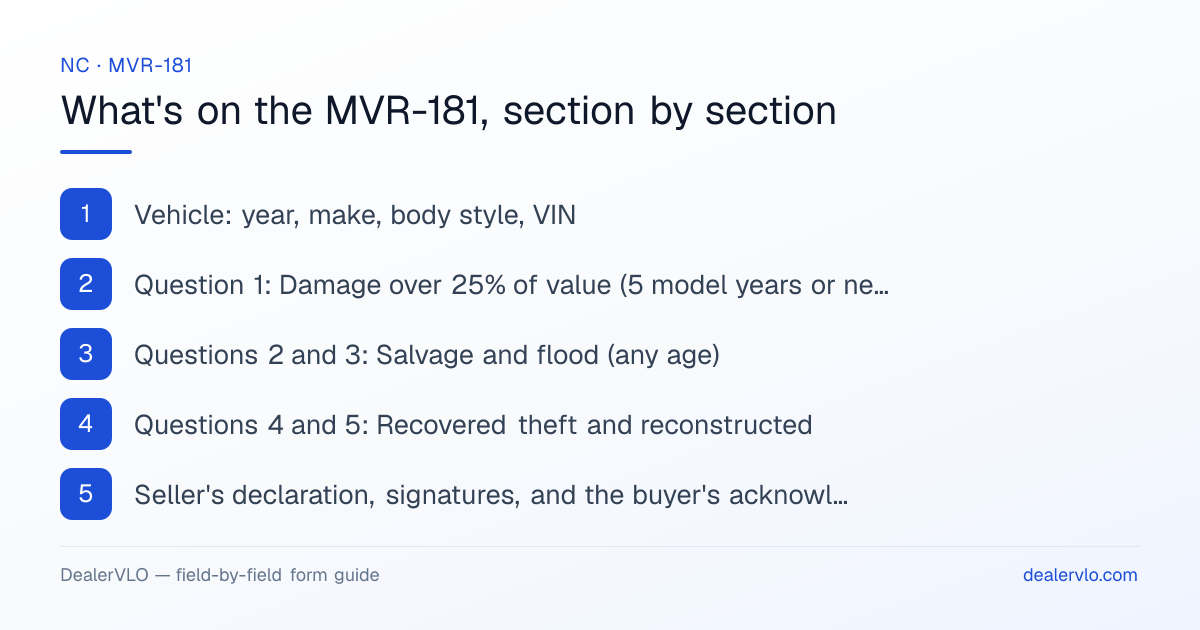
MVR-181, section by section
Vehicle: year, make, body style, VIN
The top of the form identifies the vehicle: year, make, body style, and the 17-character VIN. Copy them from the title so they match the MVR-1. The form prints "Alterations or erasures void this form," so if anything goes in wrong, start a clean one.
| Field | Who fills it |
|---|---|
Year, make, body style | You (dealer) |
Vehicle identification number All 17 characters, matching the title application. | You (dealer) |
Question 1: Damage over 25% of value (5 model years or newer)
Question 1 asks whether the vehicle was damaged by collision or other occurrence to the extent that the damage exceeded 25% of its fair market retail value. Under G.S. 20-71.4(a)(1) the test is the cost of repairs, excluding the cost of replacing airbags, against 25% of the vehicle's fair market retail value at the time of the damage. It covers vehicles up to and including five model years old, counting the model year as year one and the current calendar year as the last. In 2026 that works out to model years 2022 through 2026. If Yes, list the damaged parts on the lines below the question. The disclosure has to be in writing before the transfer. NC's dealer rules make failing to disclose damage a violation with fines of $250, then $500, then $1,000 within three years.
| Field | Who fills it |
|---|---|
Question 1: Yes / No Repair cost (minus airbags) over 25% of fair market retail value. | You (dealer) |
If yes, parts that were damaged (2 lines) Fill by hand. In the state PDF this field also prints on the Question 4 line. | You (dealer) |
Questions 2 and 3: Salvage and flood (any age)
Question 2 asks whether the vehicle was a salvage motor vehicle; if Yes, write which state titled it. Question 3 asks whether it's a flood vehicle. Both apply to every model year. Under G.S. 20-4.01(33), a salvage motor vehicle is one damaged to the extent that repair would cost more than 75% of its fair market retail value, whether or not an insurer declared a total loss. The form's own definition adds a vehicle on which an insurer paid a claim over 75% of fair market retail value. A flood vehicle has been submerged or partially submerged to the extent that the body, engine, transmission, or differential was damaged.
| Field | Who fills it |
|---|---|
Question 2: Salvage, Yes / No | You (dealer) |
If yes, which state titled it | You (dealer) |
Question 3: Flood vehicle, Yes / No | You (dealer) |
Questions 4 and 5: Recovered theft and reconstructed
Question 4 asks whether the vehicle is a recovered theft vehicle (the form limits this one to five model years), with a parts line for what was damaged. Question 5 asks whether it has been reconstructed, which applies at any age. A reconstructed vehicle under G.S. 20-4.01(33) is one altered from its original construction by adding, removing, or substituting major parts. Answer every question Yes or No; don't leave a pair blank.
| Field | Who fills it |
|---|---|
Question 4: Recovered theft, Yes / No | You (dealer) |
If yes, parts that were damaged Shares a field with the Question 1 parts line in the state PDF. | You (dealer) |
Question 5: Reconstructed, Yes / No | You (dealer) |
Seller's declaration, signatures, and the buyer's acknowledgment
The seller signs and dates the declaration and gives the seller's address (street, suite, city, state, ZIP). On a retail sale that's your dealership. The buyer signs the Buyer's Acknowledgement, and the form tells them to "RETAIN THIS INFORMATION." G.S. 20-71.4 requires the disclosure before the transfer, so get both signatures before the contract. Tampering with the doorjamb marker on a branded vehicle is a separate Class I felony.
| Field | Who fills it |
|---|---|
Seller's signature and date | You (dealer) |
Seller's address Street, apartment or suite, city, state, ZIP. | You (dealer) |
Buyer's acknowledgement and signature | Buyer |
Where it goes, and the 4-year copy rule
On a dealer sale, the MVR-181 goes with the title paperwork; NCDMV lists it among the documents for a vehicle purchased from a dealer. Keep a copy: North Carolina's dealer rule 19A NCAC 03D .0219 requires dealers to keep a copy of every damage disclosure they receive or give for four years, and electronic copies are allowed. That includes the MVR-181 a customer gives you on a trade-in.
| Field | Who fills it |
|---|---|
Original with the title paperwork to NCDMV | You (dealer) |
Dealer copy, kept 4 years Including disclosures you receive on trades. | You (dealer) |
Before a salvage car is retitled: the anti-theft inspection
North Carolina brands titles Salvage Motor Vehicle, Salvage Rebuilt Vehicle, Reconstructed Vehicle, Flood Vehicle, or Non-U.S.A. Vehicle, and notes TOTAL LOSS CLAIM where an insurer paid one (G.S. 20-71.3). A collision-damaged vehicle six model years old or newer that's going to be retitled needs preliminary and final anti-theft inspections. Those are now done by the State Highway Patrol's Investigative Services Unit, formerly the DMV License & Theft Bureau. The statute says the inspections are anti-theft measures and don't certify the vehicle's safety or road-worthiness.
| Field | Who fills it |
|---|---|
Initial and final anti-theft inspections (6 model years or newer) State Highway Patrol Investigative Services Unit. | At the counter |
Rebuilder's affidavit: parts, labor, repair cost | You (dealer) |
Branded title (Salvage Rebuilt, Reconstructed, etc.) | At the counter |
Common MVR-181 mistakes that cause rejections
Only Questions 1 and 4 are limited to five model years. Salvage, flood, and reconstructed apply at any age, and the form must be answered fully.
G.S. 20-71.4(a)(1) excludes the cost of replacing airbags from the 25% damage test.
In the state's PDF that field also prints on the Question 4 line. Write the parts by hand, or you'll show damaged parts under recovered theft.
The form says alterations or erasures void it. Start a clean MVR-181.
Dealers keep every damage disclosure they give or receive for four years (19A NCAC 03D .0219). A scanned copy in the deal file counts.
Common questions
What is the NC MVR-181 form?+
MVR-181 is the North Carolina DMV's Damage Disclosure Statement. The seller answers five Yes/No questions: damage over 25% of fair market retail value (five model years or newer), salvage (and which state titled it), flood, recovered theft, and reconstructed. The seller signs a declaration, and the buyer signs an acknowledgment. The current revision is MVR-181 (Rev. 04/2026).
When is a damage disclosure required in North Carolina?+
Under G.S. 20-71.4, before transferring a vehicle the seller must disclose in writing known damage whose repair cost (excluding airbag replacement) exceeds 25% of fair market retail value, for vehicles up to and including five model years old. A flood, reconstructed, or salvage vehicle must be disclosed regardless of age, as must counterfeit, nonfunctional, or missing airbags.
How do you count model years for the NC 25% rule?+
G.S. 20-71.4 counts the model year of manufacture as year one and the current calendar year as the final year. So in 2026, model years 2022 through 2026 fall within the five-model-year window for the 25% damage question.
How long do NC dealers keep damage disclosures?+
Four years. North Carolina dealer rule 19A NCAC 03D .0219 requires dealers to keep a copy of any damage disclosure statement they receive or give, and electronic copies are allowed.
What's the penalty for not disclosing damage in North Carolina?+
A violation of G.S. 20-71.4 is a Class 2 misdemeanor. A buyer can also sue under G.S. 20-348 for the greater of three times actual damages or $1,500, plus costs and attorney fees, where the seller acted with intent to defraud. North Carolina's dealer rules add civil penalties of $250, $500, and $1,000 for repeat violations within three years.
Does the MVR-181 need to be notarized?+
The form has no notary block and no fee. It needs the seller's signature, date, and address, and the buyer's signed acknowledgment.
Is there software that fills out the MVR-181 automatically?+
Yes. The North Carolina MVR-181 is a fillable PDF, so dealer management software like DealerVLO can fill it for you: upload the blank form once, DealerVLO detects its fields and suggests a mapping you confirm, and from then on it fills from every deal you enter — the buyer, co-buyer, the vehicle you sold, and your dealership's details already in place. It's $29/month flat with a 14-day free trial, and the same deal also generates your federal documents (Bill of Sale, FTC Buyers Guide, odometer disclosure) and your state title paperwork.
- How to fill out the North Carolina MVR-1
- Salvage and branded title disclosure by state
- Can you make money selling salvage title cars?
- Title application forms in every state
- How to get a used car dealer license in North Carolina
- North Carolina dealer plates
- E-signatures and e-titling for North Carolina dealers
- How much is a dealer's license? Cost in every state
Stop filling out the MVR-181 by hand.
Upload the fillable NC MVR-181 once. DealerVLO detects its fields, you confirm the mapping, and every deal after that prints it with the buyer, co-buyer, vehicle, and your dealership already in place. $29/month. 14-day free trial, cancel any time.
Curious how it works? See how DealerVLO auto-fills every dealer document — bill of sale, FTC Buyers Guide, odometer disclosure, and state title & registration forms for all 50 states, from one deal.
Bond amounts, fees, and form rules change. Get a short email when your state does. No spam, unsubscribe anytime.