How to fill out the MV-103 in New York
A field-by-field walkthrough of the New York MV-103 (Odometer and Damage Disclosure Statement) for licensed used car dealers — what goes in every section, who signs what, and the documents you attach. Verified against the official form as of October 2026.
Don't waste another second filling out the New York MV-103.
The MV-103 itself is filled by hand, but DealerVLO fills the official New York MV-82 title application, the Bill of Sale, and the FTC Buyers Guide for you instantly.
Filing these every week? DealerVLO fills the official New York MV-82 title application and the rest of the deal paperwork from the deal you already entered, $29/month flat. See pricing
Switching from another DMS? Compare DealerVLO to DealerCenter, Frazer, or Lot Wizard.
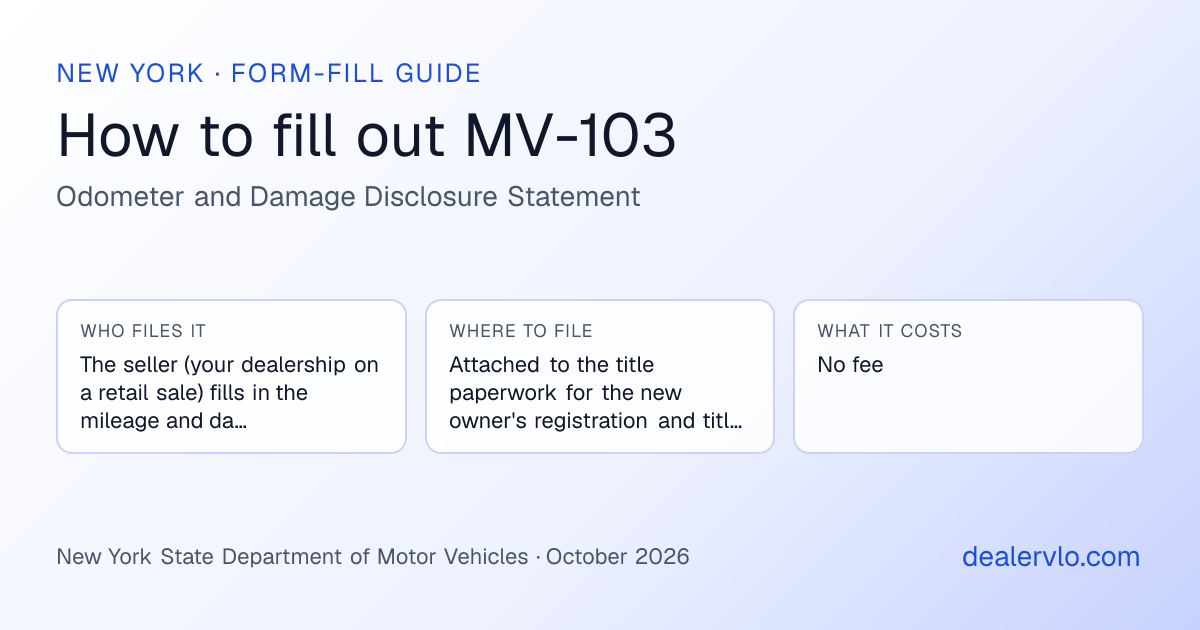
Filling out the NY MV-103 after a sale:
- What it is
- New York's separate odometer and damage disclosure statement, used when the title or dealer's certificate of sale has no disclosure section
- Who completes it
- The seller (your dealership on a retail sale) fills in the mileage and damage boxes and signs; the new owner signs and prints their name
- Where to file it
- Attached to the title paperwork for the new owner's registration and title at the DMV
- Processing time
- None of its own. It goes with the title paperwork
- Cost
- No fee
This guide is informational and does not replace the official New York instructions. Always confirm the current form and procedure with the New York State Department of Motor Vehicles before you file.
The MV-103 is one car's paperwork. A 20-second read on your lot, and the tax-and-fee math for the whole deal — built for dealers, no signup. Free calculators dealers actually use — no signup, no email.
DealerVLO fills the official New York MV-82 title application, the Bill of Sale, and the FTC Buyers Guide straight from your deal — VIN-decoded vehicle, buyer, co-buyer, and sale price already in place. $29/month, free to try — cancel any time.
What the MV-103 is and why it matters
The MV-103 is New York's Odometer and Damage Disclosure Statement: the NYS odometer statement on a separate page. One side of the form certifies the mileage. The other half says whether the vehicle has or has not been damaged past 75% of its retail value, which decides whether the new title is branded "Rebuilt Salvage: NY."
Dealers rarely need it, because New York titles and the MV-50 carry these statements. You use the MV-103 when the title or certificate of sale in your hand has no disclosure section. This guide walks every box, says who fills it on a dealer sale, and covers the odometer exemptions and the record rule.
The current revision is MV-103 (5/25). The DMV describes it as the form "for use by a dealer or private owner where the title or dealer's certificate of sale does not have an odometer/damage disclosure statement section required by law." On most New York sales the disclosure goes on the back of the title and on the dealer's Retail Certificate of Sale (MV-50) instead, so the MV-103 is a fallback, not a form for every deal. The state's PDF has typeable fields, but it's encrypted, and DealerVLO's form uploader can't open it. Type it in a PDF reader or fill it by hand.
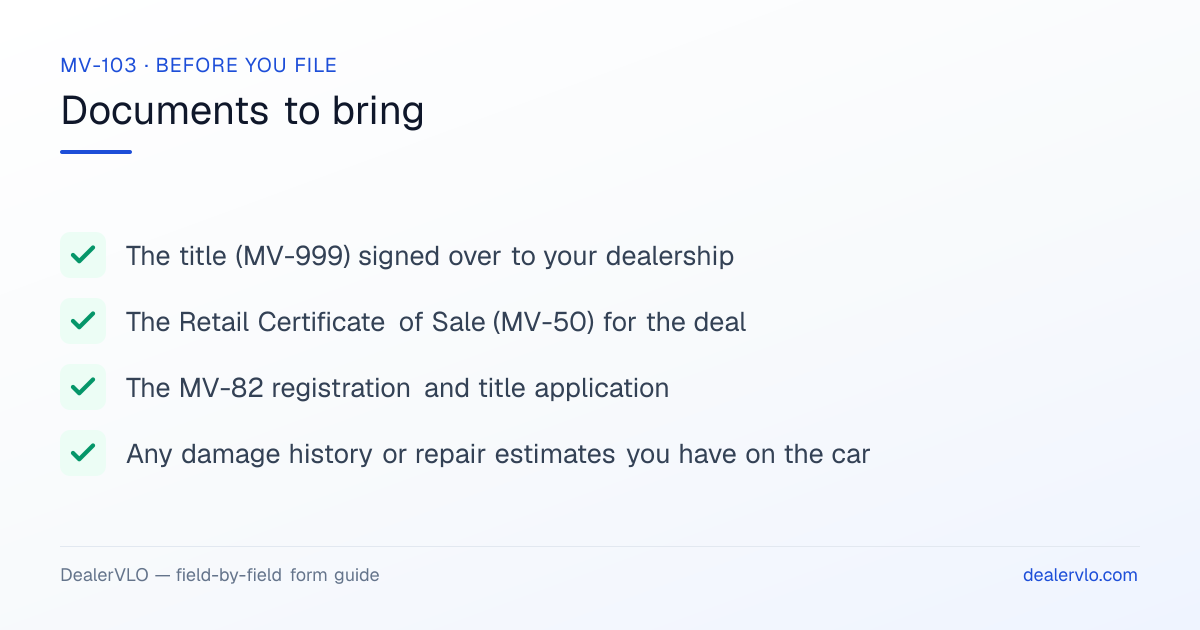
Documents to have before you start
Gather these before you complete the MV-103. A missing attachment is the number-one reason the the New York State Department of Motor Vehicles bounces a title application back.
- The title (MV-999) signed over to your dealership — Check whether it already has odometer and damage disclosure sections. If it does, use those, not the MV-103.
- The Retail Certificate of Sale (MV-50) for the deal — The DMV says the dealer's odometer statement for a retail sale is on the MV-50.
- The MV-82 registration and title application — See the MV-82 guide for the application itself.
- Any damage history or repair estimates you have on the car — You need them to answer the 75% damage question honestly.
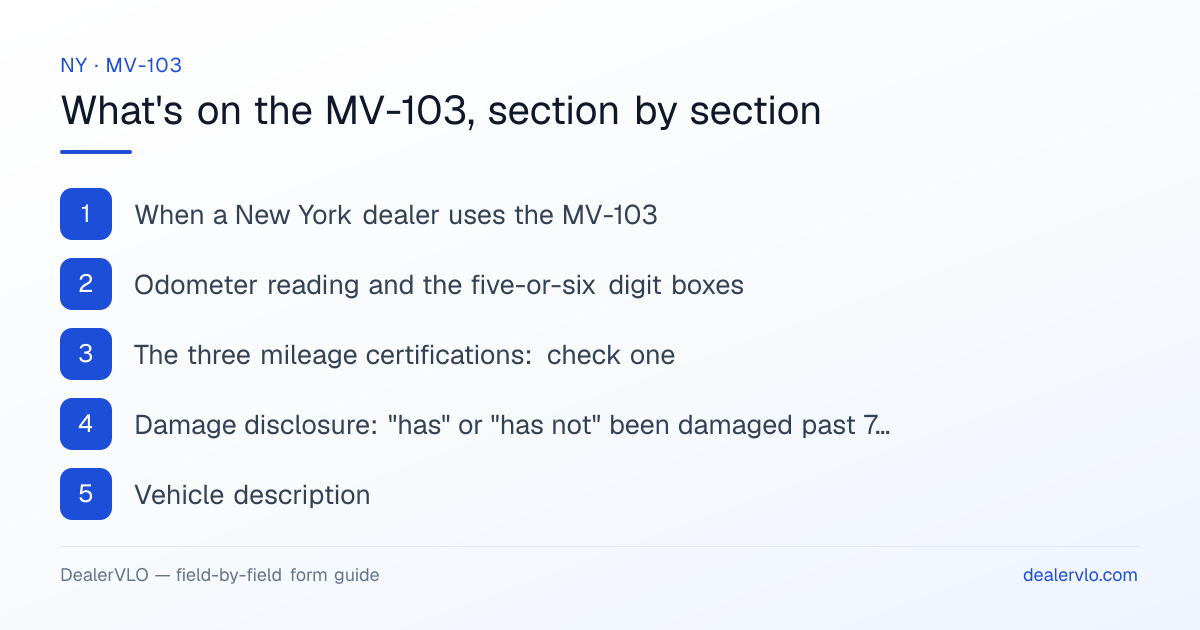
MV-103, section by section
When a New York dealer uses the MV-103
The DMV lists the MV-103 for a dealer or private owner whose title or dealer's certificate of sale doesn't have the odometer and damage disclosure section the law requires. On a normal retail sale, the odometer statement goes on the back of the title and on the MV-50, and the buyer signs to acknowledge it. Federal rule 49 CFR 580.5 says an owner who holds the title must disclose mileage on the title, not on a separate document, so don't swap in an MV-103 when the title has the section. The DMV also accepts a damage disclosure attached on an MV-103 in place of the one on the back of the title.
| Field | Who fills it |
|---|---|
Title has odometer and damage sections: use the title | You (dealer) |
Title or MV-50 has no disclosure section: use the MV-103 | You (dealer) |
Odometer reading and the five-or-six digit boxes
Enter the odometer reading exactly as it shows on the car, with no tenths. Then check whether the odometer has five digits or six digits, excluding tenths. The form tells you to copy the reading "exactly as it appears," so read it off the dash on the day of sale, not from a trade appraisal or auction sheet.
| Field | Who fills it |
|---|---|
Odometer reading (no tenths) | You (dealer) |
Odometer has five digits / six digits Check one. | You (dealer) |
The three mileage certifications: check one
Box 1 certifies the reading reflects the actual mileage. Box 2 says the reading exceeds mechanical limits, meaning the odometer started over at zero. Box 3 says the reading is not the actual mileage, with the warning "odometer discrepancy." These match the three statements 49 CFR 580.5(e) requires. Whatever you check prints on the next title: the DMV says New York titles show "EXCEEDS MECHANICAL LIMITS" or "NOT ACTUAL MILEAGE, WARNING ODOMETER DISCREPANCY" when that applies.
| Field | Who fills it |
|---|---|
1. Actual mileage | You (dealer) |
2. Exceeds mechanical limits The odometer rolled over. | You (dealer) |
3. Not the actual mileage, odometer discrepancy Broken, replaced, or unreliable odometer. | You (dealer) |
Damage disclosure: "has" or "has not" been damaged past 75%
Check one box. The seller certifies the vehicle has or has not been wrecked, destroyed, or damaged so that the estimated or actual cost of parts and labor to rebuild it for legal road use is more than 75% of its retail value at the time of loss. The form warns that checking "has" means the vehicle needs an anti-theft examination before it can be registered, and the new title will read "Rebuilt Salvage: NY." The odometer part has age exemptions; the DMV says the damage statement must be completed regardless of the vehicle's age. Failing to disclose salvage history carries a fine of up to $2,000, per the DMV, plus any Penal Law penalties.
| Field | Who fills it |
|---|---|
Has been damaged over 75% of retail value Triggers the anti-theft exam and the Rebuilt Salvage brand. | You (dealer) |
Has not been damaged over 75% of retail value | You (dealer) |
Vehicle description
Fill in the vehicle year, make, model, body type, and the full 17-character VIN. Copy them from the title so they match the MV-82 and MV-50. Federal rules require these same five items in every odometer disclosure.
| Field | Who fills it |
|---|---|
Vehicle year, make, model, body type | You (dealer) |
Vehicle identification number All 17 characters, matching the title. | You (dealer) |
Seller and new owner: signatures, names, addresses, dates
The seller signs, prints the name in full, and gives a mailing address, city, state, ZIP, and the date of the statement. On a retail sale the seller is your dealership. The new owner then signs, prints their full name, and gives their own address and date. Federal rule 580.5(f) has the buyer sign only after receiving the seller's signed statement, and the seller gets a copy. The DMV warns that it won't accept a title if any information is altered, erased, or crossed out, so if a box goes wrong, start a fresh form.
| Field | Who fills it |
|---|---|
Seller's signature and printed name | You (dealer) |
Seller's mailing address, city, state, ZIP, date | You (dealer) |
New owner's signature and printed name | Buyer |
New owner's mailing address, city, state, ZIP, date | Buyer |
Odometer exemptions, trade-ins, and the 5-year record rule
Under 49 CFR 580.17, model year 2010 and older vehicles are exempt from odometer disclosure. Model year 2011 and newer vehicles are exempt only once they're 20 years old, so in 2026 every 2011-or-newer car still needs one. Vehicles over 16,000 pounds GVWR are also exempt. On a trade-in, the customer is the seller and your dealership is the new owner: they fill the seller lines, you sign as the new owner. Under 49 CFR 580.8, dealers keep a copy of every odometer statement they issue and receive for five years at their primary place of business. An electronic copy is fine if it can't be altered.
| Field | Who fills it |
|---|---|
Trade-in: customer signs as seller Your dealership signs as the new owner. | Buyer |
Dealer copy, kept 5 years 49 CFR 580.8, statements issued and received. | You (dealer) |
Common MV-103 mistakes that cause rejections
The DMV lists the MV-103 for titles and certificates of sale that lack the section. Federal rules require a titled owner to disclose on the title itself.
The form says to enter the reading with no tenths, and to check whether the odometer has five or six digits.
The odometer part has age exemptions. The DMV says the damage statement must be completed regardless of age.
The DMV won't accept title paperwork with altered, erased, or crossed-out information. Start a clean MV-103.
49 CFR 580.8 covers statements dealers receive as well as issue. Keep both for five years.
Common questions
What is the NYS odometer statement?+
On most New York sales it's the odometer disclosure section on the back of the title (MV-999), and for a dealer retail sale, on the Retail Certificate of Sale (MV-50). When the title or certificate of sale has no disclosure section, the separate form is the MV-103, the Odometer and Damage Disclosure Statement. The current revision is MV-103 (5/25).
Where do I get a NYS odometer statement PDF?+
The New York DMV posts the MV-103 at dmv.ny.gov/forms/mv103.pdf, and the DMV says it's also available at any motor vehicle office. It has no fee.
Is the MV-103 the same as the damage disclosure?+
It covers both. The top half is the odometer disclosure statement; the bottom half is the damage disclosure, where the seller checks whether the vehicle has or has not been damaged past 75% of its retail value. Checking "has" means an anti-theft examination before registration and a "Rebuilt Salvage: NY" title.
Which vehicles need an odometer disclosure statement in New York?+
Under 49 CFR 580.17 and the DMV's guidance, model year 2010 and older vehicles are exempt, and model year 2011 and newer vehicles are exempt once they're 20 model years old. In 2026, every 2011-or-newer car needs one. Vehicles over 16,000 pounds GVWR are also exempt. The damage disclosure has no age exemption, per the DMV.
Does the MV-103 need to be notarized?+
The form has no notary block. It needs the seller's and new owner's signatures, printed names, addresses, and dates.
How long do New York dealers keep odometer statements?+
Five years. Federal rule 49 CFR 580.8 requires dealers to keep a copy of every odometer disclosure they issue and receive, at their primary place of business. Electronic copies count if they can't be altered.
Can DealerVLO fill out the MV-103?+
Not this one. The state's PDF is encrypted in a way our form uploader can't open, so you fill it in a PDF reader or by hand. DealerVLO does fill the official New York MV-82 and builds the federal Odometer Disclosure Statement from every deal.
Is there software that fills out the MV-103 automatically?+
Not this one. The New York MV-103 is an encrypted state PDF that DealerVLO's form uploader can't open, so it's completed by hand and signed in ink. Dealer management software like DealerVLO handles the paperwork around it from the deal you already entered: the official New York MV-82 title application, the Bill of Sale, the FTC Buyers Guide, and the odometer disclosure, so the MV-103 is the only page left to write. It's $29/month flat with a 14-day free trial.
Stop re-typing the rest of the deal.
The MV-103 is a hand-filled form. Everything around it isn't: DealerVLO fills the official New York MV-82 title application, the Bill of Sale, and the FTC Buyers Guide from your deal jacket. $29/month. 14-day free trial, cancel any time.
Curious how it works? See how DealerVLO auto-fills every dealer document — bill of sale, FTC Buyers Guide, odometer disclosure, and state title & registration forms for all 50 states, from one deal.
Bond amounts, fees, and form rules change. Get a short email when your state does. No spam, unsubscribe anytime.