Third-Party Listing Sites Are Bidding Against You With Your Own Inventory Feed
How Cars.com, CarGurus and Autotrader can use your synced inventory feed to run Google Vehicle Ads against you — and how to check and fight back.
Part of the Listings, photos & merchandising guide: Where to list your cars for leads — and how to be on every site at once
Switching from another DMS? Compare DealerVLO to DealerCenter, Frazer, or Lot Wizard, or see what DealerVLO's car dealer management software includes.
Here's the uncomfortable part: the same car data you send to Cars.com, CarGurus and Autotrader so shoppers can find your inventory can also be the raw material those sites use to run their own paid ads — ads that compete with you for the exact same shopper, on the exact same search. You pay to list the car. They can turn around and pay Google to put their version of your listing in front of the buyer first.
This isn't a conspiracy theory and it isn't new — it's how Google's Vehicle Ads program is built, and Google changed the rule in December 2023 to make it explicitly allowed for sites like these, which Google calls "aggregators," to run ads built from inventory that isn't theirs. The question for a small lot isn't whether this happens. It's whether it's happening in your market, and what you can actually do about it.
14-day free trial, then $29/mo · Cancel anytime
How a listing site turns your feed into its own ad
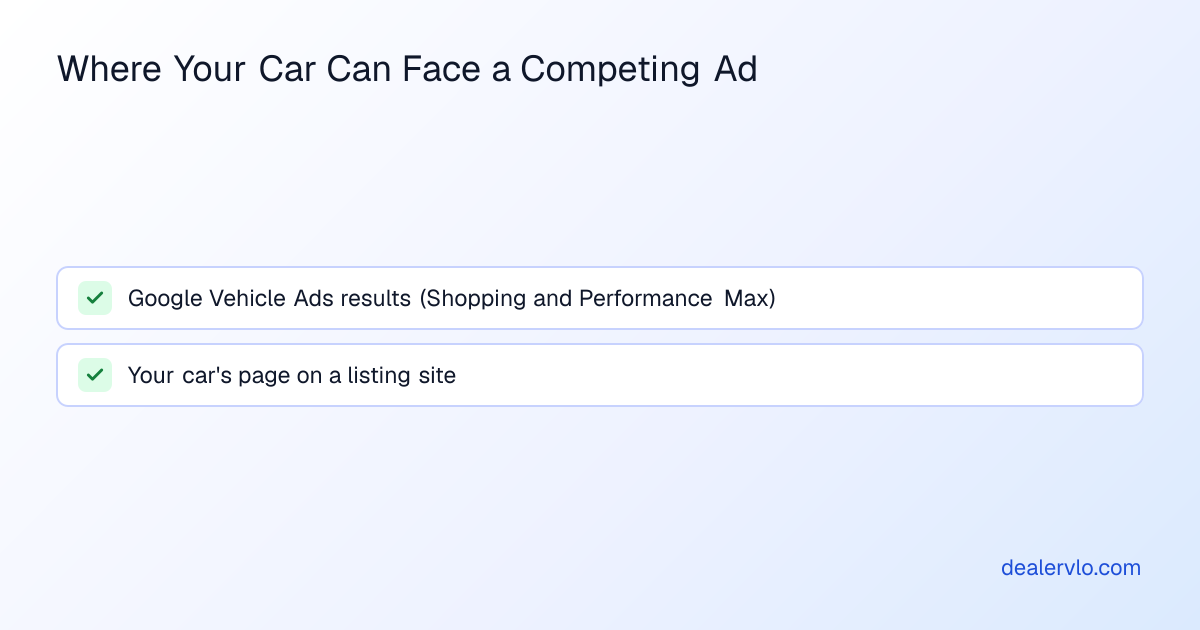
Google's Vehicle Ads format runs inside Shopping and Performance Max campaigns, and it's built to pull vehicle data from more than one kind of advertiser. Google's own vehicle ads overview says the format takes "new and used vehicle inventory from dealer, retailer stock, aggregators, or original equipment manufacturers" (Google Merchant Center Help). And Google defines an aggregator plainly: an "online marketplace representing inventory from several distinct, unrelated dealerships" (Google Merchant Center Help).
That second part is the whole mechanism in one sentence: an aggregator's ad account is, by definition, built on other people's inventory. Cars.com, CarGurus, Autotrader and similar sites already have your car's year, make, model, trim, mileage, price and photos — because you sent them that data to get listed. Nothing stops that same data from being the feed that powers their own paid Vehicle Ad, placed by them, paid for by them, competing against your listing in the same search results.
This wasn't always written into the rules. Google's Merchant Center changelog records the change: starting in December 2023, "aggregators in the United States and Canada can now participate in vehicle ads," with the requirement that they "upload vehicles from dealerships with valid licenses" (Google Merchant Center changelog). The current policy still draws one clear line: "Vehicle ads from private sellers, individuals, or auto brokers aren't permitted" — but licensed-dealer inventory flowing through an aggregator is fine (Google Merchant Center).
Dealers were seeing it before the rule was even written down. A September 2023 DealerRefresh thread, titled "Why are third parties running Google VLA ads on MY vehicles? Shut it down!", named Autotrader, Cars.com, CarGurus and CARFAX as the sites doing it (DealerRefresh forum). To be fair to the other side: the dealer who started that thread argued it's not all bad. His point was that when your own vehicle ads budget runs out before you've won every impression, the marketplace ad still puts your car in front of the shopper, and blocking it mostly helps your competitors. That's a real argument. The catch is that the click lands on the marketplace's page, next to every other dealer's cars, not on yours.
It's worth being precise about what's confirmed and what isn't here. What's confirmed in Google's own documents is the mechanism: aggregators are permitted to run Vehicle Ads, and by Google's own definition that means advertising inventory from dealerships that aren't them. What nobody outside those companies can tell you is how much each site spends doing it in your market.
Why this matters more now than it did three years ago
Google used to run a free, organic vehicle listings program: dealers sent inventory through a feed or structured data, and cars could show up in Search and on the dealership's Business Profile without paying for a click. That free channel is being shut down. Google's developer pages for the program now carry this notice: "The Organic Search Auto Listings feature will no longer appear in the coming days. Processing of vehicle listing feeds will also be stopped." The same pages note that vehicle listings is separate from the vehicle ads program (Google for Developers). Google had already dropped Search Console support for vehicle listing structured data in June 2025, as part of simplifying Search results (Google Search Central blog).
The practical effect: the free lane dealers used to get a fair shot in is closing. The paid lane — Vehicle Ads inside Shopping and Performance Max — is now the main place a car shows up when someone searches for it by make, model and ZIP. And that's exactly the lane where aggregators, running on your own feed data, are allowed to bid against you.
Where this shows up beyond Google
The same dynamic isn't limited to Google. CarGurus' own dealer-facing sales materials list "Conquest ads on competitors Restricted VDPs" as a feature of its paid listing packages. "Restricted" is the name of CarGurus' entry-level package in that brochure, so this means a dealer on a higher plan gets ads on the vehicle detail pages of competitors on the Restricted package (CarGurus dealer e-brochure). That brochure is UK material from February 2024, so don't assume the same packages exist in the U.S. But it shows the mechanism is part of CarGurus' own product line: one dealer's listing page can be sold as ad space to a competing dealer.
If you're trying to decide which of these sites is worth your ad dollars in the first place, it helps to step back and compare them on their merits rather than just their feed behavior — see CarGurus vs. Autotrader vs. Cars.com for a small used-car lot for that side-by-side. And if you're newer to syndication generally, the pillar guide on where to list your cars walks through how to be visible across sites without losing track of who's doing what with your data.
How to actually check if it's happening to you
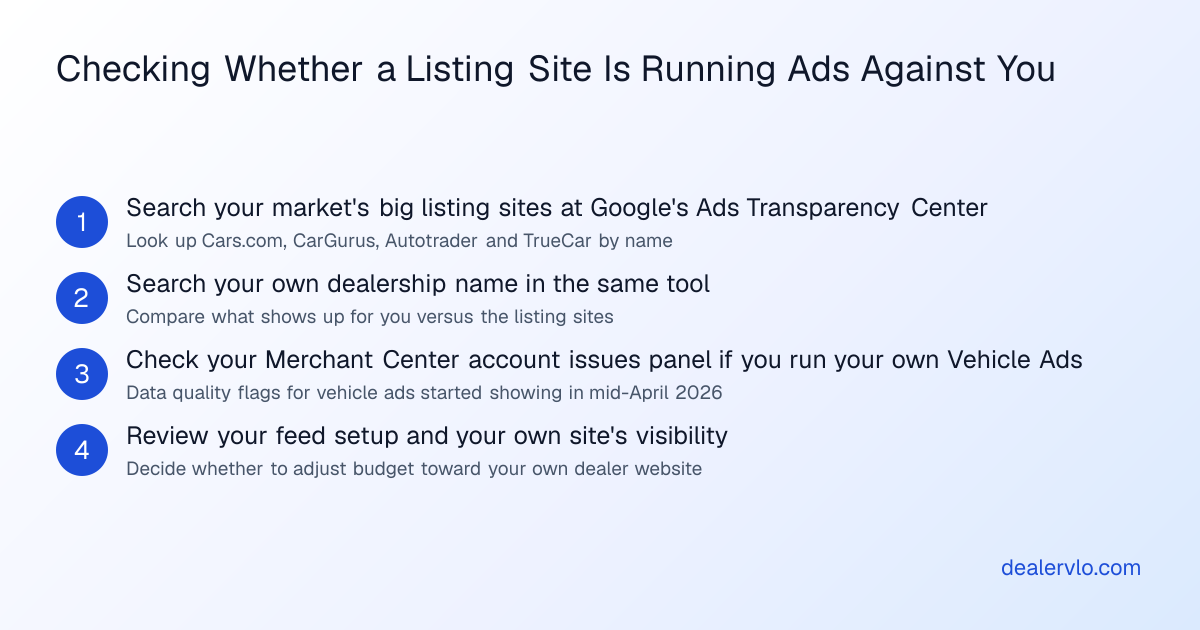
You don't need to take a forum thread's word for it — there are two free, direct ways to look.
1. Google Ads Transparency Center. This is a public tool at Google's transparency site where you can search an advertiser's name or domain — "Cars.com," "CarGurus," "Autotrader," "TrueCar" — and see the ads running under that name. For verified advertisers, Google shows the legal name and location the advertiser gave during verification, and it can show a separate payer name when someone else pays for the ads (Google Ads policy help). Run a search for your own market's big listing sites and see what inventory-style ads come up. Then search your own dealership name and compare what you find.
2. Your own Merchant Center account, if you run Vehicle Ads yourself. Google's changelog confirms that starting in mid-April 2026, the Merchant Center account issues interface began "highlighting data quality account issues related to Vehicle ads" (Google Merchant Center changelog).
Neither tool will hand you a dollar figure for what an aggregator's ad is costing you in lost clicks — nobody publishes that, and any number you see claiming otherwise online isn't backed by a named, verifiable source. What these tools do give you is a straight answer to "is this actually happening in my market," which is the first thing you need before deciding whether to act.
Turn your ad spend into a cost per car sold and a real ROI — and see how many units the spend has to produce just to break even.
Open the Marketing ROI CalculatorThe lever you actually control: your feed, not the policy
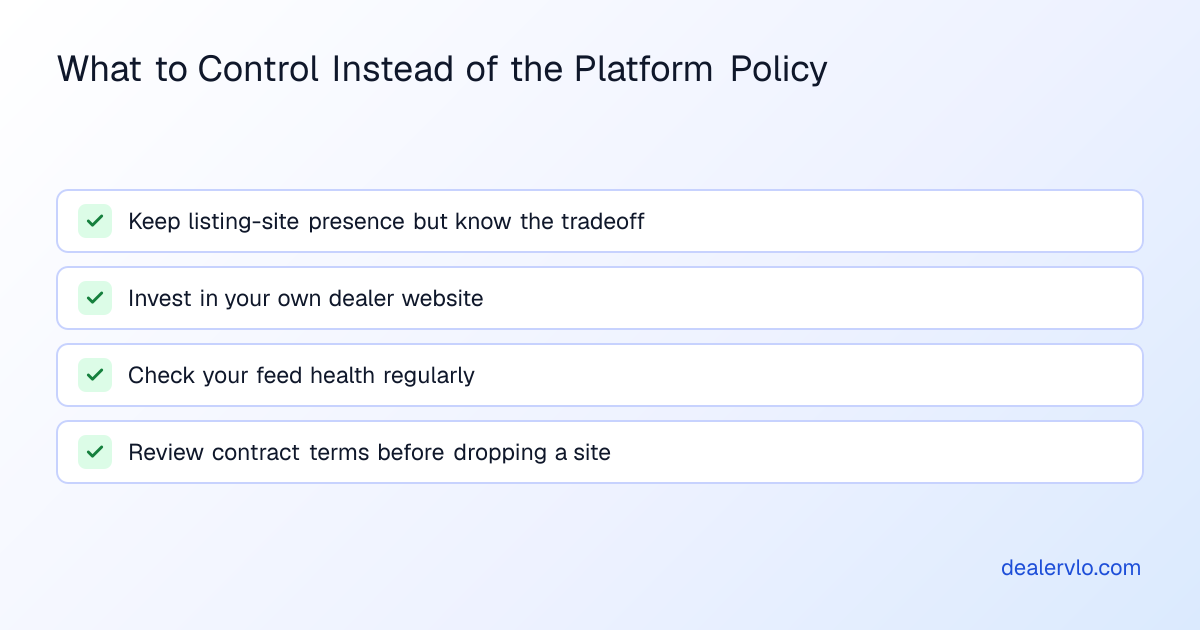
You can't change Google's aggregator policy and you can't stop CarGurus from selling ad space on a VDP built from your listing. What you can control is who sends your inventory data where, and how much of your marketing budget depends on sites that might be using your own data against you.
A dealer's inventory feed and the paid advertising account on a marketplace are two separate things, even though they get talked about as one. Understanding that split matters because it means you have a choice about where the feed comes from and what it's connected to — you're not locked into one bundled relationship with one vendor.
In DealerVLO, inventory posts to your dealer website automatically, and the same inventory pushes out as feeds to CarGurus, Cars.com, Autotrader and Carfax.com (through its Vast feed) three times a day, included in the flat monthly price with no extra per-feed charge. You still enroll with each site and pay that site's own advertising fees directly — DealerVLO supplies the feed, it doesn't replace your marketplace account or control what that site does with your data once it's in their system. What DealerVLO does change is how much time and duplicate data-entry it takes to run your own site and your own feeds in parallel, so your dealer website isn't an afterthought compared to the marketplaces.
14-day free trial, then $29/mo · Cancel anytime
Why your own website is the one channel nobody else can bid against
Every minute a shopper spends on a third-party listing site is a dollar of attention split between your car and every other dealer's car on that page — plus, now, potentially an aggregator's own ad pulling from the same page's data. Your own dealer website doesn't have that problem. Nobody else's inventory shows up on it, and nobody can buy an ad slot on your own vehicle detail page.
DealerVLO's dealer website doesn't block search engines or AI crawlers — its robots.txt allows crawlers and points to a sitemap listing your home page, inventory page and every available car, with each car carrying structured data for its VIN, mileage, price and specs, and the dealership's name, address, phone and hours carried as structured business data across the site. That's the groundwork for showing up in organic search and AI-driven answers, which is a channel aggregators don't get to insert themselves into. If you want to check how your current site stacks up on speed and basic shopper usability — regardless of what DMS or website you run — the free Dealer Website Check tool grades a single car page against Google's published mobile performance lines in a couple of minutes.
It's also worth putting real numbers on what your current marketing is actually returning before you decide where to put more budget. The Marketing ROI Calculator turns your ad spend into a cost-per-car-sold figure and shows how many units that spend needs to produce just to break even — useful context before you decide whether to lean harder on listing sites or your own site.
What this doesn't mean you should do
This isn't an argument to pull off CarGurus, Cars.com and Autotrader entirely. For most small lots, those sites still bring in real shopper volume, and walking away from them to "protect" your feed usually costs you more leads than it saves you from competing ads. If you're mid-contract and frustrated, read how to cancel a CarGurus, Autotrader, or Cars.com contract without getting burned before you make a move — early termination and auto-renewal terms can bite harder than a few competing ads ever would.
The more useful move is balance: keep your listing-site presence, understand that it comes with this tradeoff, and build up your own website and feed infrastructure so you're not entirely dependent on channels where someone else can outbid you for your own car. If you're watching your inventory drop off listing sites unexpectedly for reasons that have nothing to do with aggregators, that's usually a feed health problem, not a competing-ad problem — see why your cars aren't showing up on listing sites for the troubleshooting steps. And if you're evaluating what actually makes an inventory feed reliable in the first place, this guide on what makes a vehicle inventory feed good is worth reading before you pick (or switch) a feed provider.
Frequently asked questions
Can Cars.com, CarGurus or Autotrader really run ads using my inventory data?
Yes, for the Google Vehicle Ads format specifically. Google's own policy defines an "aggregator" as an online marketplace representing inventory from several unrelated dealerships, and as of a December 2023 policy change, aggregators in the U.S. and Canada are allowed to run vehicle ads built on inventory from licensed dealerships. That means a listing site can use data similar to what you've already sent them to run its own competing ad.
Is this new, or has it been happening for a while?
The formal Google policy change allowing aggregators into the Vehicle Ads program took effect in December 2023, per Google's own Merchant Center changelog. A September 2023 DealerRefresh thread, three months before that change, already named Autotrader, Cars.com, CarGurus and CARFAX as running Google vehicle ads on dealers' cars. So the practice predates the written rule, but December 2023 is when Google made it explicitly allowed.
How do I check if a specific listing site is running ads against my dealership?
Search the site's name (or domain) at Google's Ads Transparency Center, a free public tool that shows who's currently running ads under that name and who's paying for them. You can also search your own dealership's name there to see what comes up for comparison. If you run your own Vehicle Ads campaign, check your Merchant Center account issues panel, which began surfacing vehicle-ad data quality flags in mid-April 2026.
Does switching DMS or feed providers stop this from happening?
No — switching who sends your inventory feed doesn't change Google's or a listing site's own ad policies; those are set by the platforms themselves, not your DMS. What switching providers can do is make sure your feed is accurate and reaching every site reliably, and free up budget and attention to invest in your own dealer website, which no aggregator can place a competing ad on top of. If you are switching DMS, see how to move your listing feeds without going dark first.
Should I drop CarGurus, Cars.com or Autotrader because of this?
Not automatically. These sites still bring real shopper traffic to most small lots, and the tradeoff of a possible competing ad is usually outweighed by the leads the listing brings in. The more practical response is to keep your listings, understand how the aggregator ad mechanism works, and build your own website and feed strength so you're not solely dependent on a channel where someone else can outbid you for your own car.
Bottom line
The mechanism is real and Google confirms it in its own policy documents: aggregators can run paid vehicle ads built from licensed-dealer inventory, and that's allowed by rule since December 2023. What isn't knowable from the outside is how much of your specific market's search traffic is affected — that varies by city, by site, and by how aggressive each aggregator is in your area, so check your own numbers with the free tools above before you change anything. The one channel where nobody can bid against your own listing is your own dealer website, which is worth treating as infrastructure rather than an afterthought next to the big listing sites. Give your feeds and your own site a real look in DealerVLO and see where your visibility actually stands.
14-day free trial, then $29/mo · Cancel anytime