The First-Response-Time Benchmark: What Speed-to-Lead Actually Does to Your Close Rate
Speed to lead for car dealers: what the lead response time and close rate data really shows, what's hype, and how fast a small lot needs to be.
Part of the Profit, margins & the numbers guide: How Do Used-Car Dealerships Actually Make Money?
Switching from another DMS? Compare DealerVLO to DealerCenter, Frazer, or Lot Wizard, or see what DealerVLO's car dealer management software includes.
If you've ever googled "lead response time close rate," you've probably landed on a blog claiming a 5-minute response gets you "21x more conversions" than waiting 30. That number doesn't trace back to anything you or I could check. This post is about the handful of facts on speed-to-lead that actually hold up, and what they mean for how fast a small used-car lot needs to answer a lead.
The short version: nobody has clean, audited, automotive-specific data proving an exact multiplier between minutes-to-response and deals closed. What does hold up — a 2011 Harvard Business Review study, a dealership-consulting firm's published benchmark, and a pile of forum testimony from people who actually run ILM desks — points the same direction. Leads go cold fast, most of the decay happens in the first few days, and nothing bad has ever come from answering sooner.
14-day free trial, then $29/mo · Cancel anytime
What the research actually shows (and doesn't)
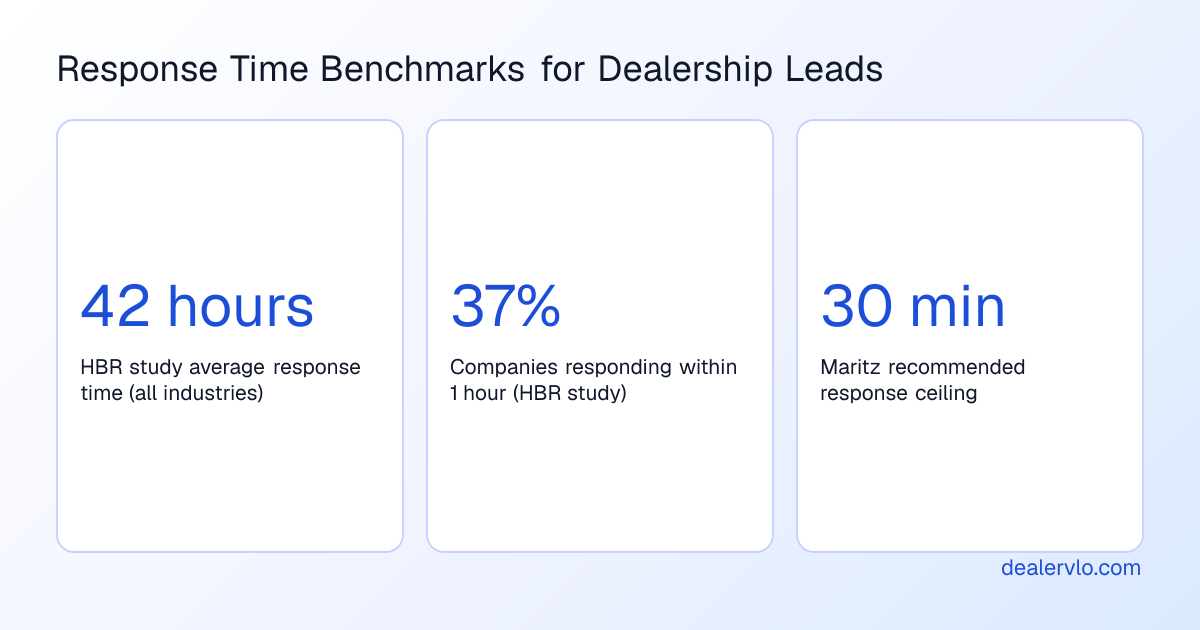
The most-cited academic source on lead response time is a real, named study: Oldroyd, McElheran, and Elkington's "The Short Life of Online Sales Leads," published in Harvard Business Review in March 2011. The researchers sent test leads to over 2,000 companies across financial services, automotive, professional services and other industries, then measured how fast — or whether — each company responded. Just over a third responded within an hour, about a sixth took one to 24 hours, nearly a quarter took more than a day, and almost a quarter never responded at all. Among companies that responded within 30 days, the average response time was 42 hours.
| Response window | Share of companies audited |
|---|---|
| Within 1 hour | 37% |
| 1–24 hours | 16% |
| More than 24 hours | 24% |
| Never responded | 23% |
That study is cross-industry, not automotive-specific. Treat it for what it actually measured — a huge share of businesses, car dealers included, are simply slow or silent on inbound leads.
On the dealership-consulting side, Maritz — a firm that works on dealership performance metrics — publishes a stated benchmark of 30 minutes or less as the target internet response time, through comments from its own performance manager. Maritz also notes that top-performing stores don't stop at meeting their OEM's 30-minute mandate; they try to beat it. That OEM mandate matters for the independent-dealer angle: franchise stores have a factory-imposed response clock. Independent and used-car lots don't. Nobody is auditing your response time but you — and the car-shopping buyer on the other end is just as likely to be cross-shopping your listing against three others on Cars.com or Autotrader at that exact moment.
The forum data: useful, but read the fine print
Two threads on the DealerRefresh forum get cited constantly in speed-to-lead content, and both deserve a harder look before you build a policy around them.
One poster described a self-run, 30-day experiment: respond to every lead within 5 minutes, no exceptions. He reported his average response time dropping from 47 minutes to 3, and his conversion and deal count both improving over the month. That's a real, specific result — for one salesperson, over one month, self-reported, with no control group, and posted alongside a plug for a specific AI response tool. It's a useful illustration that speed can move the needle. It is not proof of what speed will do for your lot, and those exact numbers shouldn't be treated as something you can expect to reproduce.
A second thread, "30-Day ILM Stats," reported a low total close rate on internet leads within a 30-day window, with the large majority of those eventual closes happening in the first few days and the rest trailing off toward the end of the month. The poster attributed this to an unnamed "national study" that nobody in the thread could produce a link to. The shape of that curve — most of your closes come fast, and the tail gets thin — shows up again and again in dealer conversation even without a named source behind the specific percentages. Use it as a widely-discussed pattern among people running internet lead management, not as a citable statistic.
A third, older DealerRefresh thread on closing ratios adds a useful gut-check: several experienced dealers in that discussion flatly said closing-ratio numbers get gamed all the time through selective lead exclusion, and more than one commenter called a 10% closing ratio "excellent" by industry standards. If someone quotes you a specific close rate as gospel, that thread is a good reminder to ask how the denominator was counted.
Why "fast enough" beats "fastest possible" on a small lot
None of this means you need a 90-second auto-responder bot running your desk. A 20-car independent lot usually has one or two people answering leads, and they're also doing test drives, paperwork, and everything else. The realistic goal isn't beating a stopwatch — it's not letting a lead sit in an inbox overnight because nobody saw it.
The common failure mode on a small lot isn't a slow typer. It's a lead that comes in on a Tuesday evening, sits unread until Thursday, and by then the shopper bought from whoever answered first. If you run the lot yourself and also handle finance and the phones, the fix is usually process, not speed: know which leads are sitting untouched right now, and know which ones have a follow-up coming due today so nothing falls through.
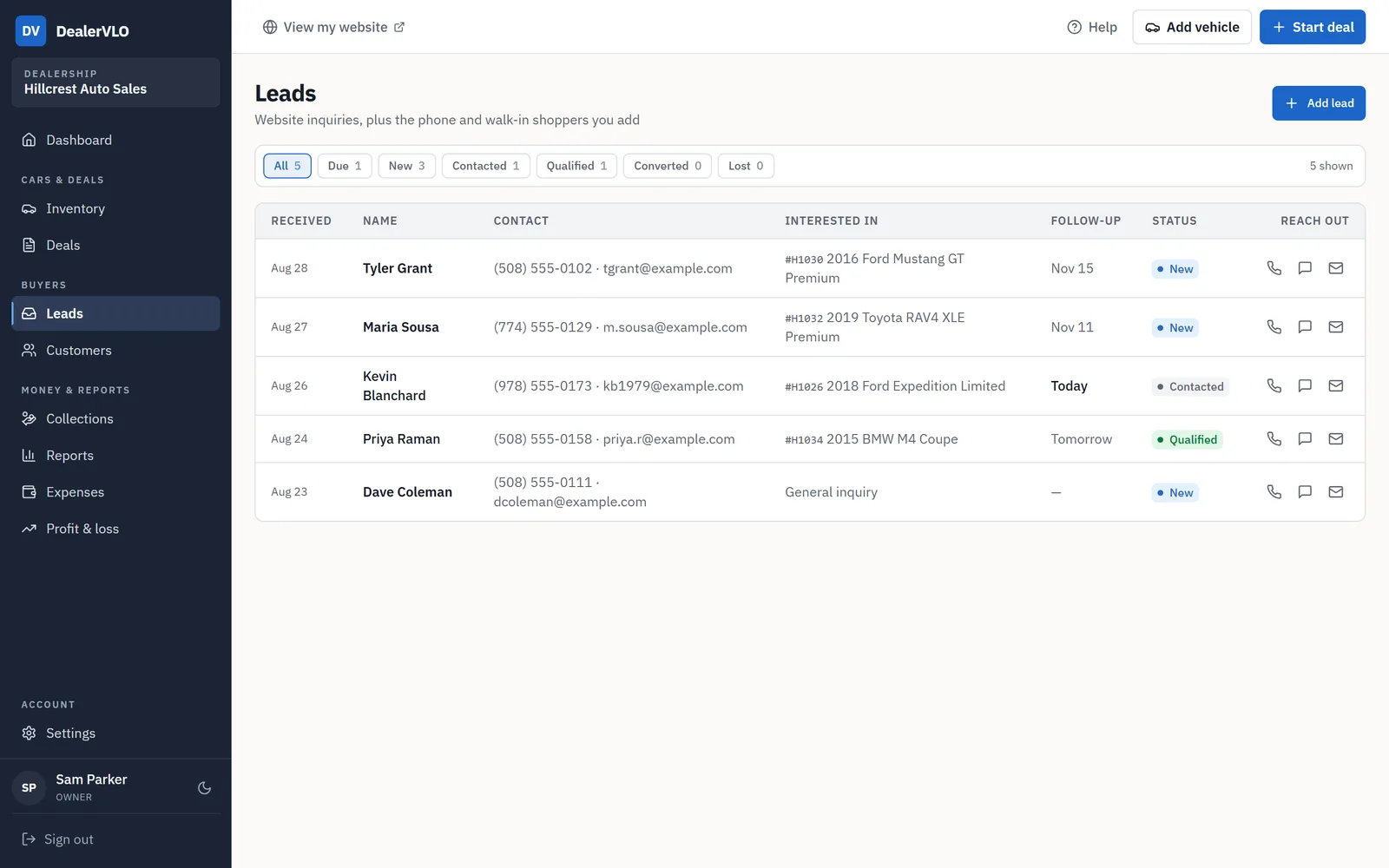
That's the part DealerVLO's lead inbox is built around: every lead shows a status, when it came in, and its next follow-up date, and the Due view sorts by most overdue first so you can see at a glance what's been sitting. The account owner also gets one daily email listing what's due that day, which matters most on a one- or two-person desk where nobody's watching the inbox at 9pm. The Text and Call buttons open your own phone, so every reply comes from you, and the Due view stops the lead from going invisible, which is the actual problem on most small lots. For a closer look at where leads come from and how to track them by source, see our guide on car dealer lead-source tracking.
14-day free trial, then $29/mo · Cancel anytime
Turn your ad spend into a cost per car sold and a real ROI — and see how many units the spend has to produce just to break even.
Open the Marketing ROI CalculatorSetting your own speed standard
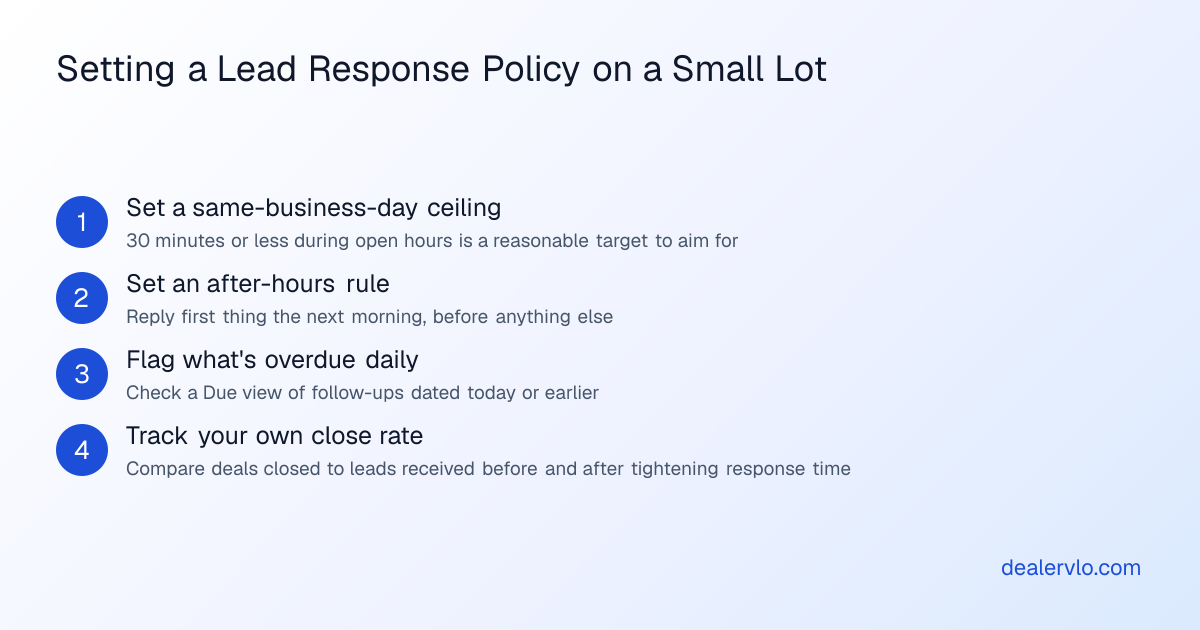
Since there's no regulator or OEM clock watching an independent lot, you're setting your own SLA. A few reasonable anchors, drawn from what's actually documented above rather than invented multipliers:
- Treat Maritz's 30-minute figure as the outside ceiling during business hours, not the target — it's the number franchise stores are held to, and your buyer doesn't know or care that you're not a franchise.
- Expect the bulk of leads that will ever close to close within the first few days, based on the decay pattern multiple dealer threads describe independently — so don't let a lead age past day three or four without a real attempt at contact.
- After-hours leads need a next-morning-first-thing policy at minimum. A lead that comes in at 11pm and gets a reply by 8am the next day is a reasonable standard for a one- or two-person desk; a lead that waits until the next time someone happens to open email is not.
None of this needs a fancy tech stack. It needs someone checking the lead list on a schedule and a way to see what's overdue without scrolling through everything. The leads view exists for exactly that — a sortable list, newest first, with a Due filter for anything dated today or earlier.
Measuring whether it's actually working
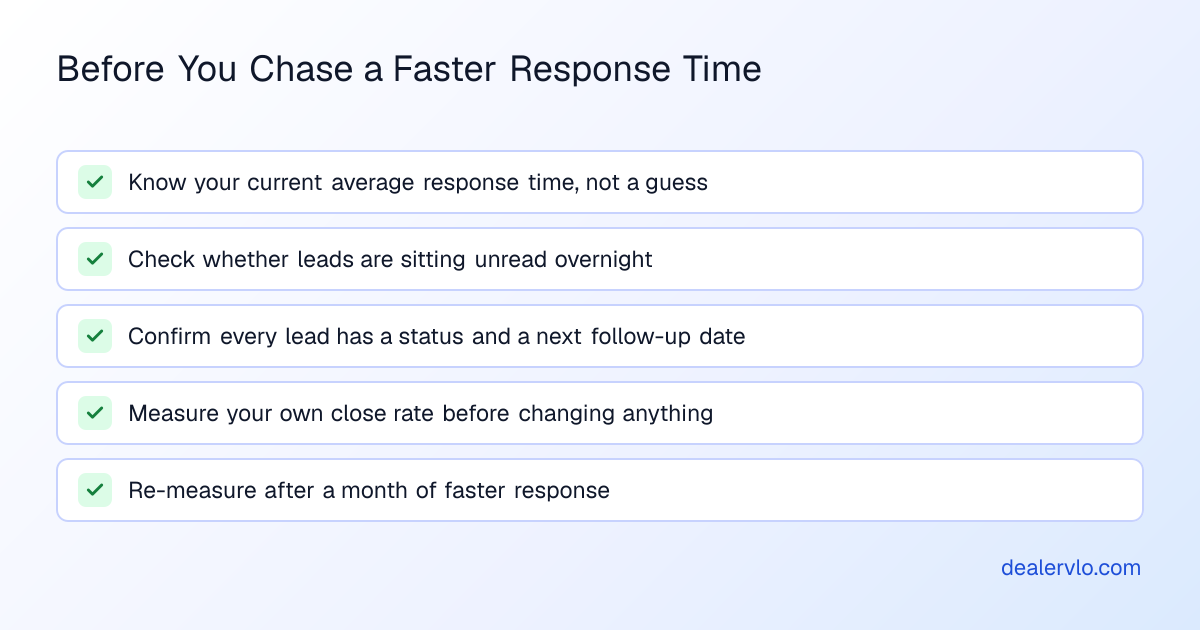
Speed only matters if it moves your close rate, and the only way to know that is to look at your own numbers over time — not someone else's forum post. Pull your deal count and your lead count for a stretch of weeks, get a rough sense of your own close rate, then tighten your response habits for a month and check again. That's the same logic the forum poster used in his 5-minute experiment; the difference is you're measuring your lot, not borrowing his.
DealerVLO's sales report shows front- and back-end gross per deal and a salesperson leaderboard for whatever period you pick — this month, last 30 days, year to date, or all time — which is a reasonable way to see if a response-time push is actually turning into more closed deals, not just busier salespeople. To see close rate by lead source or by response time, export the sales report and your lead list for the same period and line them up. For a broader weekly view of what to track on a small lot beyond just leads, the weekly KPI scorecard guide covers the other numbers worth watching alongside close rate, and the how used-car dealerships make money guide is a good primer if gross and close rate feel disconnected in your head right now.
14-day free trial, then $29/mo · Cancel anytime
What to do with a lead that already went cold
Speed-to-lead is about the leads coming in today. It's a separate problem from the ones already sitting cold in your pipeline from last month or last quarter — those need a different approach (reviving dead leads is its own topic, not this one). The point worth making here: a fast, consistent response habit going forward is the cheapest way to stop building a backlog of cold leads in the first place. If your lead list already has a long tail of untouched entries, that's a sign your intake process — not necessarily your typing speed — needs a look. A simple CRM that shows status and follow-up date for every lead, like the one built into DealerVLO, at least makes that backlog visible instead of buried across sticky notes and a salesperson's memory. If you're evaluating CRM options more broadly, see car dealer CRMs compared, and what a dealership CRM does walks through when a dedicated system actually pays for itself versus a spreadsheet.
Frequently asked questions
What's a good lead response time for a used-car dealer?
There's no legal or OEM-mandated clock for independent dealers the way there is for franchise stores, but a commonly cited ceiling from dealership-performance consulting is 30 minutes during business hours, with faster being better. For after-hours leads, responding first thing the next morning is a reasonable minimum standard for a small lot.
Is it true that 5-minute response gets 21x more conversions?
That specific multiplier isn't traceable to a verifiable, primary source — it shows up across marketing blogs attached to different studies with wildly inconsistent numbers, which is a sign it's being recycled rather than measured.
How fast do internet leads actually go cold?
Multiple dealer-forum discussions describe a similar shape: most of the leads that will eventually close do so within the first few days, with a long, thin tail trailing out to 30 days. The specific percentages behind that curve trace to an unnamed "national study" referenced in a forum thread and can't be independently verified, but the overall pattern — fast decay, thin tail — is consistent across sources.
What close rate should I expect on internet leads?
Close rates on internet leads vary widely by lot, lead source mix, and how closes are counted — dealers on industry forums have openly debated whether published closing-ratio figures are reliable, since some stores exclude leads selectively to inflate the number. A commonly referenced rough benchmark among practitioners is that a 10% closing ratio is considered strong, but treat any single number as a loose guidepost, not a target to hit exactly.
How does DealerVLO help me respond to leads faster?
It makes sure someone always knows who to contact next. Every lead has a status, its source and a follow-up date, the Due view puts the most overdue first, and the account owner gets one daily email listing what's due. The Text and Call buttons open your own phone, so the reply comes from a real person at your store.
How do I track close rate by lead source?
In DealerVLO every lead carries its source (the website form it came through, or what you picked when adding it by hand), and the sales report shows closed deals and gross for this month, the last 30 days, year to date or all time. Put your lead list next to the sales report for the same stretch to see which sources close; our lead-source tracking guide shows how to set that up.
Bottom line
The honest takeaway from everything that's actually been studied, published, or even just reliably reported on forums: speed helps, the decay curve is real even if the exact percentages aren't pinned down, and nobody — including an independent dealer with zero OEM mandate — has ever lost a deal by answering too fast. What a small lot actually needs isn't a 90-second SLA; it's a process that makes sure no lead sits untouched overnight because nobody saw it come in. Build that habit, measure your own close rate before and after, and you'll know far more than any borrowed multiplier could tell you.
14-day free trial, then $29/mo · Cancel anytime