The 15-minute morning routine that keeps a used-car lot from leaking money
The first 15 minutes on your lot set the day. A repeatable morning routine — six checks that catch the leaks (dead listings, aging units, stuck deals, cold leads) before they cost you a sale.
Ask ten dealers what their morning looks like and you'll get ten versions of the same answer: you unlock the gate, and then the day grabs you. A customer's already waiting, the phone rings, a car comes back from recon, and by the time you look up it's noon and you never actually looked at your lot — you just reacted to it.
The dealers who quietly out-earn everyone on the same street usually aren't smarter buyers or better closers. They just have a routine. Fifteen minutes, first thing, same loop every day, before the noise starts. It's not glamorous and it won't show up in any playbook, but it's the closest thing I've found to a cheat code for a small lot: it catches the little leaks the day they spring, instead of a week later when they've already cost you a sale.
Here's the version I run, and why each check earns its spot.
Why the first fifteen minutes set the day
Everything on a used-car lot is on a clock. The car you bought is depreciating and burning floor-plan interest. The lead that came in overnight is deciding, right now, whether to call you or the lot down the road. The deal you started yesterday is money you can't touch until it closes. None of that pauses while you deal with whatever walked in the door.
A morning routine is just you getting in front of those clocks before they get in front of you. It works because the problems are small when they're fresh and expensive when they're stale — a car with no price fixed on day one costs you nothing; the same car still priceless on day fifteen has been invisible to every shopper for two weeks. The ways a lot loses money are rarely one big mistake. They're a dozen small ones nobody caught in time.
The open, in order
Order matters, because you might get interrupted three checks in — so put the things that decay fastest first.
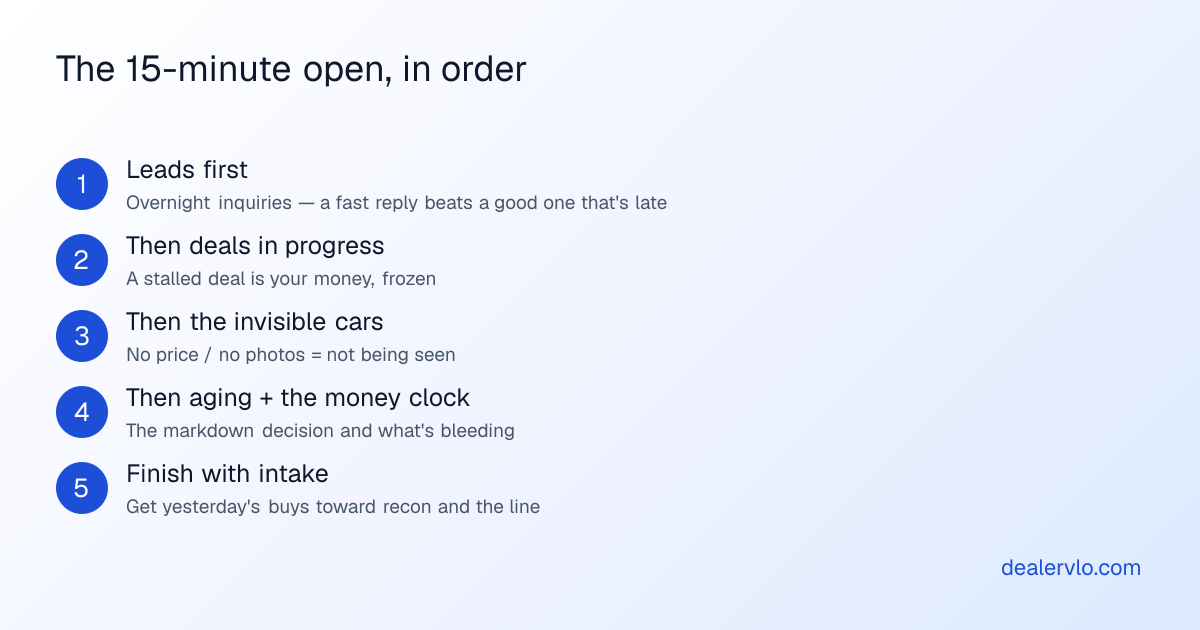
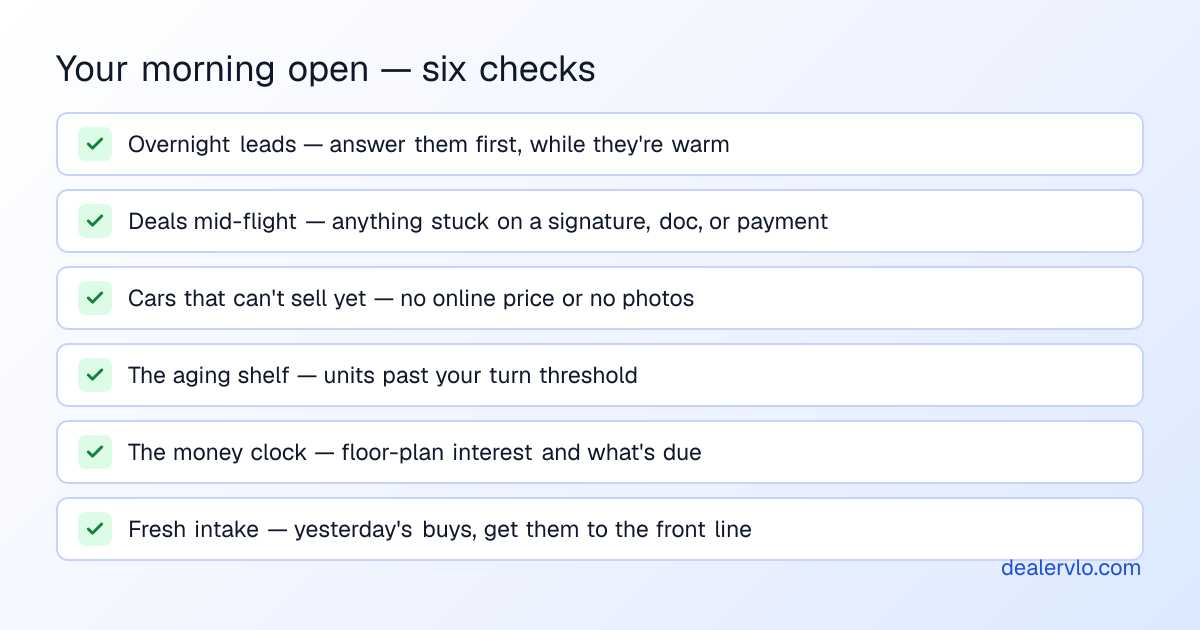
1. Overnight leads — first, always. Anything that came in through your site or Marketplace after you left. Speed-to-lead is the whole game here: a fast, plain reply beats a polished one that lands three hours later, because by then they've messaged two other lots. This is the single check with the shortest fuse, which is why it goes at the top. If you're not sure your follow-up is tight, that's its own problem worth fixing.
2. Deals mid-flight. Any deal that's started but not closed — waiting on a signature, a stip, a down payment, a title. That's your money, frozen. A deal that stalls three days because a form never got sent isn't just slow; it's gross sitting in limbo while the customer cools off and reconsiders. Glance at every open deal and ask one question: what is this one waiting on, and can I knock it loose today?
3. Cars that can't sell yet. This is the leak I see most on small lots. Somewhere on your lot right now is a unit with no online price, or no photos, or both — and online, that car doesn't exist. Shoppers filter by price and scroll by pictures; a listing missing either gets skipped every time. It's the cheapest fix in the building and the easiest to leave sitting, because nothing forces you to notice. A price and a decent set of photos turn an invisible car into a car people can actually find.
4. The aging shelf. Pull up anything past your turn threshold — pick your number, but for most lots it's somewhere around 45 to 60 days. These are your markdown decisions. A car that's aged out isn't going to un-age; every day you wait to reprice it, it costs you more to hold and sells for less. Deciding early — reprice, wholesale, or promote — is the difference between a thin gross and a real loss, and it only stays cheap if you make the call on time. (More on when to mark down aging units.)
5. The money clock. A quick look at what's actually costing you to hold inventory. You don't need to do accounting at 8 a.m. — you just need to feel the number, because that's what makes the aging decisions urgent instead of "later."
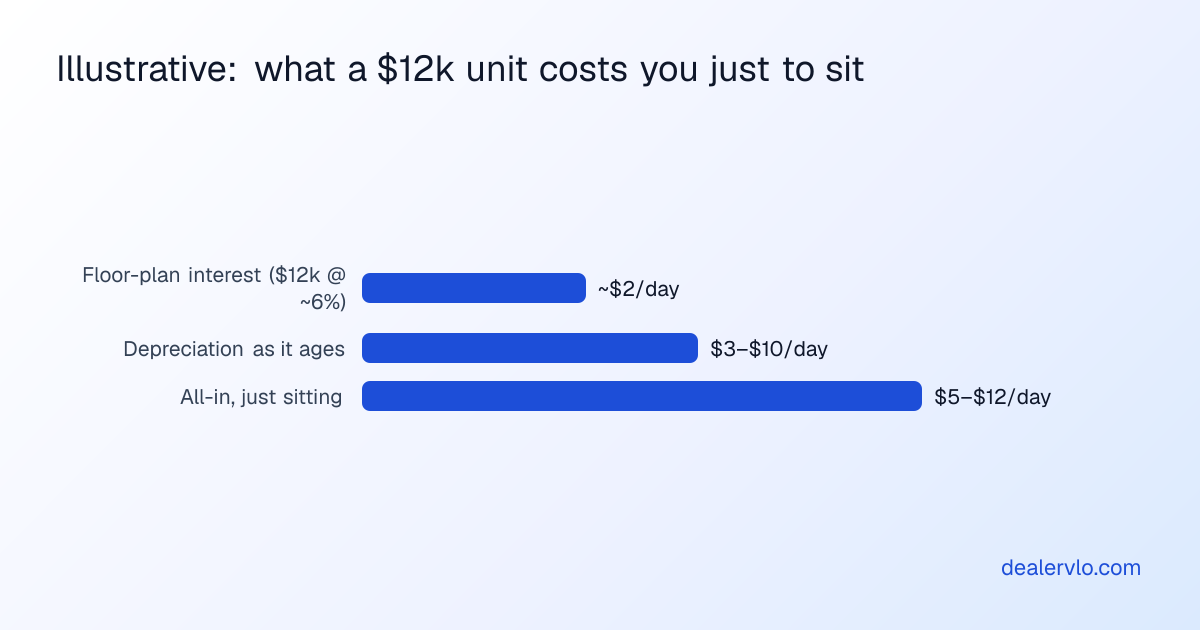
Run the math on a single $12,000 unit: floor-plan interest at around six percent is about $2 a day (12,000 × 0.06 ÷ 365 ≈ $1.97). Add depreciation as it ages — call it a few dollars to ten a day depending on the car and the market — and a unit that's just sitting is quietly costing you somewhere in the neighborhood of five to twelve dollars a day, every day, doing nothing. That's illustrative, not a quote; your numbers depend on your floor plan and your market. But feel that number and you'll never again shrug at a car that's sat a week too long. If you want the real figure for your lot, track it.
6. Fresh intake. Last check: yesterday's buys. Every car you bought is dead weight until it's recon'd, photographed, priced, and online — the clock started the day you paid for it, not the day it hits the line. The morning check is just making sure nothing you bought is stuck in a holding pattern in your own back lot.
Put a real dollar-a-day number on every unit sitting on your lot.
Open the Holding Cost CalculatorMake it a habit, not a project
The whole thing is a scan, not an audit. You're not trying to fix everything before coffee — you're looking for the handful of things that are stuck or invisible and knocking them loose. Fifteen minutes, same order, every morning. A routine you'll actually run beats a thorough review you do once a month, because the leaks are daily and the check has to be too.
The reason I'm this opinionated about it is that I run it on my own lot, and the months I let it slide are the months the numbers get soft — not because of one big miss, but because a dozen small ones piled up while I was busy. The routine is the guardrail.
Frequently asked questions
What should a used-car dealer check every morning? The same short loop, before the day grabs you: overnight leads, deals sitting mid-flight, cars with no online price or photos, units past your aging threshold, the holding cost that's ticking, and yesterday's intake that still needs to reach the front line. Each one costs you money while it waits, and each is cheap to fix the day it happens.
How long should a daily lot routine take? About fifteen minutes on a small lot. It's a scan for what's stuck or invisible, not your whole day's work. Short and fixed beats thorough and occasional, because the leaks compound daily.
Why does a car with no price or photos cost me money? Because online, a car with no price and no photos effectively doesn't exist — shoppers filter by price and scroll past listings without pictures. So it sits, burning holding cost and depreciating, while properly listed cars sell around it. It's the cheapest leak to fix and the easiest to leave sitting.
What's the most important daily habit for a small used-car lot? Catching leaks before they compound. One car that sits ten extra days, one deal stalled on a signature, one lead answered late — small on their own, but they stack into the gap between a good month and a flat one.
The bottom line
You don't need a bigger lot or a smarter strategy to stop the slow bleed most small lots run — you need a fifteen-minute habit that catches the leaks the morning they spring. Leads, stuck deals, invisible cars, aging units, the money clock, fresh intake. Same loop, every day.
That list is also, more or less, the reason DealerVLO's dashboard opens the way it does. I got tired of running the routine from memory and a spreadsheet, so I built the home screen to do the looking for me: it surfaces the cars missing a price or photos, the deals waiting to be finished, and the leads that just came in — the morning open, already scanned, the second you log in. You can run this routine on a clipboard and it'll still make you money. I just wanted mine to hand me the list.