In-House Detailing vs. Mobile Detailing Cost for Dealers: Which One Actually Pays Off
In-house vs mobile detailing cost for dealers, compared on labor, turnaround and recon totals — with the math to run before picking a vendor.
Part of the Reconditioning guide: Used Car Reconditioning Cost: Budgeting & ROI for Dealers
Switching from another DMS? Compare DealerVLO to DealerCenter, Frazer, or Lot Wizard, or see what DealerVLO's car dealer management software includes.
Every lot eventually asks the same question: do we hire a detailer, or do we send cars out to a mobile crew? The honest answer is that both can work — the decision comes down to your volume, your lot layout, and whether you'd rather control the labor or control the invoice. This post walks through the real cost and turnaround tradeoffs, using the best national benchmarks available, so you can run your own numbers instead of guessing.
This is an operational comparison, not a legal or licensing guide — nothing here is state-specific advice, and detailing vendor insurance or licensing requirements vary enough that you should confirm them with whoever you're hiring before signing anything.
14-day free trial, then $29/mo · Cancel anytime
The quick comparison
| Factor | In-house detailer | Mobile/outsourced detailer |
|---|---|---|
| Pay structure | Hourly wage, on payroll | Per-job price, no payroll overhead |
| Approx. national wage (dealer industry) | ~$17/hr median, per BLS | N/A — priced per detail, not hourly |
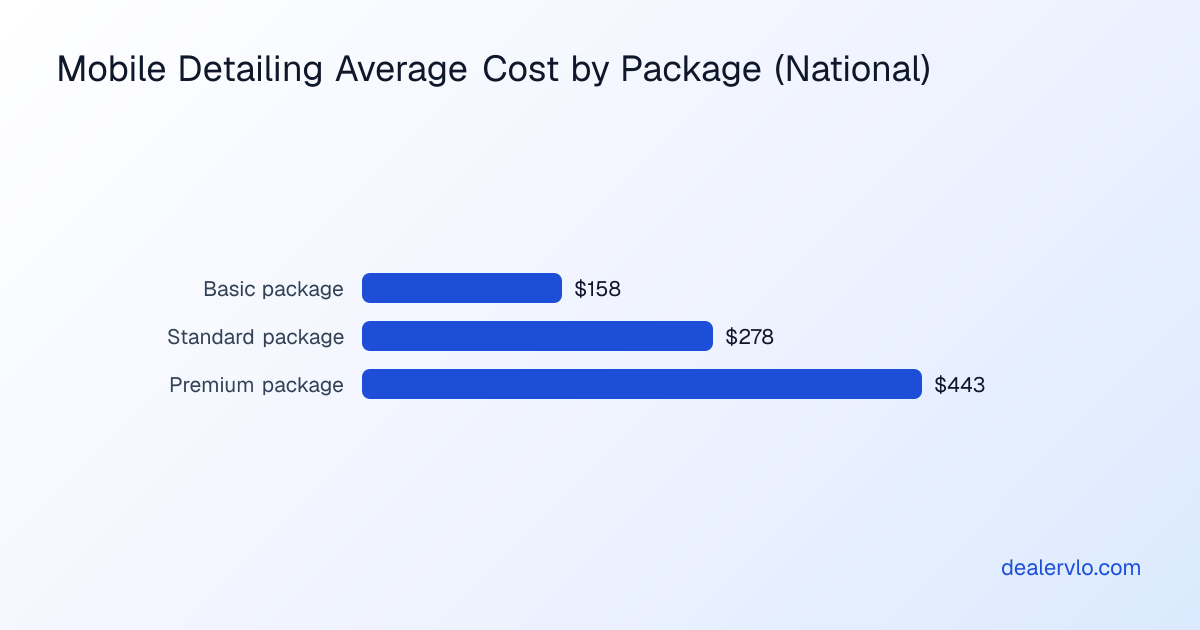
| Typical price per car | Varies by your own cost (wage + time) | Roughly $158 basic / $278 standard / $443 premium, national average |
| Turnaround | Under your scheduling control | Vendor comes to you, but on their schedule |
| Volume fit | Better at higher, steady volume | Better at low/variable volume |
| Fixed cost when idle | Yes — you pay the wage whether or not a car needs it | No — you only pay per car detailed |
That table is a starting point, not a verdict. The right call depends heavily on how many cars you move through detailing in a typical month, so let's break down each side.
What in-house detailing actually costs
The clearest dealer-specific number available is from the U.S. Bureau of Labor Statistics, which tracks wages inside the motor-vehicle-dealer industry specifically — not auto detailing shops in general. For the occupation BLS classifies as "cleaners of vehicles and equipment" within motor vehicle and parts dealers, the median hourly wage is around $17.09 and the mean is about $17.49, working out to a median/mean annual wage in the mid-$35,000s (BLS, Industries at a Glance: Motor Vehicle and Parts Dealers).
That figure is wage only. It doesn't include payroll taxes, workers' comp, benefits, or the time a manager spends supervising and scheduling that employee — and there isn't a reliable published number for how much to add on top of the base wage for those costs, so budget your own cushion rather than treating $17/hour as your true fully-loaded cost.
It's also worth separating detailing labor from mechanical recon labor, because the two get lumped together on a lot more often than they should. Automotive service technicians and mechanics earn meaningfully more — a 2025 median pay around $24.34 an hour, or roughly $50,620 a year, per BLS's Occupational Outlook Handbook (BLS, Automotive Service Technicians and Mechanics). If you're comparing "what it costs to recon a car in-house," make sure you're pricing the detailer's hour and the mechanic's hour separately — a shop that blends them into one "recon labor rate" is almost always understating the mechanical side and overstating the detail side.
The upside of in-house detailing isn't really the hourly rate — it's control. The car doesn't leave your lot, you set the queue order, and a detailer on payroll can also knock out quick wipe-downs, pre-delivery touch-ups, or get a car photo-ready on short notice without negotiating a job price every time. The downside is the fixed cost: you're paying that wage whether three cars or zero cars need detailing that day, and if your volume is genuinely a deal or so a week, an in-house detailer is likely to sit idle more often than not — which is exactly the situation a small lot needs to watch for.
What mobile detailing actually costs
The best disclosed-methodology number here comes from a 2026 industry survey of 89 operators across four major metros (New York, Chicago, Dallas, and Los Angeles), which found mobile detailing averages around $158 for a basic package, $278 for a standard package, and $443 for a premium package (Autodetailer.com 2026 Mobile Detailing Pricing Analysis). That same survey put interior-only jobs at roughly $217 on average and exterior-only at roughly $177.
Two things to keep in mind before you plug those numbers into your own budget. First, these are consumer-facing retail prices from national cost guides — not necessarily what a mobile operator would charge a dealer sending them five or ten cars a week on a standing arrangement. If you're a repeat, bulk customer, it's worth asking directly for a volume rate rather than assuming the retail number applies to you.
Second, mobile pricing has to cover the vendor's fuel, drive time, and setup in a way that a shop-based detailer working in your own bay doesn't. A reputable mobile operator builds that into their package price or charges a separate travel fee (Housecall Pro, How Much to Charge for Car Detailing). If a mobile quote looks suspiciously close to a shop rate with no travel component at all, ask what's included.
On turnaround, the same survey gives rough time-on-site figures by package: about 1.5 hours for a basic detail, 2.8 hours for a standard detail, and 4.3 hours for a premium detail. That's useful for scheduling — a mobile crew that commits to a standard package is telling you roughly how long your car will be tied up, without you having to drive it anywhere.
Where detailing sits inside your total recon number
It helps to keep perspective on how big a piece detailing actually is. Independent dealers are reporting average total reconditioning costs — mechanical plus cosmetic plus detailing combined — in the range of roughly $1,455 to $1,679 per unit depending on the year measured, with BHPH-focused dealers reporting a separate average closer to $1,440 (NIADA Dashboard data, NIADA Q1 2025 Dashboard). There isn't a reliable, named source that breaks detailing out as its own line within that total — so be skeptical of any claim you see online stating "detailing costs $X of your recon budget." Treat that kind of number as a planning guess, not a statistic.
What that NIADA figure is useful for is context: if a mobile detail job runs you $278 on a standard package, that's a meaningful chunk of a roughly $1,500–$1,700 total recon spend on an average unit — enough that it's worth tracking per car, not folding into a vague "recon" bucket you never revisit. This is one spot where a line-item view of recon costs pays for itself: when you can see the detailing line separately from the mechanical lines on every car, you actually know which vendor relationship is worth renegotiating. DealerVLO tracks reconditioning cost line by line on each vehicle — vendor, description, and cost — so a mobile detail job and a mechanical repair on the same car show up as separate lines, both rolling into that car's all-in cost and gross on the sales report, and into the P&L's single Reconditioning total for cars sold in the period.
14-day free trial, then $29/mo · Cancel anytime
If you want to sanity-check whether a specific detail job is even worth paying for before you authorize it — say, a premium exterior polish on a car that's already priced to move — the
Before you authorize the work: see whether a repair earns back its cost plus the holding days it adds.
Open the Recon ROI Calculatorweighs the cost and days in the shop against the retail value the work actually adds, whoever does the work.
Turnaround: the factor that's easy to underweight
Cost gets all the attention in this decision, but turnaround often matters more for a small lot. A car sitting in a detail queue isn't on your website at its best, isn't attracting the clicks a clean photo set would get, and isn't moving toward a sale.
In-house detailing keeps the car on your lot the whole time, under your own scheduling control — useful when you're trying to push a car through fast during a heavy acquisition week, since you're not waiting on an outside appointment slot. Mobile detailing eliminates the drop-off and pickup entirely, since the vendor comes to you, but you're still working within their schedule, and a crew juggling multiple dealer accounts may not treat your car as the priority the way your own employee would.
There's no solid published figure for exactly how many cars per day an in-house detailer or a mobile crew can turn, so don't trust any number you see claiming otherwise — the honest planning approach is to track your own cars' time in the detail step and use that as your baseline going forward. Every car in DealerVLO shows its days in inventory, and the dashboard's "needs attention" list calls out a count of cars sitting on the lot 60+ days — a general early-warning signal worth checking regularly if a detailing backlog (or any other recon step) is quietly stretching out your time to sell.

A simple way to decide which one fits your lot
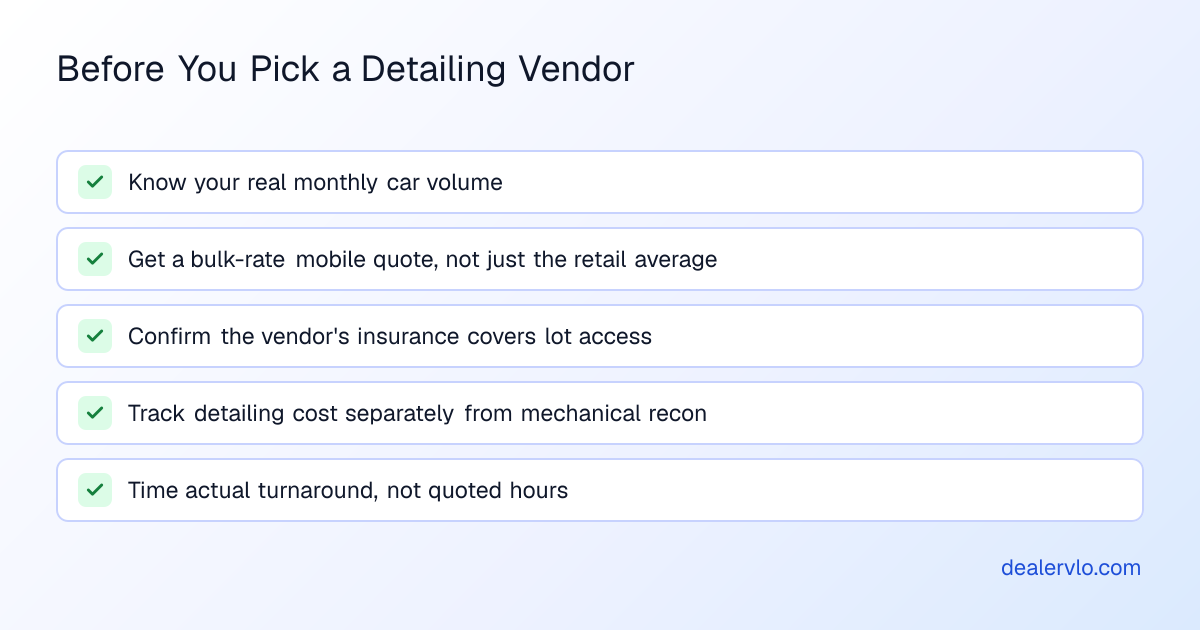
- Count your real monthly volume. If you're moving a car or two a week, the fixed cost of an in-house detailer on payroll is hard to justify against per-job mobile pricing. If you're running ten-plus units a month through detail, the math starts to flip.
- Price both sides with your own numbers. Take the BLS wage benchmark and multiply by a realistic hours-per-car estimate for your market, then add your own cushion for taxes and overhead. Compare that to a mobile quote at your actual package level (basic, standard, or premium) — and ask for a repeat-volume rate before you assume the retail average applies.
- Test turnaround with a trial run. Run a few cars through each option and time how long each car is actually out of saleable condition, door to done — not just the quoted hours.
- Track the cost per car going forward, not just once. A single comparison is a snapshot; vendor prices and your own volume both shift. Keep the detailing cost line visible on every car so you notice if a vendor's pricing creeps or your in-house detailer's output slows.
- Reassess at the next slow season. A dealer running close to the margin on a small lot often finds the right answer changes with the calendar — busy spring months may justify in-house help that doesn't pencil out in a slower stretch.
If you're weighing this decision alongside whether to bring mechanical recon in-house too, that's a related but separate call — see the comparison on in-house mechanic vs. sublet recon for that side of the shop.
14-day free trial, then $29/mo · Cancel anytime
Holding costs should factor into the decision too
A car waiting in a detail queue — whether that's an in-house backlog or a wait for a mobile appointment — is still costing you money every day it isn't sellable: floor plan interest, insurance, and lot space all keep running. DealerVLO doesn't calculate a per-car holding cost (that stays an overhead line on your P&L), but the
Put a real dollar-a-day number on every unit sitting on your lot.
Open the Holding Cost Calculatorlets you put a real dollar-a-day figure on a car sitting idle, which is useful context when you're deciding whether a two-day mobile wait is actually cheaper than paying a detailer overtime to finish it same-day.
For the bigger picture on budgeting reconditioning overall — not just the detailing slice — the used car reconditioning cost and budgeting guide covers how to set a realistic per-unit recon number before you start negotiating with any vendor. And if your detailing problems are really a symptom of cars getting stuck somewhere in the shop generally, the piece on reconditioning bottlenecks is worth a look before you blame the detailer.
Managing either option day to day
Whichever way you go, the operational discipline is the same: know what a given car cost to recon, hold vendors accountable to some standard, and keep an eye on quality. If you outsource to a mobile crew (or any sublet shop), a basic vendor scorecard and SLA keeps the relationship from drifting — late jobs, missed spots, or price creep are a lot easier to catch when you're tracking them against a standard instead of your memory. If you bring detailing in-house, the same quality-control habits that stop techs from cutting corners apply just as much to a detailer rushing through a car at the end of a shift.
Either way, once a detail job is done, the car still needs to actually go up for sale looking its best. DealerVLO's vehicle pages print the FTC Buyers Guide and a one-page window sticker directly from the car's record, no deal needed, so a freshly detailed car can get back on the lot and onto your website with its paperwork ready the same day.
Frequently asked questions
Is mobile detailing cheaper than hiring an in-house detailer?
It depends entirely on your volume. At low volume, mobile detailing avoids paying a wage for idle time, so it's usually cheaper overall even though the per-job price (roughly $158–$443 nationally depending on package, per 2026 industry survey data) looks higher than an hourly wage. At higher, steady volume, an in-house detailer's hourly cost can come out lower per car, once you account for the time a mobile crew needs to travel and set up for each visit.
What does mobile detailing cost for dealers compared to retail customers?
Published national averages (around $158 basic, $278 standard, $443 premium) are consumer retail prices from cost-guide surveys, not necessarily what a dealer sending recurring volume would pay. It's worth asking any mobile operator directly for a bulk or standing-account rate rather than assuming the published average applies to your account.
How much of my total reconditioning budget should go to detailing?
There's no reliable, named industry source that breaks out detailing as its own percentage of total recon spend — independent dealers report total reconditioning (mechanical, cosmetic, and detailing combined) averaging roughly $1,455 to $1,679 per unit, but detailing's share within that isn't separately published. Track your own detailing line per car rather than relying on a borrowed industry percentage.
How long does a mobile detail take compared to an in-house job?
The best available data point is from a 2026 mobile-detailing survey, which found average time on-site of roughly 1.5 hours for a basic package, 2.8 hours for a standard package, and 4.3 hours for a premium package. There isn't a comparable disclosed-methodology figure for in-house shop time, so track your own detailer's hours per car rather than relying on a generic number.
Should I separate detailing labor cost from mechanical recon labor cost?
Yes — they're paid very differently. Vehicle cleaners/detailers in the motor-vehicle-dealer industry earn a median wage around $17 an hour, while automotive service technicians and mechanics earn a median closer to $24 an hour, so blending the two into one "recon labor rate" will distort your numbers either way.
Does DealerVLO track which detailing vendor I use or compare mobile vs. in-house for me?
DealerVLO doesn't recommend a vendor or run that comparison for you — that's a business decision based on your own volume and market. What it does is track each recon cost line (vendor, description, and cost) on every car, so whichever option you choose, you can see exactly what detailing cost you on each unit and how it rolled into that car's all-in cost and gross.
Bottom line
There's no universal right answer between in-house and mobile detailing — it's a volume math problem, and the honest version of that math uses your real monthly car count, a realistic hourly cost (or an actual mobile quote at your market and package level), and a turnaround test you run yourself rather than a number from a blog. What matters more than which option you pick is that you keep tracking the cost per car once you've made the call, so you notice when the math changes. Run both scenarios with your own numbers before you commit to either one, and if you want every detailing and recon line visible on each car without digging through a spreadsheet, give DealerVLO a look.
14-day free trial, then $29/mo · Cancel anytime