Building a Recon Status Board: Tracking Where Every Car Is Without Buying Separate Software
How to track a car through the reconditioning process with a shared status board — stages, owners, and when to add DealerVLO instead of a dedicated tool.
Part of the Reconditioning guide: Used Car Reconditioning Cost: Budgeting & ROI for Dealers
Switching from another DMS? Compare DealerVLO to DealerCenter, Frazer, or Lot Wizard, or see what DealerVLO's car dealer management software includes.

If you've ever had to walk out to the shop, then to the detail bay, then call the photo guy, just to answer "where's the Accord?" — you already know the real problem isn't how long recon takes. It's that nobody can see where a car is without asking four people. Learning to track a car through the reconditioning process in one shared place fixes more lost gross than almost any other single change a small lot can make.
This isn't a piece about shaving days off your recon time or hunting down bottlenecks. It's about building a status board — spreadsheet, whiteboard, or DMS — that lets your used-car manager, your service writer, your body shop, your detailer, and whoever takes photos all look at the same list and know exactly where every car sits, without a single phone call.
14-day free trial, then $29/mo · Cancel anytime
Why "where is my car" is a visibility problem, not a speed problem
A DealerRefresh forum thread on this exact topic nails the actual ask: a dealer wanted one place where the UC manager, the service manager, the recon manager, and the picture guy could all look and see where a car was in the process, with the goal of getting cars on the lot with photos within 72 hours. That's not a cycle-time dashboard — it's a shared view.
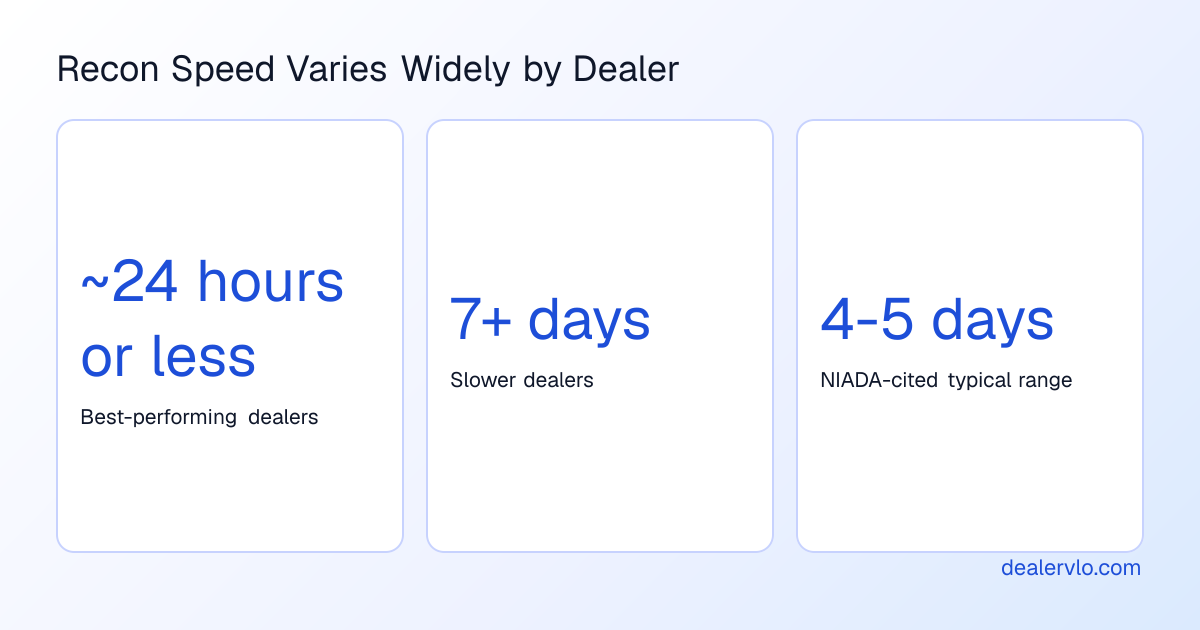
Cox Automotive's own dealer guidance makes a related point: dealers report wildly different recon timelines, with the best-performing shops finishing in about a day and others taking a week or more, and the spread usually comes down to whether the dealer treats time in recon as lost front-end profit and actually monitors the process — not whether they have faster labor. NIADA's best-practices guidance echoes this from the independent-dealer side: recon typically should take only a handful of days, but for an independent dealer it often runs much longer because of factors outside their control, which is exactly why constant follow-up matters more than raw speed. Translation for a small lot: you don't need a time-and-motion study. You need a place where "in detail" or "waiting on a part" is visible to everyone who touches that car, so nothing sits forgotten.
There's a structural reason this gap exists. Cox notes that some stores give the used-vehicle manager responsibility for recon, working it out with their counterparts in service. That manager ends up owning the outcome without running the service department, the body shop, or the detailer doing the work. A shared board is how you close that gap without reorganizing your dealership.
The stages: build your board around milestones, not vague labels
A practitioner on that same forum thread (posting as jscole86) laid out a milestone structure that's worth copying almost exactly. Instead of a single "status" field with values like "in progress," track the actual date each thing happened: Inventory Date, Service Recon Completed, Body Work Completed, Vehicle Detail Completed, Price Added, Photos Added, Description Added, Window Sticker Created, First Seen on Website, First Seen on a listing site, Vehicle Sold. Once you have dates instead of labels, you can see the gap between any two stages — how long a car sat between "detail done" and "photos added," for example — without anyone needing to remember or report it.
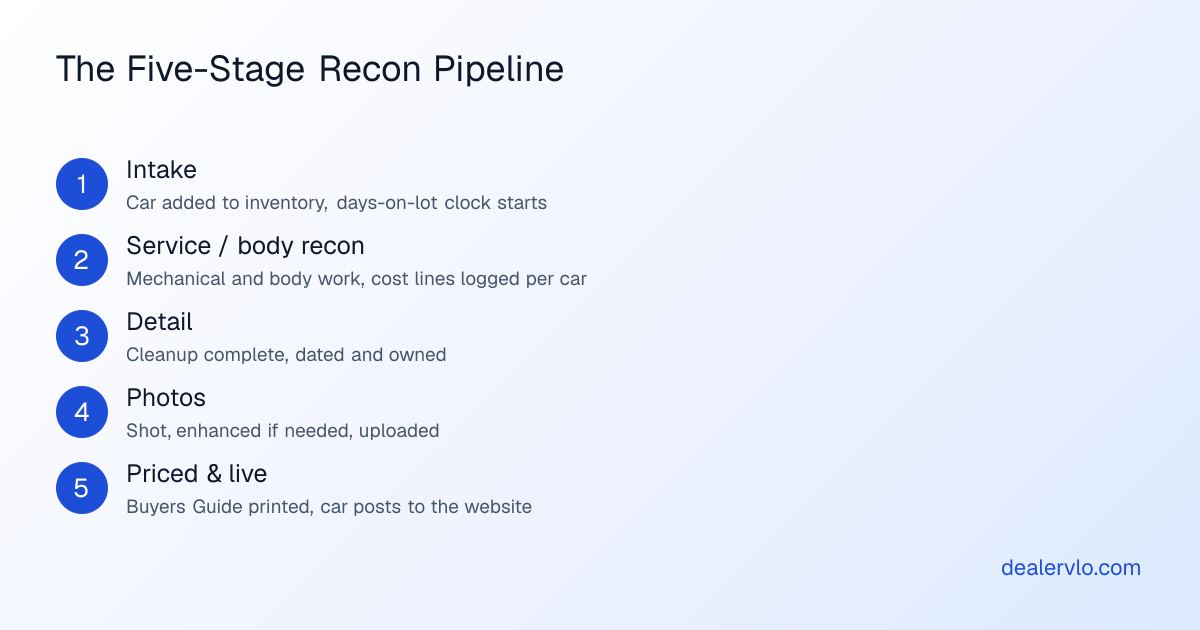
For a small independent lot, that condenses naturally into five stops: UC manager intake/appraisal, service recon, body shop (if the car needs it), detail, and photos. Each one is a column. Each column gets two things: a status, and a date it was completed. That's the whole board. You don't need software to build this — a shared spreadsheet with one row per car and one column per stage does the job on day one.
Give every stage an owner, not just a status
The same forum thread sketched an idea worth stealing even if you never build the automated version: when a deal brings in a trade, the system could create a task for the UC manager to inspect it and decide retail or wholesale, a task for service to expect the incoming unit, and a task for whoever shoots photos. The point isn't the automation — it's that every stage has a named person responsible for moving the car to the next one. A status board with a blank "owner" column just becomes another list nobody's accountable for.
This is also where photos deserve their own column, not an afterthought tacked onto "detail." It's easy for a recon board to skip the photo step, but a step with no column has no owner, no owner means no clock, and no clock means nobody notices the car that's sitting fully reconditioned with zero pictures online. If you use a third-party photographer, that's doubly true — a dealer on the same forum thread pointed out that lots relying on outside photographers have to wait on their schedule, and someone still needs to do quality control on the car coming out of the shop for grease footprints and fingerprints before it's called "photo ready." Give photos their own owner and their own completion date, full stop.
Reconditioning cost is the other half of this picture — tracking where a car sits doesn't tell you what it's costing you to get it there. If you haven't nailed down what a realistic recon budget looks like by vehicle condition, our guide to budgeting reconditioning cost and ROI is the companion piece to this one.
Why a shared spreadsheet alone tends to break down
A plain spreadsheet is a fine starting point — and it's not a new idea. A dealer on the DealerRefresh forum described using Excel back in 2007 to track most of this same information, and noted the honest limitation: most people in a dealership are comfortable with Excel, but a file lives on one desktop. Mapping it to a shared network drive helps, but it doesn't solve who's allowed to edit it, who overwrites someone else's update, or why the version your detailer has open is three hours stale by the time your used-car manager checks it. The desk managers, that dealer pointed out, need this information more often than anyone else — which means it has to live somewhere everyone can hit at once without stepping on each other.
That's the actual argument for keeping the underlying car data in a system every department already logs into, rather than a file someone has to remember to update and re-share. In DealerVLO, every car already carries its days in inventory automatically from the moment it's added, and per-car reconditioning cost lines — vendor, description, cost — sit right on that car's record, so the same record your team opens to check on a car also shows what it's cost to get there so far. It won't give you a dedicated recon task queue or an auto-generated "expect this car" alert to your service writer — that part of the board (who's responsible for what, and when they're supposed to act) is still something you run as a process, on a spreadsheet or a whiteboard next to the shop door, with DealerVLO holding the underlying inventory and cost data everyone's checking against.
Before you authorize the work: see whether a repair earns back its cost plus the holding days it adds.
Open the Recon ROI CalculatorDeciding whether one more repair is worth the wait
A status board tells you where a car is stuck. It doesn't tell you whether the thing it's stuck on is worth doing. If a car's been sitting in the body shop for a week over a dent that'll add maybe a few hundred dollars at retail, that's a decision, not just a stage to track. Before you authorize a marginal repair — whether a sublet shop or your own tech is doing it — run the numbers: what the repair costs, how many days it adds, and what it actually adds to retail value. The Recon ROI Calculator does exactly that comparison, including what the math looks like if the repair only adds half of what you expected.
14-day free trial, then $29/mo · Cancel anytime
The one compliance checkpoint every board needs at the end
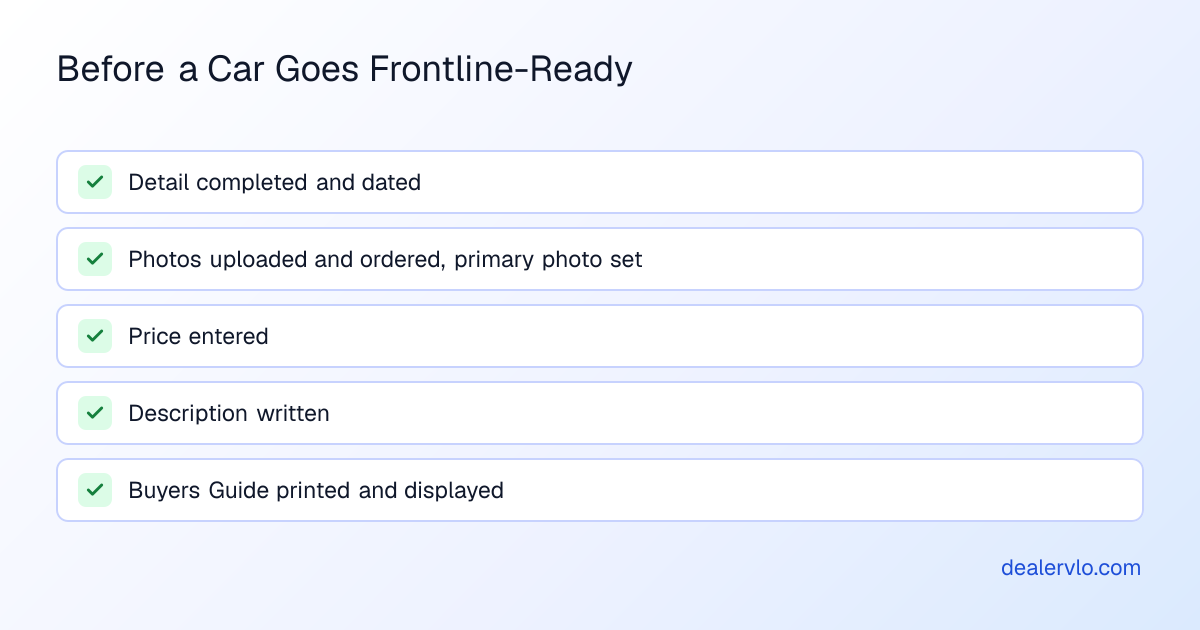
Whatever stages you track, one of them needs to be a hard gate, not a soft one: the FTC's Used Car Rule requires dealers to prepare and display a Buyers Guide window sticker on a used vehicle before offering it for sale, and that requirement applies once a dealer sells more than a handful of used vehicles a year — which covers essentially every used-car lot. The rule's been in effect since 1985 and the FTC updated it in 2016. This isn't legal advice — confirm the current Buyers Guide requirements for your state and dealership with the FTC or your state dealer association before you finalize your process, since state rules can layer on top of the federal one.
Practically: "Buyers Guide printed and on the windshield" belongs as the last column on your board, after photos, before "frontline ready." It's cheap insurance against a car getting listed or sold without it. In DealerVLO, the FTC Buyers Guide prints from each car's page without a deal, so it can hang on the car while it's for sale.
Why most independent dealers don't need dedicated recon software
Dedicated recon-tracking platforms exist, and they do more than a status board — vendors like Rapid Recon describe giving a dealer a real-time view of every car's exact position, its repair estimates, and its per-car costs from a single screen.
That's real value — for a rooftop running enough volume that department handoffs get genuinely chaotic. For a lot moving a handful of cars a week, you're usually better off replicating the visibility (shared stage list, named owners, completion dates) on a simple board, alongside the system you're already using for inventory and deals, rather than paying for and logging into a separate platform on top of your DMS. If you're weighing that tradeoff more broadly across your whole operation, not just recon, our piece on bundled vs. separate dealer software walks through when a standalone tool earns its keep and when it's just another login.
If your bottleneck isn't visibility but who's actually doing the work — your own tech versus a sublet shop — that's a separate decision with its own math; see in-house mechanic vs. sublet recon for that comparison. And if the sublet side of recon is the part that keeps slipping, a vendor scorecard with real SLAs is the fix, not a bigger spreadsheet.
Putting it together on a small lot
For a lot running the five-stage board — intake, service, body (as needed), detail, photos — here's roughly how it maps if you're running on DealerVLO alongside a simple tracking sheet or whiteboard:
- Intake. Car gets added to inventory with VIN decode and acquisition cost. Days-in-inventory starts counting from here automatically.
- Service / body recon. Recon cost lines get logged per car as work happens — vendor, description, cost — building toward that car's all-in cost.
- Detail. Mark complete on your board; this is the stage most lots forget to date-stamp, which is exactly why detail-to-photos gaps go unnoticed.
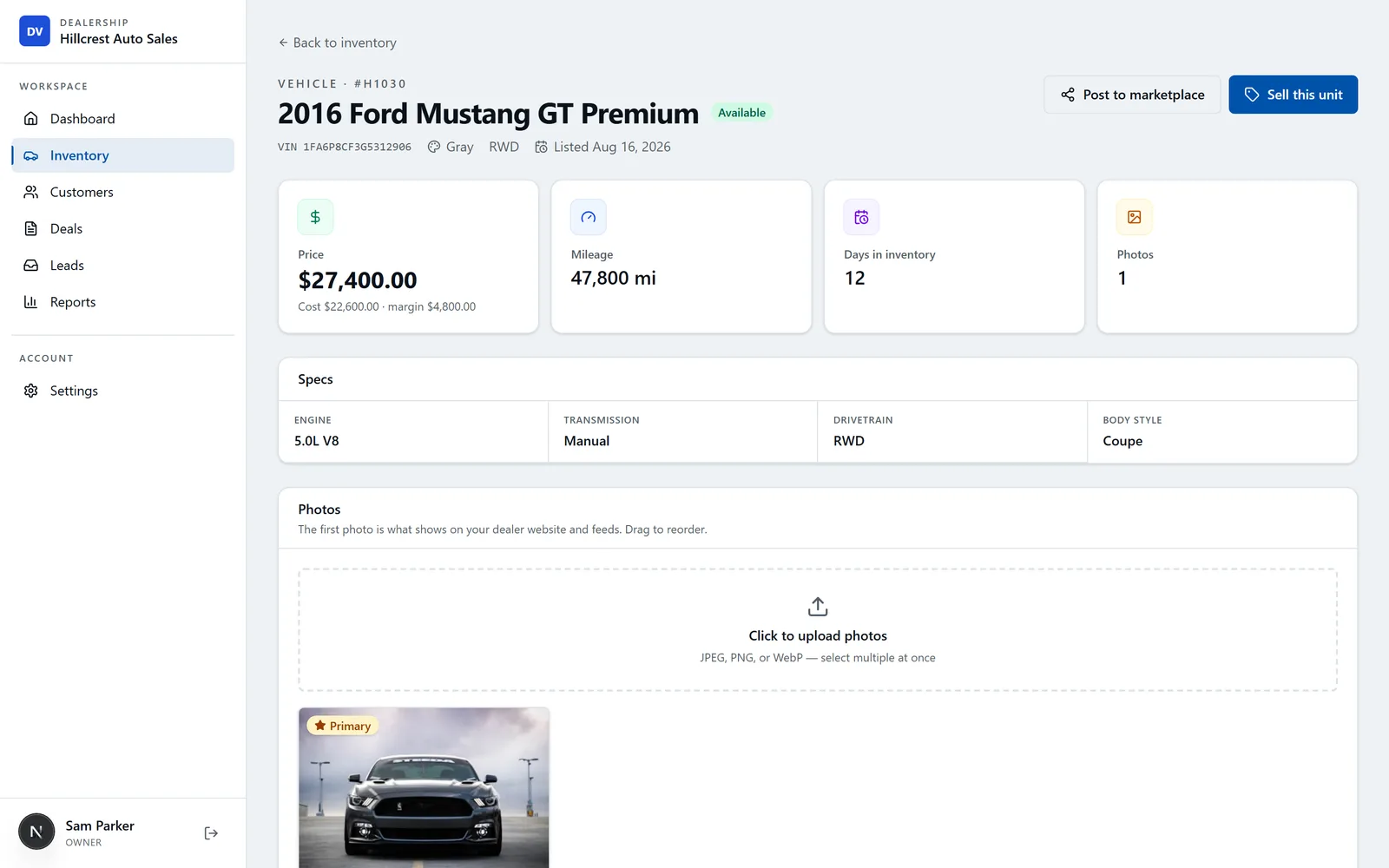
- Photos. Photos get uploaded, with the AI photo enhance option available if you want a clean backdrop on the primary shots before they hit the website — drag to reorder, and set the primary photo.
- Priced and live. Set the price. Inventory posts to your dealer website automatically, and the Buyers Guide and window sticker both print from that car's page.
Once a car hits 60 days, its page in DealerVLO shows an "aging, consider repricing" flag, and your dashboard's "Needs attention" list shows how many cars are on the lot 60+ days — a useful backstop for catching the car that fell off everyone's radar, even if your stage board missed it.
14-day free trial, then $29/mo · Cancel anytime
Frequently asked questions
How do I track a car through the reconditioning process without buying special software?
Build a shared list — a spreadsheet or whiteboard works — with one row per car and one column per stage (intake, service, body, detail, photos, priced/live). Give each stage a completion date and a named owner, not just a status word, so anyone can see where a car is and who's responsible for moving it forward without having to ask around.
What stages should a recon status board actually track?
At minimum: inventory/intake date, service recon complete, body work complete (if needed), detail complete, photos added, price set, and Buyers Guide printed. A practitioner-tested milestone list also includes description added, window sticker created, and first seen on your website or listing sites — useful if you want to see gaps between any two steps.
Who should own each stage on a recon pipeline board?
Assign one person per stage: the used-car manager typically handles intake and the retail/wholesale call, service owns mechanical recon, the body shop owns body work, a detailer owns cleanup, and someone specific — in-house or a third-party photographer — owns photos. The UC manager often owns the overall recon outcome without controlling every department doing the work, which is exactly why each stage needs its own named owner.
Why does a shared spreadsheet break down for tracking recon status?
A spreadsheet works fine for one person, but it typically lives on one desktop or one shared drive, which creates version conflicts and access issues once multiple departments need to update it at the same time. A dealer-reported precedent from 2007 found that desk managers needed this information more often than anyone else, which is why a system everyone already logs into tends to hold up better than a passed-around file.
Does tracking recon status help me sell cars faster?
It doesn't speed up the mechanical work, but it stops cars from sitting forgotten between stages — which is often where real time gets lost. NIADA's dealer guidance notes that skimping on reconditioning, not just slow reconditioning, is the most common reason a car fails to sell in its first month on the lot, and a visible pipeline makes it much harder for a car to quietly stall.
Is the FTC Buyers Guide part of the recon process or a separate paperwork step?
Treat it as the final gate on your recon board, not a separate task. The FTC's Used Car Rule requires the Buyers Guide be prepared and displayed before a used vehicle is offered for sale, so it belongs as the last column before a car is marked frontline-ready — confirm your state's specific requirements with your state dealer association or the FTC, since this isn't legal advice.
Bottom line
A recon status board isn't about cycle-time charts or shaving hours off your shop's labor — it's about making sure every car's current stage and next owner is visible to everyone who touches it, so nothing sits forgotten between the shop and the frontline. Start with the five-stage structure above, put a date on every milestone instead of a vague label, and add the Buyers Guide as your last hard checkpoint before a car goes live. If you want days on the lot, recon costs, and deals in one system while your board tracks the stages, start a free DealerVLO trial.
14-day free trial, then $29/mo · Cancel anytime