Holding Sublet Recon Vendors Accountable: Building a Vendor Scorecard and SLAs
How to set turnaround SLAs, track sublet recon vendors with a scorecard, and handle repeat offenders on a used-car lot.
Part of the Reconditioning guide: Used Car Reconditioning Cost: Budgeting & ROI for Dealers
Switching from another DMS? Compare DealerVLO to DealerCenter, Frazer, or Lot Wizard.
If you've already decided sublet makes more sense than running your own shop, the next problem is the one nobody warns you about: a sublet vendor has no built-in reason to hurry. They've got their own queue, their own priorities, and your car is one of many on their rack. Without a recon vendor scorecard and some basic SLAs in writing, "it'll be ready Thursday" turns into Thursday, then next Tuesday, while your car sits there earning nothing.
This isn't about whether sublet or in-house is the right call — that's a separate decision with its own math. This is about what to do once you've already picked sublet: how to set a turnaround standard, track each vendor against it, and know when to have the "we're moving the work elsewhere" conversation instead of just hoping next time is better.
14-day free trial, then $29/mo · Cancel anytime
Why "trust but no system" costs you real money
Every day a car sits waiting on a sublet vendor is a day it's not on your front line earning. It's still costing you, though: floor-plan interest if the unit is floored, insurance, depreciation while it sits, and the lot space it's taking from a car that's ready to sell. Ed Curry, a NIADA 20 Group moderator, writing on niada.com, puts those holding costs at roughly $35 to $55 per day per vehicle. Your own number depends on how you finance and run your lot, but at that range a few cars coming back days late every month adds up to real money you never see on an invoice.
Stack that on top of what recon itself already costs. NIADA reported in June 2024 that dealers were paying an average of $1,679 in reconditioning that year, up from $1,455 the year before, and more than $500 above 2020. A slow vendor adds holding cost to a car that's already carrying that much before it ever sees a price tag. To put a real number on a day of delay for your own cars, use the calculator below and multiply by the days your vendors routinely run over.
Put a real dollar-a-day number on every unit sitting on your lot.
Open the Holding Cost Calculator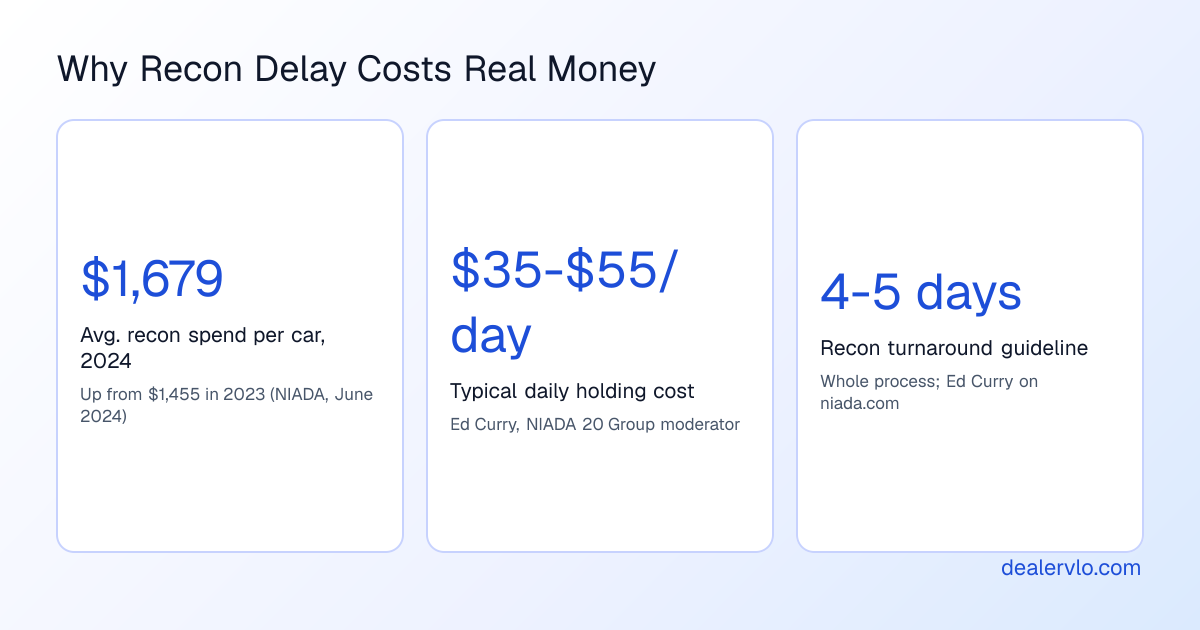
The tension worth sitting with: in the same article, Curry names skimping on reconditioning — not doing needed repairs to save money — as the most common reason a car doesn't sell in its first 30 days. So an SLA system has to penalize slowness without tempting anyone, vendor or your own used car manager, to cut corners just to beat the clock. The goal is faster and right, not faster instead of right.
Set the turnaround benchmark before you set the penalty
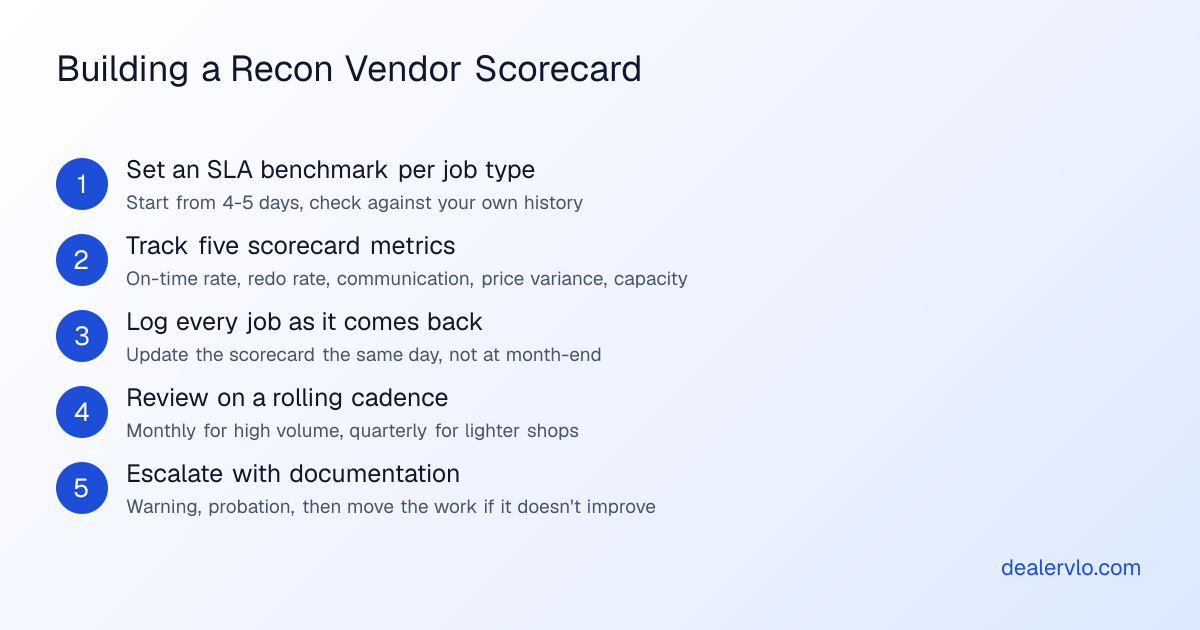
You can't hold a vendor accountable to a number you made up on the spot. There's no official industry standard, but there is a published benchmark: Ed Curry, a NIADA 20 Group moderator, writes on niada.com that the whole reconditioning process should usually take only four to five days, while noting that independent dealers often run longer for reasons outside their control — think parts availability, a backed-up body shop, or a specialty repair that has to go to a franchise shop. Check that against your own history: for a few weeks, log the date each car goes to a vendor and the date it comes back, by job type.
Use four to five days as your starting SLA for a typical job, then adjust up for job types that are legitimately slower (frame or structural work, a wait on a dealer-only part) and down for the fast stuff (a detail, a key cut, an oil change). Put the number in writing with each vendor — not as a threat, just as the agreed standard both sides are working to. A vendor who knows the clock starts the day the car arrives, and knows what "on time" means, behaves differently than one operating on vague goodwill.
This is also where basic tracking earns its keep, even though it won't do the vendor math for you. Every car's record in DealerVLO shows days in inventory, with a flag once a car crosses 60 days on the lot — that's a general aging signal for the whole lot, not something tied to recon or a specific vendor. If you want to know how much of a car's time was spent waiting on a sublet shop specifically, that's still a note you keep yourself; DealerVLO doesn't separate "days at the vendor" from total days on the lot. What it does give you is a reliable record of total days aging, so a pattern of consistently slow cars at least shows up somewhere instead of disappearing into memory.
Build the scorecard: five things worth tracking
You don't need vendor-management software to run this. A spreadsheet or even a shared note works, as long as you update it every time a car comes back. Track these five things per vendor:
- On-time rate — percentage of jobs that came back within the SLA you set for that job type. This is the headline number.
- Comeback / redo rate — how often a car comes back from that vendor and then needs the same thing fixed again, or a customer brings it back with the same complaint. Robert Ogle of Armor Auto Sales in Austin, quoted in a NIADA piece on how dealers approach recon, put the standard plainly: "We look for drivability. We don't want it coming back the next day or week." That's the failure mode a redo-rate column is built to catch.
- Communication compliance — did the vendor flag a delay before the SLA date passed, or did you have to chase them? A vendor who proactively flags a slip on a hard job is more valuable long-term than one who goes silent and then surprises you.
- Price variance — quoted cost versus what actually got billed. Occasional variance for a job that turned out worse than expected is normal; a vendor who consistently bills well over quote on routine jobs is telling you something about how they operate.
- Capacity reliability — how often the vendor accepts a car into their queue and then can't actually start it within the window they agreed to. This is different from running late on a job already in progress; it's about whether their intake promises mean anything.
Review each vendor on a rolling basis — monthly if you move a lot of volume through sublet, quarterly if it's lighter. A three-tier response (warning, probation, move the work) gives everyone a clear, documented path instead of a one-day blowup after the fifth late car.
14-day free trial, then $29/mo · Cancel anytime
Where this connects to the rest of your recon workflow
A scorecard doesn't exist in a vacuum — it's one piece of the broader recon process, and it only works if you're also diagnosing why cars get stuck in the first place. If the real bottleneck is your own intake process, not the vendor, no SLA fixes that; see the breakdown of common reconditioning bottlenecks for the other usual suspects (parts ordering, estimate approval delays, a detail queue that's its own chokepoint).
It's also worth being disciplined about what actually goes to the vendor in the first place. Every job you sublet that didn't need to be sublet is extra time in someone else's queue instead of your own control — the what-not-to-fix triage checklist is a useful filter to run before a car goes out the door, so you're only sending the vendor work that genuinely requires their shop. Before authorizing a borderline job, it's also worth running it through the recon ROI calculator to see whether the added value actually justifies the days it'll sit with the vendor.
On a related note, there's a structural reason some jobs are slow no matter who does them: independent dealers and shops don't have the same access to diagnostics, software, parts and repair data that manufacturers do (it's why NIADA lobbies for right-to-repair rules), so certain work has to go through specialty or dealer-only channels. That's a real constraint, not a vendor being lazy, and it's worth factoring into your SLA for those specific job types rather than holding every vendor to the same clock regardless of job.
Per-car cost tracking matters here too. DealerVLO lets you log each recon line item — vendor, description, cost — against the specific car, so once you enter a vendor's bill as a cost line, it rolls straight into that car's all-in cost and margin without a separate system. It won't total recon by vendor across your whole lot or flag price creep automatically — that comparison across vendors is still something you build in your own scorecard — but it keeps the per-car record straight, which is the raw material your scorecard needs anyway.
What a scorecard conversation actually sounds like
The point of all this tracking isn't to build a case file — it's to have a short, factual conversation instead of a vague one. "You've been averaging two days over SLA the last six cars, and three of those were communication misses where I found out you were behind by calling you, not the other way around" lands very differently than "you've been slow lately." One is something a vendor can act on; the other just creates friction.
For a vendor who's otherwise good — fair pricing, solid work, just occasionally slow on a specific job type — the scorecard data lets you have a targeted conversation: "your paint work is always on time, but mechanical jobs are consistently several days over — what's going on with that queue?" That's a fixable, specific ask. A vendor who can't explain or improve a pattern like that, after a documented warning, is a vendor you start moving volume away from — not necessarily all at once, but enough to signal it's not an idle threat.
Know the risk before you withhold payment on a dispute
One thing worth understanding before you ever get into a standoff over a bill: if you withhold payment on a disputed invoice, most states' mechanic's- or garage-lien laws let the shop keep the car until the bill is settled, and eventually sell it after whatever notice steps the state requires. The exact timelines and thresholds differ significantly state to state, so if you're ever actually facing this situation, read your state's lien statute and check with your DMV or motor vehicle agency before you act — this isn't legal advice, and the specifics matter.
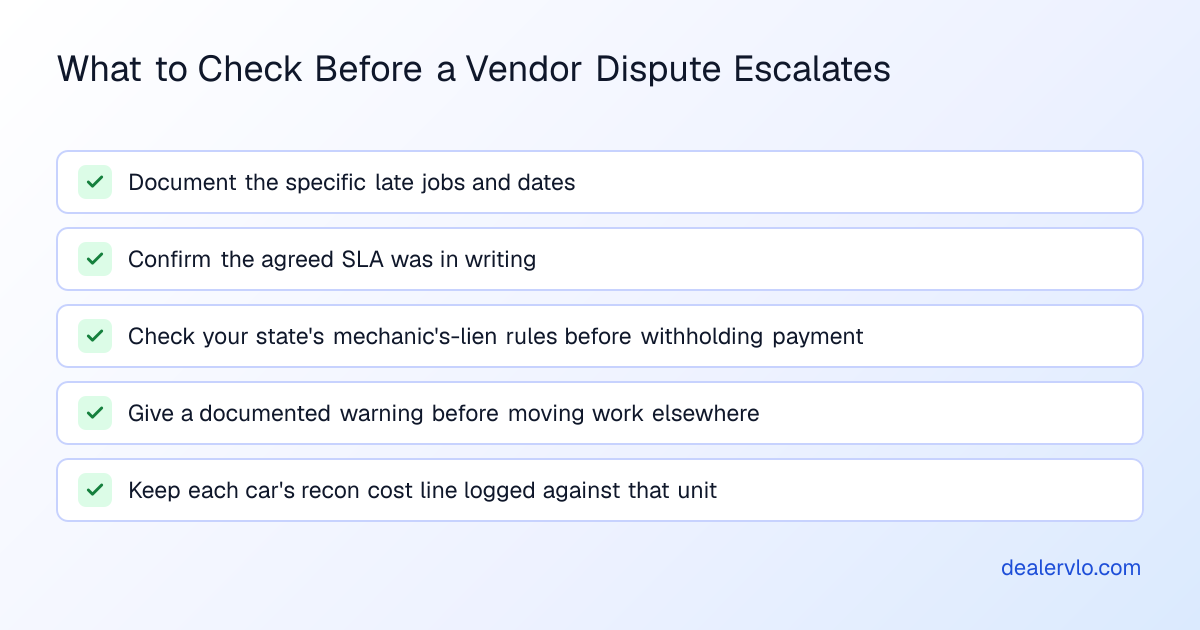
The practical takeaway: because the legal remedy once a vendor asserts a lien can be slow, a scorecard and SLA system is partly a prevention tool. Catching slowness early and having the "move the work" conversation before a car sits long enough to become a dispute is a lot cheaper than finding out how your state's lien process works in practice.
14-day free trial, then $29/mo · Cancel anytime
The quick comparison: what to track and why
| Scorecard metric | What it catches | Rough target |
|---|---|---|
| On-time rate | Vendor consistently running past agreed turnaround | Start from 4-5 days for a typical job (Ed Curry, NIADA 20 Group moderator), adjusted to your history, in writing |
| Comeback/redo rate | Work that doesn't hold up, customer complaints repeat | Zero tolerance pattern — track and confront early |
| Communication compliance | Vendor goes silent instead of flagging delays | Proactive heads-up before the SLA date, every time |
| Price variance | Quoted vs. billed creep over time | Occasional is normal; consistent overage is a flag |
| Capacity reliability | Vendor accepts work they can't actually start on time | Should match what they promised at intake |
Frequently asked questions
What's a reasonable SLA to set with a sublet recon vendor?
There's no official industry standard. One published benchmark: Ed Curry, a NIADA 20 Group moderator, wrote on niada.com that the whole reconditioning process should usually take only four to five days, though independent dealers often run longer for reasons outside their control. Use that as a starting point, check it against your own history at each vendor, and agree a written turnaround per job type — with a longer, separately agreed window for anything that genuinely needs a specialty part or diagnostic work.
How do I track vendor performance without buying a whole new system?
A simple spreadsheet with five columns — on-time rate, comeback/redo rate, communication compliance, price variance, and capacity reliability — updated every time a car comes back is enough to start. You don't need dedicated vendor-management software; you need consistency in logging it every single time, which is usually the harder part.
What should I do about a vendor who keeps running late?
Document the pattern with specific dates and jobs, have a factual conversation referencing the scorecard rather than a general complaint, and give it a documented warning-and-review period before moving volume away. A three-tier approach — warning, probation, then shifting work elsewhere — keeps the process fair and gives both sides a clear record if it escalates.
How much does a day of recon delay actually cost?
Ed Curry, a NIADA 20 Group moderator, puts holding costs at roughly $35 to $55 per day per vehicle in a reconditioning article on niada.com. Your own figure depends on floor-plan interest if the car is floored, insurance, depreciation while it sits, and the share of your overhead each car carries, so work it out with the holding cost calculator and multiply it by the days your vendors run over.
What happens if I withhold payment and a vendor won't release my car?
Most states have mechanic's- or garage-lien laws that let a repair shop keep a vehicle until its bill is paid and, after the notice steps the state requires, eventually sell it. The notice periods and thresholds vary significantly by state, so confirm your state's rules (the state statute, and your DMV or motor vehicle agency for the title side) before you get into a payment dispute, and treat this as a reason to catch slowness early rather than let a car sit long enough to become a lien situation.
Should I track recon costs by vendor inside my dealer software?
DealerVLO tracks recon cost lines against each individual car — vendor, description, and cost — which gives you the raw data, but it doesn't total or compare costs across vendors for you. Building the vendor-level scorecard from that per-car data is still a manual step, typically a spreadsheet you update as cars come back from each shop.
Bottom line
A recon vendor scorecard isn't about catching anyone in a lie — it's about replacing "trust and hope" with a number you can both see. Anchor your SLA to a published benchmark like the four-to-five-day guideline and check it against your own turnaround history per job type, track on-time rate and comeback rate at minimum, and have the hard conversation early, before a slow vendor turns into an aging car and an aging car turns into a dispute you don't want to be in. Keep your per-car recon costs and each car's days in inventory visible in one place so a slow-vendor pattern shows up before it eats a month of margin, and try DealerVLO to see how that tracking fits into your daily workflow.
14-day free trial, then $29/mo · Cancel anytime