The DMS Demo Call: Questions to Ask a Vendor Before You Sign
A dealer's script of dms demo questions — data export, per-user traps, renewal terms — for the call before you sign a DMS contract.
Part of the Choosing dealer software guide: The best car dealership software in 2026: 14 DMS options for independent lots, with real prices
Switching from another DMS? Compare DealerVLO to DealerCenter, Frazer, or Lot Wizard, or see what DealerVLO's car dealer management software includes.
You've narrowed your list down to two or three systems. The demo calls are booked. This is the moment that actually decides whether you're happy with this software in year two — not the sales pitch, and not the contract fine print you'll read later (or won't). The questions you ask on the call are what get commitments in writing before a salesperson has any reason to hedge.
Most dealers treat the demo as a product tour: can it print my state's forms, does it have a website, what's the monthly price. Those matter, but they're not what gets you burned. What gets you burned is finding out eighteen months in that getting your own data out costs money, that "per user" meant something different than you assumed, or that the contract auto-renewed into another full term the week before you planned to leave. This post is the script for the call itself — the step between picking your shortlist and reading a contract line by line.
14-day free trial, then $29/mo · Cancel anytime
Why the demo call is the leverage point, not the contract review
Once you sign, you have no leverage. The salesperson on a demo call wants the deal, so this is when a vendor will actually answer a pointed question instead of pointing you to a support ticket. The legal fights between dealers and the two largest legacy DMS providers, CDK Global and Reynolds & Reynolds, turned partly on exactly this gap — a Reynolds spokesperson was quoted in court filings saying plainly that "the data belongs to the dealers," yet dealers in that litigation described switching providers as a costly, drawn-out process that disrupted their operations for months. Ownership on paper and the practical ability to get your data out are two different things, and the demo call is where you find out which one you're actually getting.
If you haven't already compared systems side by side, our roundup of DMS options for independent lots is a good place to build the shortlist before you start booking calls. And if you want the background on what a DMS actually does and how pricing models differ, this explainer covers it.
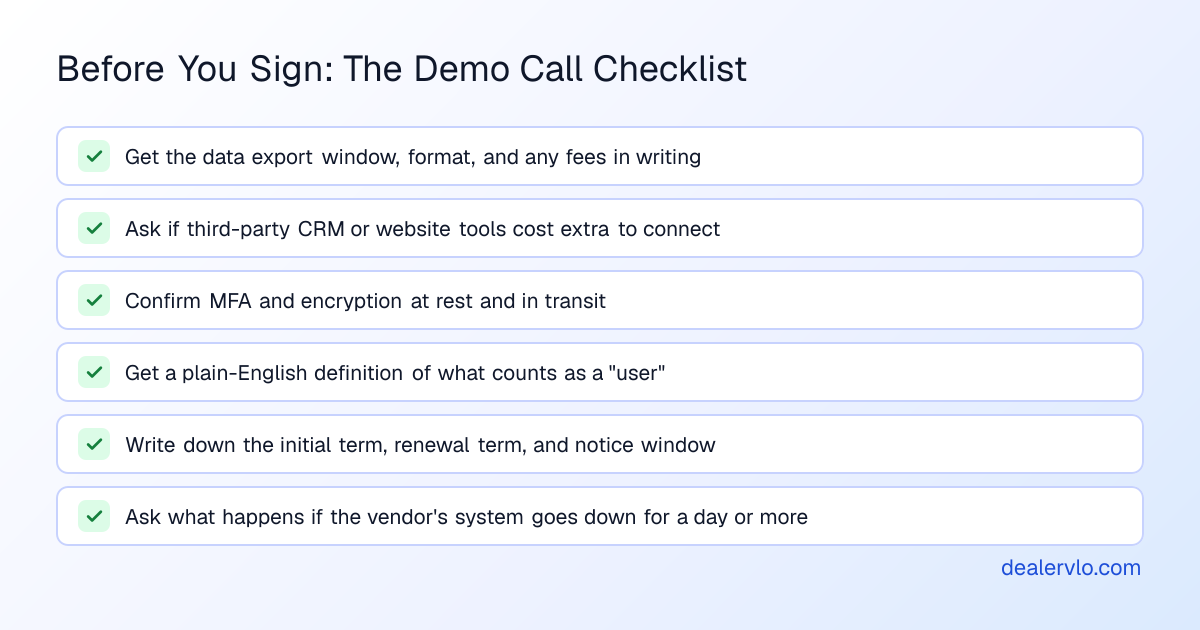
Question 1: What happens to our data if we leave?
This is the single most important question on the call, and it has three parts you need answered separately — not "yes, you own your data," which every vendor will say.
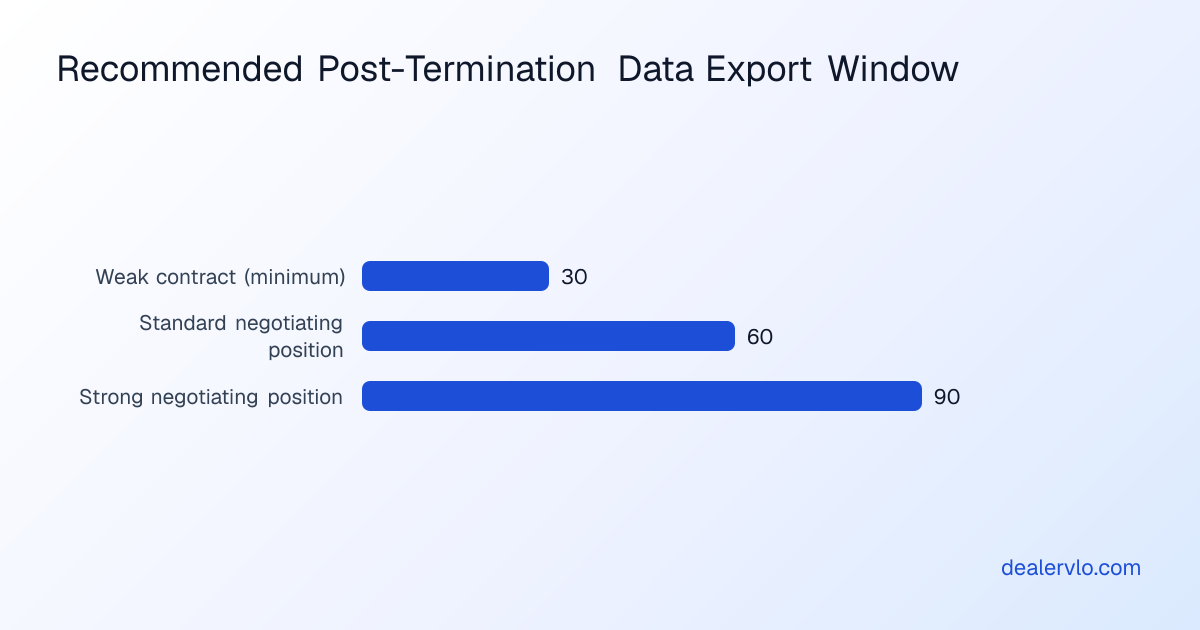
- How many days of access do we get after we cancel, and in what format? General SaaS contract guidance from law firms suggests a defined export window during the contract and for a meaningful period after termination — in the 30-to-90-day range — in a usable, machine-readable format is the standard a buyer should push for. A lot of standard SaaS agreements default to a shorter window than that, which can be tight if your data is spread across years of deals.
- Is there a fee to get it out? Ask directly. Some contracts charge per record or per export, even though the vendor states you "own" the data.
- Will the vendor put in writing that it has no ownership claim on our dealer and customer records? NADA's own guidance to members has specifically warned dealers to check that no clause in a DMS contract purports to grant the vendor ownership of dealer data, and recommends asking the vendor, in the contract, to list everything it accesses — even data it says it never actually pulls.
Get the answer in an email at minimum, in the contract ideally. "We'll work with you" is not an answer.
Question 2: Who else can pull our data, and what does that cost?
If you run a CRM, a separate website provider, or an accounting tool alongside your DMS, ask whether the vendor charges that third party — or you — to connect. Some DMS providers treat API access as a separate revenue line and charge integrators per connection or per pull.
Arizona is the one state where this is actually written into law and confirmed through the courts: a 2019 Arizona statute bars DMS providers from limiting a dealer's ability to store, copy, share or use its own data, requires providers to build a standardized way for authorized third parties to access it, and caps what a vendor can charge for that access at its direct cost of providing it — enforced by the Arizona Department of Transportation. The Ninth Circuit upheld that law against a challenge from CDK and Reynolds. Outside Arizona, you don't have that legal backstop, which is exactly why you ask the question on the call and get the answer in writing rather than assuming it.
Ask: "If we sign up with [CRM/marketing tool], does your system charge them, or us, for a data connection? Is that a one-time or ongoing fee?"
Question 3: How do you handle a breach, and what security is built in?
If your dealership finances or arranges financing on vehicles, you're treated as a financial institution under the FTC's Safeguards Rule, and that rule requires a written information security program covering things like multi-factor authentication and encryption of data at rest and in transit — regardless of how big your lot is. The rule explicitly reaches your service providers too, which means your DMS vendor is part of your own compliance obligation, not separate from it.
On the call, ask:
- "Do you support multi-factor authentication for every login, not just the admin account?"
- "Is our data encrypted both in storage and in transit?"
- "What's your commitment on notifying us if there's a breach, and how fast?"
A vendor that can't answer these clearly in a sales call is not going to get better about it after you're a customer. This isn't legal advice — the Safeguards Rule's exact requirements and any thresholds that apply to your dealership are worth confirming with the FTC's published guidance or your own counsel, since the details vary by how your dealership is structured.

Question 4: What counts as a "user," and does that price change at renewal?
Per-seat pricing is where a lot of dealers get surprised later, not at signing. Ask for a plain-English definition before you sign anything:
- Is a "user" a named login, or a concurrent session you can share across a shift?
- Do service writers, part-time staff, or an F&I-only hire count as full users or something cheaper?
- Does the per-user price change at renewal, and is that change capped anywhere in the contract?
There's no reliable industry-average per-seat figure to quote here — pricing structures vary too much vendor to vendor to generalize — but the framework matters regardless of price: get the definition of "user" in writing, and ask specifically whether adding staff later triggers a new negotiation or a published rate card. A flat, unlimited-user structure sidesteps this question entirely, which is one reason some small lots prefer it — DealerVLO, for example, is a flat $29 a month with unlimited users, so a service writer or a second salesperson logging in doesn't change the bill. If you're scoping out a new lot's software stack from scratch, the setup checklist for a new dealership walks through what to line up before your first sale, pricing included.
Question 5: What's the actual contract term, and how does it renew?
This is the fact that's changed recently, and a lot of advice online is stale on it. The FTC's "click-to-cancel" rule — which would have forced businesses to make cancellation as easy as sign-up — was vacated by the Eighth Circuit in mid-2025, and as of early 2026 the FTC had only reopened it as a proposed rulemaking, not a rule in effect. That means there is currently no federal rule guaranteeing you an easy, one-click way out of a B2B software contract. Some states have their own auto-renewal statutes that reach business contracts, but coverage is uneven and depends heavily on how the contract is written. This isn't legal advice — confirm your state's current rule with your own counsel or state regulator before relying on it.
Practically, that means the demo call — not a clause you hope is standard — is where you lock down:
- Initial term length. One year? Three?
- Renewal term length. Does it auto-renew into another full multi-year term, or month to month?
- Notice window and method. How many days before renewal do you have to cancel, and does it have to be certified mail, or is email enough?
- Early termination fees, if you need out before the term ends.
A month-to-month, no-contract structure removes most of this risk outright — there's no renewal clock to miss. That's part of why we built DealerVLO that way: $29 a month, cancel any time from the billing page, no cancellation fee. But if you're evaluating a vendor that does use multi-year terms, write down every answer to this section before you hang up, because it's much harder to get a straight answer about renewal terms once you're already a customer. Our DMS contract red flags post goes deeper into what to look for once you're actually reading the paper.
14-day free trial, then $29/mo · Cancel anytime
Question 6: What happens if your system goes down?
Outages aren't hypothetical. A widely reported cyberattack on CDK Global in the summer of 2024 knocked dealerships off their DMS for an extended stretch, and trade press reporting afterward described more dealers becoming willing to switch providers than before — a real, visible example of why "what's your uptime history, and what do we do if you're down" belongs on every demo call, not just in a disaster-recovery footnote. Ask what the vendor's own incident communication looks like, and whether you can still print a bill of sale or access customer records if their servers are unreachable. If the answer is vague, that's useful information on its own. A small lot's own plan for this — what to do with pen, paper, and a backup export while a system is down — is worth having regardless of vendor; see the outage plan for a small lot for a concrete approach.
Where state paperwork fits into the evaluation
While you're on the call, ask specifically how the system handles your state's title and registration paperwork — not just "do you do paperwork," but whether it fills your state's actual form or a generic worksheet, and what happens when your state issues forms through a portal instead of a PDF. DealerVLO fills state title and registration paperwork for all 50 states — the official state PDF where the state publishes one, or a print-ready worksheet of the deal's values where the state issues forms through a portal or as controlled paper. That distinction matters because a vendor who says "we do all 50 states" without clarifying which path applies to yours can leave you printing a worksheet when you expected a finished form. If you want the deeper breakdown of what "fills your paperwork" should and shouldn't mean from a DMS, read what title and registration software should actually fill, and where it stops.
This is also where it's worth seeing the full used car dealer software picture rather than evaluating paperwork, inventory, and the website as three separate purchases — a system that handles inventory with VIN decode, the deal jacket with live deal math, state paperwork, and a dealer website together avoids a lot of the integration questions in Question 2 above, because there's nothing to connect.
Paste a VIN, the buyer, and the price — see the title & registration form filled in for 50 states, free, no signup.
Open the State Form Auto-FillA short script to bring to the call
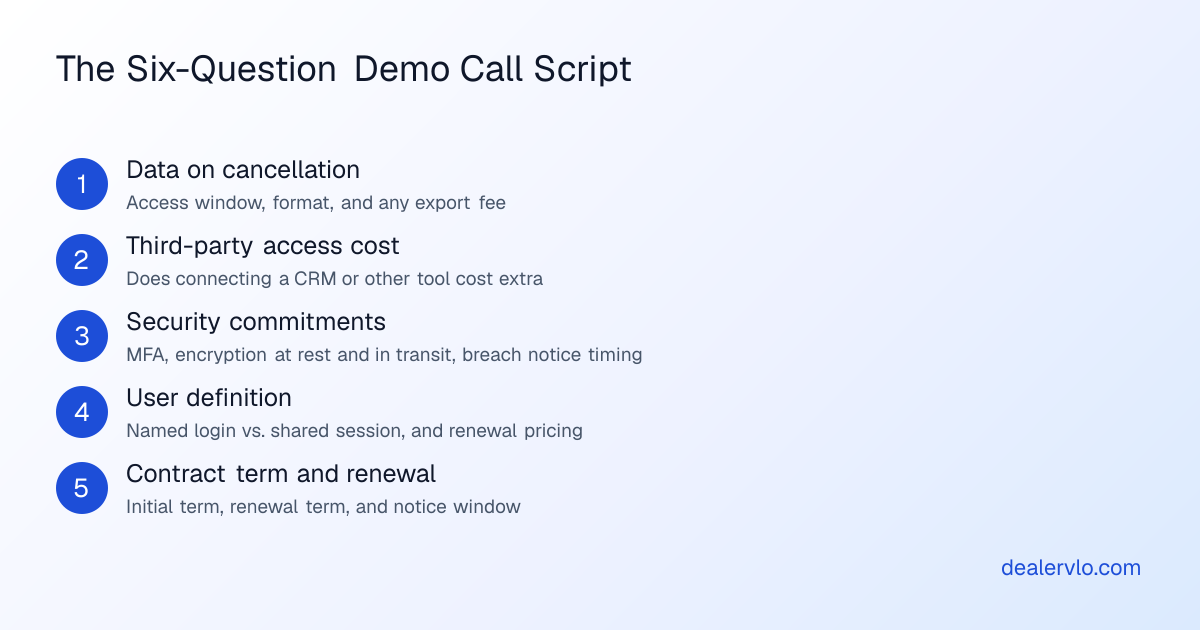
You don't need a lawyer on the line to ask these. Bring a printed list and take notes on the answers — not a recap afterward, actual notes during the call:
- "Walk me through exactly what happens to our data the day we cancel — access window, format, any fee."
- "If we connect a CRM or website tool you don't provide, does that cost anything, ongoing or one-time?"
- "Do you support MFA on every login, and is our data encrypted at rest and in transit?"
- "Define 'user' for me, and tell me if that price changes at renewal."
- "What's our initial term, our renewal term, and exactly how many days' notice do we need to cancel?"
- "What's your plan if your system goes down for a day? Two days?"
A vendor who answers all six clearly and puts the important ones in writing is telling you something real about how they'll treat you after you've signed. A vendor who gets vague on even one of these is telling you something too.
Frequently asked questions
What are the most important DMS demo questions to ask before signing?
The ones with real consequences later: what happens to your data on cancellation (access window, format, fees), whether third-party tools can connect without extra charges, what security the vendor commits to in writing, how "user" is defined for pricing, and the exact contract term and renewal notice window. Get the answers in writing, not just a verbal "sure, we handle that."
Does a DMS vendor have to let me export my own data for free?
It depends entirely on your contract, with one notable exception: Arizona law requires DMS providers to allow dealer data access and caps what they can charge for it at the vendor's direct cost of providing that access, enforced by the state's Department of Transportation. Outside Arizona there's no equivalent guarantee, which is why you need to get export terms and any fees spelled out in your contract before you sign.
Is the FTC's click-to-cancel rule in effect for DMS contracts?
No. The rule was vacated by the Eighth Circuit in mid-2025, and as of early 2026 the FTC had only reissued it as a proposed rulemaking, not an active rule. That means there is currently no federal requirement forcing easy cancellation on a business software contract — your negotiated contract terms are what actually protect you.
What should I ask about per-user or per-seat pricing on a demo call?
Ask for a plain definition of what counts as a "user" — a named login versus a shared/concurrent session — whether service or part-time staff count the same as a full seat, and whether the per-seat price can change at renewal. There's no reliable industry-standard figure to compare against, so get the definition and any renewal terms in writing rather than assuming it matches another vendor's structure.
How does the FTC Safeguards Rule affect which DMS questions I should ask?
If your dealership finances or arranges financing, you're treated as a financial institution under the rule and are required to maintain a written information security program covering things like multi-factor authentication and encryption — and that obligation extends to how your vendors handle your data. Ask your DMS vendor directly about MFA support, encryption at rest and in transit, and their breach-notification commitment, since those answers feed into your own compliance, not just theirs.
What's the difference between the demo call and reading the contract later?
The demo call is your leverage point — a salesperson wants the deal and will answer pointed questions you can hold them to later, in writing if possible. The contract review is where you confirm those verbal answers actually appear in the document. Treat the demo as where you gather commitments, and the contract read as where you verify nothing got left out — our contract red flags guide covers what to look for in that second step.
Bottom line
None of these six questions are hard to ask. What's hard is remembering to ask them before you're excited about a slick demo and ready to sign. Write the script down, bring it to every call, and get the important answers in an email you can point back to later — data export terms, third-party access costs, security commitments, the definition of a user, and the exact renewal window. A vendor worth your money will answer all of it without flinching. If you want to see how a flat-rate, month-to-month system answers these questions for itself, with inventory, deal paperwork, and your dealer website in one place, give it a look.
14-day free trial, then $29/mo · Cancel anytime