How to fill out the VSA 59 in Virginia
A field-by-field walkthrough of the Virginia VSA 59 (Rebuilt Vehicle Disclosure Statement) for licensed used car dealers — what goes in every section, who signs what, and the documents you attach. Verified against the official form as of October 2026.
Filing these every week? Upload the VSA 59 to DealerVLO once and it fills from every deal you enter, $29/month flat. See pricing
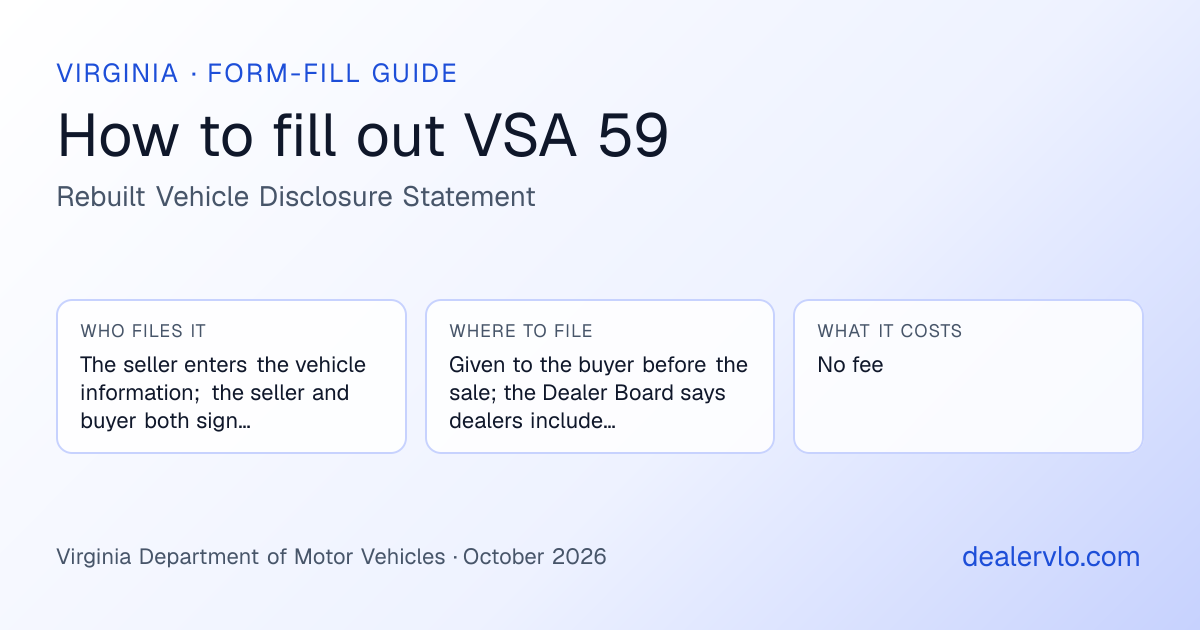
Filling out the VA VSA 59 after a sale:
- What it is
- Virginia's required written disclosure that a vehicle is "rebuilt" (Va. Code § 46.2-1602(A)(4))
- Who completes it
- The seller enters the vehicle information; the seller and buyer both sign and each keep a copy
- Where to file it
- Given to the buyer before the sale; the Dealer Board says dealers include it with the title paperwork they submit to DMV
- Processing time
- None of its own. It travels with the sale and title paperwork
- Cost
- No fee
This guide is informational and does not replace the official Virginia instructions. Always confirm the current form and procedure with the Virginia Department of Motor Vehicles before you file.
The VSA 59 is one car's paperwork. A 20-second read on your lot, and the tax-and-fee math for the whole deal — built for dealers, no signup. Free calculators dealers actually use — no signup, no email.
Upload the fillable Virginia VSA 59 to DealerVLO once. It maps the fields, then fills the form from every deal — buyer, co-buyer, the vehicle you sold, and your dealership already in place. $29/month, free to try — cancel any time.
What the VSA 59 is and why it matters
VSA 59 is Virginia's Rebuilt Vehicle Disclosure Statement. Va. Code § 46.2-1602(A)(4) makes it unlawful for any person to sell a rebuilt vehicle without first disclosing in writing that it's rebuilt, on the form the DMV Commissioner prescribes. That applies to dealers and private sellers alike. A first violation is a Class 1 misdemeanor; a second is a Class 5 felony.
The form is one page: the vehicle, a notice that the title is branded "rebuilt," and signatures from both seller and buyer, who each keep a copy. The part dealers get wrong isn't the boxes. It's knowing when a car counts as rebuilt, since Virginia includes some late-model cars that never had a salvage title. This guide covers both.
Use the DMV's current revision, VSA 59 (07/01/2017), linked at the top of this guide. As of October 2026 the Motor Vehicle Dealer Board's forms page still links the older 07/01/2015 version, which carries a definition of "rebuilt" (a 90% repair limit) that the statute dropped in 2017. The current form also quotes Va. Code § 46.2-1602(A)(4) without its last words: the statute requires the disclosure "in writing on a form prescribed by the Commissioner," and VSA 59 is that form. The official PDF is fillable, so you can upload it to DealerVLO once under Settings → Forms. Its fields have generic names, so you map them by hand the first time, and every one has a match in the deal: VIN, year, make, body type, title number and state, both names, and the sale date.
Documents to have before you start
Gather these before you complete the VSA 59. A missing attachment is the number-one reason the the Virginia Department of Motor Vehicles bounces a title application back.
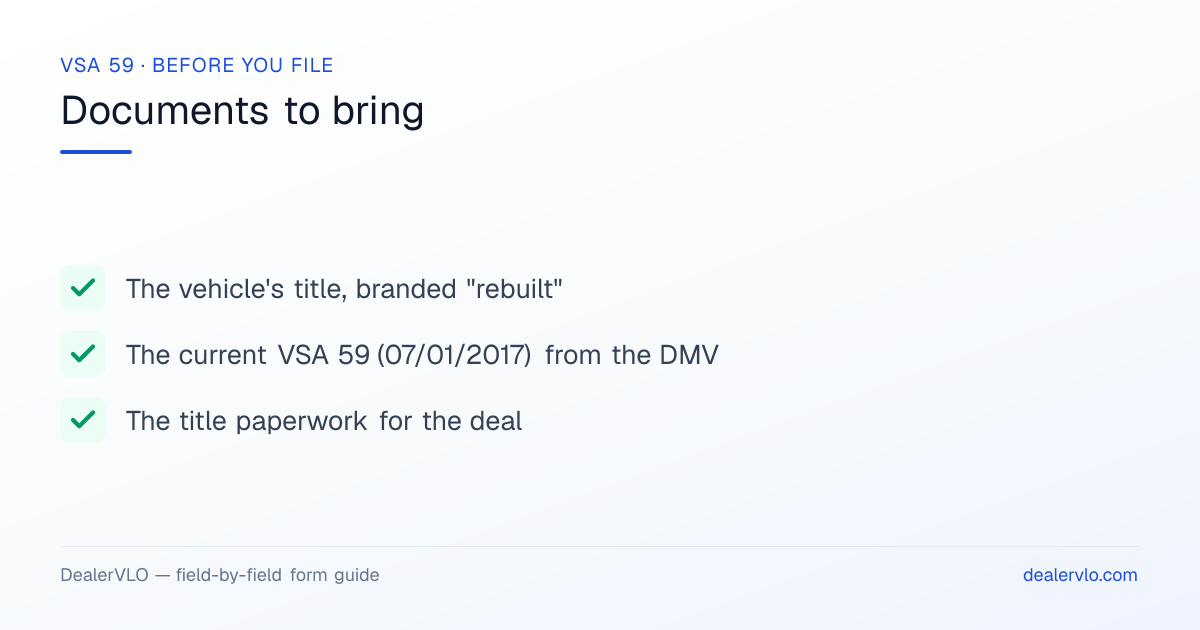
- The vehicle's title, branded "rebuilt" — Virginia permanently brands a rebuilt vehicle's title, and the VSA 59 notice says the brand may be carried forward from another state.
- The current VSA 59 (07/01/2017) from the DMV — Not the 07/01/2015 revision still linked from the Dealer Board's forms page.
- The title paperwork for the deal — The Dealer Board's October 2023 newsletter says VSA 59 "must be included with the sales documents, title paperwork" the dealer submits to DMV. See the VSA 17A guide for the title application.
VSA 59, section by section
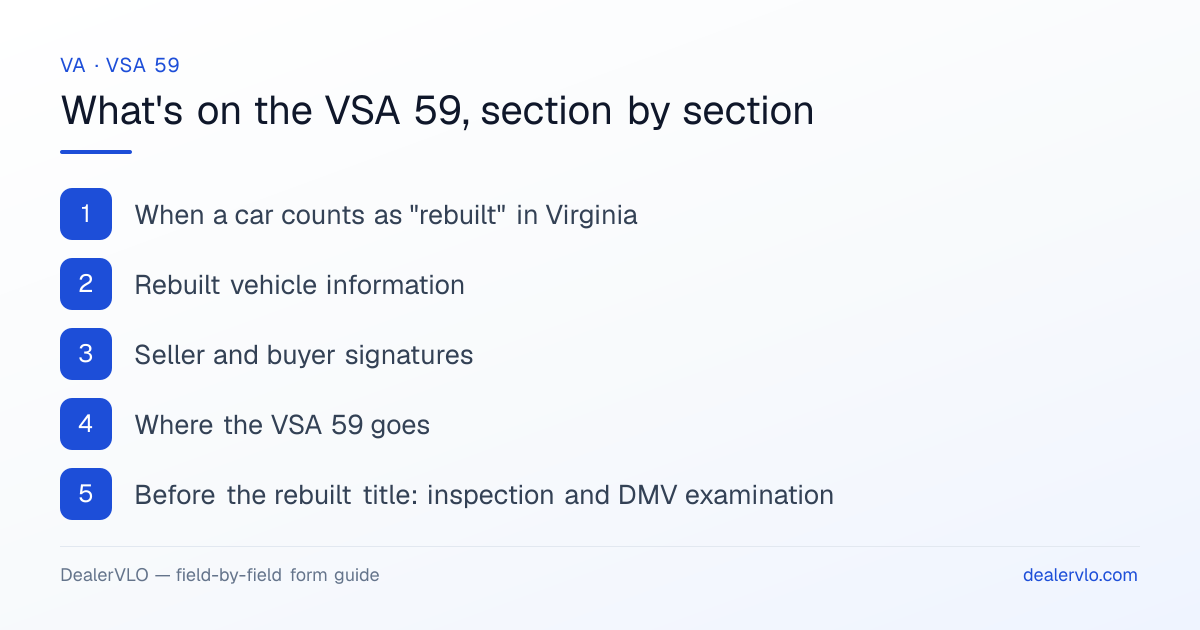
When a car counts as "rebuilt" in Virginia
Va. Code § 46.2-1600 defines a rebuilt vehicle two ways, and the form prints both. One is any salvage vehicle that's been repaired for use on the highways. The other is any late-model vehicle that's been repaired when the estimated cost of repair exceeded 75% of its actual cash value, excluding the cost to repair the engine, transmission, or drive axle. "Late model" means the current model year and the five before it, or any vehicle worth at least $10,000 before it was damaged. So a two-year-old car with a big collision repair can be a rebuilt vehicle even if it never had a salvage certificate. If either definition fits, you need a VSA 59.
| Field | Who fills it |
|---|---|
Repaired salvage vehicle Rebuilt by definition. | You (dealer) |
Late-model car repaired after damage over 75% of actual cash value Rebuilt even without a salvage title. Engine, transmission and drive axle costs don't count toward the 75%. | You (dealer) |
Rebuilt vehicle information
The seller fills in the vehicle block: vehicle identification number, year, make, body type, title number, and the state that issued the title. Copy each from the title. There's no model, odometer, or dealer license box. Below the vehicle block, the form prints the notice that the Virginia title has been branded "rebuilt" and that the brand may be carried forward from another state or based on a DMV examination. You don't fill anything in there; it's what the buyer is acknowledging.
| Field | Who fills it |
|---|---|
Vehicle identification number (VIN) All 17 characters. | You (dealer) |
Year Four digits. The field holds four characters. | You (dealer) |
Make and body type | You (dealer) |
Title number and state From the rebuilt title you're transferring. | You (dealer) |
Seller and buyer signatures
The signature block has the seller's printed name, signature, and date, then the buyer's. On a dealer sale, the seller is your dealership, signed by an authorized person. The form's instruction is plain: "Seller and buyer must sign and each retain a copy." Have the buyer sign before the sales contract. The statute says the disclosure comes first, and the signed form is your proof it did. The Dealer Board's newsletter calls both signatures a best practice; the form itself requires them, so get both.
| Field | Who fills it |
|---|---|
Seller name (print), signature, date | You (dealer) |
Buyer name (print), signature, date Before the contract is signed. | Buyer |
Where the VSA 59 goes
Each party keeps a copy: the buyer leaves with theirs, along with the title signed over to them, as the DMV's rebuilt-vehicle page describes. The Dealer Board's October 2023 newsletter says the VSA 59 must be included with the sales documents and title paperwork the dealer submits to DMV, so put one in the title packet as well. Virginia dealers keep sales records for five years; keeping the VSA 59 with them is the safe reading, though the records rule doesn't name the form.
| Field | Who fills it |
|---|---|
Buyer's copy | Buyer |
Copy in the title packet to DMV Per the Dealer Board. | You (dealer) |
Copy in your deal file | You (dealer) |
Before the rebuilt title: inspection and DMV examination
A salvage vehicle can't be titled for the road until it's rebuilt and goes through Va. Code § 46.2-1605. First comes a state safety inspection by an inspector "wholly unaffiliated" with whoever asks for it. Then the DMV examines the vehicle before it issues a title: photos of the car before it was rebuilt if available, the parts and labor documentation, and the VIN, odometer, and major components. The exam fee is $125, and the statute says the exam is an anti-theft and anti-fraud check, not a safety certification. Some rebuilders are exempt from the exam: a rebuilder licensed at least 10 years with no penalties, a vehicle at least 10 years old, and a resale value under $10,000, all three. The title that results is permanently branded rebuilt. A vehicle that was ever issued a nonrepairable certificate can never be titled or registered.
| Field | Who fills it |
|---|---|
State safety inspection by an unaffiliated inspector | At the counter |
DMV rebuilt vehicle examination $125. Anti-theft and anti-fraud, not a safety check. | At the counter |
Title permanently branded rebuilt | At the counter |
Common VSA 59 mistakes that cause rejections
The Dealer Board's forms page still links it, and its definition of rebuilt is out of date. Use the DMV's VSA 59 (07/01/2017).
A late-model car repaired after damage over 75% of its actual cash value is a rebuilt vehicle in Virginia. If the title is branded rebuilt, or the repair history puts it over the line, the VSA 59 applies.
The statute requires disclosure before the sale. Get the buyer's signature on the VSA 59 first, then the buyer's order.
The form says seller and buyer must sign and each keep a copy. A disclosure with only your signature doesn't show the buyer received it.
The Dealer Board says the VSA 59 must be included with the title paperwork the dealer submits to DMV. Add it to the packet with the signed-over title.
Common questions
What is the Virginia VSA 59 form?+
VSA 59 is the Virginia DMV's Rebuilt Vehicle Disclosure Statement. Anyone selling a rebuilt vehicle uses it to disclose in writing, before the sale, that the vehicle is rebuilt, as Va. Code § 46.2-1602(A)(4) requires. The seller enters the VIN, year, make, body type, title number and state; the seller and buyer both sign and each keep a copy. The current revision is VSA 59 (07/01/2017).
Is a rebuilt title disclosure required in Virginia?+
Yes. Va. Code § 46.2-1602(A)(4) makes it unlawful for any person to sell a rebuilt vehicle without first disclosing that it's rebuilt to the buyer in writing on a form prescribed by the Commissioner. A first violation is a Class 1 misdemeanor, and second and later violations are a Class 5 felony.
What counts as a rebuilt vehicle in Virginia?+
Under Va. Code § 46.2-1600, either a salvage vehicle repaired for use on the highways, or a late-model vehicle repaired when the estimated cost of repair exceeded 75% of its actual cash value, excluding engine, transmission, and drive axle repairs. Late model means the current model year and the five preceding ones, or a vehicle worth at least $10,000 before the damage.
Does the VSA 59 go to DMV?+
The Motor Vehicle Dealer Board's October 2023 newsletter says the VSA 59 must be included with the sales documents and title paperwork a dealer submits to DMV. The buyer also keeps a signed copy, and the DMV's rebuilt-vehicle page says the buyer receives the signed-over title and the VSA 59.
How do you get a rebuilt title in Virginia?+
Under Va. Code § 46.2-1605, the rebuilt salvage vehicle passes a state safety inspection by an unaffiliated inspector, then a DMV examination ($125) of the pre-repair photos if available, parts and labor documents, VIN, odometer and major components. The title is then permanently branded rebuilt. A vehicle that ever received a nonrepairable certificate can never be titled.
Does the VSA 59 need to be notarized?+
No. The form has no notary block and no fee. It needs the seller's and buyer's printed names, signatures, and dates.
Is there software that fills out the VSA 59 automatically?+
Yes. The Virginia VSA 59 is a fillable PDF, so dealer management software like DealerVLO can fill it for you: upload the blank form once, DealerVLO detects its fields and suggests a mapping you confirm, and from then on it fills from every deal you enter — the buyer, co-buyer, the vehicle you sold, and your dealership's details already in place. It's $29/month flat with a 14-day free trial, and the same deal also generates your federal documents (Bill of Sale, FTC Buyers Guide, odometer disclosure) and your state title paperwork.
- How to fill out Virginia Form VSA 17A
- Salvage and branded title disclosure by state
- Selling salvage and rebuilt title cars as a dealer
- Title application forms in every state
- How to get a used car dealer license in Virginia
- Virginia dealer plates
- E-signatures and e-titling for Virginia dealers
- How much is a dealer's license? Cost in every state
Stop filling out the VSA 59 by hand.
Upload the fillable VA VSA 59 once. DealerVLO detects its fields, you confirm the mapping, and every deal after that prints it with the buyer, co-buyer, vehicle, and your dealership already in place. $29/month. 14-day free trial, cancel any time.
Curious how it works? See how DealerVLO auto-fills every dealer document — bill of sale, FTC Buyers Guide, odometer disclosure, and state title & registration forms for all 50 states, from one deal.
Bond amounts, fees, and form rules change. Get a short email when your state does. No spam, unsubscribe anytime.