How to fill out the VD-119 in Vermont
A field-by-field walkthrough of the Vermont VD-119 (Vermont Registration, Tax & Title Application) for licensed used car dealers — what goes in every section, who signs what, and the documents you attach. Verified against the official form as of September 2026.
Filing these every week? DealerVLO fills the VD-119 from the deal you already entered, $29/month flat. See pricing
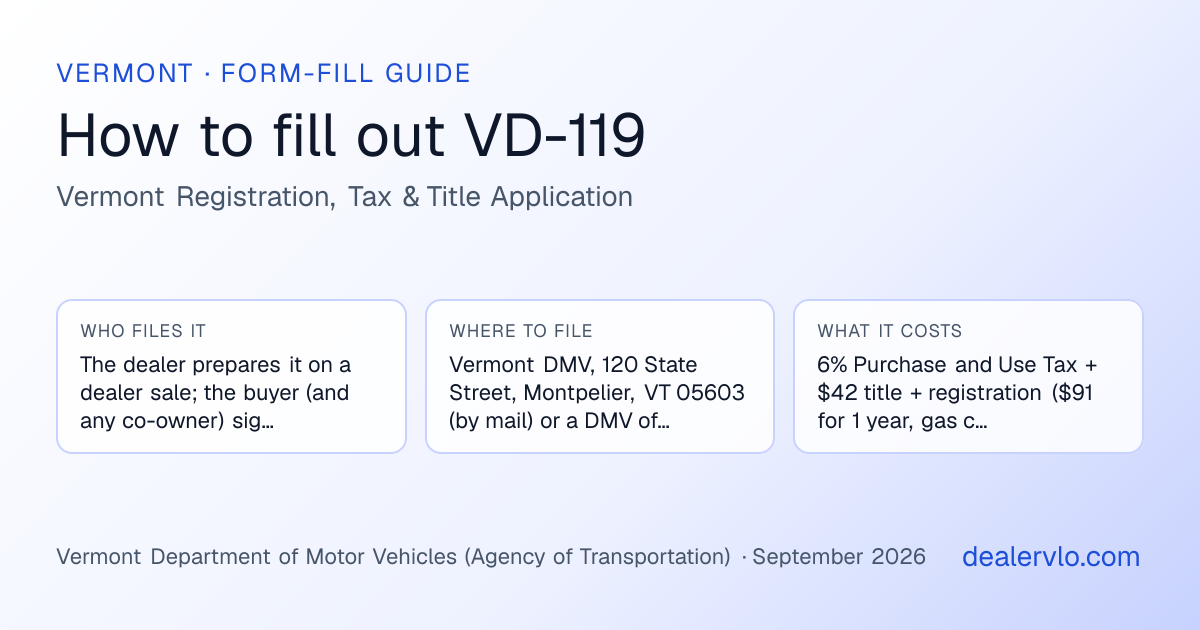
Filling out the VT VD-119 after a sale:
- What it is
- Vermont's combined registration, Purchase and Use Tax, and title application
- Who completes it
- The dealer prepares it on a dealer sale; the buyer (and any co-owner) signs
- Where to file it
- Vermont DMV, 120 State Street, Montpelier, VT 05603 (by mail) or a DMV office
- Processing time
- Dealers must submit within 15 calendar days of the date of sale
- Cost
- 6% Purchase and Use Tax + $42 title + registration ($91 for 1 year, gas car) + $14 per lien
This guide is informational and does not replace the official Vermont instructions. Always confirm the current form and procedure with Vermont Department of Motor Vehicles (Agency of Transportation) before you file.
See the VT VD-119 filled — from just a VIN
Enter a VIN, the buyer's name, and the price. We decode the vehicle and drop it onto the actual Vermont VD-119 — the same fill DealerVLO produces from a deal. Watermarked preview; nothing is saved.
What the VD-119 is and why it matters
VD-119 is Vermont's Registration, Tax & Title Application — the single form that registers the vehicle, issues the title and computes the Purchase and Use Tax. On a dealer sale, the dealer fills it out, the buyer signs, and the dealer mails or delivers it to the Vermont DMV with the title (or MCO) and a check within 15 calendar days of the sale.
The part that decides whether it comes back is Section 8. Vermont's Purchase and Use Tax is 6% of the taxable cost, and the dealer works it right on the form: purchase price, minus a trade-in credit the buyer is actually entitled to, equals the taxable amount. The form's instructions mention the J.D. Power clean trade-in value, but the DMV's dealer guide says the "JD Power Value" and "Adjustments" lines are N/A for dealers. The doc fee is part of the taxable price, and there's no tax cap on a car. This guide walks the current (10/2024) form section by section.
VD-119 is one combined form: registration, title and the Purchase and Use Tax all ride on it, and the DMV's title guide says it's required for every Vermont title scenario unless otherwise noted. On a dealer sale the dealer prepares it, collects the tax and fees, and must get the application to the Vermont DMV within 15 calendar days of the date of sale. The Vermont tax is a motor-vehicle Purchase and Use Tax paid to the DMV — not a sales tax filed with the Department of Taxes.
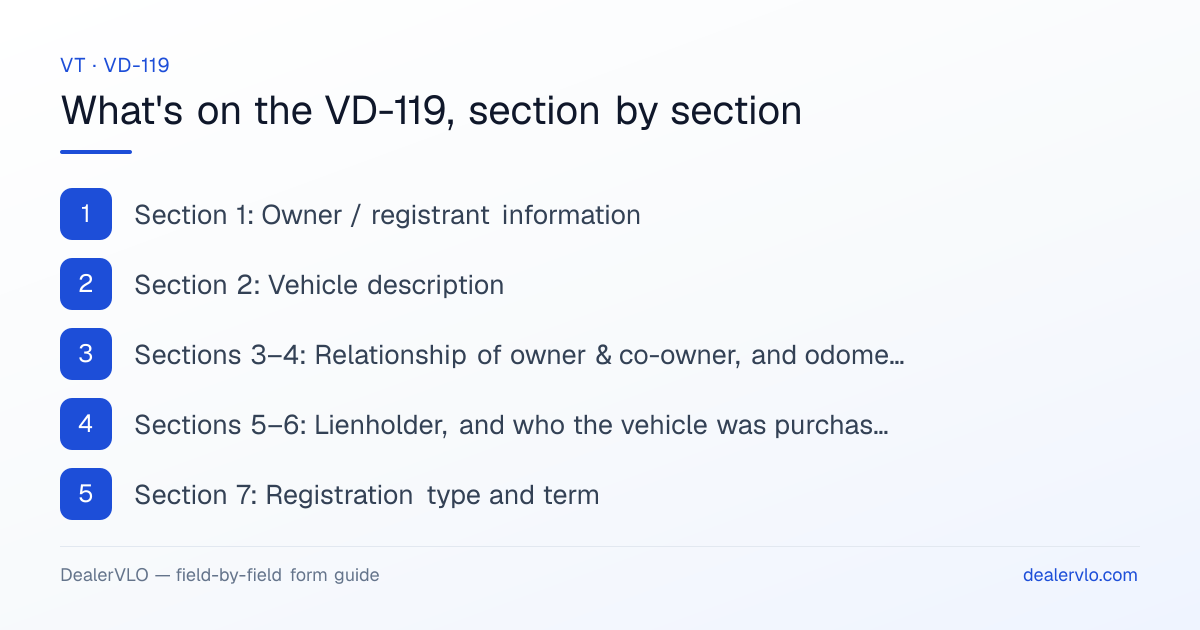
Documents to have before you start
Gather these before you complete the VD-119. A missing attachment is the number-one reason the Vermont Department of Motor Vehicles (Agency of Transportation) bounces a title application back.
- The assigned title (or MCO for a new vehicle) — Signed over by all owners on the title, with any liens released. The DMV's dealer guide says to compare the title or MCO to the vehicle's VIN before sending the application.
- Odometer disclosure statement — Required for model year 2011 or newer. The reading also goes on the VD-119.
- Buyer's license number, date of birth and gender — Required for individual owners. A business uses its FEIN — the DMV says not to list an SSN.
- Trade-in or prior-vehicle details — Year, make, VIN and plate of the vehicle claimed for tax credit, plus buyer name, city, state and sale date if the buyer sold a vehicle instead of trading it.
- VT-012 (more than two owners) or VT-007 (transfer on death), if applicable — VT-012 lists extra owners; VT-007 is required for a transfer-on-death title.
- Check payable to VT DMV — For the tax and fees totaled in Section 9. The DMV suggests one check per transaction.
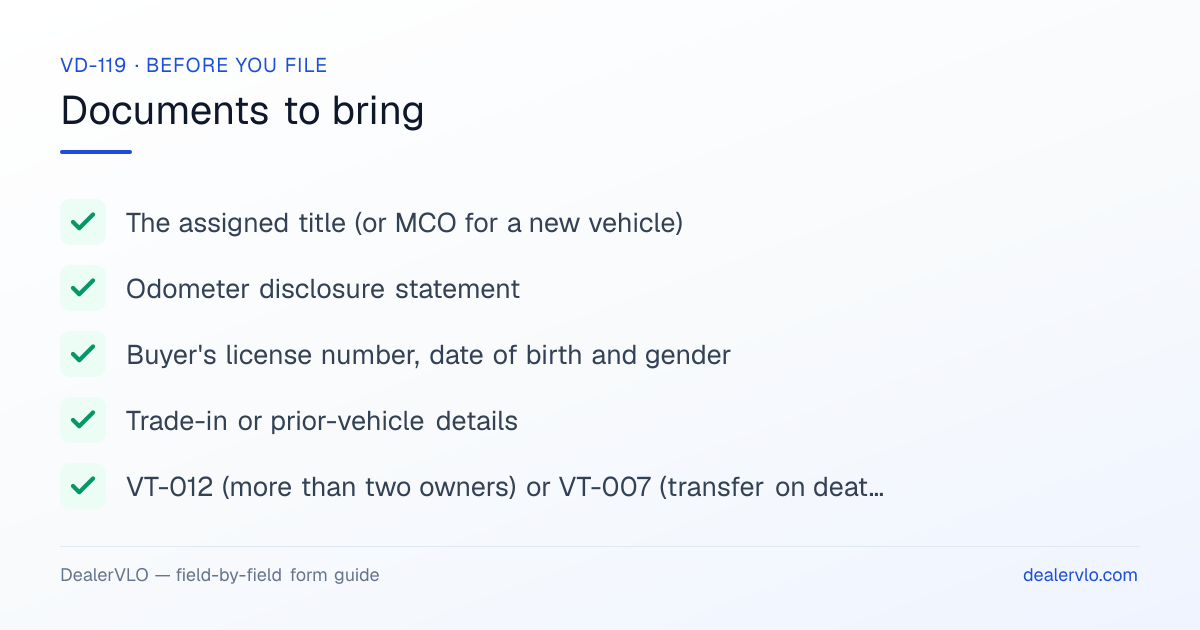
VD-119, section by section
Section 1: Owner / registrant information
The buyer, exactly as they'll appear on the registration and title. For an individual, Vermont requires the license number, date of birth and gender; a business uses its FEIN (don't list an SSN). A physical address is required if the mailing address is a PO box or private mailbox. The second block is for a co-owner — or the lessor on a lease. More than two owners go on form VT-012.
| Field | Who fills it |
|---|---|
Name of primary registrant (last, first, middle, or business name) | Buyer |
Former name | Buyer |
License number or FEIN License number for individuals; FEIN for a business. | Buyer |
Date of birth, gender Required for individuals. | Buyer |
Email, phone (mobile / home / work) | Buyer |
Mailing address, city, state, ZIP, country | Buyer |
Physical address Required if the mailing address is a PO box or private mailbox. | Buyer |
Co-owner or lessor name, license/FEIN, DOB, contact, address | Buyer |
Section 2: Vehicle description
Identify the vehicle and mark it New, Used or Rebuilt. The DMV's dealer guide says color is a must and the fuel type has to be marked (it affects the fee). The truck, trailer, motorcycle/ATV and jitney fields only apply to those vehicles — trucks need axles, brake type, and empty and loaded weights. A rebuilt vehicle needs the salvage/rebuilt section of the Dealer Report of Sale completed.
| Field | Who fills it |
|---|---|
Serial number (VIN) Compare it to the title or MCO before you send the application. | You (dealer) |
New / Used / Rebuilt | You (dealer) |
Year, make, model, body style | You (dealer) |
Fuel type, cylinders Fuel type drives the registration fee. | You (dealer) |
Color 1, Color 2 | You (dealer) |
Truck / trailer / MTC & ATV / jitney fields Only for those vehicle types (weights, axles, brake type, length, width, power). | You (dealer) |
Sections 3–4: Relationship of owner & co-owner, and odometer
With more than one owner, mark one relationship: Spouses, Joint Tenants, Tenants in Common, Business Partners, or Transfer on Death. All but Tenants in Common carry a right of survivorship, and Transfer on Death allows only one owner and needs VT-007. Then enter the odometer without tenths and mark whether it's the actual mileage, exceeds mechanical limits, or is not the actual mileage.
| Field | Who fills it |
|---|---|
Relationship of owner & co-owner Spouses / Joint Tenants / Tenants in Common / Business Partners / Transfer on Death (VT-007). | Buyer |
Odometer reading (no tenths) | You (dealer) |
Actual / exceeds mechanical limits / not actual | You (dealer) |
Sections 5–6: Lienholder, and who the vehicle was purchased from
If the buyer financed, enter the lienholder and loan date so the Vermont title goes to the lender; if there's no loan, write NONE. Section 6 is the seller — on a dealer sale that's the dealership: name, address, date purchased, VT dealer number and the temporary plate number. The DMV's dealer guide says an authorized agent of the selling dealership must sign here.
| Field | Who fills it |
|---|---|
Lienholder name (if none, write NONE) | You (dealer) |
Date of loan, lienholder address | You (dealer) |
Name of person or company vehicle purchased from | You (dealer) |
Date purchased | You (dealer) |
VT dealer number, temporary plate # | You (dealer) |
Address of seller, seller signature Signed by an authorized agent of the dealership. | You (dealer) |
Section 7: Registration type and term
Mark the transaction — New Registration, Transfer, Renew, Title Only, Replacement, Weight Change, IRP — plus the plate type and term (1 or 2 years; 5 years for trailers and municipal). For a new registration with a metal plate, enter the plate number; for a cardboard D plate, enter the D number. On a transfer, mark Transfer and list the current plate number.
| Field | Who fills it |
|---|---|
Transaction type New Registration / Transfer / Renew / Title Only / Replacement / Weight Change / IRP. | You (dealer) |
Current plate # Transfers, or the plate/D-plate issued on a new registration. | You (dealer) |
Registration/plate type (car, truck, trailer, motorcycle, other) | Buyer |
Registration term (1 year / 2 years / 5 years) | Buyer |
Section 8: Purchase price, trade credit and taxable amount
This is where the 6% Purchase and Use Tax gets worked out. Enter the purchase price (the doc fee is part of it — Vermont taxes it). Enter the trade-in credit only if the buyer owned the trade: Vermont's statute requires it to have been registered or titled by the buyer with no change of ownership since, and there's no credit on a leased vehicle. If the buyer sold their old vehicle instead, a credit is allowed only if that sale was within 3 months, up to the vehicle's J.D. Power clean trade-in value, and you record the purchaser of the old vehicle, city, state and date of sale. Per the DMV's dealer guide, the JD Power Value and Adjustments lines are N/A for dealers. Purchase price minus credit is the taxable amount; 6% of it carries to Section 9.
| Field | Who fills it |
|---|---|
Purchase price Include the doc fee — it's subject to Purchase and Use Tax. | You (dealer) |
Credit for trade Only for a vehicle the buyer owned and registered/titled; none on a leased vehicle. | You (dealer) |
Purchaser of old vehicle, city, state, date of sale When the buyer sold their prior vehicle — credit only if within 3 months. | You (dealer) |
Year, make, VIN, plate # of the credited vehicle | You (dealer) |
JD Power value / Adjustments N/A for dealers per the DMV's dealer guide. | You (dealer) |
Taxable amount Purchase price − credit. 6% of this is the tax. | You (dealer) |
VT P&U tax & title fee calculator
Free · no signup · updates as you type
Vermont's Purchase and Use Tax is 6% of the purchase price (including the doc fee) minus an allowable trade-in credit — no local tax. There's no cap for cars, motorcycles, motor homes, or trucks with a curb weight of 10,099 lbs or less; other vehicles (including heavier trucks) are capped at $2,486. The trade credit requires a vehicle the buyer owned and registered/titled; none on a leased vehicle. Title $42, plus $14 per lien. Registration for a gas car is $91 for 1 year or $167 for 2 years (EV and plug-in hybrid rates are higher). If the tax isn't paid as required, Vermont adds a penalty of 1% of taxable cost or $150, whichever is smaller. Confirm with the Vermont DMV.
Stop re-keying this onto the VD-119.
DealerVLO runs this math on every deal and drops it — with the VIN, buyer, and sale price — straight onto the official VT VD-119, the bill of sale, and the FTC forms. One screen, no re-keying.
14-day free trial — a card starts it, no charge until day 14, then $29/month. Cancel any time.
Section 9: Fees due, and owner signatures
Total what's due to the DMV: registration/transfer, the tax from Section 8, the title fee, the warranty fee (the $8 motor vehicle warranty fee on a new vehicle), fuel user and other fees if they apply, and the total — make the check payable to VT DMV. Then the owner and co-owner (or the lessor's authorized agent) sign under penalty of perjury, certifying the information is true, the vehicle is properly equipped, and liability insurance is in effect. Owners sign their own names unless you hold a power of attorney or other written authorization.
| Field | Who fills it |
|---|---|
Registration/Transfer | You (dealer) |
Tax 6% of the Section 8 taxable amount. | You (dealer) |
Title $42 for a car, truck, trailer or motorcycle title. | You (dealer) |
Warranty, Fuel User, Other Only if they apply. | You (dealer) |
Total | You (dealer) |
Signature of owner + date signed | Buyer |
Signature of co-owner/lessor + date signed | Buyer |
The VD-119 is one car's paperwork. A 20-second read on your lot, and the tax-and-fee math for the whole deal — built for dealers, no signup. Free calculators dealers actually use — no signup, no email.
DealerVLO fills the official Vermont VD-119 straight from your deal — VIN-decoded vehicle, buyer, co-buyer, and sale price already in place. $29/month, free to try — cancel any time.
Common VD-119 mistakes that cause rejections
Vermont's trade-in credit only applies to a vehicle the buyer owned and had registered or titled, with no change of ownership since. The DMV's dealer guide says to make sure the customer owned the trade-in; a gifted trade needs the VT-014, and there's no credit on a leased vehicle.
If the buyer sold their old vehicle privately instead of trading it, the credit is allowed only if that sale was within 3 months of this purchase, and it's capped at the old vehicle's J.D. Power clean trade-in value. Past 3 months there's no credit at all.
The Vermont DMV says the documentation fee belongs in the overall purchase price and is subject to the Purchase and Use Tax. Leaving it out understates the taxable amount.
Dealer registration/title applications must be submitted to the Vermont DMV within 15 calendar days from the date of sale. That includes the Dealer Report of Sale for vehicles you sold but didn't register in Vermont (out-of-state buyers, dealer-to-dealer).
An individual owner needs a license number, date of birth and gender; a business needs its FEIN, not an SSN. With two owners, one relationship box must be marked — and Transfer on Death allows only one owner and needs VT-007.
Common questions
What form do I use to register and title a car in Vermont?+
Form VD-119, the Vermont Registration, Tax & Title Application, issued by the Vermont Department of Motor Vehicles. It handles registration, title and the Purchase and Use Tax on one form; on a dealer sale the dealer prepares it and the buyer signs.
Where do I get Vermont form VD-119?+
VD-119 is published free as a fillable PDF on the Vermont DMV website (dmv.vermont.gov). The download button at the top of this guide links straight to the official PDF, and the DMV's VD-119i has the instructions.
How much is the tax on a car in Vermont?+
Vermont charges a 6% Purchase and Use Tax on the taxable cost of a car, collected by the DMV at registration or titling — there's no local add-on. Cars, motorcycles, motor homes and trucks up to 10,099 lbs curb weight have no cap; other vehicles are capped at $2,486.
Does a trade-in reduce Vermont Purchase and Use Tax?+
Yes. The value allowed on a trade-in the buyer owned and had registered or titled comes off the taxable cost. If the buyer sold their old vehicle instead, a credit up to its J.D. Power clean trade-in value is allowed if the sale was within 3 months. There's no trade credit on a leased vehicle.
Is the dealer doc fee taxable in Vermont?+
Yes. The Vermont DMV says the documentation fee should be included in the overall purchase price of the vehicle and is subject to the Purchase and Use Tax.
How much is a Vermont title and registration?+
A new Vermont title for a car, truck, trailer or motorcycle is $42, plus $14 for each lien. Registering a gas or diesel car is $91 for 1 year or $167 for 2 years; electric and plug-in hybrid registrations cost more.
How long does a Vermont dealer have to submit registration and title paperwork?+
15 calendar days from the date of sale. The Vermont DMV's dealer guide says registration/title applications — and Dealer Report of Sale copies for vehicles sold but not registered in Vermont — must be submitted within that window.
Is there software that fills out the VD-119 automatically?+
Yes. Dealer management software like DealerVLO fills the Vermont VD-119 from the deal you already entered — the VIN-decoded vehicle, buyer, co-buyer, lienholder, and sale price are placed for you instead of hand-writing them. For most states that's the official DMV form itself; where a state issues its form only through its own dealer portal, you get a print-ready worksheet with every value already in place. It's $29/month flat with a 14-day free trial, and the same deal also generates your federal documents (Bill of Sale, FTC Buyers Guide, odometer disclosure) and any other state's title forms.
Stop filling out the VD-119 by hand.
DealerVLO fills the official VT VD-119 straight from your deal jacket — VIN-decoded vehicle, buyer, co-buyer, lienholder, and sale price already in place. Print, sign, and file in about 90 seconds. $29/month. 14-day free trial, cancel any time.
Curious how it works? See how DealerVLO auto-fills every dealer document — bill of sale, FTC Buyers Guide, odometer disclosure, and state title & registration forms for all 50 states, from one deal.
Bond amounts, fees, and form rules change. Get a short email when your state does. No spam, unsubscribe anytime.