How to fill out the TDMV 23 in New Hampshire
A field-by-field walkthrough of the New Hampshire TDMV 23 (Application for Certificate of Title) for licensed used car dealers — what goes in every section, who signs what, and the documents you attach. Verified against the official form as of September 2026.
Filing these every week? DealerVLO builds the TDMV 23 worksheet from the deal you already entered, $29/month flat. See pricing
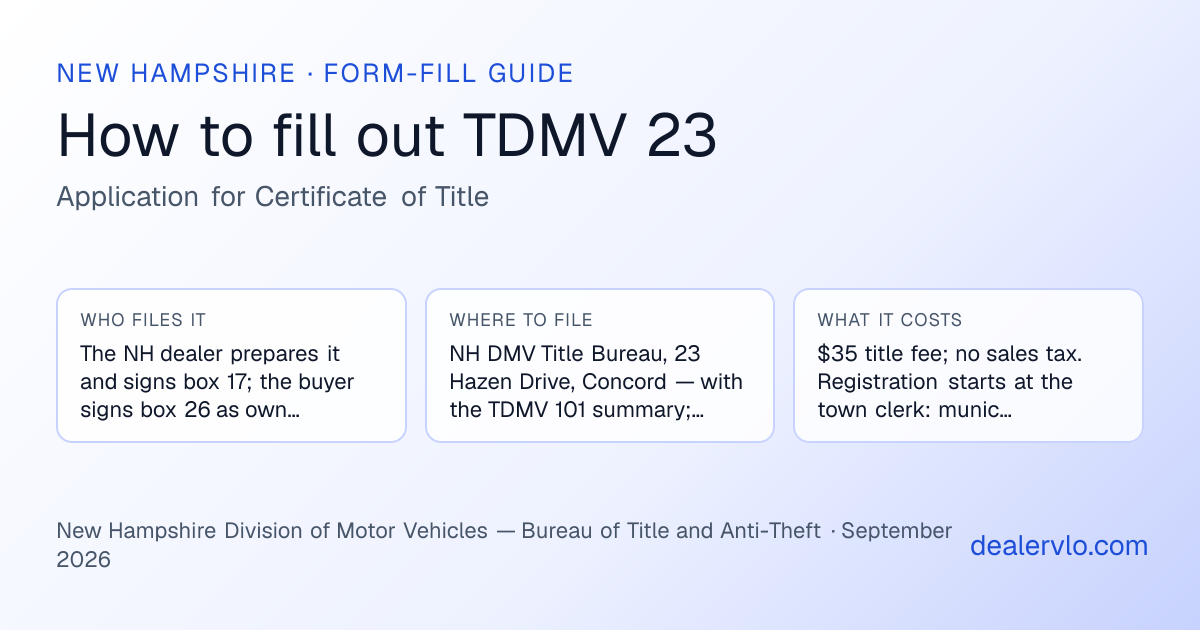
Filling out the NH TDMV 23 after a sale:
- What it is
- New Hampshire's application to title a vehicle in the buyer's name (a controlled, pre-numbered form)
- Who completes it
- The NH dealer prepares it and signs box 17; the buyer signs box 26 as owner
- Where to file it
- NH DMV Title Bureau, 23 Hazen Drive, Concord — with the TDMV 101 summary; the buyer registers at their town/city clerk
- Processing time
- Due within 10 days of sale (40 if a lienholder holds the title); DMV mails the title in about 40–50 days
- Cost
- $35 title fee; no sales tax. Registration starts at the town clerk: municipal permit fee + state registration fee
This guide is informational and does not replace the official New Hampshire instructions. Always confirm the current form and procedure with New Hampshire Division of Motor Vehicles — Bureau of Title and Anti-Theft before you file.
See the NH TDMV 23 filled — from just a VIN
Enter a VIN, the buyer's name, and the price. We decode the vehicle and drop it onto a worksheet for the New Hampshire TDMV 23 — the same fill DealerVLO produces from a deal. Watermarked preview; nothing is saved.
What the TDMV 23 is and why it matters
Form TDMV 23 is New Hampshire's Application for Certificate of Title. When an NH resident buys from an NH dealer, the dealer fills it out and sends it to the DMV with the $35 title fee and the old title, then gives the buyer the owner's and town clerk's copies of the application. The buyer takes them to their town or city clerk to register the car. In New Hampshire, title goes through the state and registration goes through the town.
New Hampshire has no sales tax, so there's no tax affidavit to work out. The risk on this form is the paperwork itself. It's a controlled document, it has to be typed or computer-generated, every box has to be filled in, and it's due at the DMV within 10 days of the sale (40 days if a lender still holds the old title). This guide goes through boxes 1–27 in the order they're printed.
New Hampshire's title application is a controlled, pre-numbered form — you won't find a blank PDF of it on the DMV website. NH rules name it TDMV 23 (rev. 07/19) and TDMV 23B (rev. 07/18); the DMV forms page calls the clerk-office version TDMV 23A and says it's only available from a town or city clerk. A licensed dealer orders its own numbered stock from the Title Bureau on the Supply Order Form (TDMV 21E), and applications can't be loaned to or borrowed from another dealer, lender, or clerk. The boxes are numbered the same way across the versions, and the DMV's Title Handbook walks them box by box — that's what this guide follows.
Documents to have before you start
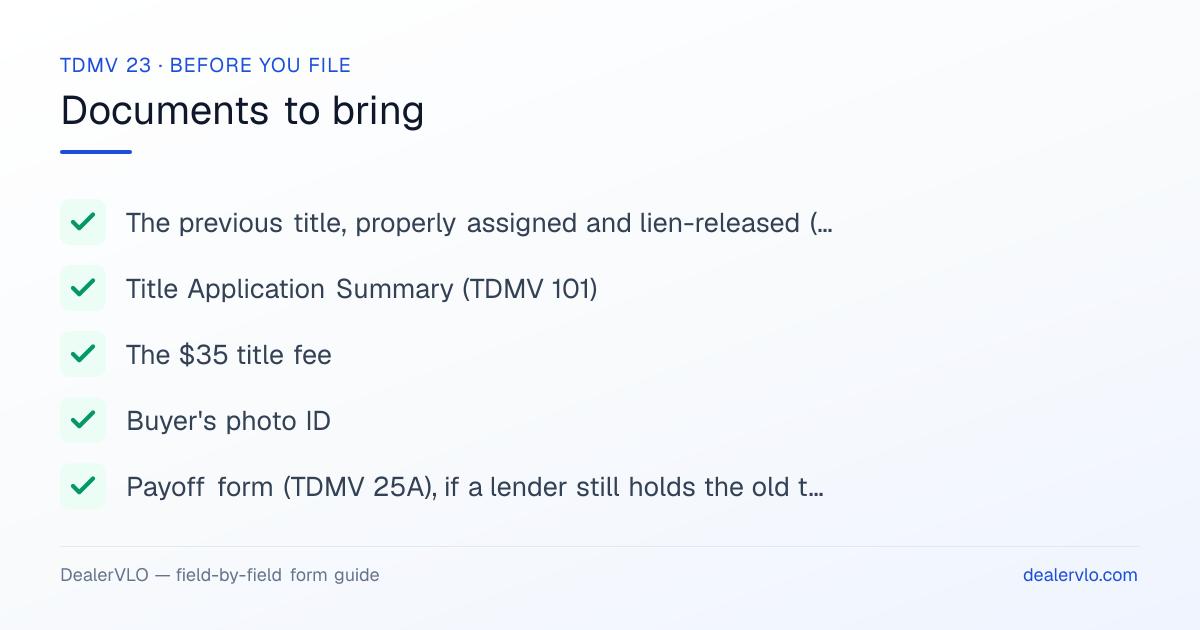
Gather these before you complete the TDMV 23. A missing attachment is the number-one reason the New Hampshire Division of Motor Vehicles — Bureau of Title and Anti-Theft bounces a title application back.
- The previous title, properly assigned and lien-released (or the MCO for a new vehicle) — The title number and issuing state go in boxes 15–16. For a new vehicle, enter "MCO" in box 15 and send the certificate of origin.
- Title Application Summary (TDMV 101) — NH rule Saf-C 1908.01 says the dealer files an itemized TDMV 101 along with the title applications, supporting documents, and fees.
- The $35 title fee — The form says to make checks payable to "State of New Hampshire – DMV."
- Buyer's photo ID — Under NH rules the applicant proves identity with a state-issued photo ID card, photo driver's license, military ID, or passport.
- Payoff form (TDMV 25A), if a lender still holds the old title — With a payoff, the dealer has 40 days from the sale instead of 10 to file.
- Odometer disclosure (TDMV 12), when needed — Use it when the title assignment doesn't carry the current mileage or there's a discrepancy.
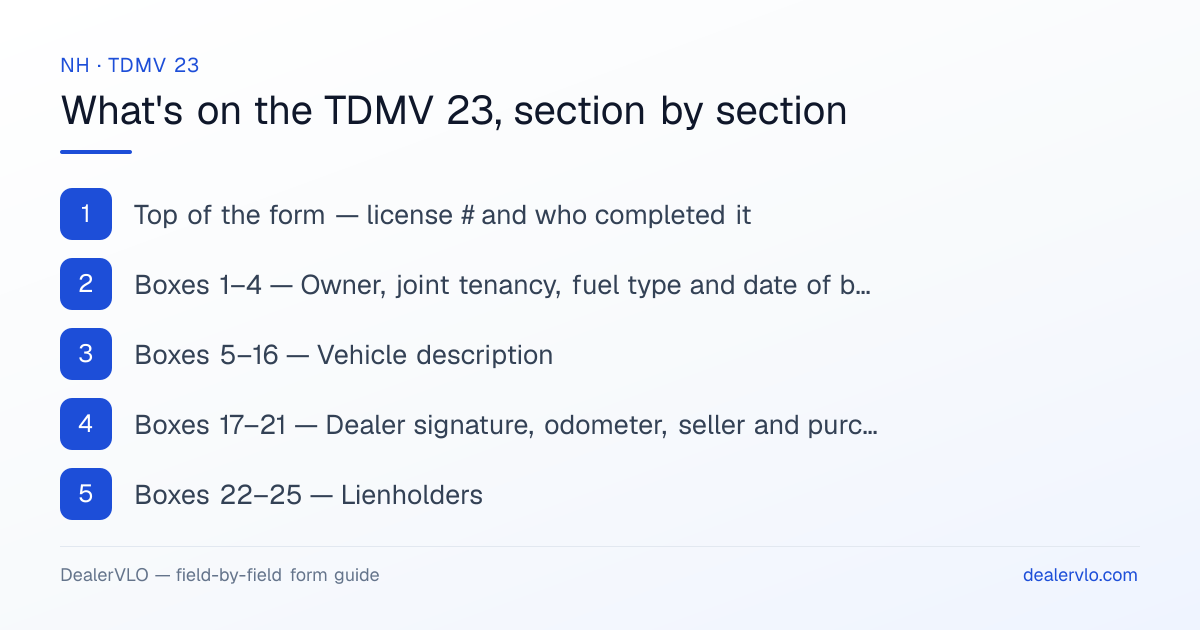
TDMV 23, section by section
Top of the form — license # and who completed it
The pre-printed C.T.A. (control) number in the top right is what ties this application to your dealership. Title Bureau assigns applications by that number, so keep your stock locked up and don't hand blanks to anyone else. Check the box to show a licensed dealer completed the application. The Title Handbook says to use the License # space above the owner's name to identify the applicant.
| Field | Who fills it |
|---|---|
C.T.A. number Pre-printed on your controlled stock; issued to your dealership only. | At the counter |
Application completed by (Town Clerk / Licensed Dealer / Lending Institution / Other) Check Licensed Dealer. | You (dealer) |
License # Identifies the applicant, per the Title Handbook. | You (dealer) |
Boxes 1–4 — Owner, joint tenancy, fuel type and date of birth
Box 1 is the owner's name (last, first, middle) and mailing address, plus phone and email. The owner has to be a legal New Hampshire resident. If there are two owners, pick either "and" or "or" as the conjunction, never both. Box 2 is only for two unmarried owners using "and" who want joint tenancy with rights of survivorship. On an NH title, "or" already works as JTWROS. Box 3 is the fuel type plus each owner's date of birth (not needed for a business owner, but a lessee's DOB is required). Only fill in box 4 if the legal residence is different from the mailing address, or if box 1 uses a P.O. box.
| Field | Who fills it |
|---|---|
1. Owner's name(s) — last, first, middle Must be an NH legal resident; use "and" or "or" — never both. | Buyer |
Street or box no., city or town, state, ZIP Mailing address — the title is mailed here (or to the lienholder). | Buyer |
Phone number, email address | Buyer |
2. Joint tenancy with rights of survivorship Only for two unmarried owners joined by "and." | Buyer |
3. Vehicle powered by (gas, diesel, electric, propane, other) | You (dealer) |
Date(s) of birth — owner 1 and 2 Required for each individual owner; not for a company. | Buyer |
4. Legal residence if other than mailing address (or lessee) Required if box 1 shows a P.O. box. | Buyer |
Boxes 5–16 — Vehicle description
Type the VIN carefully. A typo can mean the DMV needs a physical VIN check (TDMV 19A). Box 6 is new, used, or demo, where a demo is a vehicle on an MCO with more than 2,000 miles. Boxes 7–11 are all required, and body type and color have to use the DMV's codes (like 4DSED, APURP, PKUP; BLK, WHI, SIL). Vehicles from model year 1999 or older are generally exempt from title. Gross weight is required on every application because it sets the registration fee. Box 15 is the previous title number ("MCO" for a new vehicle), and box 16 is the state that issued it.
| Field | Who fills it |
|---|---|
5. Vehicle identification no. Must match the title and the vehicle exactly. | You (dealer) |
6. Purchased — new / used / demo Demo = MCO vehicle with more than 2,000 miles. | You (dealer) |
7. Make of vehicle | You (dealer) |
8. Model name or number | You (dealer) |
9. Body type DMV body-style code, e.g. 4DSED, APURP, PKUP. | You (dealer) |
10. Vehicle color(s) DMV color code, e.g. BLK, WHI, SIL. | You (dealer) |
11. Year of manufacture | You (dealer) |
12. Model year Model year 1999 or older is generally title-exempt. | You (dealer) |
13. No. of cylinders | You (dealer) |
14. Gross weight As it appears on the title; drives registration fees. | You (dealer) |
Axles For trucks over 18,000 lb gross weight. | You (dealer) |
15. Title no. Previous title number, or "MCO" for a new vehicle. | You (dealer) |
16. State The state that issued the previous title. | You (dealer) |
Boxes 17–21 — Dealer signature, odometer, seller and purchase date
On a dealer sale, an authorized person from the dealership signs box 17 and puts your NH dealer number in box 18. State law requires a dealer-sale application to be signed by the dealer as well as the owner. Box 19 is the actual mileage: no tenths, and no estimates. Enter kilometers if that's what the odometer reads, and leave it blank for a trailer. Box 20 is the seller's full name and address with ZIP (your dealership on a normal retail sale). Box 21 is the full date of purchase, and it starts your 10-day filing clock.
| Field | Who fills it |
|---|---|
17. N.H. licensed dealer's signature Required on a dealer sale. | You (dealer) |
18. Dealer no. | You (dealer) |
19. Odometer — actual mileage No tenths; must agree with the assignment's disclosure. | You (dealer) |
20. Seller's name(s) & address Full name and address including ZIP. | You (dealer) |
21. Date of purchase (mo/day/yr) Starts the 10-day (or 40-day) deadline. | You (dealer) |
Boxes 22–25 — Lienholders
If the buyer financed, put the first lienholder's name, full mailing address, lien date, and lienholder number (the # box) in boxes 22–23. The DMV mails the title to the lienholder when one is listed. If there's no loan, type "NONE" in box 22 and don't leave it blank. In NH, a lender's lien is perfected by this application, so a wrong lender address causes real problems. Use the lienholder name and address exactly as the DMV has them on file. Boxes 24–25 are only for a second lienholder.
| Field | Who fills it |
|---|---|
22. First lienholder's name (if none, type NONE) | You (dealer) |
Lienholder address, city or town, state, ZIP The title is mailed here when a lien is listed. | You (dealer) |
23. Date of lien + lienholder # | You (dealer) |
24. Second lienholder's name(s) & address Only if there is a second lien. | You (dealer) |
25. Date of lien (second) | You (dealer) |
Boxes 26–27 — Owner certification and signatures
Above the signature line, the owner certifies that every lien is listed, and the signatures have to match the owner(s) named in box 1. If there are two owners, both sign. If the owner is a corporation, partnership, or other association, the signer prints their name in the certification below and certifies they're authorized. No notary is needed. The form's penalty note (RSA 262:1) makes a false name, false statement, or hidden lien a class B felony for an individual.
| Field | Who fills it |
|---|---|
26. Owner's signature(s) Must agree with the owner(s) in box 1. | Buyer |
27. Date signed | Buyer |
Authorized-agent certification (business owners) Print name and the owner it signs for; not notarized. | Buyer |
The TDMV 23 is one car's paperwork. A 20-second read on your lot, and the tax-and-fee math for the whole deal — built for dealers, no signup. Free calculators dealers actually use — no signup, no email.
DealerVLO turns your deal into a print-ready New Hampshire TDMV 23 worksheet — VIN-decoded vehicle, buyer, co-buyer, and sale price laid out and ready to key in or copy over. $29/month, free to try — cancel any time.
Common TDMV 23 mistakes that cause rejections
New Hampshire law gives a dealer 10 days from the date of sale to get the application and supporting documents to the DMV. It's 40 days only when a lienholder held the title at the time of sale, and that case goes in with a TDMV 25A payoff form. Send each batch with the TDMV 101 summary.
The Title Handbook requires applications to be typed or computer-generated, with every box filled in and only originals accepted (no copies or faxes). A blank lienholder box should say "NONE." Filling it from one deal record prevents most of these returns.
Boxes 9 and 10 take the DMV's codes, not plain English: "4DSED," not "sedan," and "SIL," not "silver." A non-standard entry is an easy reason for the Title Bureau to send the application back.
Pick one conjunction. "Or" lets either owner sell and already works as joint tenancy with rights of survivorship. "And" requires both owners to sign. Box 2 JTWROS is only for two unmarried owners using "and." Never write "and/or."
TDMV 20A is the Release of Lien or Other Encumbrances, which is a lender's form and not a title application. The dealer's title application is the numbered TDMV 23/23B stock ordered from the Title Bureau on the TDMV 21E supply form.
Common questions
What form do I use to title a vehicle in New Hampshire?+
The Application for Certificate of Title, form TDMV 23 (NH rules also list a TDMV 23B version, and the DMV forms page calls the clerk version TDMV 23A). It's a controlled, pre-numbered form. Only NH town/city clerks, NH licensed dealers, and NH lienholders can prepare it.
Can I download the New Hampshire title application?+
No. The NH DMV doesn't publish a blank TDMV 23 because it's a controlled document. Buyers get one prepared by their town or city clerk. Licensed dealers order numbered stock from the DMV Title Bureau using the Supply Order Form, TDMV 21E.
Does New Hampshire charge sales tax on a car?+
No. New Hampshire has no general sales tax, so there's no sales tax on a vehicle purchase and nothing for a trade-in to reduce. The buyer pays the $35 title fee plus registration costs: a municipal permit fee and a state registration fee, paid when the vehicle is registered (registration starts at the buyer's town or city clerk).
How much is a New Hampshire title?+
$35 for a certificate of title after a transfer, with or without a lienholder, under RSA 261:20 as in effect from January 1, 2026. Duplicate titles are also $35.
How long does a New Hampshire dealer have to submit the title application?+
10 days from the date of sale, under RSA 261:4. It's 40 days when a lienholder held the vehicle's title at the time of sale. The application goes to the DMV with the supporting documents, the fee, and a TDMV 101 Title Application Summary.
How does the buyer register a car bought from a New Hampshire dealer?+
The dealer gives the buyer the owner's and town clerk's copies of the title application. The buyer takes them to the town or city clerk where they live to get a registration permit and register the vehicle. Title and registration are separate in New Hampshire: the state issues the title and the town handles registration.
How long does it take to get a New Hampshire title?+
The NH DMV says it produces and mails a new title to the owner, or to the lienholder if there's a loan, within about 40 to 50 calendar days after it receives the application.
Is there software that fills out the TDMV 23 automatically?+
Yes. Dealer management software like DealerVLO turns the deal you already entered into a print-ready New Hampshire TDMV 23 worksheet — the VIN-decoded vehicle, buyer, co-buyer, lienholder, and sale price laid out and ready to copy onto the form or key into the state's system. It's $29/month flat with a 14-day free trial, and the same deal also generates your federal documents (Bill of Sale, FTC Buyers Guide, odometer disclosure) and any other state's title forms.
Stop filling out the TDMV 23 by hand.
DealerVLO turns your deal jacket into a print-ready NH TDMV 23 worksheet — VIN-decoded vehicle, buyer, co-buyer, lienholder, and sale price laid out, so keying it in or copying it over takes minutes. $29/month. 14-day free trial, cancel any time.
Curious how it works? See how DealerVLO auto-fills every dealer document — bill of sale, FTC Buyers Guide, odometer disclosure, and state title & registration forms for all 50 states, from one deal.
Bond amounts, fees, and form rules change. Get a short email when your state does. No spam, unsubscribe anytime.