How to fill out the Form TR-1 in Rhode Island
A field-by-field walkthrough of the Rhode Island Form TR-1 (Application for Registration and Title Certificate) for licensed used car dealers — what goes in every section, who signs what, and the documents you attach. Verified against the official form as of September 2026.
Filing these every week? DealerVLO fills the Form TR-1 from the deal you already entered, $29/month flat. See pricing
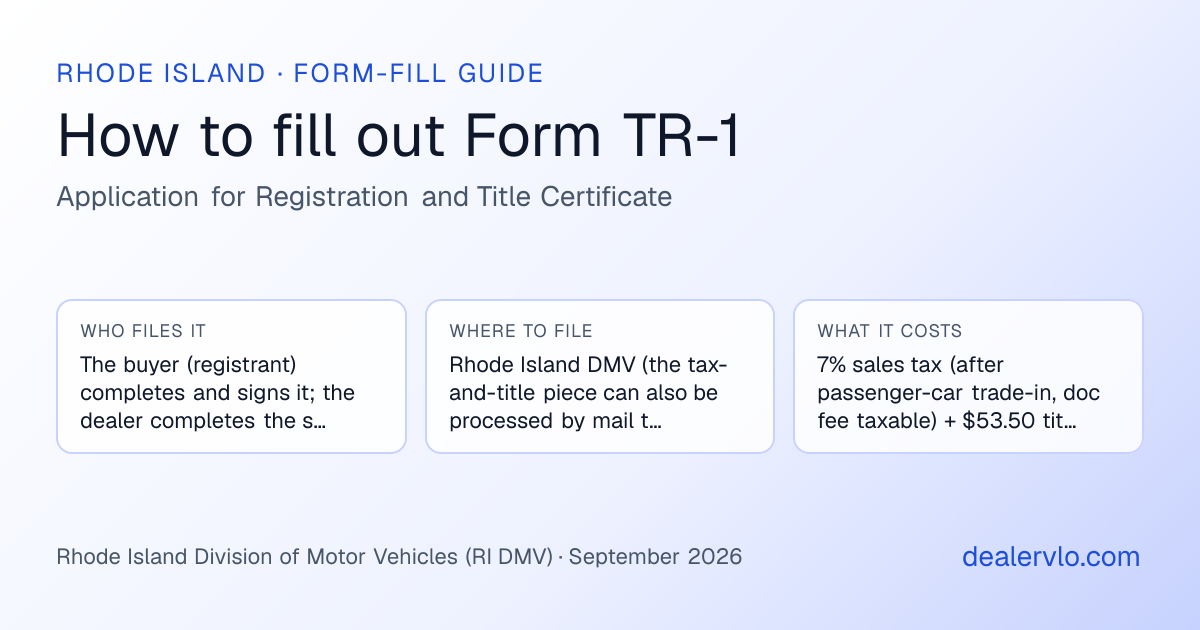
Filling out the RI Form TR-1 after a sale:
- What it is
- Rhode Island's combined application for registration and title (TR-1)
- Who completes it
- The buyer (registrant) completes and signs it; the dealer completes the seller section with its RI dealer license number
- Where to file it
- Rhode Island DMV (the tax-and-title piece can also be processed by mail to the Cranston DMV)
- Processing time
- Sales tax due by the 20th of the month after the sale, even if not yet registered
- Cost
- 7% sales tax (after passenger-car trade-in, doc fee taxable) + $53.50 title + weight-based registration and surcharges
This guide is informational and does not replace the official Rhode Island instructions. Always confirm the current form and procedure with Rhode Island Division of Motor Vehicles (RI DMV) before you file.
See the RI Form TR-1 filled — from just a VIN
Enter a VIN, the buyer's name, and the price. We decode the vehicle and drop it onto the actual Rhode Island Form TR-1 — the same fill DealerVLO produces from a deal. Watermarked preview; nothing is saved.
What the Form TR-1 is and why it matters
The TR-1 is the Rhode Island DMV's Application for Registration and Title Certificate — one form used for new registrations, transfers, plate changes, renewals and tax-and-title transactions. For a dealer sale you check New Registration (or Transfer Registration if the buyer is moving a plate) and complete Sections A through G: the registrant, any lessee, the seller (that's you), insurance, the vehicle, liens, and the signatures.
The Rhode Island quirk that catches out-of-state dealers is the sales tax. It's 7% of the price after a qualifying trade-in, but a Rhode Island dealer can't add it to the sale price on a sale to an RI resident — the buyer pays it directly to the state at the DMV at registration, using the dealer's sales-tax form. It's due by the 20th of the month after the sale even if the car isn't registered yet, or interest and penalties start. And the dealer's doc fee is part of the taxable amount. This guide walks the current (rev. 6/21) form section by section.
The TR-1 is Rhode Island's single application for both registration and title — the DMV lists it as the "Application for Registration" and the form itself is headed Application for Registration and Title Certificate. On a dealer sale the buyer is the registrant and signs; the dealer fills in the seller section with its RI dealer license number, and Rhode Island law requires an application for a dealer-sold vehicle to be signed by the dealer as well as the owner (R.I. Gen. Laws § 31-3.1-4). The big difference from most states: the dealer doesn't collect the sales tax. The buyer pays it to the state at the DMV, and it's due by the 20th of the month after the sale.
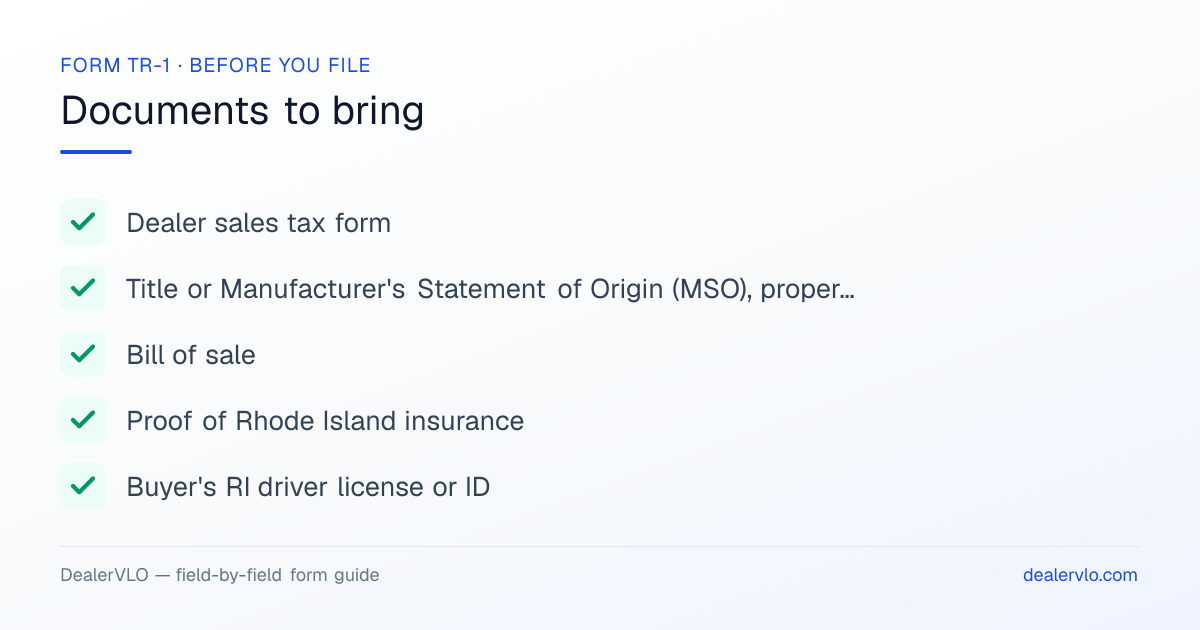
Documents to have before you start
Gather these before you complete the Form TR-1. A missing attachment is the number-one reason the Rhode Island Division of Motor Vehicles (RI DMV) bounces a title application back.
- Dealer sales tax form — The dealer's statement of sale the buyer presents at the DMV to pay the 7% sales tax (the Division of Taxation's regulation calls it the Dealer's Statement of Sale, T-336-1).
- Title or Manufacturer's Statement of Origin (MSO), properly assigned — Since January 1, 2024, Rhode Island titles all used vehicles regardless of model year. The document checklist printed with the TR-1 PDF (rev. 11/13) still says "2001 or newer" — that's out of date.
- Bill of sale — Listed on the DMV's dealer-sale checklist.
- Proof of Rhode Island insurance — Section D asks for the liability insurer, policy number and effective dates.
- Buyer's RI driver license or ID — Plus the gross vehicle weight (on the door-jamb VIN plate), which the registration fee is based on.
- VIN check, if the vehicle came from out of state — Required when the vehicle was titled or registered in another state. A Power of Attorney is needed on a leased vehicle.
Form TR-1, section by section
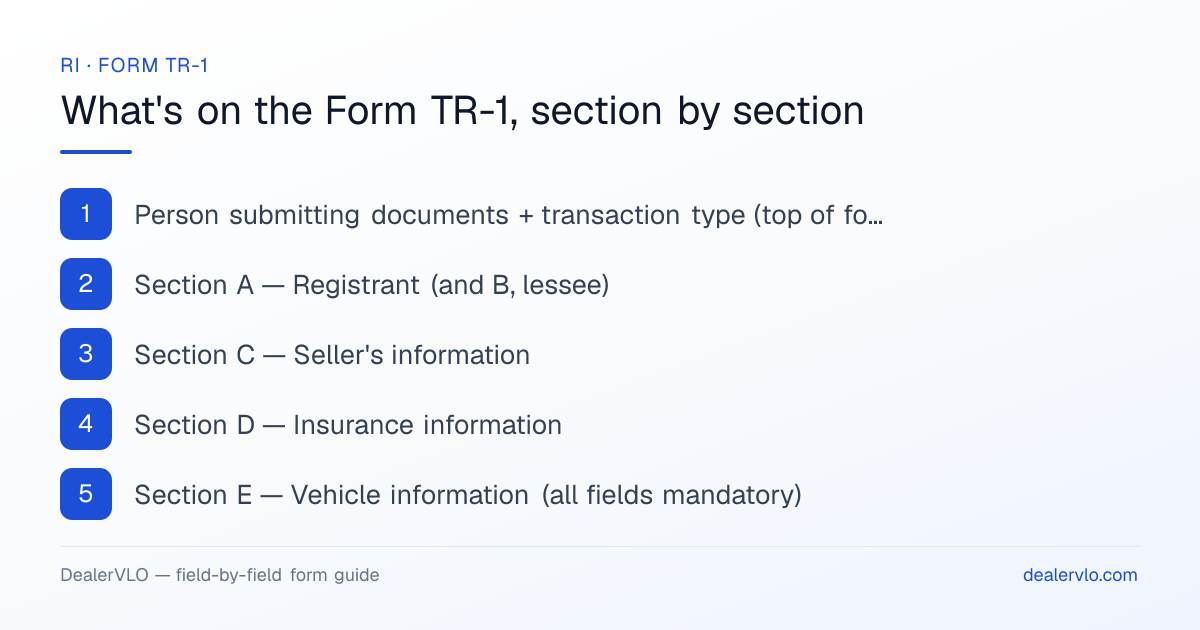
Person submitting documents + transaction type (top of form)
The top-left block identifies whoever is physically handing the paperwork to the DMV — printed name, signature, and their license number and state. Below it, pick one transaction type. A retail sale is normally New Registration; use Transfer Registration and enter the plate number if the buyer is moving a plate from a vehicle they're giving up. Each box on the form lists the sections to complete — both of those call for A, B (if leased), C, D, E, F and G. Tax & Title is for paying the sales tax and titling without registering.
| Field | Who fills it |
|---|---|
Printed name, signature, license # and state of person submitting Whoever submits — the dealer's runner or the buyer. | You (dealer) |
Transaction type New Registration or Transfer Registration (with plate #) on a retail sale. | You (dealer) |
Section A — Registrant (and B, lessee)
Section A is the buyer — the new owner. Enter the legal name, RI license number and date of birth, the residence where the vehicle is kept or garaged, the tax town, and a mailing address if it's different. A second owner goes in the "Second owner information" lines. Section B is only for a leased vehicle: the leasing company is the registrant in A and the lessee's details go in B.
| Field | Who fills it |
|---|---|
Last name (or company), first name, middle initial, suffix | Buyer |
License #, date of birth, phone | Buyer |
Residence (where vehicle is kept or garaged) | Buyer |
Tax town, email address | Buyer |
Mailing address (if different) | Buyer |
Second owner name, license #, DOB | Buyer |
Section B — lessee's information Leased vehicles only. | Buyer |
Section C — Seller's information
This is the dealer's section. Enter the dealership name and address, the date of sale, and your RI dealer's license number. The date of sale is what starts the sales-tax clock — the buyer's 7% is due by the 20th of the following month.
| Field | Who fills it |
|---|---|
Seller's name + street address, city/state/ZIP | You (dealer) |
Date of sale Sales tax is due by the 20th of the next month. | You (dealer) |
RI dealer's license # | You (dealer) |
RI Sales tax & title fee calculator
Free · no signup · updates as you type
Rhode Island sales tax is 7% of the purchase price minus trade-in and other allowances, with no local add-on. The trade-in credit only applies when a passenger car is traded toward a passenger car (the DMV also lists motorcycles and motor homes) — a truck traded toward a car doesn't count. A dealer's title or documentary fee is part of the taxable amount. The buyer pays the tax to the state at the DMV (the dealer can't add it to the price on a sale to an RI resident), due by the 20th of the month after the sale. Title fee $53.50 (includes the $3.50 technology surcharge); registration is based on vehicle weight, prorated, plus a $3.50 surcharge, a $20-per-year DOT surcharge and, for hybrids and EVs, a per-year EV/hybrid fee — enter it in the plate/registration box. Confirm current figures with the RI DMV.
Stop re-keying this onto the Form TR-1.
DealerVLO runs this math on every deal and drops it — with the VIN, buyer, and sale price — straight onto the official RI Form TR-1, the bill of sale, and the FTC forms. One screen, no re-keying.
14-day free trial — a card starts it, no charge until day 14, then $29/month. Cancel any time.
Section D — Insurance information
The buyer's liability insurance company, policy number and effective dates. Rhode Island won't register an uninsured vehicle, and by signing, the buyer also swears to the insurance compliance statement printed on the back of the form.
| Field | Who fills it |
|---|---|
Liability insurance company name | Insurance agent |
Policy # | Insurance agent |
Effective dates (from and to) | Insurance agent |
Section E — Vehicle information (all fields mandatory)
The form marks every field in this section mandatory, so don't leave gaps. The VIN must match the title and the VIN plate, and the gross vehicle weight matters because Rhode Island registration fees are based on vehicle weight. Current mileage should match the odometer disclosure on the title. The trailer/camper and motorcycle boxes only apply to those vehicle types.
| Field | Who fills it |
|---|---|
Year, VIN Must match the title and VIN plate. | You (dealer) |
Make, model, body type | You (dealer) |
Gross vehicle weight From the door-jamb VIN plate; drives the registration fee. | You (dealer) |
Color, # of cylinders, current mileage | You (dealer) |
Number of seat belts | You (dealer) |
Fuel type (check one) Gas, diesel, hybrid, electric, CNG/LPG. | You (dealer) |
Pickup bed yes/no | You (dealer) |
Section F — Lien information
If the buyer financed, enter the lienholder's name, address and the date of the lien (the date of the security agreement). There's room for a second lienholder. If there's no loan, check the "no lien" box — don't just leave the section blank. Rhode Island law requires a dealer-sold vehicle's application to show any lienholder whose security interest was created at the sale, with the date of the security agreement.
| Field | Who fills it |
|---|---|
No-lien box Check it when there's no loan. | You (dealer) |
(1) Lienholder name, street address, city/state/ZIP | You (dealer) |
(1) Date of lien The date of the security agreement. | You (dealer) |
(2) Second lienholder + date of lien | You (dealer) |
Section G — Signature
The owner signs under penalty of perjury that they own (or lease) the vehicle, that there are no liens except those listed, and that they'll follow the insurance compliance statement. A second owner signs too. The buyer also answers whether they consent to the DMV disclosing personal information. If an owner isn't present at the DMV, their signature must be notarized — with an ink stamp, not embossed only, and the notary's commission expiration date is mandatory.
| Field | Who fills it |
|---|---|
Owner's signature + date | Buyer |
Second owner's signature | Buyer |
Title or position (if a corporation) | Buyer |
Parent/guardian signature (if a minor) | Buyer |
Consent to disclosure yes/no | Buyer |
Notary signature, name, date, commission expiration Only when an owner isn't present — completed by a notary public. | At the counter |
For Official Use Only (plate, type, tax, total) | At the counter |
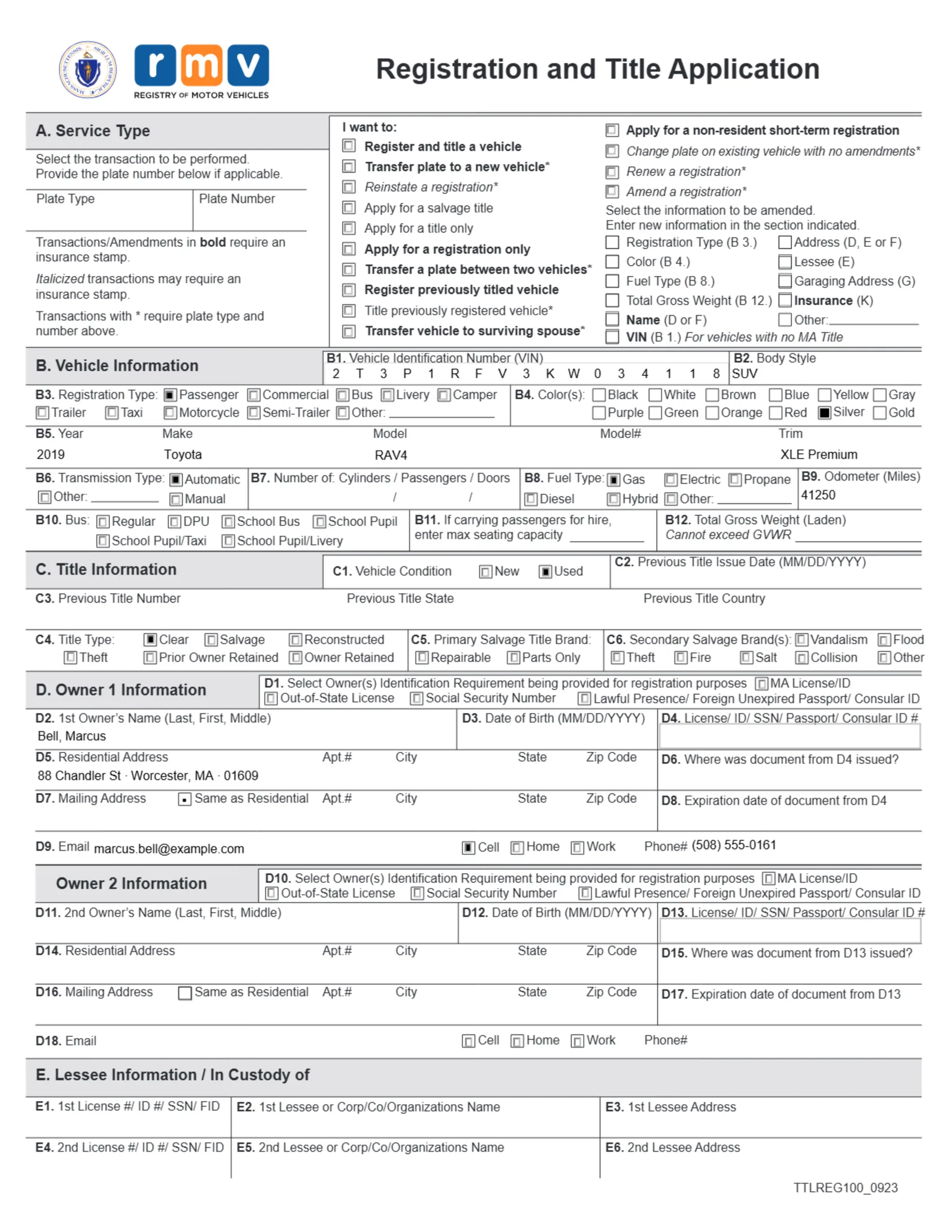
The Form TR-1 is one car's paperwork. A 20-second read on your lot, and the tax-and-fee math for the whole deal — built for dealers, no signup. Free calculators dealers actually use — no signup, no email.
DealerVLO fills the official Rhode Island Form TR-1 straight from your deal — VIN-decoded vehicle, buyer, co-buyer, and sale price already in place. $29/month, free to try — cancel any time.
Common Form TR-1 mistakes that cause rejections
On a sale to a Rhode Island resident, the dealer can't add the sales tax to the sale price — the buyer pays it directly to the state at the DMV using the dealer's sales-tax form. (The exception is a sale to a nonresident whose state taxes vehicles, where an RI dealer collects tax at that state's rate, capped at 7%.)
Sales tax on a vehicle is due by the 20th of the month after the sale, even if the car isn't registered by then. After that, interest and penalty charges are added. If the buyer can't get to the DMV in time, they can pay the Division of Taxation directly before the due date.
Rhode Island's trade-in allowance applies to a passenger car traded toward a passenger car (motor homes and, per the DMV, motorcycles too). A truck traded toward a car gets no deduction, and a separate private sale of the buyer's old car isn't a trade-in even if the money goes into the deal.
Rhode Island's tax regulation makes a dealer's title-preparation and documentary fees part of the taxable measure — and they must be stated separately on the invoice. Relabeling the fee doesn't take it out of the tax.
If two owners are on the application and one won't be at the DMV, that person's signature on the TR-1 must be notarized, with an ink stamp and the commission expiration date filled in. Otherwise the registration gets turned away at the counter.
Common questions
What form do I use to register and title a car in Rhode Island?+
The TR-1, the Rhode Island DMV's Application for Registration and Title Certificate. One form covers registration and title. On a dealer sale the buyer is the registrant and signs, and the dealer completes the seller section with its RI dealer license number.
How much is sales tax on a car in Rhode Island?+
7% of the purchase price minus any qualifying trade-in and other allowances, on both new and used vehicles bought from a dealer. There's no local sales tax on top. On a private sale, a vehicle seven years old or newer is taxed on the greater of the sale price or the NADA clean retail value.
Who pays Rhode Island sales tax on a dealer sale, and when?+
The buyer pays it directly to the state, at the DMV at registration or earlier at the Division of Taxation. The dealer can't add it to the price on a sale to an RI resident. It's due by the 20th of the month after the sale, even if the vehicle isn't registered yet; after that, interest and penalties accrue.
Does a trade-in reduce Rhode Island sales tax?+
Yes, when a passenger car is traded toward a passenger car (motor homes qualify, and the DMV also lists motorcycles). The trade allowance is subtracted before the 7% is figured, and so is a manufacturer's rebate. A truck traded toward a car doesn't get the deduction.
Is the doc fee taxable in Rhode Island?+
Yes. Under the Division of Taxation's regulation, a dealer's title-preparation and documentary fees are included in the taxable sales price and must be stated separately on the invoice.
How much does a Rhode Island title cost?+
$53.50 for a new or transfer title, including the $3.50 technology surcharge. Registration is separate: based on vehicle weight and prorated, plus the $3.50 surcharge, a $20-per-year DOT surcharge and, since 2026, a per-year fee on hybrids and EVs.
Does Rhode Island require a VIN check?+
Yes, when the vehicle was titled or registered in another state. Since January 1, 2024, every used vehicle coming into Rhode Island from out of state needs a VIN inspection from a local police department, regardless of model year.
Is there software that fills out the Form TR-1 automatically?+
Yes. Dealer management software like DealerVLO fills the Rhode Island Form TR-1 from the deal you already entered — the VIN-decoded vehicle, buyer, co-buyer, lienholder, and sale price are placed for you instead of hand-writing them. For most states that's the official DMV form itself; where a state issues its form only through its own dealer portal, you get a print-ready worksheet with every value already in place. It's $29/month flat with a 14-day free trial, and the same deal also generates your federal documents (Bill of Sale, FTC Buyers Guide, odometer disclosure) and any other state's title forms.
Stop filling out the Form TR-1 by hand.
DealerVLO fills the official RI Form TR-1 straight from your deal jacket — VIN-decoded vehicle, buyer, co-buyer, lienholder, and sale price already in place. Print, sign, and file in about 90 seconds. $29/month. 14-day free trial, cancel any time.
Curious how it works? See how DealerVLO auto-fills every dealer document — bill of sale, FTC Buyers Guide, odometer disclosure, and state title & registration forms for all 50 states, from one deal.
Bond amounts, fees, and form rules change. Get a short email when your state does. No spam, unsubscribe anytime.