How to fill out the MVT-2 in Maine
A field-by-field walkthrough of the Maine MVT-2 (Application for Certificate of Title) for licensed used car dealers — what goes in every section, who signs what, and the documents you attach. Verified against the official form as of September 2026.
Filing these every week? DealerVLO builds the MVT-2 worksheet from the deal you already entered, $29/month flat. See pricing
Filling out the ME MVT-2 after a sale:
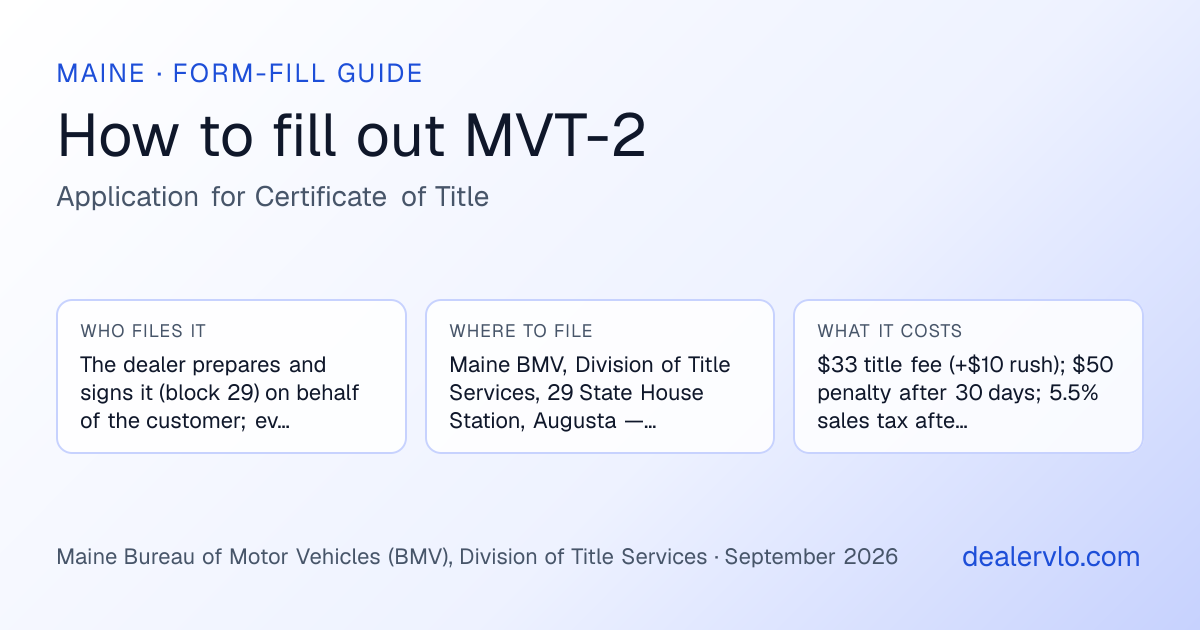
- What it is
- Maine's Application for Certificate of Title — a carbon-copy form ordered from the BMV, not a download
- Who completes it
- The dealer prepares and signs it (block 29) on behalf of the customer; every owner signs block 30
- Where to file it
- Maine BMV, Division of Title Services, 29 State House Station, Augusta — within 30 days of the sale
- Processing time
- About 2 weeks from receipt; rush (expedited) 3–5 business days for $10 more
- Cost
- $33 title fee (+$10 rush); $50 penalty after 30 days; 5.5% sales tax after trade-in is collected by the dealer
This guide is informational and does not replace the official Maine instructions. Always confirm the current form and procedure with Maine Bureau of Motor Vehicles (BMV), Division of Title Services before you file.
See the ME MVT-2 filled — from just a VIN
Enter a VIN, the buyer's name, and the price. We decode the vehicle and drop it onto a worksheet for the Maine MVT-2 — the same fill DealerVLO produces from a deal. Watermarked preview; nothing is saved.
What the MVT-2 is and why it matters
The MVT-2 is Maine's Application for Certificate of Title — the form that puts a vehicle in the buyer's name. On a dealer sale it isn't optional paperwork you can hand to the customer: Maine law requires the application to be signed by the dealer, and the dealer must deliver it to the Secretary of State within 30 days of the sale, with a copy to any lienholder. Late means a $50 penalty, and 90 days or more is a Class E crime.
The form has no sales-tax section — Maine's 5.5% sales tax is collected by the dealer and reported on the dealer's own sales tax return, and the buyer's bill of sale is their proof of payment when they register at the town office. What the MVT-2 does care about is the MSRP in box 5 (the town uses it for excise tax), an honest odometer statement, and complete lien information. This guide walks the form box by box in printed order.
Don't confuse the MVT-2 with the MVT-1: in Maine BMV's own dealer training, "MVT-1" is the Maine Certificate of Title itself — the document you assign on the back. The MVT-2 is the application that gets the buyer a new one, and the BMV says it must be submitted by all Maine dealers on behalf of the customer. There's no downloadable MVT-2: it's a numbered, multi-part carbon form the BMV says is not available online. Dealers order it free from the BMV stockroom on form MVT-44 (in increments of 25), or buy pre-validated MVT-2A applications in increments of 50. Only originals are accepted — photocopies are rejected. The layout below follows the MVT-2 (Rev. 3/23) as reproduced in the BMV's Dealer Title Processes training.
Documents to have before you start
Gather these before you complete the MVT-2. A missing attachment is the number-one reason the Maine Bureau of Motor Vehicles (BMV), Division of Title Services bounces a title application back.
- The assigned title (MVT-1) or MCO — Transfer on the reverse of the current title, or on an MVT-16 attached to it (close the back of the title, e.g. "See MVT-16"). A new vehicle's MCO is assigned on the back and submitted with the application.
- Title fee — $33 per application — Checks payable to "Secretary of State". Add $10 if you check the rush box at the top of the form.
- MVT-56 Title Application Summary Log (when sending several) — Lists each application's CTA number, owner and VIN; applications stapled and in the same order. Not required with pre-validated applications.
- MVT-32 Odometer Information, if the reading isn't actual — Required when box 20 shows the odometer was changed or broken, or when the reading is questionable.
- Lien details and the lienholder's ID number — If the lender participates in Maine's Electronic Lien Titling program, its lienholder ID# sends the title electronically. The dealer must also deliver a copy of the application to the lienholder.
- A bill of sale or buyer's order showing the sales tax — Not filed with the MVT-2, but the buyer must show it at registration as proof Maine sales tax was paid — it needs the price, trade-in, and tax amount.
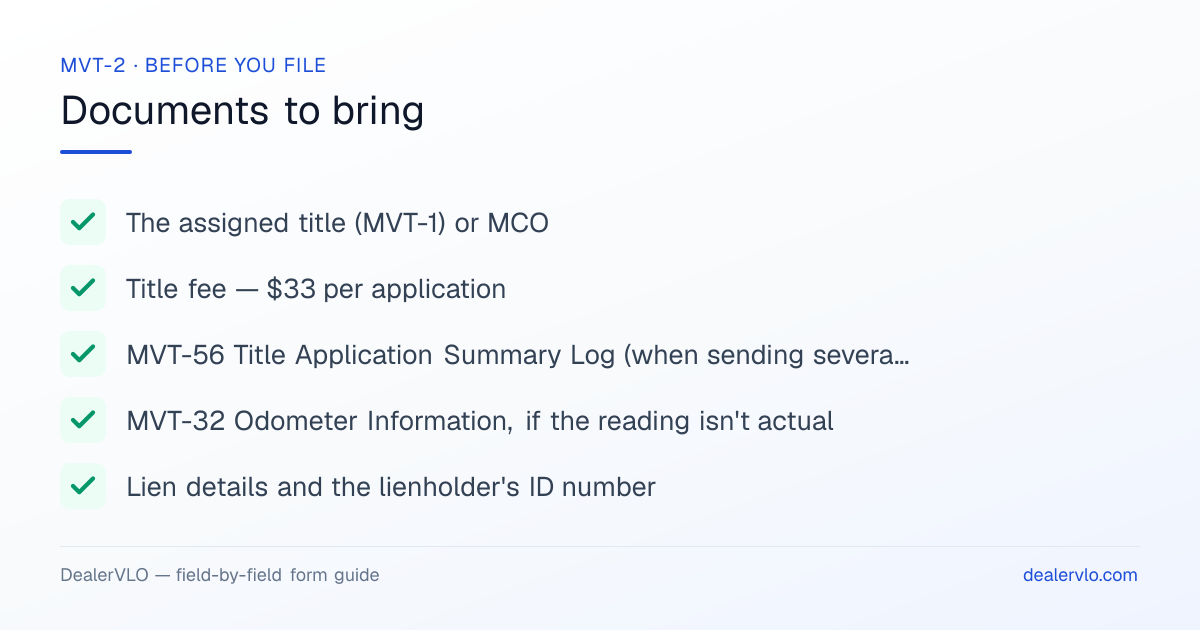
MVT-2, section by section
Rush request + Owner information (blocks 1–3)
At the very top, check the rush box only if you want expedited processing — it adds $10 to the $33 fee. Block 1 is the buyer's name, last-first-middle initial, with room for two owners (a and b). The conjunction "or" is not permitted. If there are two owners, Maine assumes common ownership unless you check the Joint ownership box — so ask the buyers which they want before you print. Dates of birth go in block 2 for each owner, and a telephone number in block 3.
| Field | Who fills it |
|---|---|
Check if rush is requested Additional $10 fee; processing 3–5 business days. | You (dealer) |
1. Name(s): last, first, middle initial (a and b) No "or" between owners. | You (dealer) |
Joint ownership box Unchecked = common ownership is assumed for two owners. | Buyer |
2. Date(s) of birth (MM/DD/YYYY) | Buyer |
3. Telephone | Buyer |
Addresses, MSRP and lessee (blocks 4–7)
Block 4 is the mailing address; if it's a P.O. box, block 6 (legal residence) must be completed too. Block 5 is the MSRP, and the BMV training calls it out specifically: for a new vehicle, MSRP is the total vehicle price on the Monroney label minus the destination charge — that number goes in box 5. For a used vehicle, list the MSRP if it's recorded on the previous Maine title; otherwise check "Not required." Don't attach the Monroney label. Block 7 is only for a leased vehicle — the lessee's name and address.
| Field | Who fills it |
|---|---|
4. Mailing address, city, state, ZIP If a P.O. box, block 6 must be completed. | Buyer |
5. MSRP — New (Monroney) / Used (prior title) / Not required New: total vehicle price minus destination charge. | You (dealer) |
MSRP amount ($) The town office uses it to calculate excise tax. | You (dealer) |
6. Legal residence, if other than mailing address | Buyer |
7. If a leased vehicle, name and address of lessee | You (dealer) |
Vehicle information (blocks 8–17)
Describe the vehicle exactly as it appears on the title you're surrendering. The VIN in block 11 has to match the title and the vehicle. Block 13 is new, used, or rebuilt; block 14 is the purchase date — which also starts your 30-day clock. Blocks 15 and 16 are the number and issuing state of the title being surrendered. Block 17 (Other data) is for BMV use — leave it blank. Remember Maine's title cutoff: as of January 1, 2026, the BMV won't process title applications for model year 2000 and older.
| Field | Who fills it |
|---|---|
8. Year | You (dealer) |
9. Make | You (dealer) |
10. Model | You (dealer) |
11. Vehicle identification number Must match the title and the VIN plate. | You (dealer) |
12. Body type | You (dealer) |
13. New / Used / Rebuilt | You (dealer) |
14. Purchase date (Mo/Day/Year) The dealer's 30-day filing deadline runs from the sale date. | You (dealer) |
15. Title number The title being surrendered. | You (dealer) |
16. State of origin | You (dealer) |
17. Other data BMV use only. | At the counter |
Odometer (blocks 18–20)
Block 18 is the current odometer reading — the form says do not estimate and no tenths — with a box for miles or kilometers. The BMV requires an accurate reading even when the title is mileage-exempt. Block 19 states whether it's actual mileage, in excess of mechanical limits, or not actual (odometer discrepancy). If it's not actual, block 20 asks whether the odometer was changed or broken, and you must file an MVT-32 with the application.
| Field | Who fills it |
|---|---|
18. Current odometer reading (Mi. / Km.) Do not estimate — no tenths. Required even if mileage-exempt. | You (dealer) |
19. Mileage stated is: actual / in excess of mechanical limits / not actual | You (dealer) |
20. If not actual: odometer changed / odometer broken Must file MVT-32. | You (dealer) |
Lien information (blocks 21–26)
If the buyer financed, block 21 is the first lienholder's name, 21a its lienholder ID#, 22 the date of the lien, and 23 its address. The form spells out what happens next: the title is mailed to the first lienholder, otherwise to the owner — and if a lienholder ID# is listed, the title is sent electronically. Blocks 24–26 repeat the same for a second lienholder. Maine law also requires the dealer to deliver a copy of the application to the lienholder.
| Field | Who fills it |
|---|---|
21. First lienholder's name, if vehicle financed | You (dealer) |
21a. Lienholder ID# For an ELT lender — the title is then sent electronically. | You (dealer) |
22. Date of lien (MM/DD/YYYY) | You (dealer) |
23. Lienholder address, city, state, ZIP | You (dealer) |
24–26. Second lienholder name, ID#, date of lien, address | You (dealer) |
Seller information + dealer certification (blocks 27–29)
Block 27 is your dealership's name and address. Block 28 is your plate number if you're a Maine licensed dealer, with a box for the plate class (D, UC or MC). Block 29 is the dealer's certification that the vehicle was sold to the owner(s) named and that the information is true — signed by the dealer's representative with their official title and the date. Maine law requires this dealer signature on any application for a vehicle bought from a dealer.
| Field | Who fills it |
|---|---|
27. Name and address of seller | You (dealer) |
28. Plate #, if a Maine licensed dealer (D / UC / MC) | You (dealer) |
29. Signature of dealer's representative, official title, date | You (dealer) |
Owner signatures + penalty (block 30)
Block 30 is the owner's certification that all liens against the vehicle are listed and the information is true. Every owner named in block 1 must sign. A power of attorney must accompany the form if someone signs for an owner, and if an owner is under 18, a parent or guardian must also sign. For a company, an authorized representative signs with their official title. The penalty line at the bottom is worth pointing out: a false name or address, a material false statement, or hiding a security interest is a Class D crime. The right-hand column (sent to Secretary of State, municipal agent validation, fee paid, BMV use) is not yours to fill.
| Field | Who fills it |
|---|---|
30. Signature(s) of owner(s) as named in block 1 + date All owners must sign; POA must accompany the form. | Buyer |
Parent or guardian signature (owner under 18) | Buyer |
Company owner: authorized representative, official title, date | Buyer |
Sent to SOS / municipal agent validation / fee paid / BMV use | At the counter |
ME Sales tax & title fee calculator
Free · no signup · updates as you type
Maine sales tax is a flat 5.5% statewide (Maine Revenue Services). It's figured on the price after a trade-in only when a motor vehicle is traded toward a motor vehicle; a trailer or non-vehicle trade gets no credit. Maine Revenue Services treats processing or documentation fees as part of the taxable sale price; title fees are not taxed. The $33 title fee rides with the MVT-2 ($10 more for rush). Excise tax and registration are paid separately at the buyer's town office — enter them as plate/registration if you know them. Confirm current figures with Maine BMV and Maine Revenue Services.
Stop re-keying this onto the MVT-2.
DealerVLO runs this math on every deal and drops it — with the VIN, buyer, and sale price — straight onto the official ME MVT-2, the bill of sale, and the FTC forms. One screen, no re-keying.
14-day free trial — a card starts it, no charge until day 14, then $29/month. Cancel any time.
The MVT-2 is one car's paperwork. A 20-second read on your lot, and the tax-and-fee math for the whole deal — built for dealers, no signup. Free calculators dealers actually use — no signup, no email.
DealerVLO turns your deal into a print-ready Maine MVT-2 worksheet — VIN-decoded vehicle, buyer, co-buyer, and sale price laid out and ready to key in or copy over. $29/month, free to try — cancel any time.
Common MVT-2 mistakes that cause rejections
Maine requires the dealer to deliver the MVT-2 to the Secretary of State within 30 days of the sale. After that, the BMV collects a $50 penalty per application; 30–89 days late is a traffic infraction, and 90 days or more is a Class E crime. Batch and mail title work weekly, not monthly.
Only original MVT-2 applications are accepted — photocopies are rejected. The form isn't available online; order stock from the BMV on an MVT-44 at least two weeks ahead, or buy pre-validated MVT-2A applications.
For a new vehicle, MSRP is the Monroney label's total vehicle price minus the destination charge — not the selling price. For a used vehicle, use the MSRP from the prior Maine title if it's there. Don't staple the Monroney label to the application.
Block 18 says do not estimate and no tenths, and the BMV wants an accurate reading even when the title is mileage-exempt. If the reading isn't actual, check the reason in block 20 and attach an MVT-32.
With two owners and the Joint ownership box unchecked, Maine assumes common ownership — and "or" between names isn't allowed. Ask the buyers how they want to own it, check the box if they want joint ownership, and get both signatures in block 30.
Common questions
What form does a Maine dealer use to title a vehicle for a buyer?+
Form MVT-2, the Application for Certificate of Title, issued by the Maine Bureau of Motor Vehicles. The BMV says it must be submitted by all Maine dealers on behalf of the customer, signed by the dealer and by every owner.
Can I download the Maine MVT-2?+
No. The BMV states the Application for Title is not available online. It's a numbered carbon-copy form available at BMV branches and town offices; dealers order it free from the BMV stockroom on form MVT-44, or buy pre-validated MVT-2A applications. Only originals are accepted.
What's the difference between Maine MVT-1 and MVT-2?+
MVT-1 is the Maine Certificate of Title itself — the ownership document you assign on the back when you sell. MVT-2 is the application for a new certificate of title in the buyer's name, which the dealer files with the BMV.
How long does a Maine dealer have to submit the title application?+
30 days from the date of sale. After 30 days the BMV collects a $50 penalty per application. Under 29-A M.R.S. §654, filing more than 30 but less than 90 days late is a traffic infraction, and 90 days or more is a Class E crime.
How much is the Maine title fee?+
$33 for an application for certificate of title, plus $10 if you request rush (expedited) processing. Normal processing is about two weeks from receipt; rush is 3–5 business days, not counting mail time.
How much is Maine sales tax on a car, and does a trade-in lower it?+
Maine's sales tax is 5.5%. When a motor vehicle is traded toward another motor vehicle, the tax applies only to the difference between the sale price and the trade-in allowance. Maine Revenue Services treats dealer documentation or processing fees as part of the taxable sale price.
Who collects the sales tax on a Maine dealer sale?+
The dealer. It's reported on the dealer's sales and use tax return, with each vehicle sale listed on the STMV-8 supplemental report. The buyer must show the bill of sale or buyer's order, with the sales tax amount, when registering at the town office, where excise tax is paid.
Is there software that fills out the MVT-2 automatically?+
Yes. Dealer management software like DealerVLO turns the deal you already entered into a print-ready Maine MVT-2 worksheet — the VIN-decoded vehicle, buyer, co-buyer, lienholder, and sale price laid out and ready to copy onto the form or key into the state's system. It's $29/month flat with a 14-day free trial, and the same deal also generates your federal documents (Bill of Sale, FTC Buyers Guide, odometer disclosure) and any other state's title forms.
Stop filling out the MVT-2 by hand.
DealerVLO turns your deal jacket into a print-ready ME MVT-2 worksheet — VIN-decoded vehicle, buyer, co-buyer, lienholder, and sale price laid out, so keying it in or copying it over takes minutes. $29/month. 14-day free trial, cancel any time.
Curious how it works? See how DealerVLO auto-fills every dealer document — bill of sale, FTC Buyers Guide, odometer disclosure, and state title & registration forms for all 50 states, from one deal.
Bond amounts, fees, and form rules change. Get a short email when your state does. No spam, unsubscribe anytime.