How to Become an Auto Broker: License First, Then Clients, Then a System
How to become an auto broker: the car broker license question by state, setting up the business, sourcing, first clients, and a system to run it.
Part of the Starting a used-car lot guide: How to Start a Used Car Dealership: A Step-by-Step Launch Playbook (2026)
Switching from another DMS? Compare DealerVLO to DealerCenter, Frazer, or Lot Wizard.
A lot of people who want to know how to become an auto broker already sell cars, or are the friend everyone calls before buying one. The pitch to yourself is simple: you know how to find the right car and negotiate it, people would pay you to do it, and you don't need a lot full of inventory to start.
That's mostly true. But the first step isn't finding clients, it's finding out what your state calls you. I run a used-car lot and built the software it runs on, so this is written from the dealer side of the counter: the licensing question first, then the setup, sourcing, and first clients, in the order you'll hit them. I'm not a lawyer, so the licensing section tells you what to ask, not what the answer is.
14-day free trial, then $29/mo · Cancel anytime
Step 1: Find out whether you need a license to be a car broker
This is the step people skip, and it's the one that can end the business. States handle brokers in very different ways, and the differences matter.
Some states treat anyone who negotiates a car sale for a fee as a dealer. California's Vehicle Code definition of a dealer covers someone who, for a commission or brokerage fee, negotiates a vehicle sale. On top of that, the California DMV says dealers need an autobroker's endorsement on their dealer license to broker retail sales, keep an autobroker's log of each brokered sale, and deposit consumer purchase money into a trust account. So in California, "auto broker license" really means a dealer license plus an endorsement.
Florida takes a different approach. Its motor vehicle dealer statute defines a "motor vehicle broker" as someone who procures cars for the public without storing, displaying, or taking ownership of them, and lists brokers among the people not included in the definition of a motor vehicle dealer. That doesn't mean "no rules apply." It means the rules are written differently, and you need Florida's answer for what you plan to do.
Those are two states. Yours may require a full dealer license, a salesperson license under a dealer, a separate registration, or nothing broker-specific at all. That's why I won't give you a 50-state table: they go stale, and the only answer that protects you is your own state's, in writing.
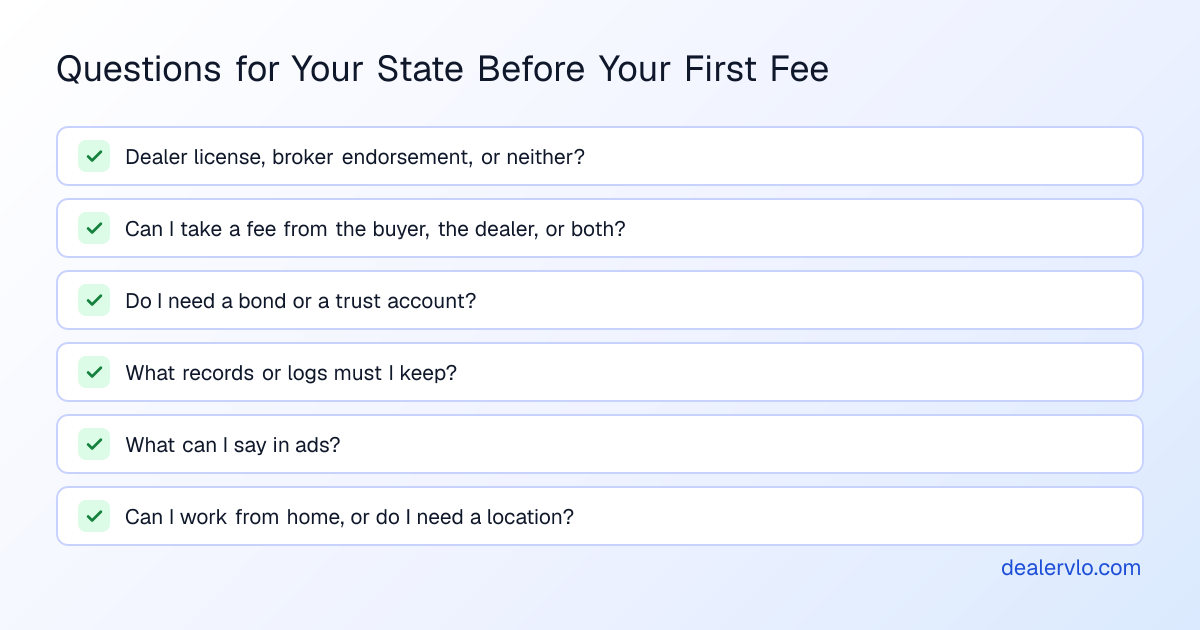
Call or email your state's dealer licensing agency with those questions, and write down who answered and when. If it turns out you need a dealer license, the dealer license guide walks through the usual steps, the no-lot license guide covers states that let you skip the retail lot, and this calculator adds up what licensing tends to cost:
Add up the real first-year cost of getting licensed in your state.
Open the Dealer License Cost CalculatorStep 2: Form the business
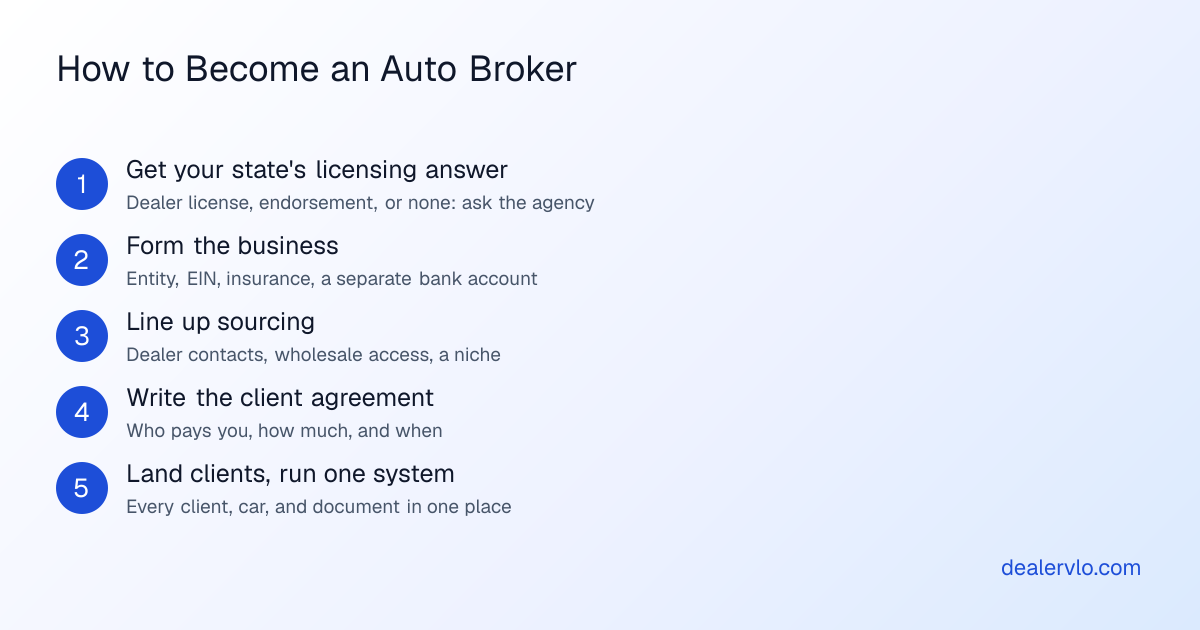
Once you know what you're allowed to do, set up the boring parts. Each one matters more for a broker than it looks:
- A legal entity and an EIN. Your accountant can tell you which structure fits; the point is to keep the business separate from you.
- Insurance. Ask an agent who writes for dealers what coverage fits brokering in your state, especially if you'll ever drive a client's car or hold a deposit.
- A separate bank account. Client money and your fees should never mix with personal money. If your state requires a trust account for client funds, as California does for brokered retail sales, this is where that starts.
- A written client agreement. Before your first deal, write down what you'll do, what you charge, who pays it, and when it's earned. A broker with no agreement is one misunderstanding away from working for free.
Have a lawyer in your state look the agreement over, then turn it into a fillable PDF. In DealerVLO you upload it once, it maps the fields, and it fills the buyer, vehicle, dealer, and deal details from each deal, so you're not retyping a client's name and a VIN into a template every time. One catch: a DealerVLO deal is written on a car in your own inventory, so this fits deals where the car passes through your dealer license, not ones where you never own it.
Step 3: Line up your sourcing
A broker's value is finding the car. That means relationships before clients.
- Dealer contacts. Sales managers at franchise and independent stores who'll take your call, give you a straight number, and hold a car for a day. These are earned one deal at a time.
- Wholesale access. If you hold a dealer license, you may be able to buy at dealer auctions. Our dealer auction buying guide covers how the lanes work, and how to determine wholesale value covers what a car is really worth before you quote it.
- A niche. "Any car for anyone" is hard to sell. One brand, work trucks, family SUVs under a set budget, or leases for a specific kind of buyer gives you a story clients repeat to their friends.
Without a dealer license, you're usually arranging a purchase from a dealer who sells the car, so those dealer relationships are the whole business.
Step 4: Land your first clients
Your first clients almost always come from people who already trust you: past customers if you've sold cars, friends and family, coworkers, a local group you're part of. A few habits make the first ten deals easier:
- Pick a lane you can explain in a sentence. "I find and negotiate used trucks for contractors" is easier to refer than "I help people buy cars."
- Quote the out-the-door number, not just the price. Clients judge you on the final check they write. The out-the-door price calculator shows the pieces.
- Ask every finished client for one referral. Referrals are how brokers grow. Our lead follow-up post is written for dealers, but the cadence works the same for a broker.
You'll want somewhere for people to find you, too. A DealerVLO account includes a dealer website, and its contact and inquiry forms drop into a lead inbox where each lead gets a status (New, Contacted, Qualified, Converted, or Lost) and your notes. Two honest limits: phone and walk-in prospects can't be entered into that inbox by hand (add them as customers instead), and it doesn't text anyone or remind you to follow up.
Step 5: Put every client and deal in one system
This is where new brokers lose money without noticing. Clients live in texts, wants lists live in your head, documents live in an email thread, and nobody can tell you what last month actually earned.
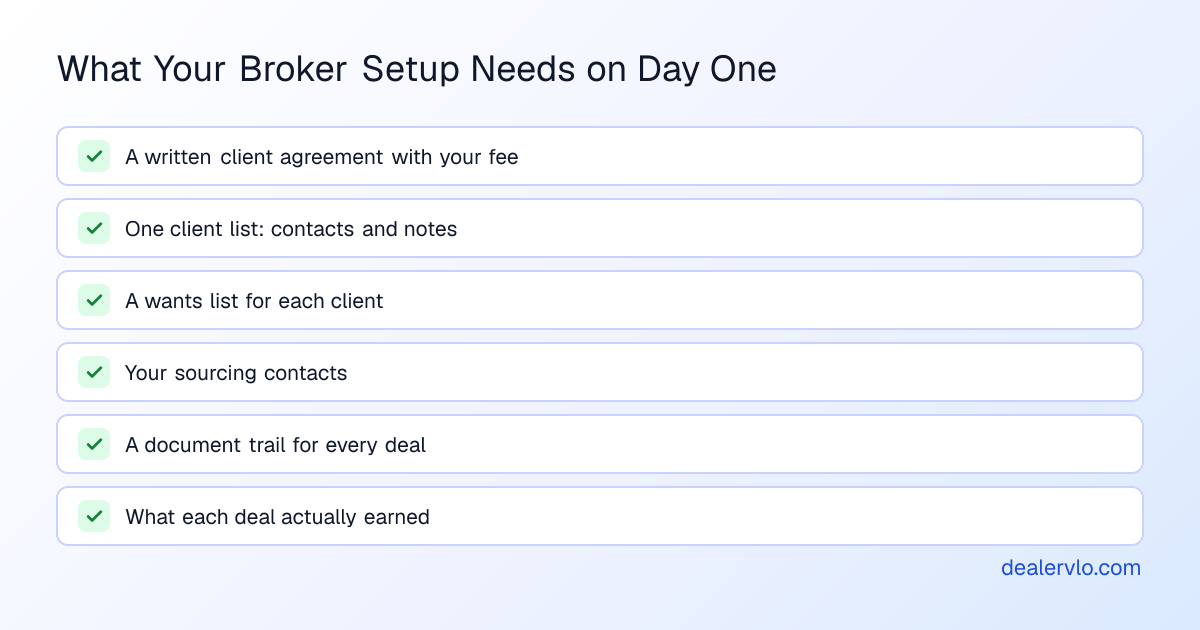
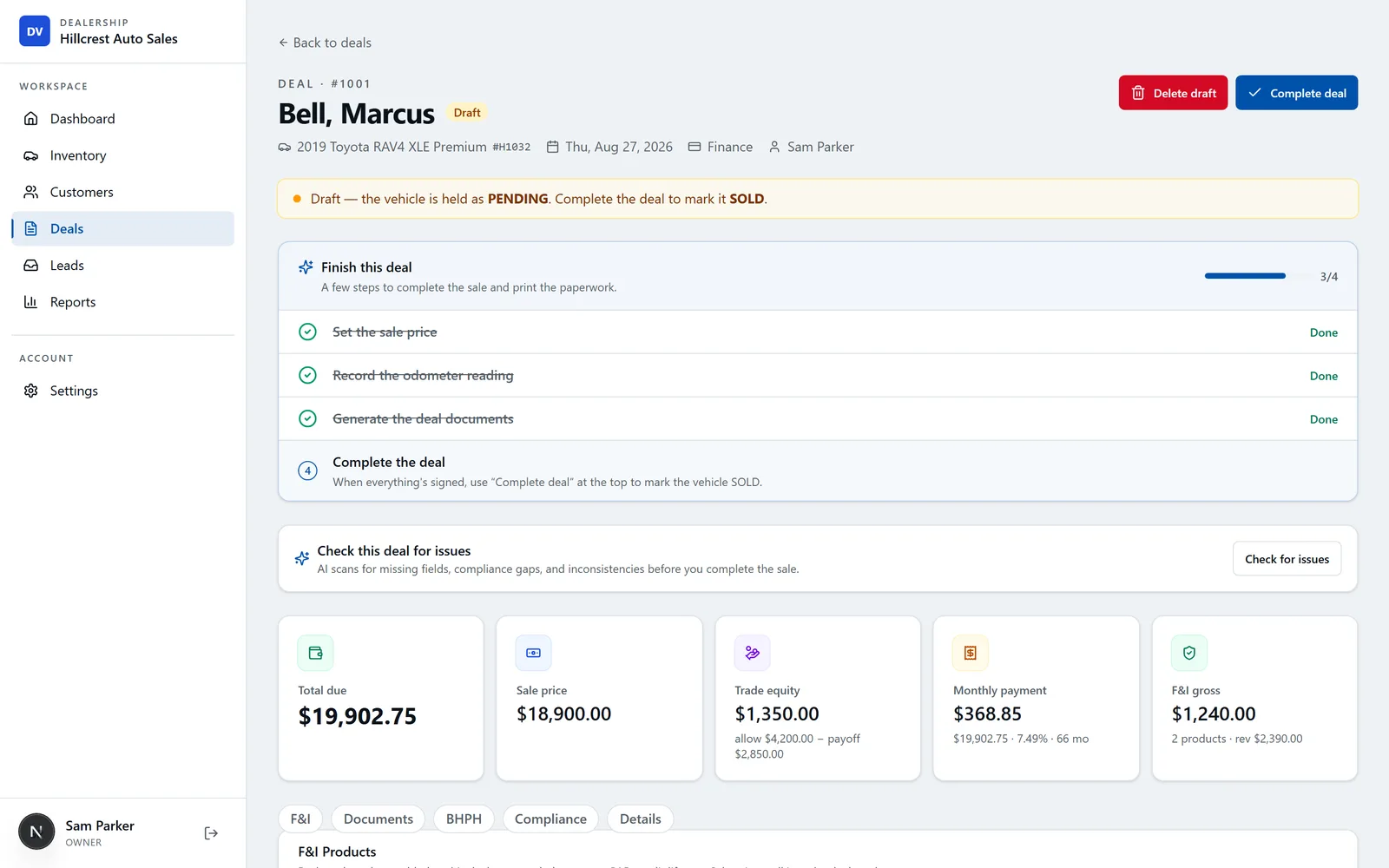
If your state has you broker under a dealer license, a dealer management system covers most of that list. DealerVLO is the one I built for my own lot. Every customer gets a record with their contact details, address, and notes, plus the deals they've been on. You can scan the barcode on a driver's license to fill the record instead of typing it. When a deal happens, the deal jacket computes the totals live and fills the FTC Buyers Guide and your state's title and registration paperwork, and buyers can e-sign in person or from a link.
14-day free trial, then $29/mo · Cancel anytime
What it isn't: DealerVLO has no broker module. There's no autobroker's log, no trust-account tracking, no SMS, and no follow-up reminders. If you never own the cars you broker, its best use is the client book and your own documents. The full honest rundown is in how to manage clients as an auto broker.
What comes after you're set up
Once you're licensed (or confirmed you don't need to be), the next two questions are what the job is day to day and how the money works. What does an auto broker do walks through a deal from first call to delivery. How auto brokers make money covers fee models and what eats your margin. If you already hold a dealer license and want to add brokering to the lot, start with can a used car dealer broker cars, which covers the three deal structures and who collects the sales tax.
14-day free trial, then $29/mo · Cancel anytime
Frequently asked questions
How do I become an auto broker?
Start with your state's dealer licensing agency, because the license question decides everything else. Then form the business, set up insurance and a bank account, line up dealer and wholesale sources, write a client agreement that spells out your fee, and land your first clients from people who already trust you. Put every client and deal in one system from day one.
Do you need a license to be a car broker?
In many states, yes, or at least you can't assume no. Some states fold anyone who negotiates a car sale for a fee into the definition of a dealer. California's Vehicle Code works that way, and its DMV requires an autobroker's endorsement on a dealer license to broker retail sales. Florida's dealer statute defines a motor vehicle broker separately. Ask your state's dealer licensing agency before you take a fee.
How long does it take to become a car broker?
It depends mostly on your state's licensing process. Where a dealer license or endorsement is required, the timeline is set by the application, bond, background check, and any required course or inspection. Where it isn't, you can start as soon as the business, insurance, and client agreement are in place. Ask your state for its current processing time.
Can I become an auto broker with no experience?
You can, but the job is sourcing, negotiating, and paperwork, so experience in car sales, a dealership, or wholesale buying shortens the learning curve a lot. If you're new, start with a narrow niche you already know, like one brand or one kind of truck, and a handful of clients who'll forgive a slower first deal.
What's the difference between an auto broker license and a dealer license?
It depends on the state. In some states there's no separate broker license and a broker needs a dealer license. In California, brokering retail sales takes an autobroker's endorsement added to a dealer license. Elsewhere a broker may be defined and treated differently from a dealer. Your state's dealer licensing agency is the only reliable answer.
Bottom line
Becoming an auto broker is mostly a licensing question followed by a relationships business. Get your state's answer in writing, set up the entity, insurance, and a separate account, build dealer and wholesale contacts in a niche you know, and write a client agreement before your first fee. Then keep every client and deal in one place so you can see what's working.
If you'll broker under a dealer license, start a free DealerVLO trial and put your first clients and deals in it.