How Do Car Brokers Make Money? Fee Models, What Eats the Margin, and the Real Math
How car brokers make money: flat fees, dealer-paid fees, percent of savings and buy-and-resell, what eats an auto broker's margin, and the real math.
Part of the Profit, margins & the numbers guide: How Do Used-Car Dealerships Actually Make Money?
Switching from another DMS? Compare DealerVLO to DealerCenter, Frazer, or Lot Wizard.
How do car brokers make money? Mostly from a fee on each deal: paid by the buyer, by the selling dealer, or both. Brokers who hold a dealer license have one more option, buying the car and reselling it to the client for a gross profit, the way a dealer does.
The fee is the easy part to explain. What decides whether brokering pays is what's left after the costs nobody puts in the pitch: licensing, insurance, the drive to look at a car, the ads, and the deals that fall apart after you've done the work. I run a used-car lot and watch my own per-deal numbers closely, so this post is about the math, not a promise of what you'll earn.
14-day free trial, then $29/mo · Cancel anytime
The four ways auto brokers get paid
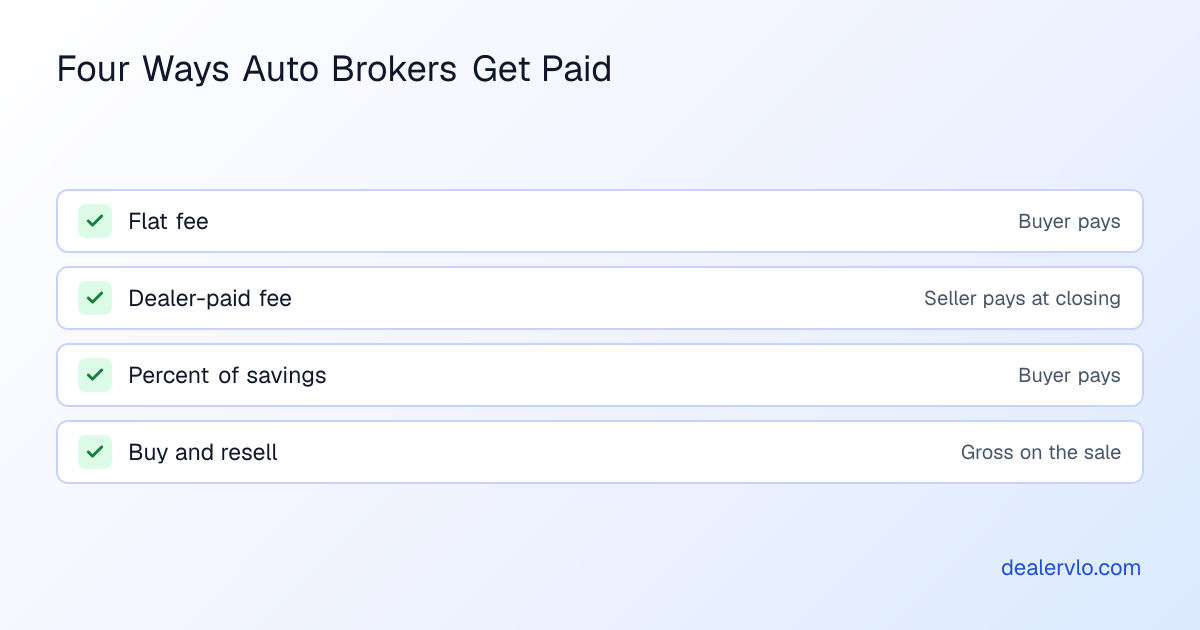
Flat fee from the buyer. The client pays you a set fee to find and negotiate the car. It's simple to explain and keeps you clearly on the buyer's side. The risk is getting paid only at the end; many brokers take part of it up front so a client can't walk after you've done the sourcing.
Dealer-paid fee. The selling dealer pays you when the deal closes, so the buyer may pay nothing extra. It's an easy sell to clients, but it raises the obvious question of whose side you're on, and some states regulate who can take or pay these fees. Disclose it in writing.
Percentage of savings. You take a share of what you saved the client against a benchmark. It sounds fair, but "savings" is only as honest as the starting number, so agree on that number in writing first.
Buy and resell. If you hold a dealer license, you can buy the car yourself and sell it to the client as a normal dealer sale. Now you earn gross, not a fee, and you carry the risk: if the client walks, you own the car. That's a dealer deal with all the dealer paperwork. Can a used car dealer broker cars covers how it works and who collects the sales tax, and how to flip cars for profit covers the buy-and-sell math.
Which of these you can use depends on your state. California, for example, requires an autobroker's endorsement on a dealer license to broker retail sales and has consumer purchase money go into a trust account. Get your state's answer before you pick a model; how to become an auto broker has the questions to ask.
If you run buy-and-resell deals through DealerVLO, every car carries its acquisition cost plus its cost lines (transport, inspection, an auction buy fee), and gross on the deal and the sales report is the sale price minus that all-in cost. Extra charges can go on a deal as their own labeled lines and roll into the total, for any fee your state lets you charge on the sale.
How much do car brokers make?
There's no reliable public number for this, and I won't make one up. Broker income swings with the market, the kind of cars, the fee model, and mostly with how many clients keep sending you referrals. Treat any single "average car broker salary" you read with suspicion unless it says where the number came from.
What you can work out is your own number:
Net income = (net fee per deal × deals closed) − monthly overhead
To show how the formula moves, with round numbers picked only for the math: at a $500 net fee and 6 deals a month, the fees come to $3,000 before overhead. Double the deals and you double the fees, but your overhead mostly stays put. That's why volume and referrals matter more than squeezing the fee.
For the per-deal percentage on buy-and-resell deals, this calculator does the margin math:
Punch in cost, recon, holding days, and sale price to see your true net gross and margin.
Open the Profit Margin CalculatorWhat eats an auto broker's margin
A broker doesn't carry inventory, so the costs are easy to underestimate. These are the ones to put on paper before you set your fee:
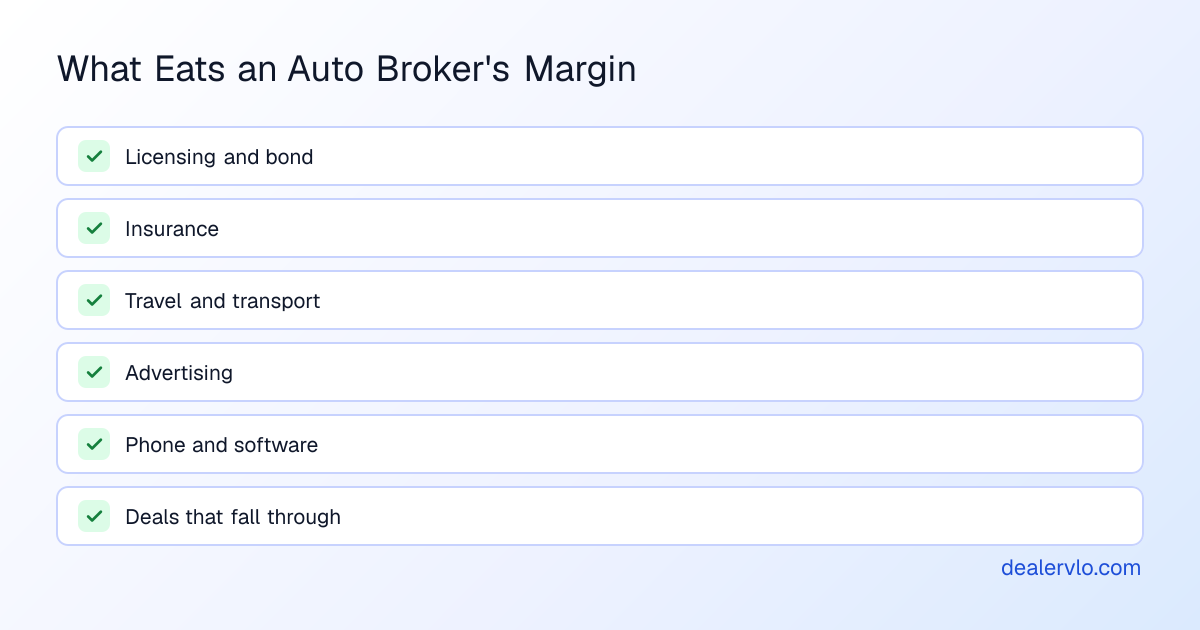
The last one is the quiet killer. Every client who goes cold after you've sourced three cars costs you the same hours as a closed deal and pays nothing. A written agreement with part of the fee up front, or a clear "earned when" clause, is how brokers protect against it.
The same split between gross and net trips up dealers too; gross vs. net profit walks through it from the lot side.
14-day free trial, then $29/mo · Cancel anytime
Work out what each deal really earned
A broker who only tracks fees collected will think business is better than it is. Run this on every deal for a few months:
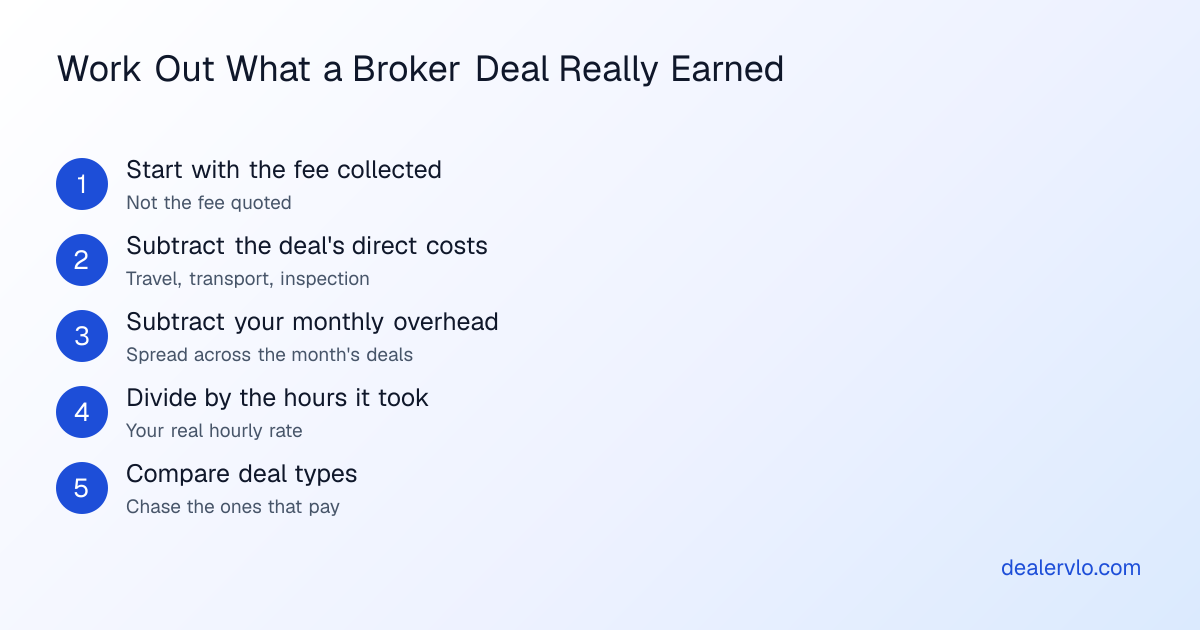
After a few months the pattern shows up: maybe one kind of deal closes fast and pays little, while another takes twice the hours and pays far more. That tells you which clients to chase and where to raise your fee.
In DealerVLO, overhead goes in as one-time or recurring monthly expenses by category (rent, payroll, advertising, insurance and others), and the P&L shows gross profit minus that overhead for this month, the last 30 days, year to date, or all time.
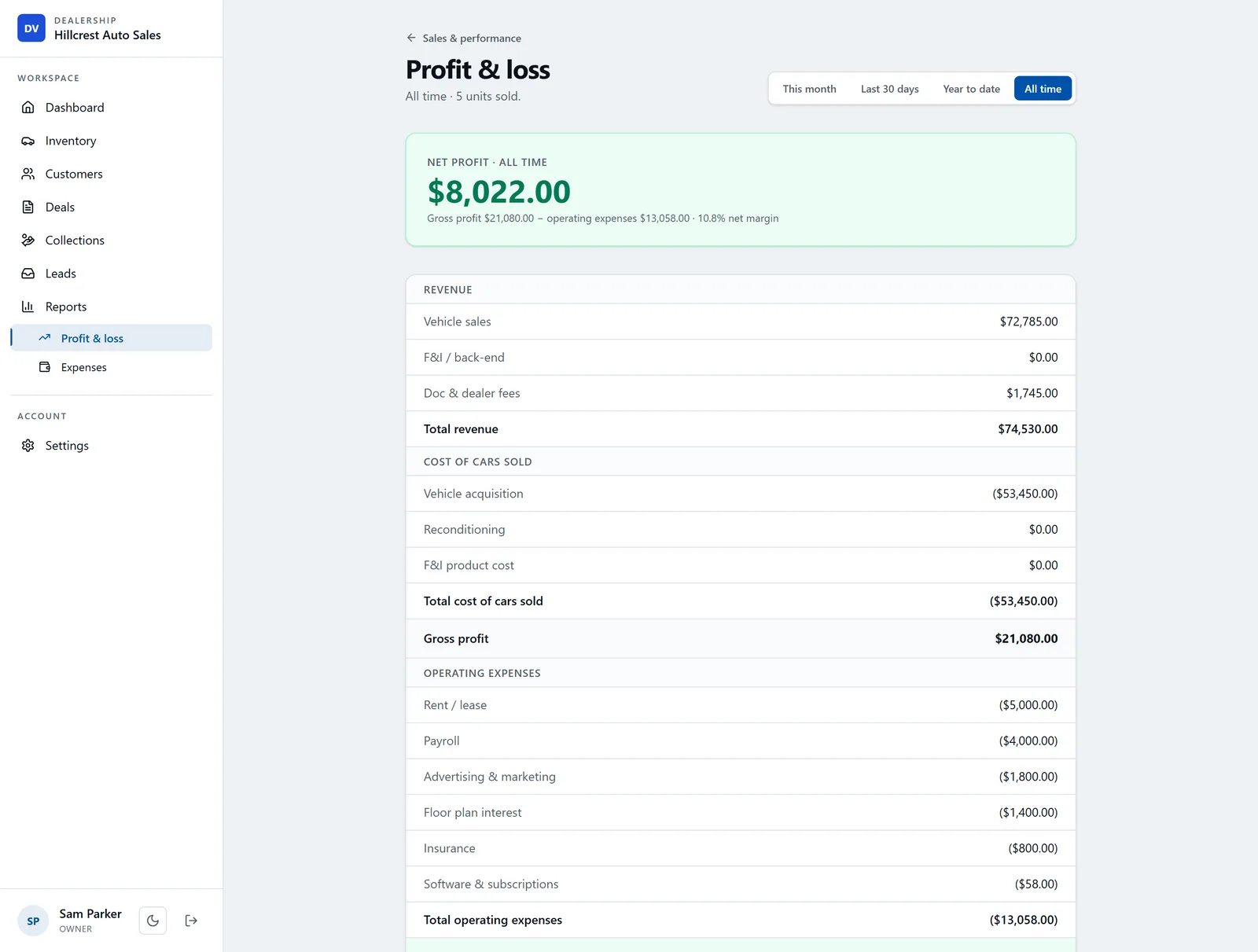
The sales report lists front- and back-end gross per deal. What it doesn't do is divide overhead per deal or track your hours, so that last step is a spreadsheet line. For setting up the categories, see how to build a P&L statement.
Raising what you make without raising the fee
- Narrow your niche. Brokers who are known for one thing get referred for that thing, and close faster because they know where those cars are.
- Ask every client for a referral. It's the cheapest client you'll ever get.
- Cut the deals that don't pay. Your own per-deal numbers will tell you which ones.
- Get the agreement signed before the work. Fewer free sourcing jobs is a raise.
14-day free trial, then $29/mo · Cancel anytime
Frequently asked questions
How do car brokers make money?
Most auto brokers are paid a fee per deal. It may be a flat fee the buyer pays, a fee the selling dealer pays when the deal closes, or a share of what the broker saved the buyer. Brokers who hold a dealer license can also buy the car and resell it to the client, earning gross on the sale like a dealer. Which models you can use depends on your state's rules.
How much do car brokers make?
There's no reliable public figure for broker income, and it varies too much to quote one. What you make is your net fee per deal times the deals you close, minus what it costs to run the business: licensing, bond, insurance, advertising, travel, and deals that fall through. Work it out from your own numbers, not someone else's.
What is a typical auto broker fee?
Fees vary by market, by the kind of car, and by who pays, so be careful with any "typical" number you read. Some brokers charge buyers a flat fee, some are paid by the selling dealer, and some charge a percentage of savings. Whatever you charge, put it in a written client agreement and check what your state requires you to disclose.
Do car brokers get paid by the dealer?
Some do. A broker may be compensated by the selling dealer when the deal closes, so the buyer pays no separate fee. Whether that's allowed, and what has to be disclosed to the buyer, depends on your state. Ask your state's dealer licensing agency, and tell clients in writing who pays you.
Is being a car broker profitable?
It can be, because you aren't tying up money in inventory, but the fee per deal is usually thinner than a dealer's gross and your income depends on steady referrals. It's profitable when your fee, times the deals you can actually close, beats your fixed costs and your time. Track it deal by deal from the start.
Bottom line
Car brokers make money from a fee per deal, paid by the buyer, the selling dealer, or both, or from gross on the sale if they buy and resell under a dealer license. What you actually make is that fee times the deals you close, minus licensing, insurance, travel, ads, and the deals that die after you've done the work. Track it per deal from day one.
If you'll broker under a dealer license, start a free DealerVLO trial and watch your real per-deal numbers from the first one.