How to Flip Cars for Profit: A Licensed Dealer's Playbook (and Where the Legal Line Is)
How to flip cars for profit: what to buy, what to check before you buy, cheap recon that pays back, and where the legal dealer line sits.
Part of the Profit, margins & the numbers guide: How Do Used-Car Dealerships Actually Make Money?
Switching from another DMS? Compare DealerVLO to DealerCenter, Frazer, or Lot Wizard.
Flipping cars for profit sounds simple: buy a clean car cheap from someone who doesn't want to deal with selling it right, fix the small stuff, sell it for market price. It can work. It's also the single easiest side hustle in America to accidentally turn into unlicensed dealing — and most people who get into trouble doing it didn't mean to cross a line, they just didn't know where it was.
This is the practical version: how to find cars worth flipping, what to check before you hand over money, what recon actually pays back versus what wastes your weekend, how to price and list the car, what paperwork has to happen at the sale no matter who you are, and — the part most "how to flip cars" content skips — the point where your hobby legally becomes a dealership and what changes when it does.
14-day free trial, then $29/mo · Cancel anytime
What actually makes a car worth flipping
The cars worth your time share a few traits, and none of them are exotic:
- Common — a Camry, Civic, F-150, or Silverado sells itself; a niche import with three body shops in the state that can service it sits.
- Clean title, in the seller's name — a branded or out-of-state title you haven't traced adds risk and time you can't price for.
- Priced under market because the seller needs it gone, not because something's wrong you can't see — moving, divorce, upgrading, dead battery scaring off lazy buyers.
- Problems you can see and price — a bad detail, worn tires, a check-engine light for a known inexpensive sensor. Not problems hiding behind "runs great" from someone who won't let you test drive it.
The FTC's own shopping checklist for used cars is a good filter here even though it's written for consumers: inspect the car, test drive it in varied conditions (highway, stop-and-go, hills), ask for maintenance records, talk to the previous owner if you can, get a mechanic to look at it, and price it against market comps before you negotiate — in that order, before you talk numbers.
Where flippers actually find cars
Three lanes, and they're not equal:
Private sellers. This is the core lane for a flipper, and it's also the one with the most variance — no dealer protections apply because the seller isn't a dealer, so everything in the "what to check" section below is on you. You're the one who has to chase down title, lien status, and condition yourself, because there's no dealer disclosure standing behind the deal.
Public listings and marketplaces. Facebook Marketplace, Craigslist, local classifieds — same diligence rules as private sellers, just with more competition for the good ones.
Trade-in leftovers from dealers. Here's the structural fact worth knowing: the units a franchise or independent store wholesales out rarely show up where you can bid on them. Dealer-only wholesale auctions (Manheim, ADESA and similar platforms) require an active dealer license and auction registration, usually through AuctionACCESS, to even get a buyer number. That's not a technicality you can work around; it's how those auctions are built. Public-access auctions like Copart or IAAI exist, but those are mostly salvage and insurance-loss inventory, a different game with different risks. As a non-licensed flipper, you're structurally limited to private-party and public-listing sourcing — which is also where the best clean-title bargains actually show up, since that's where sellers who just want a car gone are posting.
What to check before you buy
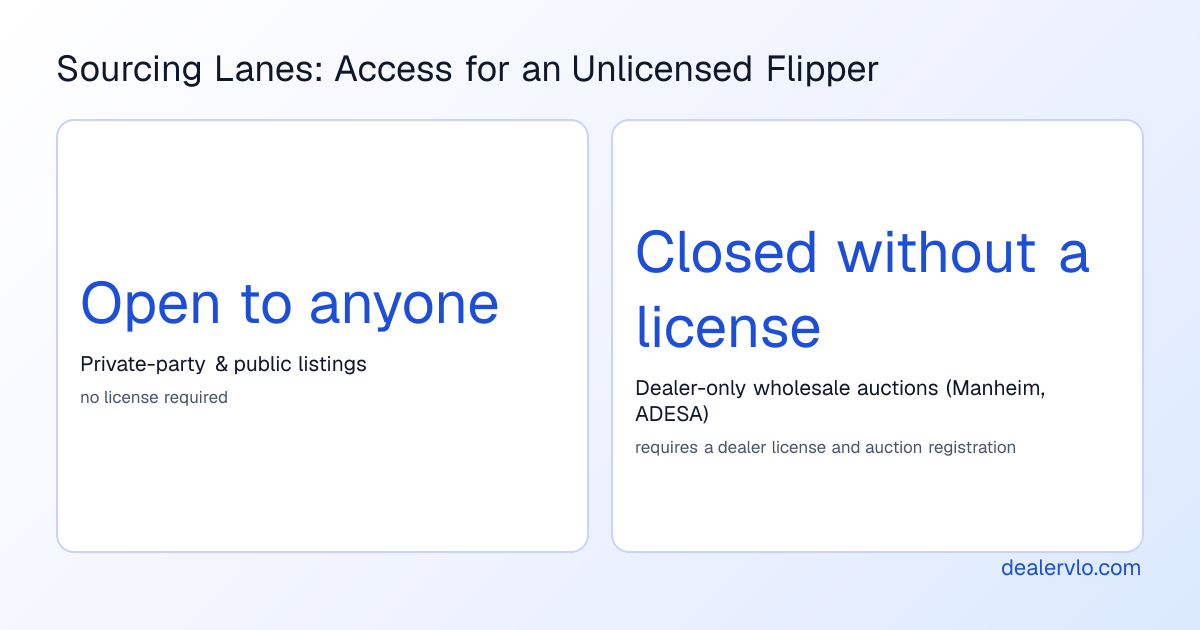
This is the part that separates a profitable flip from an expensive lesson:
- Title is in the seller's name, and matches their ID. If it isn't, you're not buying from the owner — you're buying from a middleman, and now you have two unknowns instead of one.
- No lien, or the lien payoff is handled before you pay. The title document itself is your first check; don't take the seller's word for "it's paid off."
- A vehicle history report. The FTC points consumers to vehiclehistory.gov to find NMVTIS-approved providers — NMVTIS is the only vehicle history database every state, insurance carrier, and salvage yard is federally required to report into, which is why it catches title brands and salvage history that a seller might not disclose. One limitation worth knowing: NMVTIS doesn't carry lienholder names or detailed repair history, so pair it with your own check of the physical title and a mechanic's look at the car, not a VHR alone.
- A real test drive and inspection, not a driveway idle. Hills, highway speed, a few stop-and-go lights. If the seller won't let you drive it or won't let a mechanic look at it, that's the whole answer.
One flip, worked out in full (hypothetical numbers)
Say you find a 2017 sedan, 92,000 miles, clean title in the seller's name, needs a detail and a tire. Here's a hypothetical run of the math — every figure below is made up for illustration, not a claim about what any specific flip earns:
- Buy price (hypothetical): $7,200
- Title/registration fees paid at purchase (hypothetical, varies by state): $150
- Detail (hypothetical): $120
- Two tires (hypothetical): $240
- Minor repair, sensor plus labor (hypothetical): $180
- Holding period (hypothetical): 18 days
- Sale price (hypothetical): $9,400
All-in cost: $7,200 + $150 + $120 + $240 + $180 = $7,890. Gross profit on this hypothetical deal: $9,400 − $7,890 = $1,510, before accounting for your time, gas, listing effort, or any holding cost you want to assign to those 18 days. Every extra day a car sits costs you something even if it never shows up on a receipt — insurance, lost capital, a parking spot that could hold the next car. The free holding cost calculator estimates that daily cost for a car sitting unsold, so you can count it before you buy.
That $1,510 is one hypothetical car, one set of made-up assumptions. Change the mileage, the market, or the repair list and the number moves a lot — which is exactly why you price every car from its own comps, not from how the last one went.
Cheap recon that pays back — and what not to touch
The recon that actually returns money on a flip is boring: a full detail (interior and exterior), fixing anything that throws a warning light for cheap, replacing tires that are visibly bald, and taking good photos in daylight. Buyers pay for "looks cared for" far more than they pay for mechanical perfection they can't see.
What not to fix: cosmetic issues a buyer will negotiate off anyway, anything requiring specialty parts with a long wait, and repairs that cost more than the value bump they create. Before you authorize a repair, the question is always the same: does this dollar in recon actually come back out at sale, and how many days does the shop keep the car tied up while it happens? The free recon ROI calculator below walks through exactly that trade-off for one repair at a time: recon cost, days in the shop, the value it adds, and what happens if it only delivers part of what you expected. Once you're licensed and tracking cars in DealerVLO, each car's reconditioning lines (vendor, description, cost) roll into that car's all-in cost, so the gross on every sale reflects what you really spent.
Before you authorize the work: see whether a repair earns back its cost plus the holding days it adds.
Open the Recon ROI Calculator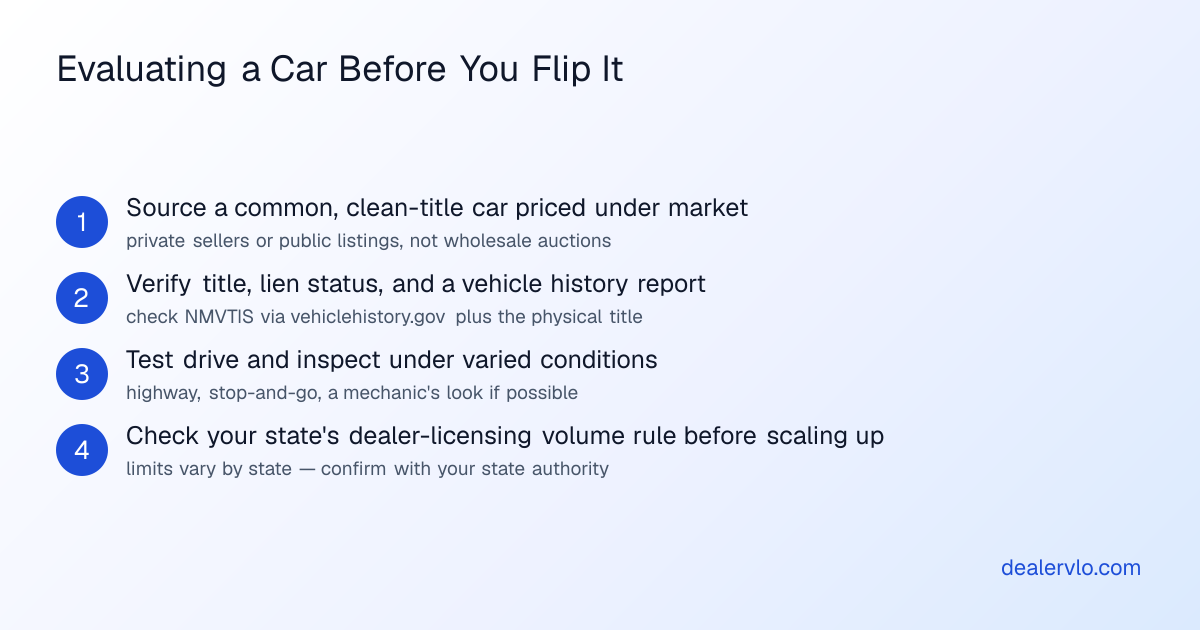
Pricing and where to list
Price from comps — what the same year, mileage, and trim are actually listed for in your market right now, not what a valuation guide says in the abstract. Undercut slightly if you want speed, match the market if the car is clean and you can wait a little longer.
For listing: Facebook Marketplace by hand is the default channel for a one-off flip — photos, description, post it yourself, no dealer feed involved. Local classifieds and community groups fill in around that. This is manual work at flip volume, and it should be. Once you're a licensed dealer, DealerVLO puts your inventory on your own dealer website automatically and can send daily listing feeds to CarGurus, Cars.com and Autotrader once you enroll with each site (and pay its fees). At flip volume, you're still doing the Marketplace post by hand.
14-day free trial, then $29/mo · Cancel anytime
The paperwork that has to happen at sale — flipper or dealer
Regardless of your status, two things are non-negotiable, one by federal law and one by plain common sense:
A signed, dated bill of sale that names both parties, the VIN, and the price: your record if anything gets disputed later (and some states require one to register the car).
Odometer disclosure. Federal law requires the seller to disclose the mileage in writing at the point of transfer, and the buyer has to sign acknowledging it. On most titles that happens in the title's own odometer section; some states use a separate official odometer statement form (our odometer disclosure guide lists them). It's never just a verbal number. Under NHTSA's current rule, model year 2010 and older vehicles are exempt, and model year 2011 and newer need the disclosure until they're 20 years old. If the title is still with a lienholder when you need to transfer, federal rules allow a power of attorney to execute the mileage disclosure once the title is obtained. Anyone operating as a dealer also has to keep copies of odometer statements on file for a period set by federal rule — a habit worth starting even before you're technically required to.
Where the legal line actually is
Here's the part most "how to flip cars for profit" guides either skip or guess at: states license and regulate dealers, and part of that regulation is a limit on how much private selling a person can do before they're legally considered to be acting as a dealer. Selling past that line without a license is what's known as curbstoning — running a car lot without a lot, parking inventory on the street or in a driveway and selling as if you were a private individual each time.
States regulate this for real reasons: licensed dealers have to post the FTC Buyers Guide on every used car, deliver a clean title, in most states carry a surety bond that protects buyers if something goes wrong, and collect sales tax on their sales. A curbstoner skips all of that, and buyers who deal with an unlicensed seller have none of those protections if something goes wrong with the car afterward.
The specific threshold is not uniform — it varies by state, and some states look at behavior (advertising a pattern of sales, for example) rather than a strict headcount. There is no single national number to quote here, and anyone telling you a flat figure that applies everywhere is guessing. The only reliable way to know your state's threshold is to check with your state's dealer licensing authority directly. The used-car dealer license guide walks through what licensing generally involves if you're starting to look into it, and the dealer license cost calculator gives you a feel for the first-year cash a license and bond take before you commit to the move. If you're wondering whether you can get licensed without a full lot, see dealer licenses without a lot.
This isn't legal advice — licensing thresholds, bonding requirements, and penalties for unlicensed dealing vary by state and change over time. Confirm your state's current rule with your state's dealer licensing authority or DMV before you plan around a number.
When it's time to get licensed and run it like a business
A few honest signals that you've outgrown the side-hustle structure: you're buying more than a couple of cars a year, you're advertising regularly enough that it looks like a pattern to anyone watching (including your state's regulator), you want access to dealer-only wholesale auctions for better sourcing, or you simply want the bond and title protections that come with doing this the right way.
Once you're licensed, the job doesn't really change — you're still finding a fair-priced clean car, reconditioning it cheap and smart, and pricing from comps. What changes is the paperwork load and the number of cars you can responsibly track at once. On a small licensed lot, each car's all-in cost adds up fast: purchase price, every recon line, any fees — and knowing that number cold, per car, is what tells you whether a deal actually made money or just felt like it did. DealerVLO tracks each car's acquisition cost and every recon line item (vendor, description, cost), rolling them into that car's all-in cost, so the gross shown on the deal and the sales report reflects what the car actually cost you, not just what you paid for it at the curb.
The deal paperwork itself scales too. At flip volume, a handwritten bill of sale and a title disclosure cover you. At dealer volume, DealerVLO fills federal paperwork like the Buyers Guide and state title and registration paperwork from the deal — the official state form where DealerVLO fills it, and a filled worksheet in states that issue title through a portal or a controlled paper form — so you're not re-typing the same VIN and buyer info onto five different forms every sale.
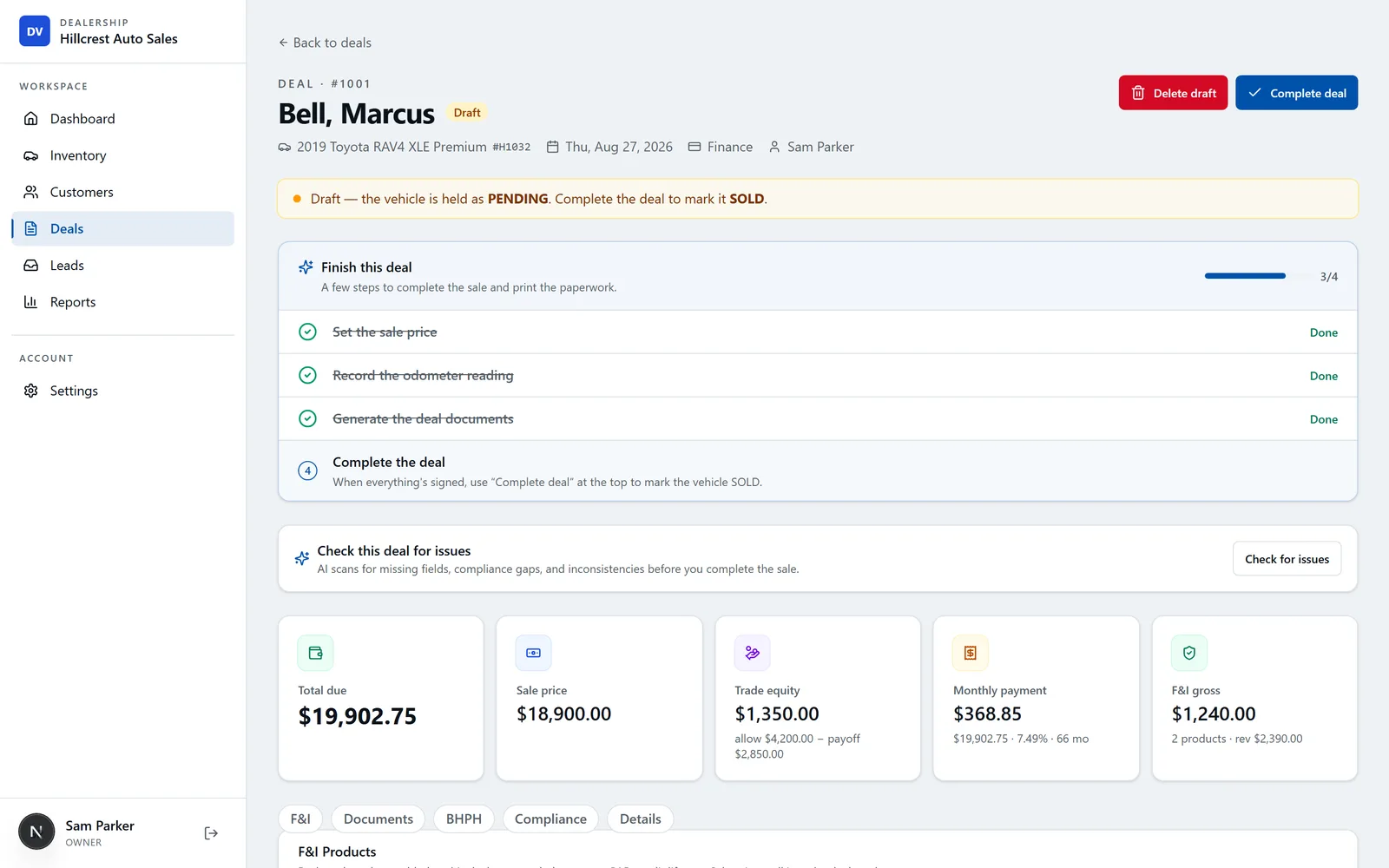
If you've only ever sold with a handwritten bill of sale, seeing a deal's math computed live — totals, trade equity, front and back-end gross — next to the forms it fills is the clearest way to see what licensing actually buys you operationally.
14-day free trial, then $29/mo · Cancel anytime
Before you scale past a car or two a year, it's worth running a few deals through the auction profit calculator to see what margin you'd need if you did start buying at dealer-only auctions: buy price, fees, recon and a target margin in, max bid out.
Work out the most you can bid at the lane and still hit your target margin.
Open the Auction Profit Calculator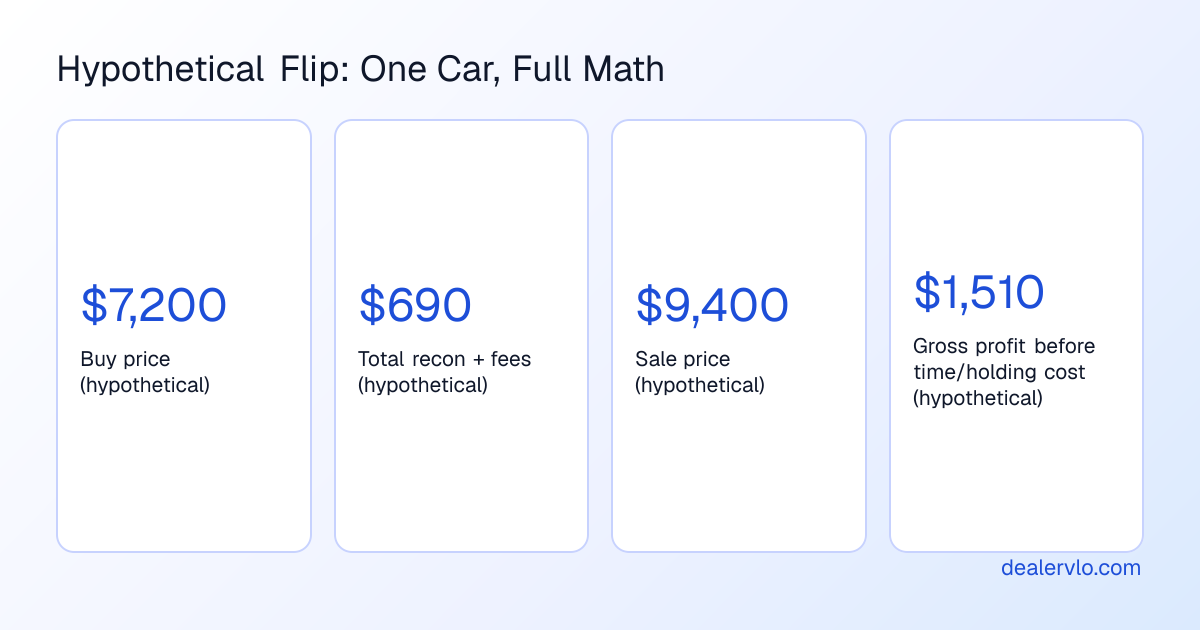
Frequently asked questions
How many cars can I sell per year before I need a dealer license?
It varies by state, and there's no single national number — some states set a specific annual count, others look at whether your selling pattern (repeat advertising, buying to resell) makes you a dealer regardless of count. Check directly with your state's dealer licensing authority before you plan around any figure you see online.
Is curbstoning illegal in every state?
Operating as an unlicensed dealer past your state's threshold is against the law in every state that licenses dealers, though the specific rules, bonding requirements, and penalties differ by state. No state makes unlimited unlicensed selling legal — the question is only where that state draws the line and how it enforces it.
Do I have to disclose the odometer reading when I sell a car privately?
Yes, for nearly all vehicles. Federal law requires the seller to disclose the mileage in writing at the point of transfer, usually on the title (some states use a separate odometer statement form), with the buyer signing to acknowledge it — under NHTSA's current rule, model year 2010 and older vehicles are exempt, and model year 2011 and newer need the disclosure until they're 20 years old.
Where can I check a car's title history before buying it to flip?
Start with vehiclehistory.gov, the FTC-referenced site for NMVTIS-approved vehicle history providers, which pulls from the one national database every state, insurer, and salvage yard is required to report into. It doesn't include lienholder names or detailed repair history though, so also check the physical title for the seller's name and any lien, and have a mechanic look at the car.
Can I buy cars at dealer auctions like Manheim or ADESA without a license?
No. Both Manheim and ADESA are dealer-only wholesale auctions: you need an active dealer license and auction registration (usually through AuctionACCESS) to bid. As an unlicensed flipper, your sourcing lanes are private sellers and public listings, not wholesale dealer auctions.
What's the difference between flipping cars and brokering them?
Flipping means you buy the car, hold title, and resell it as your own inventory — you carry the risk and the paperwork the whole way. Brokering means helping someone sell a car they still own without ever taking title yourself, which is a different arrangement with its own questions about who's responsible for sales tax and disclosures. Can a used car dealer broker cars? covers how that works for licensed dealers.
Bottom line
Flipping a car or two a year off clean private-party titles, checked carefully and reconditioned cheaply, is a reasonable way to make a little money on the side — as long as you treat the title check, the history report, and the odometer disclosure as non-negotiable every single time. The moment you're buying with any regularity or advertising like a lot, stop guessing about the legal line and check your state's actual threshold before you cross it by accident. If that's where you're headed, DealerVLO is built for the paperwork and cost-tracking load that starts the day you get licensed.
14-day free trial, then $29/mo · Cancel anytime