How Much Should a Used-Car Dealer Pay Themselves? Owner's Draw vs. Salary on a Small Lot
How a small-lot owner sets their own pay from net profit, the base-plus-true-up method, and the warning signs you're taking too much or too little.
Part of the Profit, margins & the numbers guide: How Do Used-Car Dealerships Actually Make Money?
Switching from another DMS? Compare DealerVLO to DealerCenter, Frazer, or Lot Wizard.
If you run a small used-car lot, the question of how much you should pay yourself is really a question about what the business can afford without shrinking your inventory or leaving you unable to buy the next car. Every dollar you draw out is a dollar not sitting in a trade, not paying down a floorplan advance, and not sitting in the account when the rent or the insurance bill comes due. A lot that's growing its inventory can show net profit on the P&L and still leave the owner broke — because the profit is locked in unsold cars or owed to the floorplan lender. The mechanics of paying yourself depend on how your business is set up (sole proprietor, LLC, S corp), but the underlying question is the same: how much can you take out this month without starving the business?
This article walks through how to set a number — starting from trailing net profit, not gross and not the bank balance — and how to structure it so you can take a steady base with a quarterly true-up when the numbers are in. I'll show the method as worked math with clearly labeled example numbers, explain the general difference between an owner's draw and a salary, and flag the warning signs that you're paying yourself too much (shrinking inventory count, leaning on floorplan for operating cash) or too little (personal debt funding the business). This is not tax advice or a cash-flow forecast; your CPA should set up the structure and the tax treatment for your entity type.
14-day free trial, then $29/mo · Cancel anytime
Why lot owners end up paying themselves last
The fundamental challenge for used-car dealers is that cash flow and profitability are not the same thing, and this disconnect is amplified in inventory-heavy businesses. Most car dealers do not pay cash for the vehicles on their lot; floorplan financing preserves cash for payroll, reconditioning, advertising, and buying the next car before the last one sells. Interest and fees accrue while the car is on the lot, and flooring used cars is costly — the terms are not great. Every dollar the owner draws out is a dollar not available to buy the next car. A lot that is growing its inventory can show net profit on the P&L but still leave the owner cash-starved — because the profit is locked in unsold cars or owed to the floorplan lender.
Net margins on used cars are thin, and on a small lot a thin margin is applied to a small revenue base. Take an example lot (example numbers, not a benchmark): $2 million a year in revenue at a 3% net margin leaves $60,000 in net profit to work with annually — before paying yourself. That $60,000 must cover owner compensation, taxes, working capital reserves, and any reinvestment. If you take all of it, you have no cushion for slow months or inventory growth.
How used-car dealerships make money — and where the margin goes — is covered in depth in that guide. The short version: a car might gross $1,800, and after its share of reconditioning, floorplan interest, advertising, rent, and payroll, only a few hundred dollars of that is net. That gap is why you can't set your own pay from gross profit or from the bank balance; you have to start from net.
Set your pay from net profit, not gross or cash in the bank
The most common mistake small-lot owners make is confusing gross profit (what the P&L shows after cost of goods sold) with net profit (what's left after all operating expenses). On a car lot, gross profit is what you make on the sale of the car minus what you paid for it; net profit is what's left after you subtract reconditioning, floorplan interest, advertising, rent, payroll, insurance, utilities, and every other operating expense. Gross profit is not net profit, and the bank balance is not profit at all — it includes floorplan advances, deposits on cars you haven't delivered, and last month's profit that you haven't drawn yet.
A common rule of thumb is to limit total owner compensation to 50% of net profit. It's a starting point, not a rule anyone enforces. Why 50%? It leaves half of net profit available for taxes (which you'll owe on the full profit if you're a pass-through entity), working capital reserves, and reinvestment. If your business earns $120,000 in net profit, you would draw no more than $60,000.
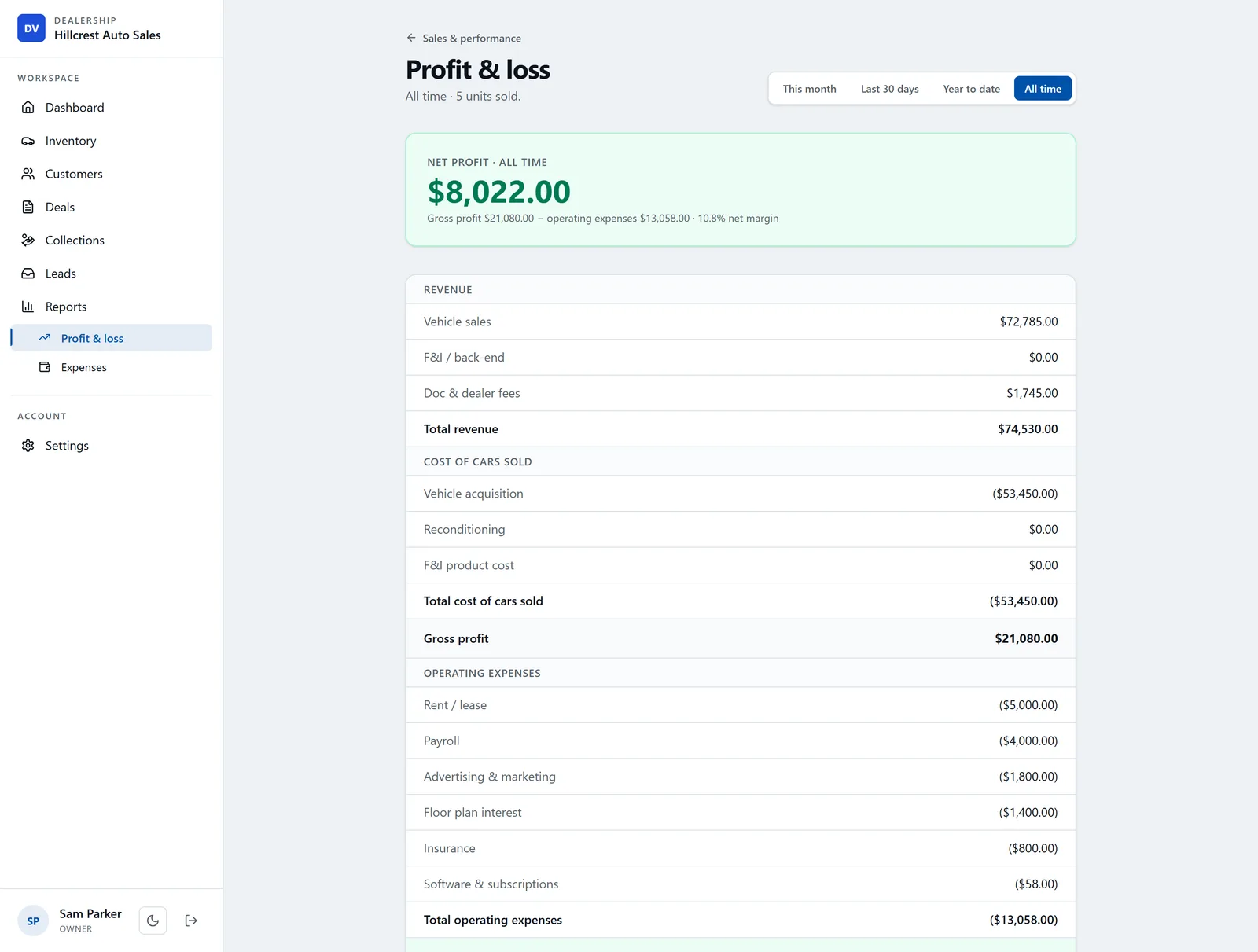
In DealerVLO, the profit-and-loss report shows gross profit minus overhead, with overhead recorded as one-time or recurring monthly expenses by category — rent, payroll, floorplan, advertising, insurance. The bottom line of that report is your net profit, and that is the number you use to set your pay. The sales report shows front-end and back-end gross per deal, which is useful for understanding which cars or salespeople are contributing to the top line, but gross is not the number you pay yourself from.
Punch in cost, recon, holding days, and sale price to see your true net gross and margin.
Open the Profit Margin CalculatorThe base-plus-true-up method: a worked example
A practical approach for owner-operators of small lots is to take a conservative monthly base that the business can sustain during slow months, then true up quarterly when you have actual net profit numbers. This method avoids starving yourself during profitable periods, but it also avoids draining the business during slow stretches. The base is always affordable because it's anchored to past performance, and the true-up rewards current performance without committing you to a higher monthly nut you can't sustain.
Here's how it works, step by step, with clearly labeled example numbers.
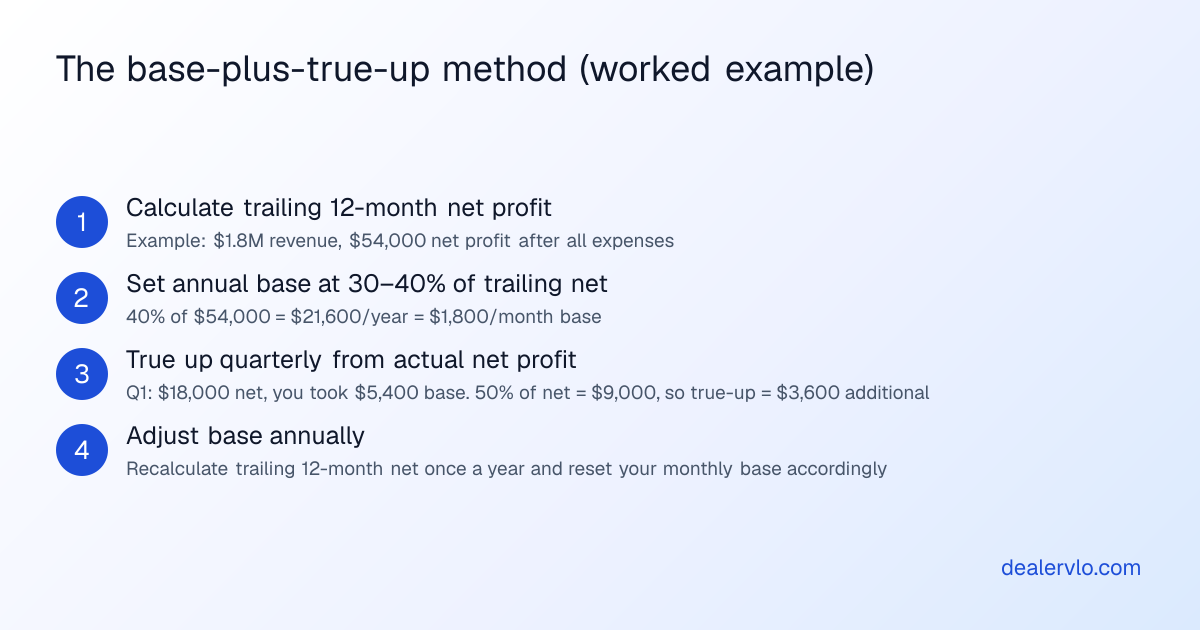
Step 1: Calculate trailing 12-month net profit
Pull your P&L for the last 12 months. Find the bottom line: net profit after all operating expenses. Not gross profit, not EBITDA, not "cash in the bank."
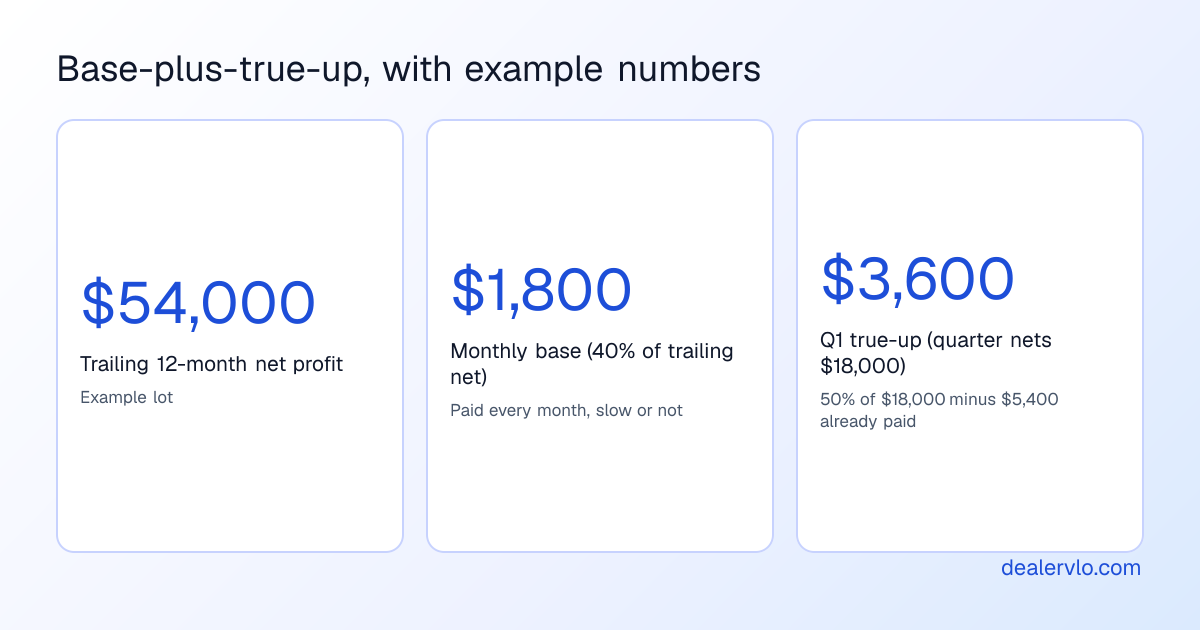
Example: Your lot did $1.8 million in sales over the trailing 12 months. Net profit after all expenses (inventory cost, floorplan interest, reconditioning, rent, payroll, advertising, insurance, utilities) = $54,000.
Step 2: Set your annual base at 30–40% of trailing net
Take 30–40% of that trailing net profit as your annual owner compensation budget. This is what you draw or pay yourself every month, regardless of whether this month was strong or weak. It's budgeted from what the lot has actually earned historically, not what you hope it will earn.
Example: 40% of $54,000 = $21,600 per year = $1,800 per month base.
Step 3: True up quarterly based on actual performance
At the end of each quarter, run your P&L. Calculate actual net profit for the quarter. If net profit came in higher than the trailing average, you have room for an additional draw. If it came in lower, you skip the true-up and leave the cash in the business as a cushion.
Example Q1:
- Revenue: $500,000
- Net profit: $18,000
- Owner took in base pay: $5,400 (3 months × $1,800)
- 50% of net = $9,000
- True-up available: $9,000 – $5,400 = $3,600 additional draw
If net profit came in at $12,000 instead, 50% = $6,000, and you already took $5,400, so your true-up is only $600 — or you skip it and leave that $600 in the business for next quarter's cushion.
Step 4: Adjust base annually
Once a year (or when you see a sustained change in profitability), recalculate your trailing 12-month net and reset your base accordingly. If the lot has grown and is consistently netting more, you raise the base. If the margin has compressed or sales have slowed, you lower it.
DealerVLO's P&L runs for this month, the last 30 days, year to date, or all time, and it totals your gross profit, breaks out overhead by category, and shows net at the bottom. It doesn't run custom date ranges, so pull the trailing-12-month and quarterly figures this method uses from your books; the P&L is for keeping an eye on the current month and the year so far.
14-day free trial, then $29/mo · Cancel anytime
Owner draw vs. salary: the general difference (ask your CPA)
The method by which you pay yourself — and the tax treatment that follows — depends entirely on how your business is set up. The two most common methods are an owner's draw and a salary, and the rules for which one you can use (or must use) vary by entity structure. This section explains the general difference; your CPA should set it up correctly and tell you what's allowed for your specific situation.
Owner's draw
An owner's draw means you take funds out of the business for personal use. Sole proprietors and single-member LLCs typically use draws, and partners in a partnership or multi-member LLC take draws (or guaranteed payments). Draws are not treated as a deductible business expense, and in a pass-through entity you are taxed on the full net profit whether you draw it or leave it in the business. You can take out as much as you want from your business's profits, but the tax bill is based on the profit, not the draw.
Draws offer more flexibility. You can withdraw money as needed without sticking to a fixed payment schedule. If your business has a slow month, you can reduce the amount of the draw. This flexibility is useful for small lots with lumpy cash flow — you might sell six cars one month and two the next, and your draw can adjust accordingly.
Salary
A salary works the same way it would for any employee: a set amount on a set schedule. S corporation owners who work in the business must take a reasonable W-2 salary before taking distributions, and C corporation owners typically take a salary as well. The salary is a deductible business expense, payroll taxes are withheld and sent to the IRS each pay period, and you receive a W-2 at year-end.
Paying yourself a salary means your business must have a consistent income to cover it. If cash flow is unpredictable, it can put extra pressure on you to find the money, which could lead to financial stress or even debt. You must stick to a fixed payroll schedule, even during slower business periods. If you set your salary too high, this can strain cash.
Which one to use
The choice is not a preference; it is a function of your entity structure and the tax rules that apply to it. If you're a sole proprietor or single-member LLC, you take draws. If you're an S corp, you take a salary first, then distributions. If you're a partnership, you take draws or guaranteed payments. Your CPA will set up the structure that makes sense for your situation and tell you what method to use.
The practical takeaway: draws are simpler and more flexible for small lots with lumpy cash flow. Salary provides predictability but requires payroll administration and commits you to a fixed amount even during slow stretches. Either way, the 50% guideline and the base-plus-true-up method still apply — they tell you how much to take, and your entity structure tells you how to take it.
Warning signs: paying yourself too much or too little
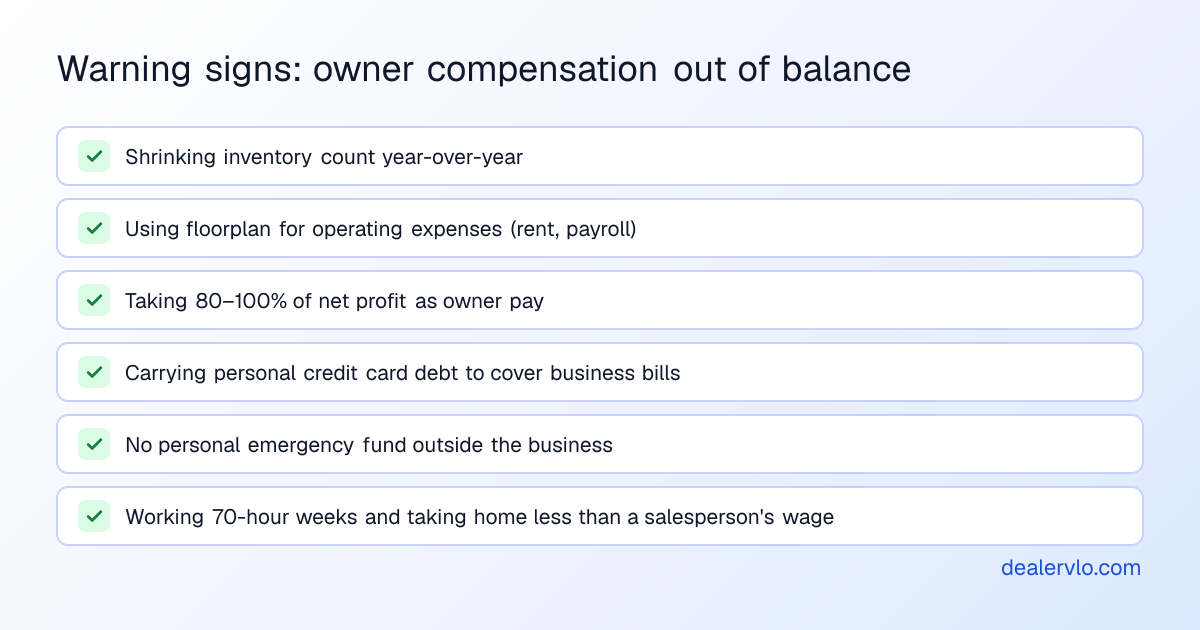
There are clear signals that tell you when your owner compensation is out of balance. Some indicate you're taking too much and starving the business; others indicate you're taking too little and subsidizing the business from your personal finances. Both are problems.
Signs you're taking too much
Shrinking inventory count. If your lot carried 18 cars last year and now carries 12, and you haven't changed your sales model, you're probably undercapitalizing inventory to fund owner draws. Drawing too much, or taking out money at a less-than-ideal time, can reduce the immediate funds you need for inventory, seasonal slowdowns, and marketing.
Relying on floorplan for operating expenses. If you're using floorplan advances or lines of credit to cover rent, payroll, or utilities — rather than just inventory acquisition — you're likely drawing too much cash out of operations. Floorplan is for buying cars, not for covering overhead that should be paid from gross profit.
Consistently missing the 50% rule. If you're taking 80–100% of net profit as owner compensation, you have no buffer for taxes, slow months, or growth. The business has no retained earnings, and the first slow quarter will put you in the red.
Signs you're taking too little (or subsidizing the business personally)
Carrying personal credit card debt to cover business expenses. If you're paying the lot's advertising bill or the floorplan interest from a personal card because the business account is dry, you're subsidizing the business from personal funds. That is a sign that the business is not profitable enough to sustain itself, or that you're reinvesting every dollar and taking nothing for yourself.
No personal emergency fund. If you have no savings outside the business and every dollar you earn goes back into inventory or overhead, you're exposed to personal financial risk. The business might be growing, but you're one medical bill or one car repair away from a crisis.
Burnout. If you're working 70-hour weeks, handling every role on the lot, and taking home less than you could earn as a salesperson at another dealership, the math doesn't work. A business that can't pay its owner a livable wage is not a sustainable business; it's a job you're paying to keep.
The break-even calculator can help you see how many cars you need to sell each month to cover your overhead, including a target owner salary. If the break-even number is higher than what you're actually selling, you need to either grow sales, cut overhead, or adjust your expectations on owner pay.
Where DealerVLO fits: tracking the numbers that set your pay
Setting your owner compensation correctly depends on knowing your real net profit — not your gross, not your bank balance, and not a guess. You need a P&L that breaks out overhead by category, shows gross profit minus those expenses, and gives you a bottom-line number you can trust. That number is what you base your monthly draw or salary on, and it's what you use to calculate your quarterly true-up.
DealerVLO's profit-and-loss report shows gross profit minus overhead, with overhead recorded as one-time or recurring monthly expenses by category: rent, payroll, floorplan, advertising, insurance. The report runs for this month, the last 30 days, year to date, or all time, so you can see whether the lot is netting what your base assumes; the trailing-12-month and quarterly figures for the base and true-up come from your books. The sales report shows front-end and back-end gross per deal, so you can see which cars are contributing to the top line and which are eating into your margin with heavy reconditioning or long days on the lot.
Every car in DealerVLO tracks its reconditioning costs line by line — vendor, description, cost — and those roll into the car's all-in cost and margin. When you sell the car, the deal jacket computes the front-end gross (sale price minus all-in cost) and the back-end gross (F&I products, if any), and those figures feed into the sales report and the P&L. You don't have to reconstruct the numbers from memory or from scattered receipts; the system tracks it from the moment you buy the car to the moment you close the deal.
DealerVLO does not do payroll, bookkeeping, or tax preparation, and it does not connect to QuickBooks or any outside accounting software. You record your overhead expenses in DealerVLO (or your accountant does), and the P&L shows you the bottom line. Your CPA handles the entity structure, the tax treatment, and the mechanics of paying yourself — DealerVLO gives you the numbers you need to make the decision.
The guide to building a profit-and-loss statement for your used-car lot walks through what categories to track and how to structure the report. The month-end close checklist shows you how to run the numbers in under an hour at the end of each month, so your P&L is always current when you need it.
How do used car dealers actually pay themselves? A summary
Most small-lot owners take an owner's draw or a salary, depending on their entity structure. The 50% guideline — limiting total owner compensation to half of net profit — is a common benchmark that leaves room for taxes, reserves, and reinvestment. The base-plus-true-up method lets you take a steady monthly base that the business can sustain, then true up quarterly when you have actual net profit numbers. You set the base at 30–40% of trailing 12-month net, and you take an additional draw at the end of each quarter if actual net profit exceeded the base you already took.
The warning signs that you're taking too much are shrinking inventory count, relying on floorplan for operating expenses, and consistently missing the 50% rule. The warning signs that you're taking too little are carrying personal credit card debt to cover business expenses, no personal emergency fund, and burnout. Either extreme is unsustainable.
The choice between an owner's draw and a salary is not a preference; it is a function of your entity structure. Sole proprietors and single-member LLCs take draws; S corp owners take a salary first, then distributions; partnerships take draws or guaranteed payments. Your CPA sets up the structure and tells you which method to use. The 50% guideline and the base-plus-true-up method apply either way — they tell you how much to take, and your entity structure tells you how to take it.
The weekly KPIs article shows what numbers to watch week-to-week, and the daily routine article covers the 15-minute morning check that keeps a lot from leaking money. Both feed into the larger question of whether the business can afford to pay you what you need — and whether you're paying yourself in a way that lets the business grow.
Frequently asked questions
How much salary should a car lot owner take?
A common rule of thumb is to limit total owner compensation to 50% of net profit, leaving the other half for taxes, working capital reserves, and reinvestment. If your lot nets $60,000 annually after all expenses, you would draw no more than $30,000. A practical approach is to set a monthly base at 30–40% of trailing 12-month net profit, then true up quarterly based on actual performance. For example, if trailing net is $54,000, take a base of $1,800 per month ($21,600 annually), and at the end of each quarter, if actual net profit exceeds the base you took, draw up to 50% of the actual net.
What's the difference between an owner's draw and a salary for a small car dealership?
An owner's draw means you take funds out of the business as needed, without a fixed schedule. Sole proprietors, single-member LLCs, and partners typically use draws. You're taxed on the full net profit whether you draw it or leave it in, and draws are not a deductible business expense. A salary is a set amount paid on a fixed schedule, with payroll taxes withheld. S corporation owners working in the business must take a reasonable W-2 salary before distributions. The choice depends on your entity structure — your CPA should set it up and tell you which method to use.
How do I know if I'm paying myself too much from my dealership?
Warning signs include a shrinking inventory count (if your lot carried 18 cars last year and now carries 12, you're likely undercapitalizing inventory), relying on floorplan advances or lines of credit to cover rent or payroll instead of just inventory, and consistently taking 80–100% of net profit as owner compensation with no buffer for taxes or slow months. If you're drawing more than 50% of net profit and the business has no retained earnings, the first slow quarter will put you in the red.
Should I pay myself from gross profit or net profit?
Pay yourself from net profit — what's left after all operating expenses — not gross profit. Gross profit is what you make on the sale of a car minus what you paid for it, but net profit is what's left after you subtract reconditioning, floorplan interest, advertising, rent, payroll, insurance, utilities, and every other operating expense. A car might show $1,800 in gross profit but only $400 in net profit after all those costs. If you base your pay on gross, you'll drain the business and leave no cash to cover overhead or buy the next car.
Can I take all the profit from my car lot as owner pay?
You can, but it's not sustainable. If you take 100% of net profit, you have no buffer for taxes (which you'll owe on the full profit if you're a pass-through entity), no cushion for slow months, and no retained earnings to reinvest in inventory growth or marketing. The 50% guideline leaves half for those needs. If your lot nets $60,000 and you take all of it, you'll owe income tax on that $60,000 with no cash left to pay it, and the first slow quarter will leave the business unable to buy cars or cover overhead.
How often should I adjust my owner draw or salary?
Set your monthly base annually, based on trailing 12-month net profit, then true up quarterly when you have actual numbers. If the business has grown and is consistently netting more, raise the base at your annual review. If the margin has compressed or sales have slowed, lower it. The base should always be affordable even during slow months — it's anchored to past performance, not what you hope to earn. The quarterly true-up rewards current strong performance without committing you to a higher monthly amount you can't sustain.
Bottom line
Paying yourself from a small used-car lot is a balance between taking enough to live on and leaving enough in the business to keep buying cars. The 50% guideline — limiting total owner compensation to half of net profit — is a common benchmark that leaves room for taxes, reserves, and growth. The base-plus-true-up method gives you a steady monthly base that the business can sustain, with a quarterly true-up when actual net profit comes in higher. Set the base at 30–40% of trailing 12-month net, run your P&L quarterly, and take an additional draw if the numbers support it. Whether you take an owner's draw or a salary depends on your entity structure — your CPA should set it up correctly and tell you which method to use.
14-day free trial, then $29/mo · Cancel anytime