How to Build a Profit & Loss Statement for Your Used-Car Lot
A used-car P&L is five lines: revenue, cost of cars sold, gross profit, operating expenses, and net. Here's what goes in each — with a worked example you can copy.
If you've never built a profit and loss statement for your lot, it sounds like accountant territory. It isn't. A used-car P&L is five lines, and once you've seen it laid out, you can read your own business at a glance — and finally answer the question gross alone can't: did the month actually make money?
What are the five lines of a used-car P&L?
Every P&L, from a corner lot to a franchise store, is the same shape:
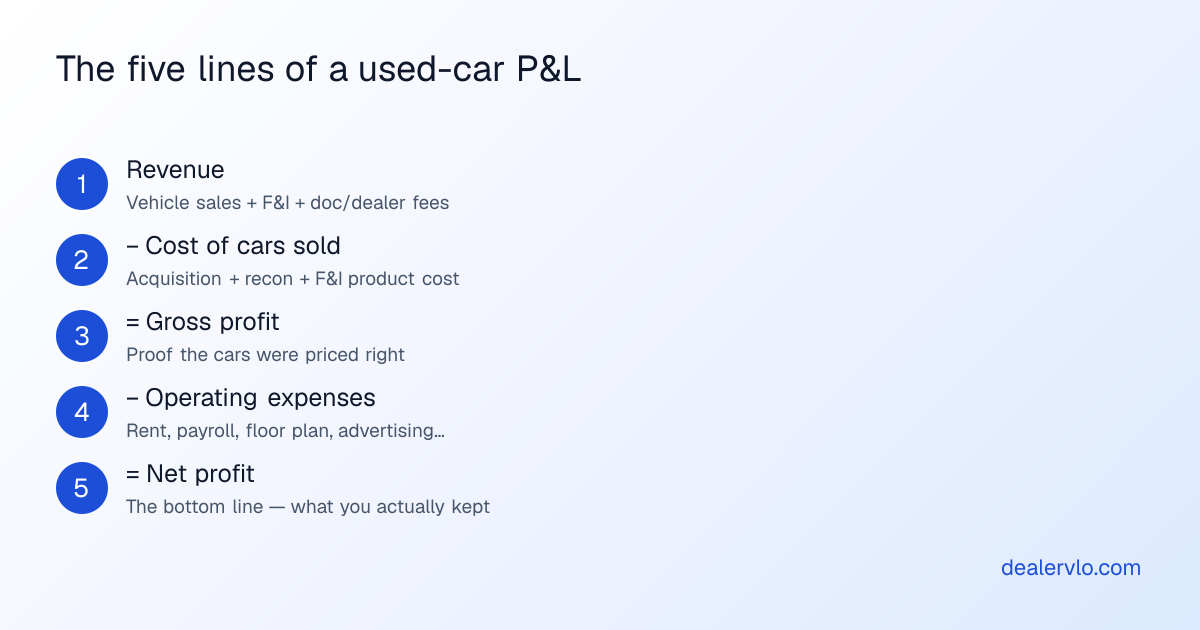
Read top to bottom, it tells a story: here's what came in, here's what the cars cost, here's the gross that proves they were priced right, here's what it costs to keep the doors open, and here — the bottom line — is what you actually kept. Let's take the two lines dealers get wrong.
Line 2: cost of cars sold — get recon in there
Cost of cars sold is the direct cost of the specific vehicles you sold this period: acquisition price + reconditioning + the cost of any F&I products on those deals. It does not include rent or payroll — those come later.
This is the line that makes gross honest. Spend $1,200 getting a car retail-ready and leave it out, and your gross looks $1,200 better than it is. Put every dollar of recon into the car's cost.
Line 4: operating expenses — get all of it in there
Operating expenses are everything you pay to keep the business running whether or not you sold a car:
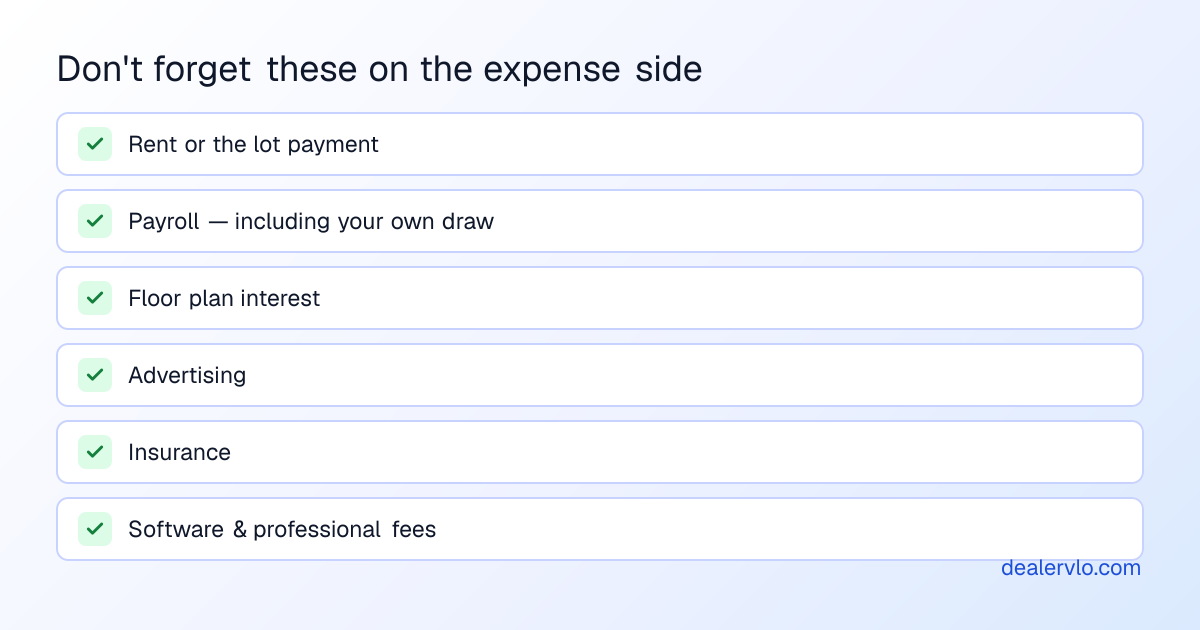
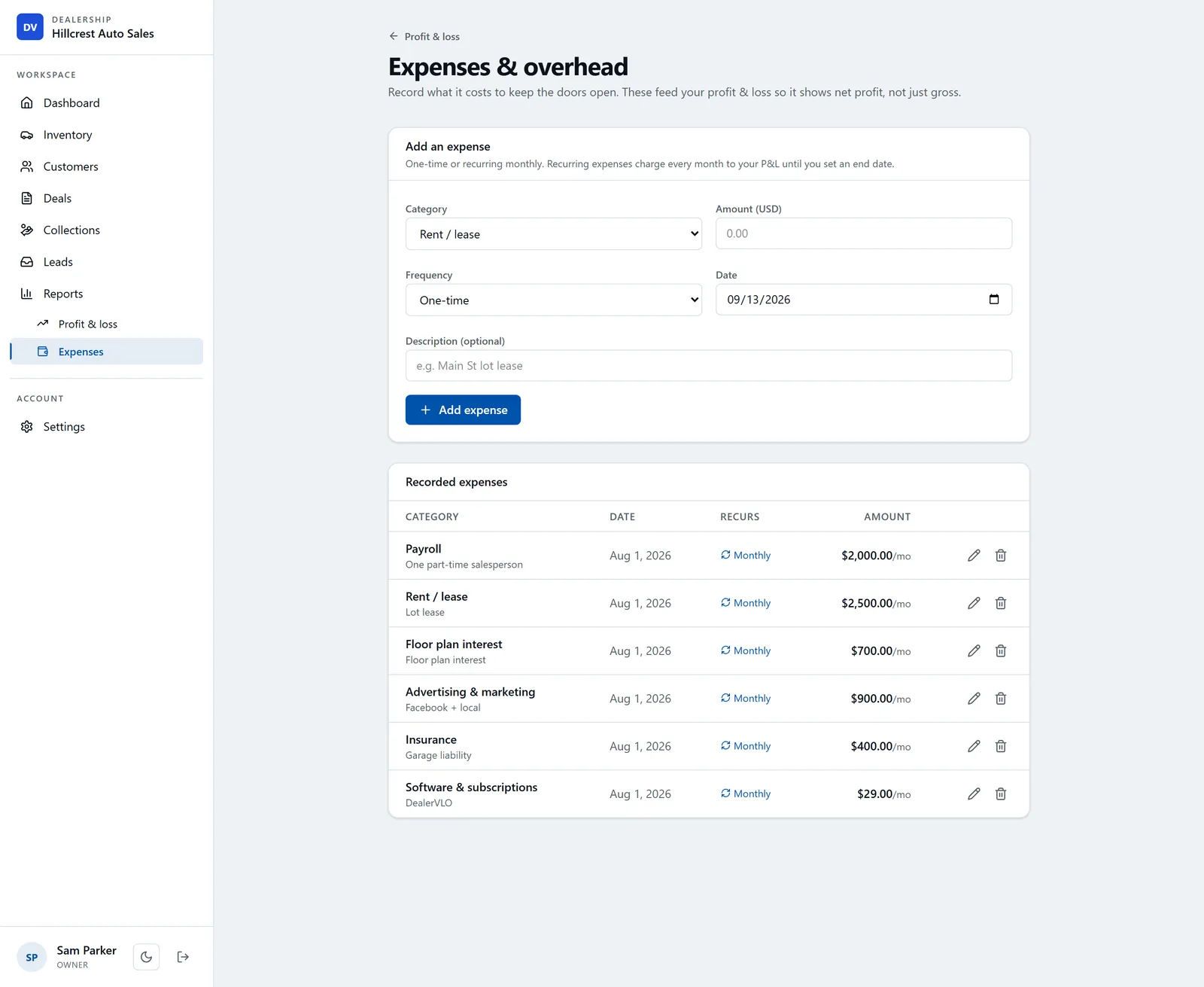
The two most commonly missed are floor plan interest and your own draw — both quietly make net look better than it is when they're left off. The clean way to keep this line accurate is to record each fixed cost once as a recurring monthly expense so it carries forward instead of being rebuilt from receipts:
Putting it together
With cost and overhead recorded, the statement writes itself. Here's a sample lot's numbers running down the five lines:
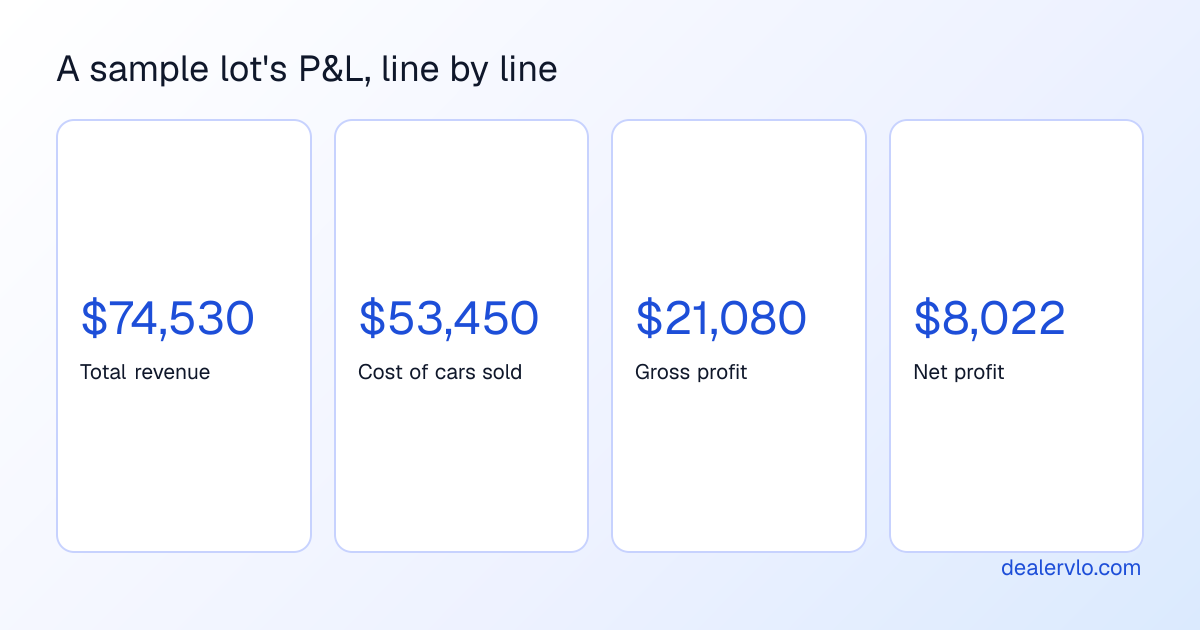
Revenue of $74,530, cost of cars sold of $53,450, and you're left with $21,080 in gross profit. Strong month, right? Then operating expenses come out — and net lands at $8,022. Still profitable, but a very different number than the gross. That gap is the entire reason to build the statement.
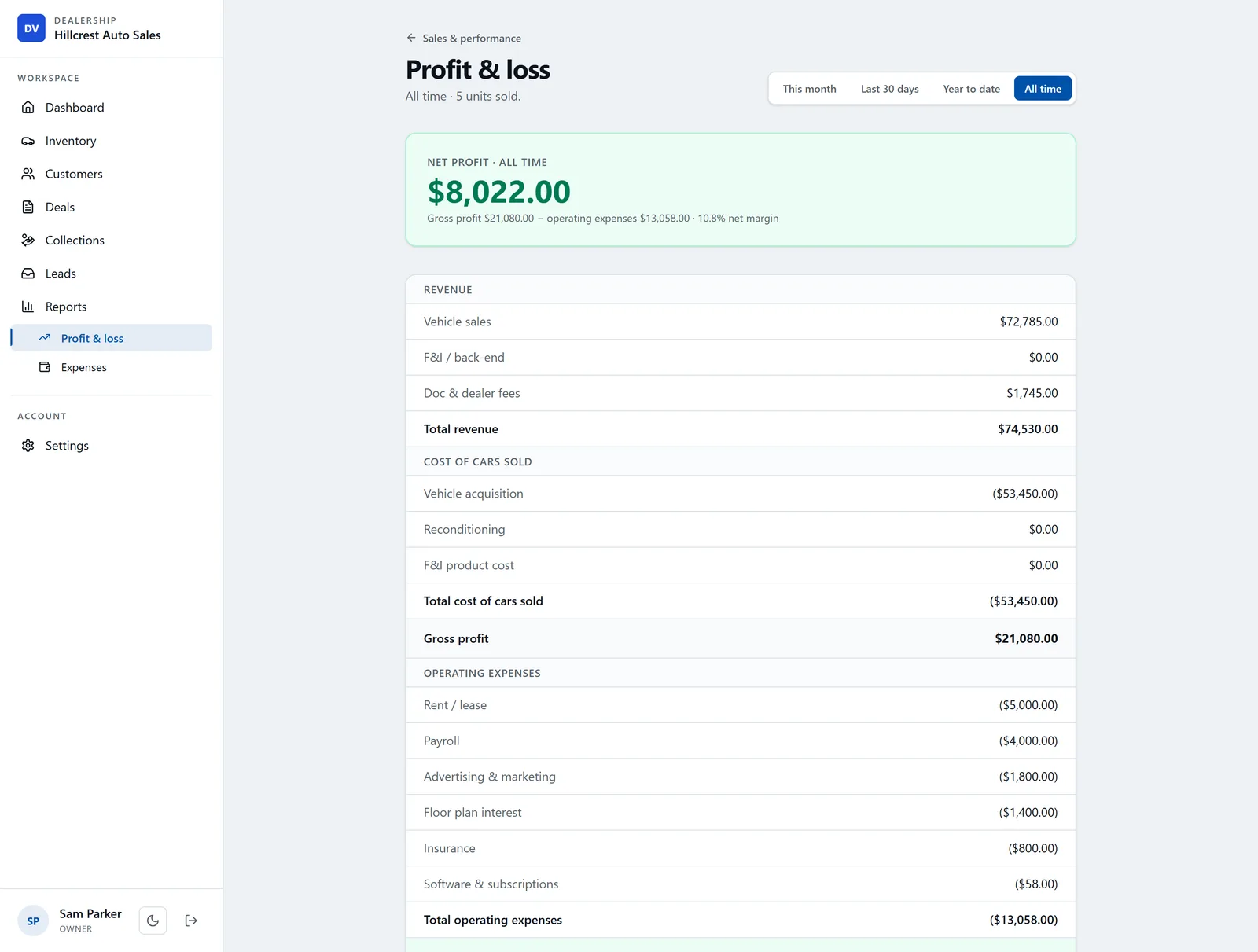
And this is the part worth stressing: you don't have to assemble any of it by hand. Because the deal data already carries cost and the overhead is recorded, the P&L generates for any period on demand:
How often should you produce a P&L?
A P&L is only useful if you look at it. Produce one at least monthly — it matches how your rent, floor plan, and payroll actually hit, and it's frequent enough to catch a losing stretch while you can still act. Once you know your net, the next question is how many cars it takes to cover overhead: run that on the break-even calculator, and check your margin while you're at it.
Frequently asked questions
What is a P&L statement for a car dealership? A summary of what your lot made and spent over a period, arranged so the bottom line is real profit. Five parts: revenue, cost of cars sold, gross profit, operating expenses, and net. The point is to get past gross and see net.
How do I calculate cost of goods sold for a used-car lot? Cost of cars sold is the direct cost of the specific vehicles sold in the period: acquisition + recon + F&I product cost. It excludes overhead like rent and payroll. Leaving recon out makes gross look better than it is.
What's the difference between gross and net profit on a P&L? Gross is revenue minus cost of cars sold — the cars were priced right. Net is gross minus operating expenses — the business made money. Strong gross can still land at a negative net if overhead outruns it, which is why the P&L shows both.
What operating expenses go on a dealership P&L? Rent, payroll (including your draw), floor plan interest, advertising, insurance, utilities, software, and professional fees — everything you pay regardless of sales. The two most missed are floor plan interest and the owner's wage.
How often should a dealer produce a P&L? At least monthly — it matches how costs hit and catches a losing stretch early. Doing it by hand is where most give up, so software that has your deal gross and overhead and generates it on demand is the practical answer.
Bottom line
A used-car P&L is five lines: revenue, cost of cars sold, gross profit, operating expenses, net. Get recon into the cost and get all your overhead into the expenses, and the bottom line finally tells the truth. DealerVLO builds the whole statement from your deals and recorded expenses — for any period, always current. Start a free trial and read your lot at a glance.
Punch in cost, recon, holding days, and sale price to see your true net gross and margin.
Open the Profit Margin Calculator