Dealer Reserve: How Rate Markup on Financing Actually Adds to Your Gross
Dealer reserve explained: how rate markup on financing adds gross, what the law does and doesn't require you to disclose, and a worked example.
Part of the Profit, margins & the numbers guide: How Do Used-Car Dealerships Actually Make Money?
Switching from another DMS? Compare DealerVLO to DealerCenter, Frazer, or Lot Wizard, or see what DealerVLO's car dealer management software includes.
Dealer reserve is the spread between the rate a lender approves a buyer at and the rate you actually write on the contract, and it's real gross, even though it never shows up as a line item on the buyer's paperwork. If you've wondered why two dealers can finance similar buyers on similar cars at different rates, this is a big part of why.
Below: the mechanics, what a couple of points adds up to, what you do and don't have to disclose, and the fair-lending history behind the scrutiny. This isn't legal or lending advice; your reserve runs through your lender agreements and state law, so confirm specifics with your lenders and attorney.
14-day free trial, then $29/mo · Cancel anytime
What "dealer reserve" actually is
When you send a deal to an indirect lender, it comes back with a buy rate: the rate it's willing to fund that buyer and vehicle at, based on its own risk pricing. If your agreement with that lender allows it, you can write the contract at a higher contract rate. The difference is what the industry calls dealer reserve, also called finance reserve or dealer participation. The lender still buys the contract; the reserve is how it compensates you for arranging the financing and bringing it the business.
The CFPB described exactly this setup when it issued its 2013 guidance on indirect auto lending: lender policies that let dealers mark up the interest rate above the lender's buy rate, with the dealer compensated from the extra interest (CFPB, March 2013). It draws scrutiny because the amount is usually left to the finance manager's discretion, deal by deal, and discretion is where pricing for similar buyers drifts apart.
Lenders also set their own rules, and the programs differ more than most dealers expect (our rundown of lenders for independent auto dealers covers who works with small lots). A lender can cap how far above the buy rate you can go, and some pay a flat fee per contract instead of a share of the spread; the CFPB's 2013 bulletin named flat fees per transaction as one way for lenders to compensate dealers without discretionary markup (CFPB auto finance fact sheet).
What the markup looks like on a deal
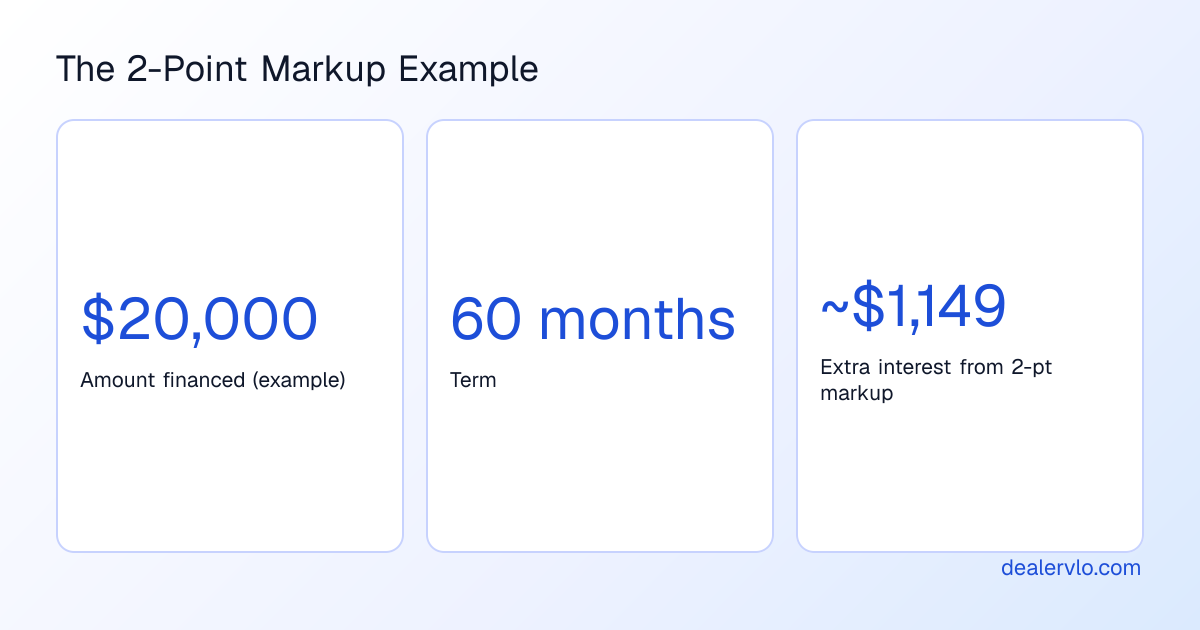
Here's a worked example, with illustrative numbers, just to show the mechanics. Say a buyer is financing $20,000 over 60 months. The buy rate for that buyer's tier comes back at 7.0% APR: about $396 a month and about $3,761 in total interest over the loan. Write the contract at 9.0% instead, a 2-point markup, and the payment moves to about $415 a month and total interest to about $4,910.
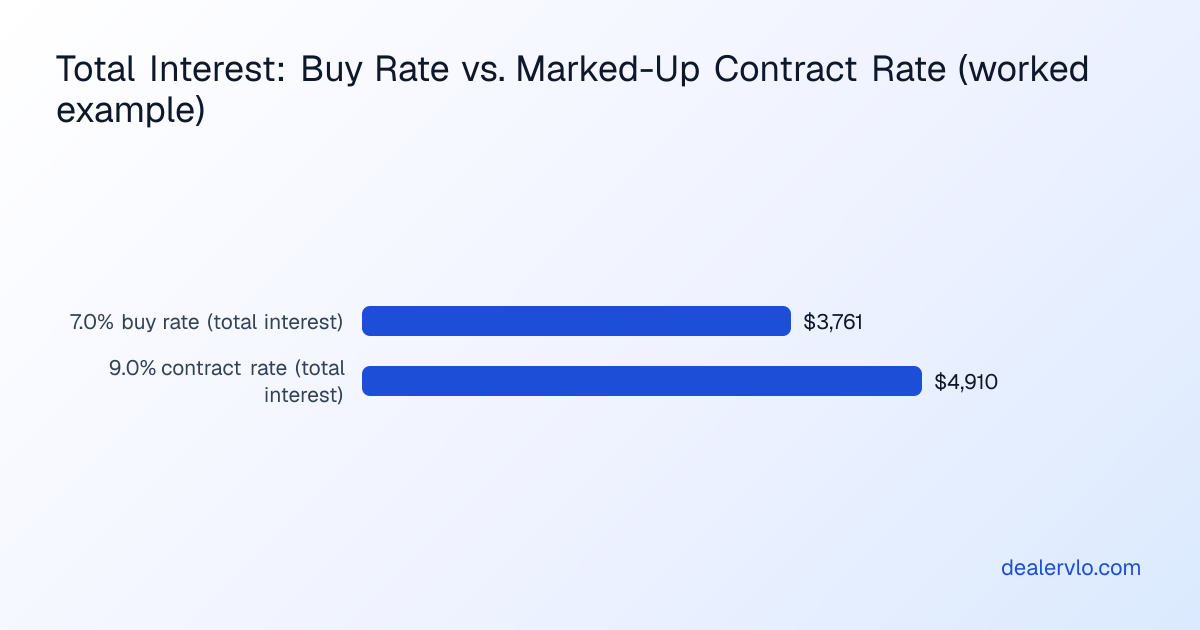
That's roughly $1,149 in extra interest over 60 months, purely from the 2-point spread. That pool is where reserve comes from: it's the buyer's cost of credit, part of which the lender passes back to you.
You don't necessarily collect that full amount. How much of the spread a lender pays, when it's paid, and what happens to it if the loan pays off early or goes bad are all set in that lender's dealer agreement, and they differ from program to program. Ask each lender how its reserve actually pays out before you build an assumption into your deals.
If you're working the payment side first, the free deal structuring calculator works backward from a customer's monthly payment to the highest vehicle price you can structure, with the trade allowance and payoff entered separately.
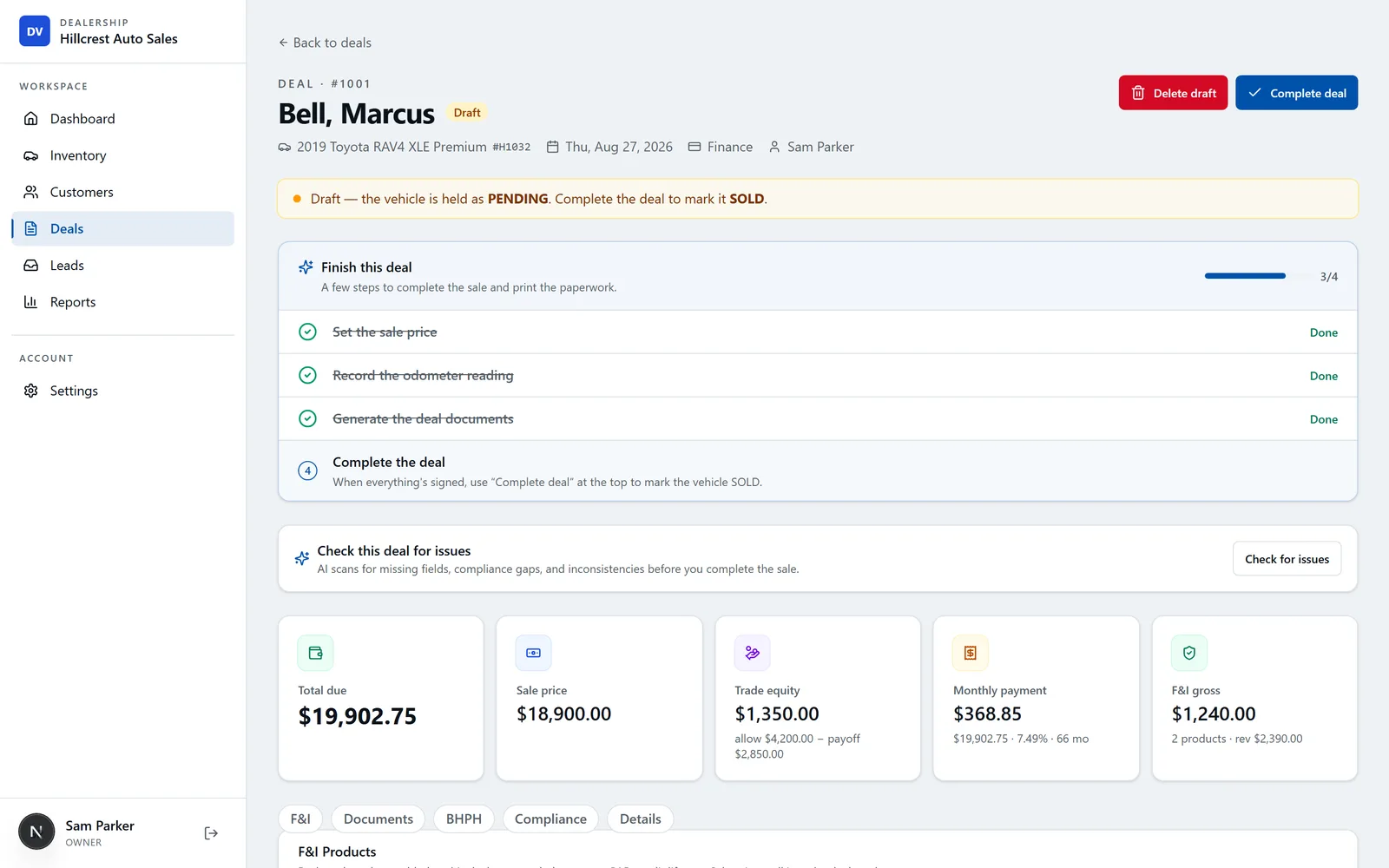
I built DealerVLO for my own lot in Tewksbury, and its deal jacket computes the deal math live as you build it: totals, trade equity, payment, and front-end and F&I gross. That puts the back-end number next to the front-end number on the same screen, instead of on a side spreadsheet you have to remember to reconcile against the contract.
What you're required to disclose, and what you're not
This is the part that surprises dealers who assume more transparency is mandated than actually is. Federal Truth in Lending disclosures center on the cost of the credit: the APR, which the CFPB describes as the total cost of credit expressed as a yearly rate, along with the finance charge, amount financed and total of payments (CFPB). The buy rate and the dealer's spread aren't on that list.
Courts have turned down attempts to create that duty. In 2005, the Minnesota Court of Appeals held that when a retail installment contract fully discloses what the consumer has to pay, the dealer's markup is immaterial, and that neither TILA nor the state's consumer protection statutes required dealers to disclose it (CU Times). That's one state's appellate court, not a national rule. Some states address it in statute; Illinois, for example, says there's no duty to disclose to the buyer an arrangement in which the assignee pays the seller part of the finance charge (815 ILCS 375/5).
So the buyer sees an accurate APR, finance charge and payment, but generally not the buy rate underneath. State rules vary, so check with your state's consumer credit regulator and your attorney.
Why markup is the lever regulators watch hardest
On March 21, 2013, the CFPB issued Bulletin 2013-02, saying an indirect lender that lets dealers mark up the buy rate and pays them based on that markup could be liable under the Equal Credit Opportunity Act for pricing disparities that result. It suggested lenders either control markup and monitor for disparities, or eliminate dealer discretion and pay dealers another way, such as a flat fee per transaction (CFPB).
That theory was enforced. In December 2013, the CFPB and the Department of Justice ordered Ally Financial and Ally Bank to pay $80 million in damages to borrowers and an $18 million penalty, over higher rates the agencies tied to dealer markup of Ally's buy rate. The CFPB called it the federal government's largest auto loan discrimination settlement in history (CFPB; DOJ). In July 2015, American Honda Finance agreed to $24 million in restitution and to cap dealer markup at 1.25 points on loans of 60 months or less and 1 point on longer loans (DOJ). Those cases were against lenders, but the markup at issue was written by dealers.
14-day free trial, then $29/mo · Cancel anytime
Then the guidance itself was rolled back. In December 2017, the Government Accountability Office concluded the 2013 bulletin was a "rule" under the Congressional Review Act, which meant it should have been submitted to Congress (GAO B-329129). Congress passed a resolution disapproving it, and the President signed it on May 21, 2018 (White House archive).
Be precise about what that did. It nullified the bulletin, not the underlying law. A note the CFPB later added to its enforcement pages says ECOA and Regulation B are unchanged and remain in force (CFPB). Markup is still legal, and pricing that disadvantages buyers on a prohibited basis is still illegal.
Where reserve fits into your numbers
On a flat-fee program, the rate you write doesn't change what you earn; on a spread program, it does. If you compare lenders, track what each program actually paid from its funding statements.
Buy-here-pay-here paper is a different animal. There's no outside buy rate to work against: you set the rate (within your state's limits) and carry the note yourself, so your return comes in as payments over time rather than as reserve at funding. The free BHPH payment calculator structures an in-house note: payment, total interest, and what it collects per month. Inside DealerVLO's buy here pay here software, turning on buy-here-pay-here tracking for a deal builds its payment schedule from the amount financed, term, payment frequency and first payment date, and the collections view shows what's due and past due.
For the front end of the same car, the profit margin calculator takes cost, recon and sale price and shows your true net gross and margin. Our piece on gross profit per car by price tier covers how that gross shifts between cheap and higher-ticket units.
Punch in cost, recon, holding days, and sale price to see your true net gross and margin.
Open the Profit Margin CalculatorSetting reserve policy without creating fair-lending risk
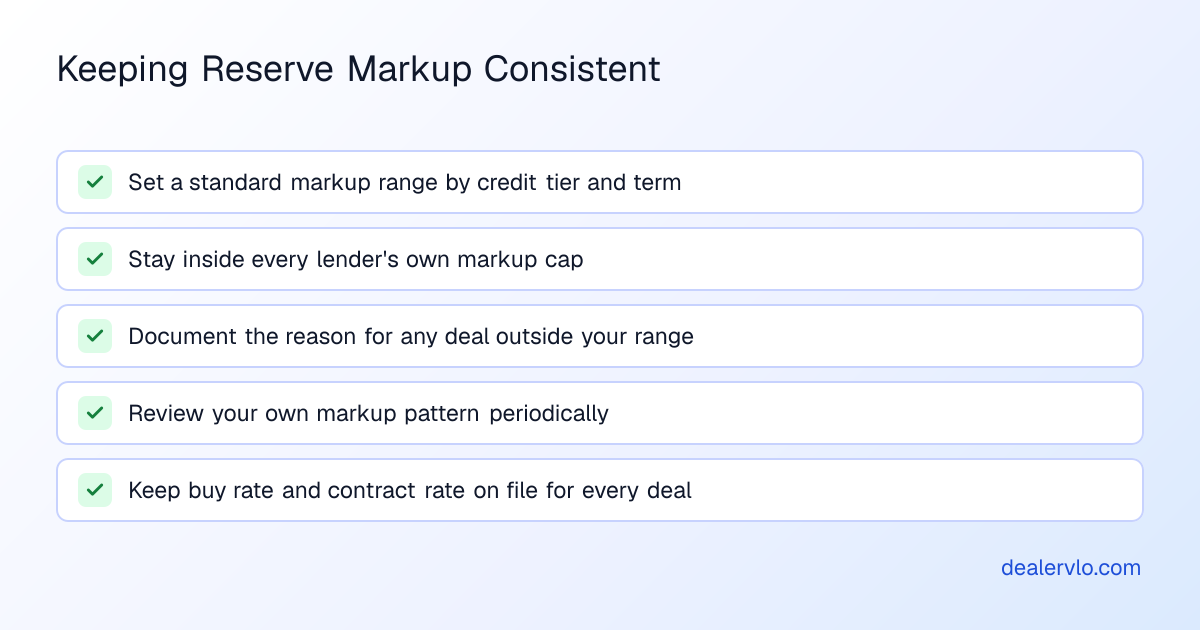
You don't need a compliance department, you need consistency. The lesson from those cases isn't "never mark up a rate"; it's "don't let similar buyers end up with different spreads for no documented reason." Habits a small lot can keep:
- Pick a standard markup range for similar credit tiers and terms, instead of deciding deal by deal what a buyer "seems like" they'll accept.
- Stay inside each lender's cap. Your lender agreement sets the ceiling, and it varies by program.
- Write down why any deal falls outside your range (a lender program quirk, a rate the buyer brought from their own bank that you matched) so there's a documented, non-discriminatory reason if anyone asks.
- Review your own pattern periodically. If you write enough financed deals to see one, look at it before a lender or regulator does.
This is a habit more than software. DealerVLO's deal compliance checklist gives you a place to record that steps like an OFAC screen and a Red Flags review were done on a deal. It's a checklist you complete, not an automated screening service, but it builds the same documentation habit that protects you on rate decisions.
Frequently asked questions
Is dealer reserve the same as finance reserve?
Yes. Dealer reserve, finance reserve and dealer participation are names for the same thing: the part of the finance charge a lender pays the dealer when the contract rate is written above the lender's buy rate.
Is dealer reserve on auto loans legal?
Generally, yes. Rate markup is a long-standing way lenders compensate dealers for arranging financing, and no federal statute bans it. What's regulated is how it's applied: pricing that disadvantages buyers on a prohibited basis violates the Equal Credit Opportunity Act. Your lender agreements and state law can also limit markup, so check both.
Do dealers have to tell buyers about the rate markup?
Federal Truth in Lending disclosures center on the cost of the credit: the APR, finance charge, amount financed and total of payments. They don't list the lender's buy rate or the dealer's spread as a required item, and courts have rejected attempts to read that duty into TILA. State law can differ, so confirm your state's rules with counsel.
What happened to the CFPB's 2013 guidance on dealer markup?
Congress disapproved CFPB Bulletin 2013-02 under the Congressional Review Act, and the President signed the resolution on May 21, 2018, after GAO concluded in December 2017 that the bulletin was a rule. The CFPB noted afterward that ECOA and Regulation B are unchanged and remain in force.
How much extra does a rate markup cost the buyer?
It depends on the amount financed, the term and the size of the spread. As a worked example, on $20,000 over 60 months, a 7.0% rate carries about $3,761 in total interest and a 9.0% rate about $4,910, a difference of roughly $1,150 over the life of the loan.
Does the dealer get the full markup amount as cash?
Not necessarily. How much of the spread you keep, and when it's paid, is set by each lender's dealer agreement, and programs differ. Ask each lender how its reserve program pays before you count on a number.
Can a lender pay a flat fee instead of reserve?
Yes. The CFPB's 2013 bulletin named flat fees per transaction as one way for lenders to compensate dealers without discretionary markup. Whether a given lender pays flat, spread-based, or a mix is in that lender's program terms.
Bottom line
Dealer reserve is legal, common and real gross, and it's the piece of deal profit the buyer generally never sees broken out, which is why it has been at the center of federal fair-lending cases. Keep markup consistent, stay inside each lender's cap, and watch the back end of your gross as closely as the front.
14-day free trial, then $29/mo · Cancel anytime