Running a used motorcycle lot on dealer software built for cars
What carries over when a used motorcycle lot runs on car dealer software, what doesn't, and the one paperwork rule that changes for bikes.
Part of the Choosing dealer software guide: The best car dealership software in 2026: 14 DMS options for independent lots, with real prices
Switching from another DMS? Compare DealerVLO to DealerCenter, Frazer, or Lot Wizard, or see what DealerVLO's car dealer management software includes.
A motorcycle dealer emailed us this week with two questions. Does the software handle motorcycles, and can the website stop saying "cars"? They'd signed up to list pre-owned bikes, and every screen and every page of their site talked about cars.
I run a car lot, not a bike shop, so I'm not going to tell you how to buy at a motorcycle auction. But I built the software, and a used-bike lot that doesn't run a service bay works much like a small used-car lot: buy a unit, recondition it, price it, list it, sell it, do the paperwork. Here's what carries over from car dealer software, what doesn't, and the one paperwork rule that's different for bikes.
What carries over without changes
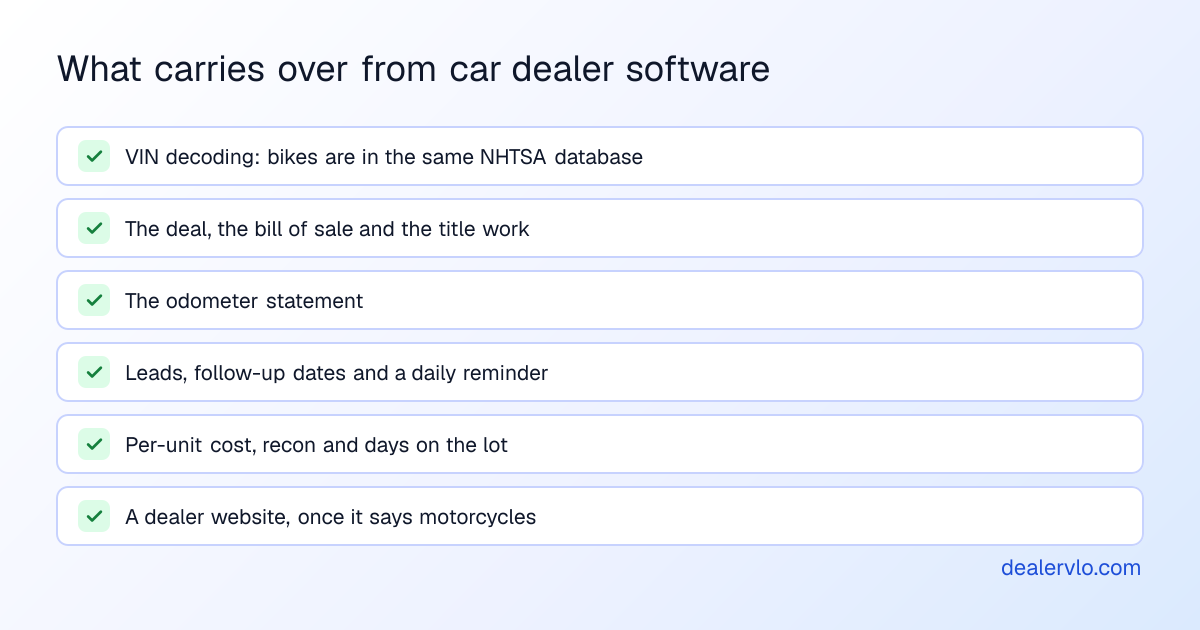
The VIN. Motorcycles built for the road since the 1981 model year carry a 17-character VIN under the same federal rule as cars (49 CFR 565). NHTSA's vPIC database, which most dealer software uses to decode VINs, covers them. I ran two through it while writing this: a 2019 Harley-Davidson Road Glide Special and a 2009 Yamaha YZF-R1 both came back with year, make, model and a motorcycle body type. One difference from a car: most bikes have no barcode label on a door jamb, so you type the VIN from the frame instead of scanning it.
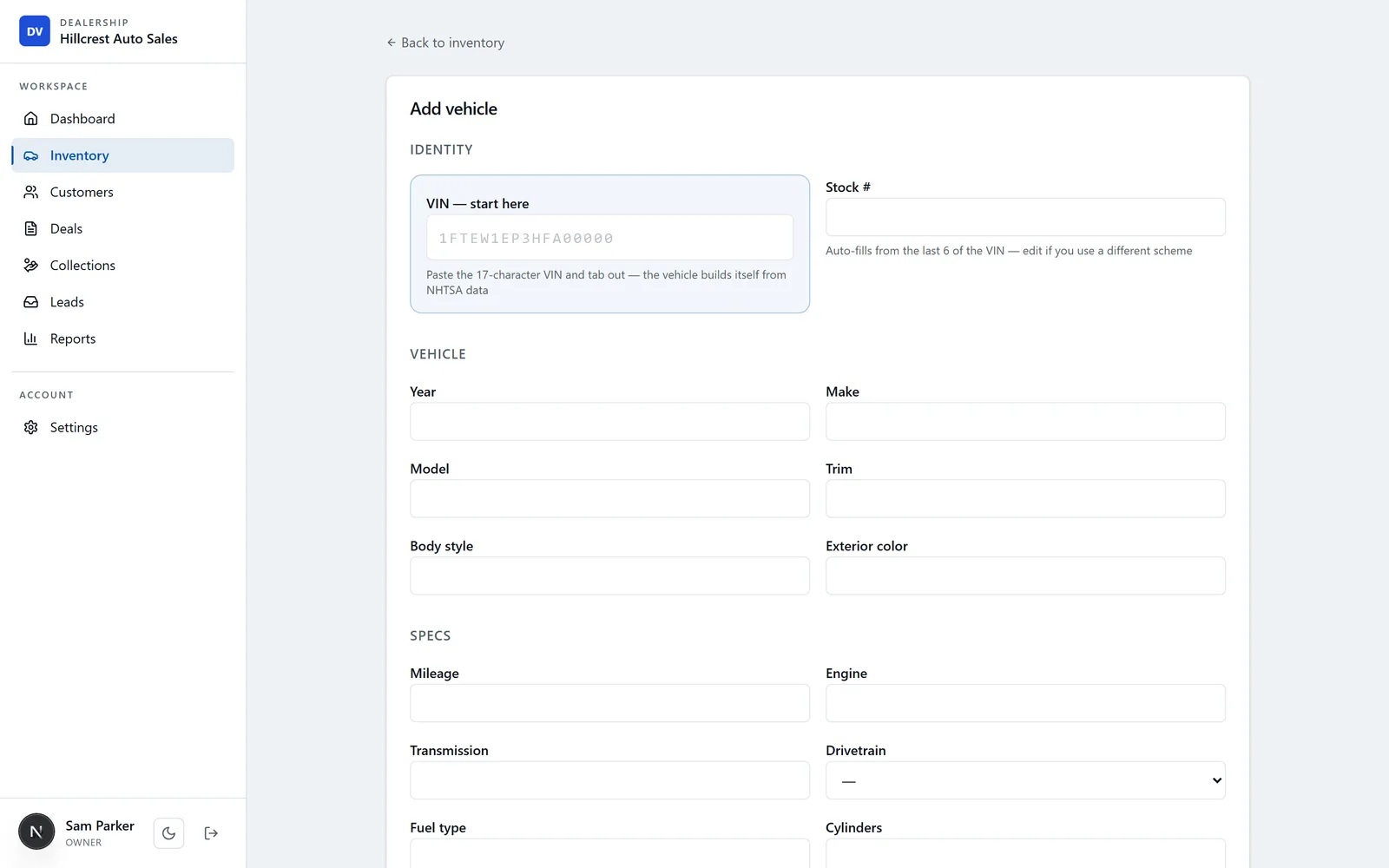
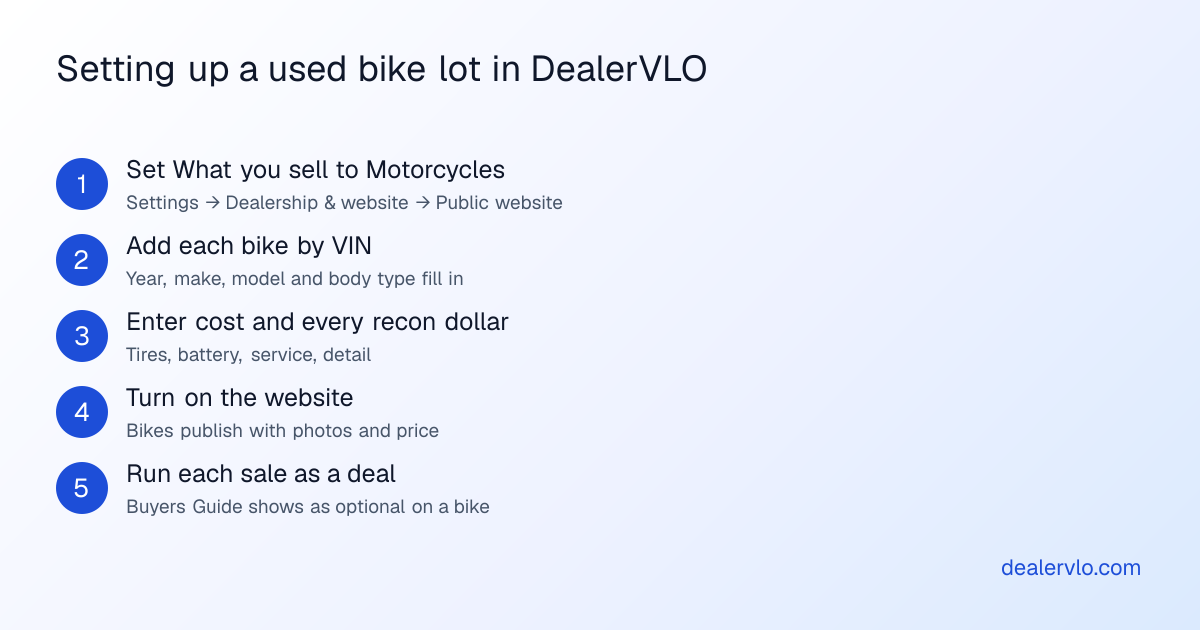
In DealerVLO, you add a bike the way you add a car: type the VIN on Add vehicle and the year, make, model and body type fill in from NHTSA. If you want to check a VIN before you buy, the same lookup runs free on our site.
Decode any VIN free — year, make, model, trim, engine — straight from NHTSA.
Open the VIN DecoderThe deal. A bike sale has a buyer, a price, maybe a trade, maybe financing, a bill of sale and title work. That's a deal jacket. DealerVLO builds the bill of sale, the odometer statement and the state title and registration forms we carry from the one deal record, and the buyer can e-sign.
The numbers. What you paid, what recon cost and how long the unit has sat don't care how many wheels it has. Every unit in DealerVLO carries its cost, its recon line items and its days on the lot, and the dashboard flags anything that's been there 60 days or more. If you sell in a place with a real riding season, watch aging closely going into winter. How I handle aging units applies to bikes the same way.
Leads. A call, a walk-in and a website inquiry go into one list with a follow-up date, and DealerVLO emails you on the days someone is due.
Make the website say motorcycles
This was the dealer's second question, and it was a fair one. A bike-only lot with "Browse our cars" on its homepage looks like it bought the wrong software.
DealerVLO now has a setting for it. In Settings → Dealership & website, under Public website, set What you sell to Motorcycles and save. The site then says motorcycles everywhere it used to say cars or vehicles: the homepage headline, the menu, "See all 12 motorcycles", "About this motorcycle", and the page titles Google shows ("Used Motorcycles in" your city). Each listing is also marked as a motorcycle in the structured data search engines read, instead of as a car.
Your tagline and About section are yours to write in the same settings section, so use them to say what you actually sell and where. The four website templates all follow the setting.
14-day free trial, then $29/mo · Cancel anytime
The one paperwork difference: the Buyers Guide
On a used car, the FTC Buyers Guide has to hang in the window. On a used motorcycle it doesn't, under federal law. The FTC Used Car Rule defines the vehicles it covers as motorized vehicles "other than a motorcycle" (16 CFR 455.1(d)(1)).
Two cautions. First, that's the federal rule only. Your state can have its own used-vehicle disclosure rules, so check what yours requires before you leave the guide off. Second, the rule follows what the vehicle is, not what your lot sells. A car you take in trade still needs its Buyers Guide.
DealerVLO follows the vehicle the same way. When a bike's body type is a motorcycle (which is what the VIN decode fills in), its deal lists the Buyers Guide as optional rather than required, and the bill of sale and installment contract leave out the line that makes the window form part of the contract. A car on the same lot keeps both. You can still print a Buyers Guide for a bike from its page if your state or your own policy calls for one.
Everything else in the deal (bill of sale, odometer statement, title work) runs the same as for a car. If your state uses a motorcycle-only title or registration form that DealerVLO doesn't carry, send it to us with Request a form or feature in the app.
Where your bikes get listed
This is where car dealer software is honestly weaker for a bike lot. DealerVLO's listing feeds go to CarGurus, Cars.com, Autotrader and Carfax.com. Those sites are built for cars and trucks, and there's no DealerVLO feed to Cycle Trader or any other motorcycle marketplace. A bike-only lot has no reason to opt in to the car feeds.
What you do get is your own website, updated automatically: add a bike with photos and a price and it's live, mark it sold and it comes down. Anywhere else you list, you post by hand. The listing sites rundown is written for cars, but its point about tracking cost per unit sold for each channel holds for bikes too.
Pricing and recon
Price from the motorcycle values the usual guides publish (Kelley Blue Book and J.D. Power both have motorcycle sections), then from what the same bike is actually listed for near you. Recon on a used bike runs smaller dollars than on a car but the same discipline: put each item (tires, battery, a service, the detail) on the unit as its own line so the all-in cost is real when you price it. The recon workflow I use on cars translates directly.
What car dealer software won't do
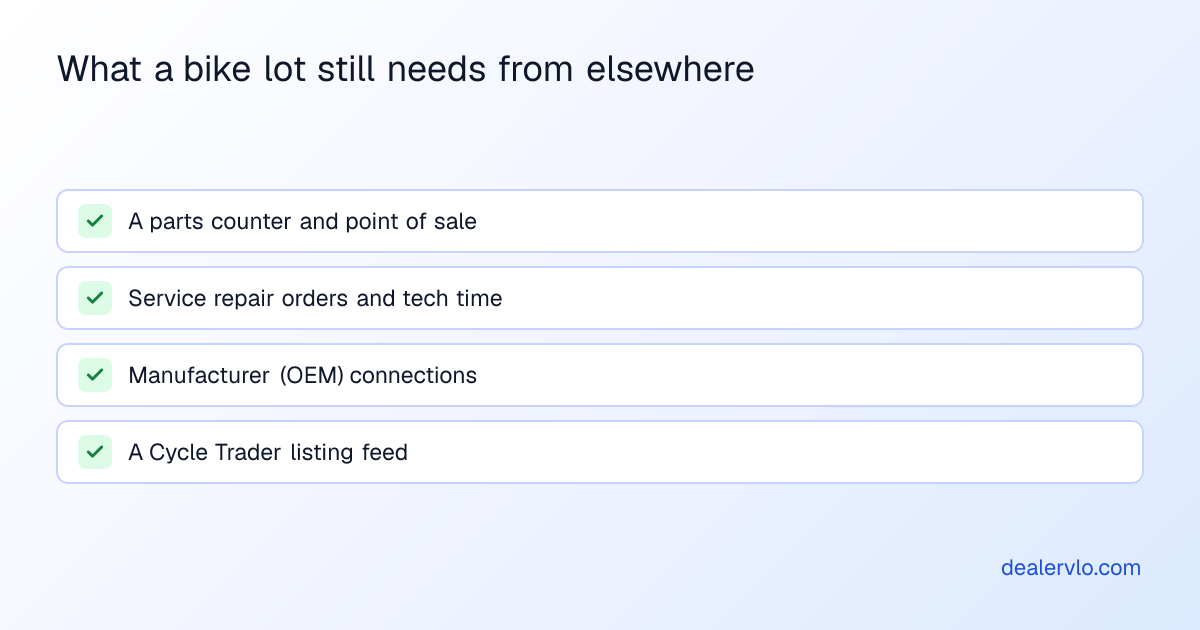
Be clear about this before you pick a system. DealerVLO has no parts inventory or counter, no service repair orders, no manufacturer connections and no Cycle Trader feed. The screens inside your own account still say "vehicle"; the motorcycle setting changes what your customers see on your website.
If your store sells parts and gear over a counter and runs a service bay, you want a powersports dealer management system built around those departments. DX1, Commander and Windward each describe their software that way. If you buy and sell used bikes and send repairs out, you're paying for departments you don't have, and the sales side is what you need. What a DMS actually does walks through that sales side one deal at a time, and the motorcycle dealer software page lays out what DealerVLO includes for a bike lot.
14-day free trial, then $29/mo · Cancel anytime
Frequently asked questions
Can a used motorcycle dealer use car dealer software?
For the sales side, yes. Bike VINs decode from the same federal database as car VINs, and a deal runs the same way: buyer, price, trade, bill of sale, title work. Leads, follow-ups and per-unit costs don't care what has wheels. What car software doesn't do is parts and service, so a store with a parts counter and a service bay needs a powersports system built around them.
Does a used motorcycle need an FTC Buyers Guide?
Not under federal law. The FTC Used Car Rule defines the vehicles it covers as motorized vehicles "other than a motorcycle" (16 CFR 455.1(d)(1)). Your state can have its own disclosure rules, so check them. In DealerVLO, a deal on a vehicle whose body type is a motorcycle lists the Buyers Guide as optional instead of required.
Do motorcycle VINs decode like car VINs?
Yes. Motorcycles built for the road since the 1981 model year carry a 17-character VIN under the same federal rule as cars (49 CFR 565), and NHTSA's vPIC database decodes them. A 2019 Harley-Davidson Road Glide Special and a 2009 Yamaha YZF-R1 both come back with year, make, model and a motorcycle body type.
Can my dealer website say motorcycles instead of cars?
In DealerVLO, yes: set What you sell to Motorcycles in the website settings. The headings, buttons, page titles and listing pages on your site then say motorcycles, and each listing is marked as a motorcycle in the data Google reads. The screens inside your own account still say vehicle.
Can DealerVLO send my bikes to Cycle Trader?
No. DealerVLO's listing feeds go to CarGurus, Cars.com, Autotrader and Carfax.com, which are built for cars and trucks. Your bikes go on your own dealer website automatically, and you post them anywhere else by hand.
Bottom line
A used-bike lot without a service bay needs what a small car lot needs: inventory by VIN, a clean deal with its paperwork, a lead list, real per-unit numbers and a website that describes the lot correctly. Car dealer software covers that once the website says motorcycles and the Buyers Guide follows the bike. It won't run a parts counter or a service bay, so if you have those, look at a powersports system.
If you sell used bikes, you can start a free 14-day DealerVLO trial and set your site to motorcycles before you add your first unit.