How to fill out the VR-197 in Maryland
A field-by-field walkthrough of the Maryland VR-197 (Odometer Disclosure Statement) for licensed used car dealers — what goes in every section, who signs what, and the documents you attach. Verified against the official form as of October 2026.
Don't waste another second filling out the Maryland VR-197.
Let DealerVLO fill out every form for you instantly.
Filing these every week? DealerVLO fills the VR-197 from the deal you already entered, $29/month flat. See pricing
Switching from another DMS? Compare DealerVLO to DealerCenter, Frazer, or Lot Wizard.
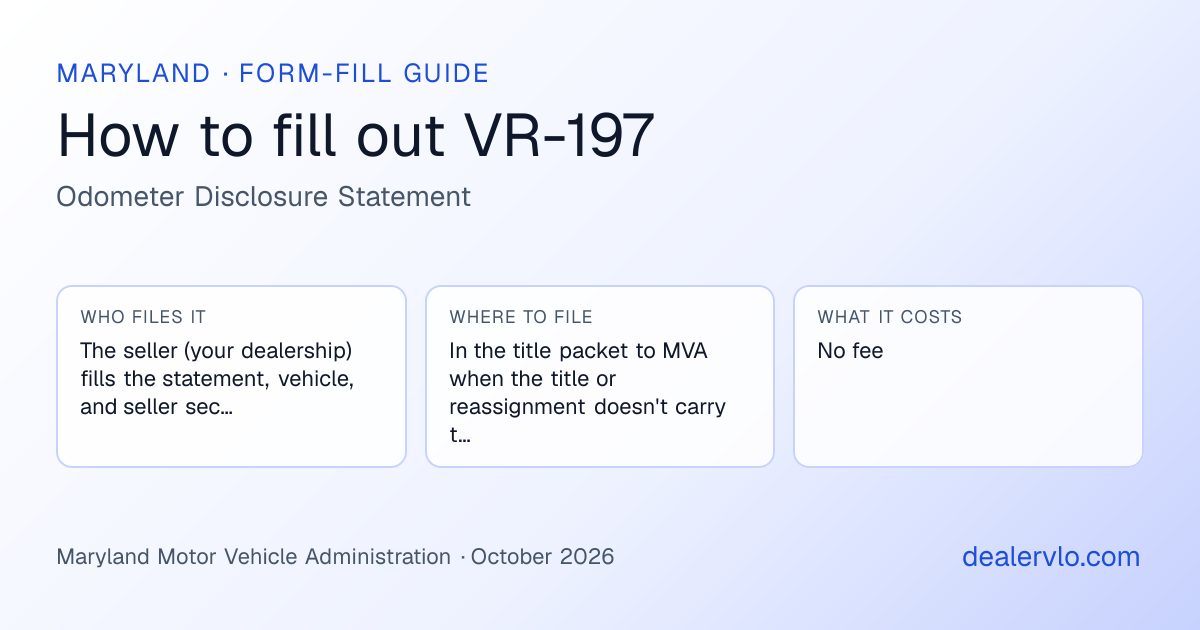
Filling out the MD VR-197 after a sale:
- What it is
- Maryland's separate written odometer disclosure on a vehicle transfer (49 CFR Part 580)
- Who completes it
- The seller (your dealership) fills the statement, vehicle, and seller sections and signs; the buyer signs
- Where to file it
- In the title packet to MVA when the title or reassignment doesn't carry the disclosure; dealers keep a copy for 5 years
- Processing time
- None of its own. It goes with the title paperwork
- Cost
- No fee
This guide is informational and does not replace the official Maryland instructions. Always confirm the current form and procedure with the Maryland Motor Vehicle Administration before you file.
The VR-197 is one car's paperwork. A 20-second read on your lot, and the tax-and-fee math for the whole deal — built for dealers, no signup. Free calculators dealers actually use — no signup, no email.
DealerVLO fills the official Maryland VR-197 straight from your deal: the vehicle and VIN, your dealership as seller in the statement line and the seller block with its address and the statement date, the buyer and co-buyer with their address, the odometer reading, and its status box. $29/month, free to try — cancel any time.
What the VR-197 is and why it matters
VR-197 is the Maryland MVA's Odometer Disclosure Statement. Federal law (49 CFR Part 580) requires the seller to state the mileage in writing when ownership transfers, and the buyer to sign that they received it. MVA's Interactive Title and Registration Manual for dealers says a title transaction must contain a disclosure on the certificate of origin, the title, a dealer's reassignment, or a separate odometer disclosure statement that meets all federal requirements. VR-197 is that separate statement.
You reach for it when the paper in the deal doesn't carry a conforming disclosure, such as a non-conforming title. MVA's manual says a non-conforming title needs a separate conforming disclosure when the vehicle is sold to a retail buyer. On a retail sale your dealership is the seller and fills nearly every box; the buyer signs. This guide walks the form box by box, covers the exemption (MVA's manual still prints the old 10-year rule), and what MVA and federal law expect you to keep.
The current revision is VR-197 (06-17), the MVA's own separate odometer statement. It's one page: the seller's mileage statement with two optional status boxes, the vehicle description, then a seller block and a buyer block. The footer splits the copies: white to MVA, canary to the seller, pink to the buyer.
Documents to have before you start
Gather these before you complete the VR-197. A missing attachment is the number-one reason the the Maryland Motor Vehicle Administration bounces a title application back.
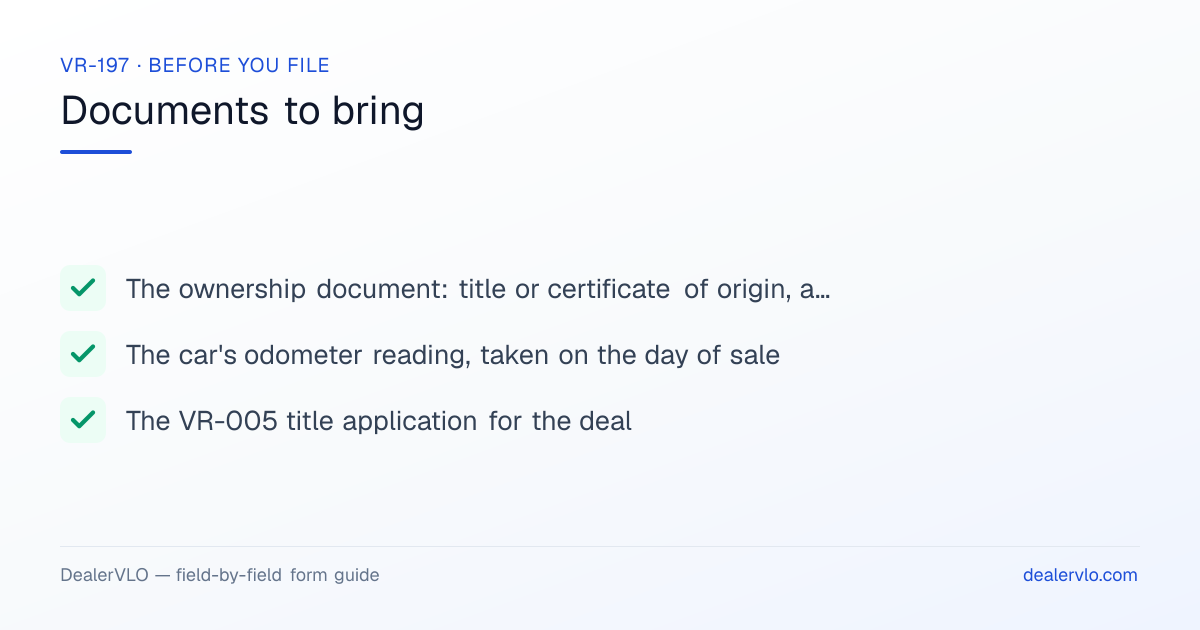
- The ownership document: title or certificate of origin, assigned — Check whether it already carries a conforming disclosure. MVA's manual says separate statements are acceptable if properly signed and completed by the seller and buyer.
- The car's odometer reading, taken on the day of sale — Compare it to the title and any reassignments. If the reading is lower or the history doesn't add up, sort it out before you certify anything.
- The VR-005 title application for the deal — It has its own odometer reading and status boxes. They must match the VR-197. See the VR-005 guide.
VR-197, section by section
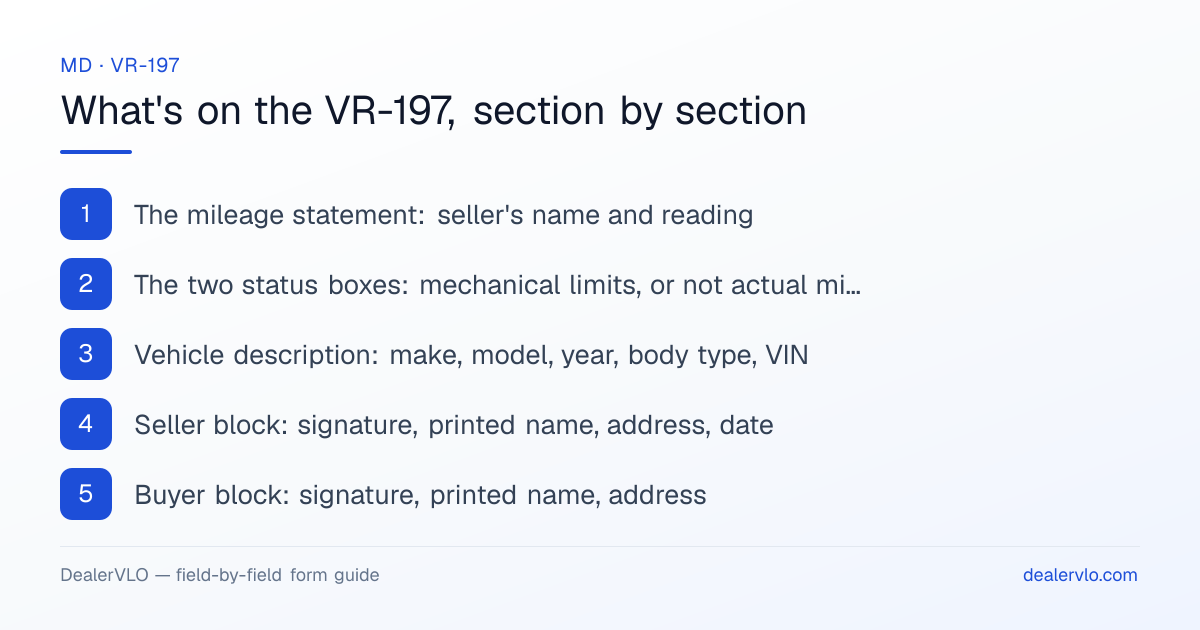
The mileage statement: seller's name and reading
The form opens with "I, (print seller's name) certify to the best of my knowledge that the odometer reading is the actual mileage of the vehicle unless one of the following statements is checked," followed by the reading in "miles (no tenths)." On a dealer sale the seller's name is your dealership's legal name. Write the reading in whole miles, read off the car on the day of sale. Leave both boxes below blank when the reading is the actual mileage; that's the default statement.
| Field | Who fills it |
|---|---|
I, (print seller's name) Your dealership's legal name (and d/b/a if you use one). | You (dealer) |
Miles (no tenths) Whole miles, read on the day of sale. | You (dealer) |
The two status boxes: mechanical limits, or not actual mileage
Check one only if the default statement isn't true. "The mileage stated is in excess of its mechanical limits" means the odometer rolled over. MVA's manual adds a Maryland note: on an odometer with six digits, don't check this box unless the vehicle has at least one million miles. "The odometer reading is not the actual mileage. Warning - odometer discrepancy" is the one you check when you know the reading differs from the real miles by more than a calibration error, or doesn't show a valid reading (49 CFR 580.5(e)). Whatever you check carries onto the title: MVA's manual says Maryland titles are branded actual mileage, exceeds mechanical limits, or not actual mileage. Check the box that's true even when it costs you on the deal.
| Field | Who fills it |
|---|---|
In excess of its mechanical limits Rolled over. Not on a six-digit odometer under a million miles. | You (dealer) |
Not the actual mileage (odometer discrepancy) Known discrepancy or no valid reading. | You (dealer) |
Vehicle description: make, model, year, body type, VIN
Five boxes identify the vehicle: make, model, year, body type, and the vehicle identification number. Federal rule 49 CFR 580.5(c) requires all five, so don't skip body type. Copy them from the title so they match the VR-005 for the same deal.
| Field | Who fills it |
|---|---|
Make, Model, Year | You (dealer) |
Body Type | You (dealer) |
Vehicle Identification No. All 17 characters, matching the title application. | You (dealer) |
Seller block: signature, printed name, address, date
Your authorized signer signs, then the seller's printed name, the dealership's street address, city, state, ZIP, and the date of statement. MVA's manual, describing the disclosure on a title assignment, says the printed name of the seller and buyer should reflect the name of the person signing, not just the company name. Apply the same habit here: make sure the signer's own name is printed, not only the dealership's. Sign after you've read the odometer yourself.
| Field | Who fills it |
|---|---|
Seller's Signature Sign by hand. | You (dealer) |
Seller's Printed Name Include the name of the person signing. | You (dealer) |
Seller's Street Address, City, State, Zip Code | You (dealer) |
Date of Statement | You (dealer) |
Buyer block: signature, printed name, address
The buyer signs, and the block carries the buyer's printed name, street address, city, state, and ZIP. Under 49 CFR 580.5(f), once the seller signs, the buyer signs and the seller gets a copy, which is what the canary copy is for. With a co-buyer, print both names on the buyer line to match the VR-005. If you print the PDF rather than use a carbon set, make the MVA, seller, and buyer copies yourself.
| Field | Who fills it |
|---|---|
Buyer's Signature | Buyer |
Buyer's Printed Name Both names with a co-buyer. | You (dealer) |
Buyer's Street Address, City, State, Zip Code | You (dealer) |
Which vehicles are exempt (MVA's manual is out of date here)
Under 49 CFR 580.17, a vehicle of model year 2010 or older is exempt, and model year 2011 and newer stay covered until 20 years after January 1 of the model year. So in 2026 every 2011-and-newer car you sell needs a disclosure, and model year 2011 cars age out in 2031. Also exempt: vehicles over 16,000 lbs GVWR, vehicles that aren't self-propelled, and a new vehicle before its first transfer for purposes other than resale. MVA's Interactive Title and Registration Manual still lists "motor vehicle 10 model years old or older" as exempt. Go by the federal rule: a 2014 car sold in 2026 still needs a disclosure. The manual also says that for a vehicle 10 years old or older, MVA wants the odometer entered on the VR-005 even when no federal disclosure is attached.
| Field | Who fills it |
|---|---|
Model year 2010 or older Exempt. Still enter the odometer on the VR-005. | You (dealer) |
Model year 2011 or newer, under 20 years Disclosure required. | You (dealer) |
Trade-ins, the secure POA, and how long to keep copies
When an out-of-state-titled trade-in's title is with a lienholder, or a duplicate title is needed, MVA's manual points to the State of Maryland Power of Attorney for Odometer Disclosure of a Motor Vehicle, a three-part secure form. Once the title arrives, it lets you disclose the mileage and complete the assignment. All three parts must be completed, and the manual says it's available only through the Maryland Automobile Dealers Association (MADA) or the Maryland Independent Automobile Dealers Association. For a Maryland-titled trade-in whose title is defective, lost, or destroyed, MVA's VR-449A Affidavit in Lieu of a Title carries its own odometer disclosure. For records: 49 CFR 580.8 and MVA's manual require dealers to keep a copy of every odometer statement they issue or receive for five years at their primary place of business, with a way to retrieve them. MVA's January 2023 bulletin on record retention repeats the five-year federal rule, which is longer than the three years Maryland Vehicle Law 15-105 sets for title records. The same bulletin puts the VR-197 tenth in the title packet, after any power of attorney and before the safety inspection certificate.
| Field | Who fills it |
|---|---|
Secure Power of Attorney for Odometer Disclosure Out-of-state trade title at the lienholder, or duplicate needed. From MADA or MIADA. | You (dealer) |
VR-449A Affidavit in Lieu of a Title Maryland title defective, lost, or destroyed. | You (dealer) |
Copy of every statement issued or received, kept 5 years | You (dealer) |
Common VR-197 mistakes that cause rejections
MVA's manual still prints the 10-year rule, but under 49 CFR 580.17 model year 2011 and newer need a disclosure until they're 20 years old.
MVA's manual says not to, unless the vehicle has at least one million miles.
The form says "miles (no tenths)." Whole miles only.
MVA's manual says printed names should reflect the person signing, not just the company. Print the signer's name.
Same reading, same status box on both. MVA brands the new title from that status.
Common questions
What is Maryland form VR-197?+
VR-197 is the Maryland MVA's Odometer Disclosure Statement. The seller states the odometer reading in whole miles and certifies it's the actual mileage unless a box is checked (in excess of mechanical limits, or not the actual mileage), and signs; the buyer signs too. The current revision is VR-197 (06-17).
When does a Maryland dealer need a VR-197?+
When the title, certificate of origin, or dealer's reassignment in the deal doesn't carry a disclosure that meets federal rules. MVA's dealer manual says the transaction must contain a conforming disclosure on one of those, or on a separate odometer disclosure statement. The vehicle also has to be covered: model year 2011 and newer, under 20 years old.
Is a 10-year-old car exempt from odometer disclosure in Maryland?+
Only if it's model year 2010 or older. MVA's manual still lists the old 10-year exemption, but the federal rule, 49 CFR 580.17, now covers model year 2011 and newer vehicles until 20 years after January 1 of their model year. In 2026 that means every 2011-and-newer car.
Who signs the VR-197?+
The seller and the buyer. On a dealer sale your authorized signer signs for the dealership after reading the odometer, and the buyer signs their own line. Under 49 CFR 580.5(h), one person can't sign as both seller and buyer in the same transaction outside the secure power-of-attorney rules.
How long do Maryland dealers keep odometer statements?+
Five years. 49 CFR 580.8 and MVA's dealer manual require a copy of every odometer statement you issue or receive, kept at your primary place of business. MVA's January 2023 bulletin notes that this federal five-year rule is longer than the three years Maryland Vehicle Law 15-105 sets for title records.
Where do I get the secure odometer power of attorney in Maryland?+
MVA's manual says the State of Maryland Power of Attorney for Odometer Disclosure of a Motor Vehicle is available only through the Maryland Automobile Dealers Association (MADA) or the Maryland Independent Automobile Dealers Association. It's for an out-of-state-titled trade-in whose title is with a lienholder, or when a duplicate title is needed.
Where do I download the VR-197?+
MVA publishes it at mva.maryland.gov/Documents/VR-197.pdf. The download link is at the top of this page.
Is there software that fills out the VR-197 automatically?+
Yes. Dealer management software like DealerVLO fills the official Maryland VR-197 from the deal you already entered: the vehicle and VIN, your dealership as seller in the statement line and the seller block with its address and the statement date, the buyer and co-buyer with their address, the odometer reading, and its status box. Signatures stay blank for ink. It's $29/month flat with a 14-day free trial, and the same deal also generates your federal documents (Bill of Sale, FTC Buyers Guide) and your state title paperwork.
Stop filling out the VR-197 by hand.
DealerVLO fills the official MD VR-197 straight from your deal jacket: the vehicle and VIN, your dealership as seller in the statement line and the seller block with its address and the statement date, the buyer and co-buyer with their address, the odometer reading, and its status box. $29/month. 14-day free trial, cancel any time.
Curious how it works? See how DealerVLO auto-fills every dealer document — bill of sale, FTC Buyers Guide, odometer disclosure, and state title & registration forms for all 50 states, from one deal.
Bond amounts, fees, and form rules change. Get a short email when your state does. No spam, unsubscribe anytime.