How to fill out the MV-217A in Pennsylvania
A field-by-field walkthrough of the Pennsylvania MV-217A (Application for Certificate of Title by a Financial Institution or Dealer After Default by Owner) for licensed used car dealers — what goes in every section, who signs what, and the documents you attach. Verified against the official form as of October 2026.
Don't waste another second filling out the Pennsylvania MV-217A.
Let DealerVLO fill out every form for you instantly.
Filing these every week? DealerVLO fills the MV-217A from the deal you already entered, $29/month flat. See pricing
Switching from another DMS? Compare DealerVLO to DealerCenter, Frazer, or Lot Wizard.
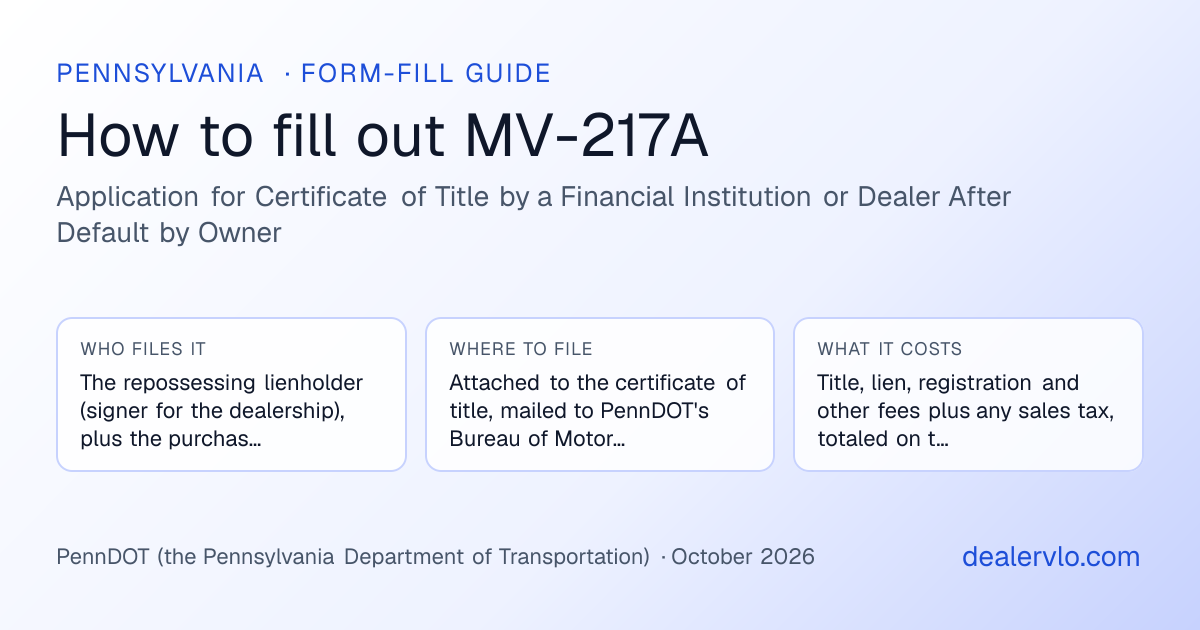
Filling out the PA MV-217A after a sale:
- What it is
- PennDOT's application for a title after default by owner, for financial institutions and dealers licensed by the Department of Banking
- Who completes it
- The repossessing lienholder (signer for the dealership), plus the purchaser in Section E when the vehicle is sold
- Where to file it
- Attached to the certificate of title, mailed to PennDOT's Bureau of Motor Vehicles, P.O. Box 68672, Harrisburg, PA 17106-8672, or through an authorized agent
- Processing time
- PennDOT processes it. The fact sheet says a purchaser named on the back of the title must immediately obtain a title in their name
- Cost
- Title, lien, registration and other fees plus any sales tax, totaled on the form and paid by one check or money order to the Commonwealth of Pennsylvania
This guide is informational and does not replace the official Pennsylvania instructions. Always confirm the current form and procedure with PennDOT (the Pennsylvania Department of Transportation) before you file.
The MV-217A is one car's paperwork. A 20-second read on your lot, and the tax-and-fee math for the whole deal — built for dealers, no signup. Free calculators dealers actually use — no signup, no email.
DealerVLO fills the official Pennsylvania MV-217A straight from your deal: the vehicle owner's name as on the title (buyer and co-buyer) in Section A, and your dealership's legal name, street, city, state and ZIP as the repossessing lienholder in Section C. It prints from the servicing section of a BHPH deal where your dealership carries the note, for when you've taken a car back, not on every deal. The title number, ABA/FIN or DIN number, Section B VIN verification, the Section D name line and option box, the odometer, the Section E purchaser, the fee column, and every signature, printed name, title and date stay blank. $29/month, free to try — cancel any time.
What the MV-217A is and why it matters
MV-217A is PennDOT's title application for a repossessed vehicle, filed by the lienholder after the owner defaults. It's restricted. The form says it "may only be used by Financial Institutions and Vehicle Dealers who are licensed by the Department of Banking," and that your ABA/FIN or DIN number, if applicable, must be listed. If your dealership carries BHPH notes under that license, this is your form. If you're on the title as lienholder but not licensed, the instructions send you to Option 1, Judgment and Execution, on Form MV-217.
This guide covers the paperwork: each section, which option box goes with which documents, and where it's mailed. It doesn't cover when or how you may repossess, or what the notices the checklist mentions must say. The form spells those out on the back; read them there.
The current revision is MV-217A (2-25). PennDOT's fact sheet calls it the "Application by Financial Institutions for Certificate of Title After Default by Owner." When people search for a "PA repossession form," this is the one for licensed lenders and dealers. Its sibling, MV-217, is the version for everyone else. The front has sections A through H; the back has the instructions and the document checklist for each option.
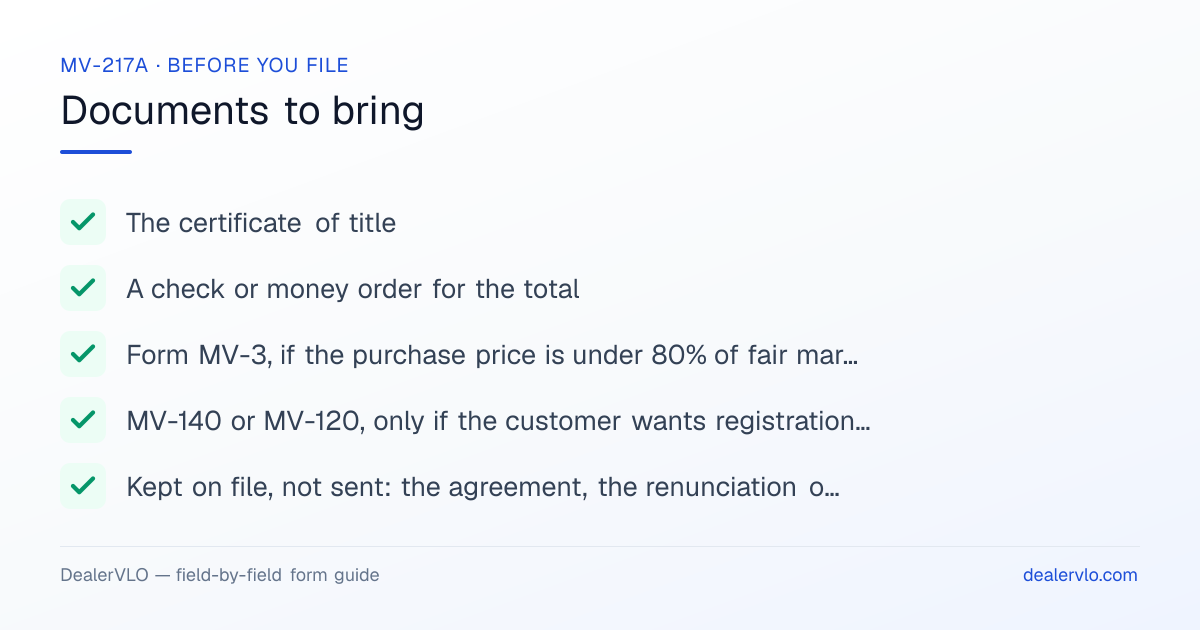
Documents to have before you start
Gather these before you complete the MV-217A. A missing attachment is the number-one reason the PennDOT (the Pennsylvania Department of Transportation) bounces a title application back.
- The certificate of title — "Title Must Be Attached," in every option. The fact sheet says the MV-217A is attached to the title held by the lienholder.
- A check or money order for the total — Payable to the Commonwealth of Pennsylvania, in the total amount listed on the form (fact sheet).
- Form MV-3, if the purchase price is under 80% of fair market value — The instructions say to attach a completed MV-3 explaining why the vehicle is being sold below fair market value.
- MV-140 or MV-120, only if the customer wants registration with the repo title — The fact sheet: MV-140 to request a plate, or MV-120 to transfer one, when the application goes by mail or messenger. MV-120 can't be used to issue a temporary plate with an MV-217A.
- Kept on file, not sent: the agreement, the renunciation or notice, and the bill of sale — The checklist on the back lists items that must be in the repossessor's possession and available on request. Other than the title, they aren't submitted with the application.
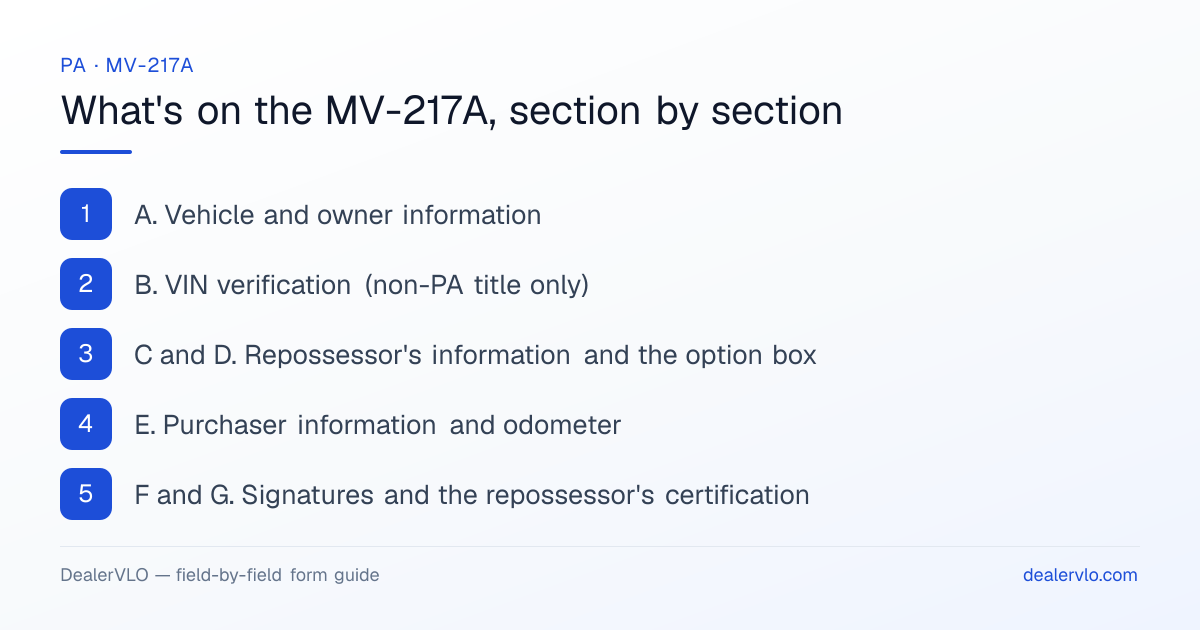
MV-217A, section by section
A. Vehicle and owner information
Enter the name of the vehicle owner exactly as shown on the attached title. On a BHPH deal that's your buyer, plus the co-buyer if they're on the title. Then the title number from the title you're attaching. The form has no separate VIN box here; the vehicle is identified by the attached title.
| Field | Who fills it |
|---|---|
Name of Vehicle Owner as Shown on Attached Title | You (dealer) |
Title Number From the attached title. | You (dealer) |
B. VIN verification (non-PA title only)
Skip this section if the attached title is a Pennsylvania title. If it's an out-of-state title, the form says a tracing of the VIN must be affixed in the space provided. If you can't get a legible tracing, the VIN must be verified by a certified inspection mechanic or an authorized notary public, who prints their name, enters the DIN/Business Partner ID or mechanic number, and signs the certification that the VIN is correct.
| Field | Who fills it |
|---|---|
Tape VIN tracing here | You (dealer) |
DIN/Bus. Partner ID#/Mechanic #, printed name, signature The notary or inspection mechanic completes these. | You (dealer) |
C and D. Repossessor's information and the option box
Section C takes the repossessing lienholder's name "as listed on face of title," with the ABA/FIN or DIN/Business Partner ID number if applicable, and the street address, city, state and ZIP. On a BHPH note that's your dealership. Section D repeats the name and ID number, then you check the option you're proceeding under. 1, Renunciation: the repossessor must take title. 2, Non-Judicial Sale or Repossession and Retention (M.V.S.F.A.). 3, Mobile Home. The fact sheet says the lienholder must take title only under Option 1; under Options 2 and 3, the lienholder may reassign Section A on the back of the title to a dealer or individual.
| Field | Who fills it |
|---|---|
Repossessing Lienholder's Name (as on face of title) | You (dealer) |
ABA/FIN or DIN/Bus. Partner ID# (if applicable) | You (dealer) |
Street Address, City, State, Zip Code | You (dealer) |
Option: 1 Renunciation / 2 Non-Judicial Sale or Repossession and Retention / 3 Mobile Home Check one. | You (dealer) |
E. Purchaser information and odometer
Section E is the purchaser, "Exactly as shown in Section A on reverse side of title." Under Option 1 that's your dealership, since the repossessor takes title. Under Option 2 it's whoever bought the vehicle at the sale, which can be the lienholder. It takes the purchaser's and any co-purchaser's name, PA driver's license/photo ID or business ID number, date of birth, address, county, date acquired, and financial institution or dealer identification number if applicable. The odometer certification is here too: the reading and whether it reflects actual mileage, mileage beyond mechanical limits, or is not the actual mileage. There's also a box for joint tenants with right of survivorship.
| Field | Who fills it |
|---|---|
Purchaser and co-purchaser: name, PA DL/Photo ID or Bus. ID#, date of birth Or your dealership, if it takes title. | Buyer |
Street Address, City, County, State, Zip Code, Date Acquired/Purchased | Buyer |
Odometer reading and mileage boxes Read it off the vehicle. | You (dealer) |
Financial Institution Number / Dealer Identification Number (if applicable) | You (dealer) |
F and G. Signatures and the repossessor's certification
Section F is the application signature. The repossessor or authorized signer signs, with title and date, and the purchaser and co-purchaser sign below. The paragraph warns of a fine up to $5,000 and up to two years' imprisonment for a false statement. Section G is the repossessor's certification that the lienholder "has repossessed the above described motor vehicle or mobile home upon default according to the terms of the security agreement and has complied with all applicable laws and regulations of Pennsylvania." The repossessor or authorized signer signs, dates, prints their name, and gives their title. Neither section has a notary block.
| Field | Who fills it |
|---|---|
F: Signature of Repossessor or Authorized Signer, Title, Date | You (dealer) |
F: Signature of Purchaser / Co-Purchaser, Date | Buyer |
G: Signature, Date, Printed Name, Title of Authorized Signer | You (dealer) |
H. Tax, title and registration fees
The right-hand column is the money. The form says only the purchaser listed in Section E completes these blocks. Purchase price, taxable amount, and sales tax at 6%, 7% for Allegheny County residents, or 8% for City of Philadelphia residents. If a sales tax exemption applies, enter the exemption reason code (a number from 1 to 26, or 0) and number; the form points to the back of Form MV-1 or MV-4ST for the codes. Then the title fee, lien fee, registration or processing fee, county fee, and the other listed fees, added up into one total for one check. PennDOT's fact sheet calls this Section G; on the 2-25 form it's lettered H.
| Field | Who fills it |
|---|---|
Purchase price, Taxable amount, Sales tax The Section E purchaser completes these. | Buyer |
1A Exemption reason code, 1B Exemption number | Buyer |
Title, lien, registration, county and other fees; Total paid | Buyer |
Common MV-217A mistakes that cause rejections
The form is only for financial institutions and dealers licensed by the Department of Banking. Unlicensed lienholders use Option 1 on Form MV-217.
"Title Must Be Attached." The fact sheet says this applies in all cases.
The form says it must be listed, if applicable, with the repossessing lienholder's name.
The checklist items must be in your possession and available on request. Other than the title, they aren't submitted.
The fact sheet says MV-120 can't issue a temporary plate with an MV-217A, because the record isn't in the applicant's name yet. By mail or messenger, use MV-140.
Attach a completed Form MV-3, as the instructions require.
Common questions
What is the Pennsylvania repossession title form?+
For licensed lenders and dealers, it's PennDOT Form MV-217A, Application for Certificate of Title by a Financial Institution or Dealer After Default by Owner. The current revision is MV-217A (2-25). Lienholders who aren't licensed by the Department of Banking use Form MV-217.
Who can use Form MV-217A?+
The form says only financial institutions and vehicle dealers licensed by the Department of Banking. Individuals or businesses not licensed by the Department of Banking that are listed as lienholder on the Pennsylvania title follow Option 1, Judgment and Execution, on Form MV-217.
What's the difference between Option 1 and Option 2 on MV-217A?+
Option 1 is Renunciation, and the repossessor must take title. Option 2 is Non-Judicial Sale or Repossession and Retention (M.V.S.F.A.); title issues in the lienholder's name or in the name of the purchaser at the sale. Each option has its own checklist on the back of the form.
Does MV-217A need to be notarized?+
The form has no notary block for the signatures. A notary only comes in under Section B, to verify the VIN on an out-of-state title when a legible tracing can't be made, and a certified inspection mechanic can do that instead.
Where do I send the MV-217A?+
PennDOT's fact sheet says to mail Forms MV-217 and MV-217A to the Bureau of Motor Vehicles, P.O. Box 68672, Harrisburg, PA 17106-8672, attached to the title, with one check or money order to the Commonwealth of Pennsylvania. Authorized agents also process it, and may charge their own service fee.
Do I send the security agreement with MV-217A?+
No. The instructions say the checklist items must be in the repossessor's possession and available on request, and other than the certificate of title, they don't need to be submitted.
Is there software that fills out the MV-217A automatically?+
Yes. Dealer management software like DealerVLO fills the official Pennsylvania MV-217A from the deal you already entered: the vehicle owner's name as on the title (buyer and co-buyer) in Section A, and your dealership's legal name, street, city, state and ZIP as the repossessing lienholder in Section C. It prints from the servicing section of a BHPH deal where your dealership carries the note, for when you've taken a car back, not on every deal. The title number, ABA/FIN or DIN number, Section B VIN verification, the Section D name line and option box, the odometer, the Section E purchaser, the fee column, and every signature, printed name, title and date stay blank. Signatures stay blank for ink. It's $29/month flat with a 14-day free trial, and the same deal also generates your federal documents (Bill of Sale, FTC Buyers Guide) and your state title paperwork.
- Affidavit of repossession forms by state
- Vehicle lien release form by state
- How to fill out PA Form MV-1
- Pennsylvania used car dealer license
- Pennsylvania dealer plates
- E-signatures and e-titling for Pennsylvania dealers
- Title application forms in every state
- How much is a dealer's license? Cost in every state
Stop filling out the MV-217A by hand.
DealerVLO fills the official PA MV-217A straight from your deal jacket: the vehicle owner's name as on the title (buyer and co-buyer) in Section A, and your dealership's legal name, street, city, state and ZIP as the repossessing lienholder in Section C. It prints from the servicing section of a BHPH deal where your dealership carries the note, for when you've taken a car back, not on every deal. The title number, ABA/FIN or DIN number, Section B VIN verification, the Section D name line and option box, the odometer, the Section E purchaser, the fee column, and every signature, printed name, title and date stay blank. $29/month. 14-day free trial, cancel any time.
Curious how it works? See how DealerVLO auto-fills every dealer document — bill of sale, FTC Buyers Guide, odometer disclosure, and state title & registration forms for all 50 states, from one deal.
Bond amounts, fees, and form rules change. Get a short email when your state does. No spam, unsubscribe anytime.