How to fill out the CS-L(MVR)1 in Hawaii
A field-by-field walkthrough of the Hawaii CS-L(MVR)1 (Application for Registration (City and County of Honolulu)) for licensed used car dealers — what goes in every section, who signs what, and the documents you attach. Verified against the official form as of September 2026.
Filing these every week? DealerVLO fills the CS-L(MVR)1 from the deal you already entered, $29/month flat. See pricing
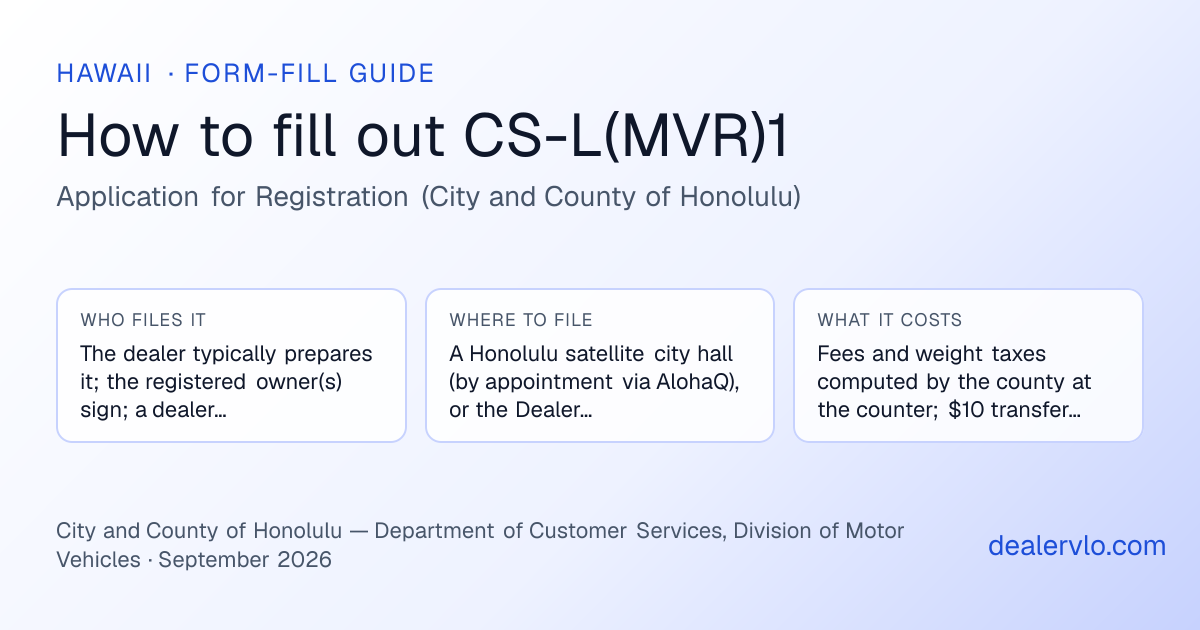
Filling out the HI CS-L(MVR)1 after a sale:
- What it is
- Honolulu's (Oahu's) application to register a vehicle — required for out-of-state and out-of-county transfers and new-vehicle registration
- Who completes it
- The dealer typically prepares it; the registered owner(s) sign; a dealer countersigns only on a new vehicle sold locally
- Where to file it
- A Honolulu satellite city hall (by appointment via AlohaQ), or the Dealer Center for licensed Oahu dealers
- Processing time
- New owner must transfer within 30 days of the seller's transfer date; Dealer Express isn't same-day and doesn't take out-of-state vehicles
- Cost
- Fees and weight taxes computed by the county at the counter; $10 transfer fee on Hawaii-plated vehicles, +$50 penalty after 30 days
This guide is informational and does not replace the official Hawaii instructions. Always confirm the current form and procedure with City and County of Honolulu — Department of Customer Services, Division of Motor Vehicles before you file.
See the HI CS-L(MVR)1 filled — from just a VIN
Enter a VIN, the buyer's name, and the price. We decode the vehicle and drop it onto the actual Hawaii CS-L(MVR)1 — the same fill DealerVLO produces from a deal. Watermarked preview; nothing is saved.
What the CS-L(MVR)1 is and why it matters
CS-L(MVR)1 is the City and County of Honolulu's Application for Registration — the one-page form that gets a vehicle registered on Oahu. For a dealer, it comes up in three cases: a unit bought off another state's title, a unit last registered on Kauai, Maui, or the Big Island, and a new vehicle's first registration. It's filed at a satellite city hall or, for licensed Oahu dealers, through the Dealer Center (Dealer Drop or Dealer Express).
The quirk that trips up mainland dealers is tax. Hawaii has no sales tax charged to the buyer. What it has is the General Excise Tax, a tax on the dealer's gross receipts (4% state plus a 0.5% Oahu surcharge), which you may pass on visibly but aren't required to. None of it goes on this form. What you do have to get right is the vehicle data the county bases its weight tax and fees on (weight, GVW, body type, and the Passenger / Non-Commercial / Property Carrying box), plus proof of Hawaii use tax on a recent-model car bought on the mainland. The county computes the registration fees and taxes at the counter.
This is a Honolulu (Oahu) form. Hawaii has no statewide DMV: each county's director of finance registers vehicles, and the City and County of Honolulu's Department of Customer Services, Division of Motor Vehicles runs Oahu. Hawaii County (Big Island), Maui County, and Kauai County each have their own motor vehicle offices, forms, and procedures, so if the vehicle will be registered on another island, use that county's paperwork. On Oahu, CS-L(MVR)1 isn't needed for every sale. A straight Oahu-to-Oahu transfer runs on the endorsed Hawaii title. The application is required when the vehicle comes in from another county or another state, and it's also used to register a new vehicle, which is why the form has a dealer countersignature line for new cars sold locally.
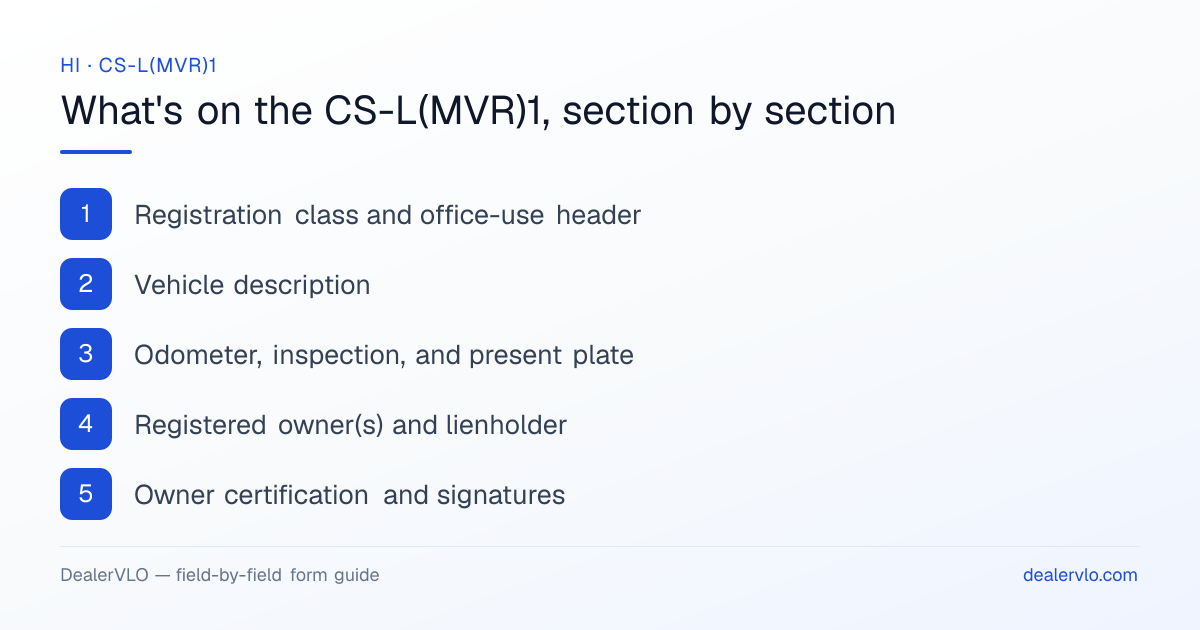
Documents to have before you start
Gather these before you complete the CS-L(MVR)1. A missing attachment is the number-one reason the City and County of Honolulu — Department of Customer Services, Division of Motor Vehicles bounces a title application back.
- Certificate of Title, properly endorsed — Signed by the seller(s), buyer(s), and any lienholder. If a lien isn't released on the title, bring a lien-satisfaction letter or the original contract stamped PAID IN FULL. A title not released by the recorded owner needs a notarized bill of sale.
- Last-issued Certificate of Registration — From the other state or county, where one exists.
- Current Hawaii Safety Inspection Certificate — Required to register on Oahu. Its expiration date also goes on the form.
- Bill of lading or shipping receipt (out-of-state vehicles) — Showing the date the vehicle arrived on Oahu, unless it holds a valid Honolulu out-of-state permit.
- Proof of Hawaii use tax (mainland purchases) — For a current, previous, or next model-year vehicle bought out of state, the county won't issue registration without proof the use tax was paid. The Department of Taxation's Form G-27 certifies that the use tax was paid or that no use tax is due (an exemption).
- Military certificate, if applicable — Active-duty service members may also submit a Non-Resident (CS-L(MVR)50) or Resident (CS-L(MVR)50A) Certificate from their unit.
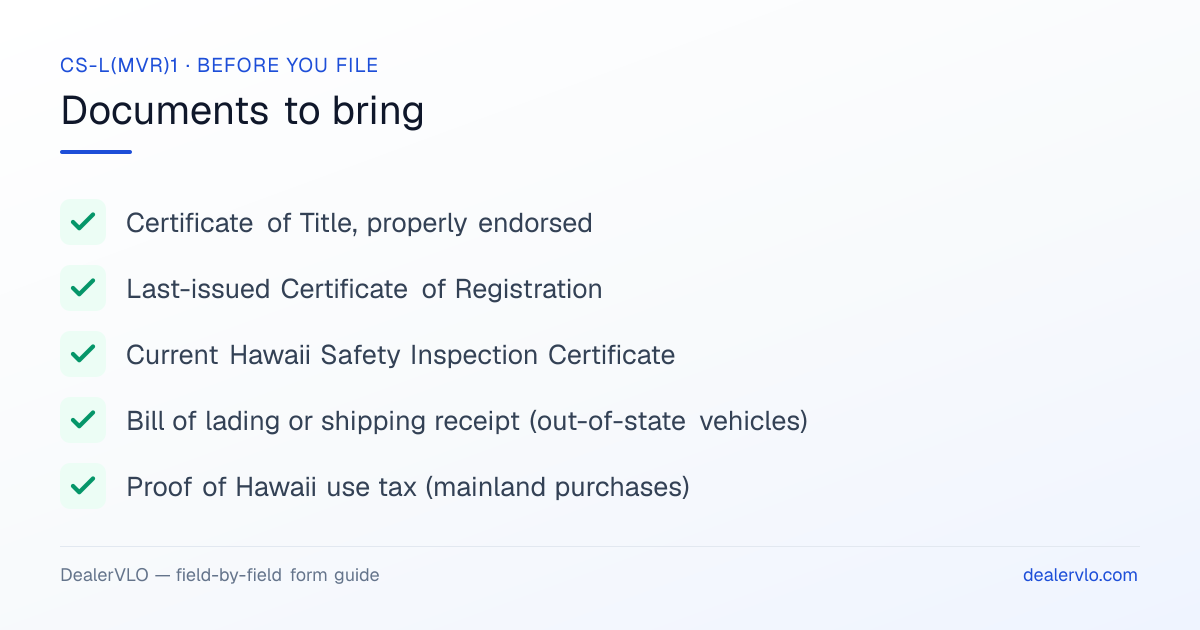
CS-L(MVR)1, section by section
Registration class and office-use header
Across the top: Registration Date, License Plate #, Emblem #, and Registration Expires are filled in by the county. The part you complete is the class: check Passenger, Non-Commercial, or Property Carrying. Non-Commercial matters for pickups and light trucks. The certification at the bottom says that a property-carrying vehicle of 6,500 lbs or less, checked Non-Commercial and not used for compensation, gets the passenger-vehicle weight-tax rate (HRS §249-13).
| Field | Who fills it |
|---|---|
Registration Date, License Plate #, Emblem #, Registration Expires | At the counter |
Passenger / Non-Commercial / Property Carrying Non-Commercial only if the buyer confirms the truck isn't used for compensation. | You (dealer) |
Vehicle description
The data the county uses to identify the vehicle and set its weight-based taxes. Type or print in ink. The VIN must match the title. Enter the empty weight and GVW in pounds. If the manufacturer's weight isn't available, the county may send the vehicle to a state-certified scale. Date Sold New is the date the vehicle was first sold new. The two HVUC boxes are for heavy trucks (8,000 lbs or more with the listed body types, and 20,000 lbs or more).
| Field | Who fills it |
|---|---|
Transmission: Automatic / Manual | You (dealer) |
Make, Body Type, Air Condition | You (dealer) |
Motive Power: Gas / Diesel / Butane / Propane / Electric / Hybrid / Plug-in Hybrid | You (dealer) |
Vehicle I.D. No. Must match the title. | You (dealer) |
Weight (lbs), GVW (lbs), Year Model Drives the weight tax — use manufacturer figures. | You (dealer) |
Date Sold New | You (dealer) |
Color top or front; color bottom or rear | You (dealer) |
HVUC 8,000 lbs or more / 20,000 lbs or more Heavy trucks only. | You (dealer) |
Odometer, inspection, and present plate
Enter the odometer reading with no tenths. If it isn't the true mileage, check a discrepancy warning: 1 (the reading is past the odometer's mechanical limits, i.e., it rolled over) or 2 (the reading is not the actual mileage). Enter the safety inspection's expiration date, the plate currently on the vehicle, and the county or state that issued it. The ACCEPTED, HOLD FOR, B/L, and permit boxes below are for the county's use.
| Field | Who fills it |
|---|---|
Odometer Reading (no tenths) Must agree with the title's odometer disclosure. | You (dealer) |
Odometer discrepancy warning 1 or 2 Only if the reading isn't actual mileage. | You (dealer) |
Vehicle Inspection Expires From the current Hawaii safety inspection certificate. | You (dealer) |
Present Lic. Plate No.; County or State | You (dealer) |
Accepted / Hold For / B/L / Permit No. | At the counter |
Registered owner(s) and lienholder
The buyer's name (last, first, middle initial), with a second line for a joint owner, then the mailing address. Below that, the lienholder's name and mailing address. If there's no loan, write NONE. Don't leave it blank.
| Field | Who fills it |
|---|---|
Registered owner name(s): last, first, M.I. Joint owners must both sign. | Buyer |
Mailing address (street or P.O. box, city, state, ZIP) | Buyer |
Lienholder name and mailing address — or NONE Write NONE on a cash deal. | You (dealer) |
Owner certification and signatures
The registered owner(s) sign, certifying they own the vehicle to the extent shown and that the statements are true, including the non-commercial weight-tax certification if that box was checked. If a business is the owner, print the authorized person's name and title. Active-duty military buyers enter their branch of service and station.
| Field | Who fills it |
|---|---|
Signature(s) of registered owner(s), or firm's authorized person | Buyer |
If firm: printed name and title of authorized person | Buyer |
Branch of Service, Station (U.S. military only) | Buyer |
Dealer countersignature (new vehicles sold locally)
The bottom-right block is only for a vehicle purchased new locally. The dealer enters its name and an authorized signature certifying the application is true and correct. On a used-vehicle sale, leave it blank. Your part of a used deal is the endorsed title and a complete package.
| Field | Who fills it |
|---|---|
Name of Dealer, By, Authorized Signature New vehicles purchased locally only. | You (dealer) |
Fees column (office use only)
The right-hand column (County Tax, State Tax, Registration, Beautification, Plate/Emblem, County Fee, Alternative Fuel Fee, penalties, Transfer Fee, and $ Total) is filled in by the county, which calculates the weight taxes and fees when the package is presented. Leave it blank. Honolulu raised its Highway Beautification Fee from $7 to $10 effective June 1, 2026. The Dealer Center takes no cash; Dealer Express takes check, cashier's check, or money order.
| Field | Who fills it |
|---|---|
County Tax, State Tax, Registration, Beautification, Plate/Emblem | At the counter |
County Fee, Alternative Fuel Fee, Penalty, Transfer Fee, Total | At the counter |
The CS-L(MVR)1 is one car's paperwork. A 20-second read on your lot, and the tax-and-fee math for the whole deal — built for dealers, no signup. Free calculators dealers actually use — no signup, no email.
DealerVLO fills the official Hawaii CS-L(MVR)1 straight from your deal — VIN-decoded vehicle, buyer, co-buyer, and sale price already in place. $29/month, free to try — cancel any time.
Common CS-L(MVR)1 mistakes that cause rejections
Hawaii has no sales tax charged to the buyer. The General Excise Tax is a tax on your business's gross receipts: 4% state plus the 0.5% Oahu surcharge. You may pass it on visibly (up to a 4.712% effective rate on Oahu) but you aren't required to, and you report it on your GET return, not on CS-L(MVR)1.
For a current, previous, or next model-year vehicle bought out of state and brought into Hawaii, the county won't issue a registration without proof the Hawaii use tax was paid. If an exemption applies, the buyer certifies it on Department of Taxation Form G-27. Settle this before the appointment.
The new owner has 30 calendar days from the seller's transfer date to forward the endorsed title (60 days if the recorded lienholder has no office in Hawaii). After that, Honolulu adds a $50 penalty to the $10 transfer fee. Build the package, including the safety inspection and bill of lading, before the clock gets short.
The weight, GVW, and Passenger / Non-Commercial / Property Carrying box drive the weight tax. Checking Non-Commercial on a work truck that's used for compensation is a false certification; leaving it unchecked on a personal pickup costs the buyer the passenger rate. Ask, and use manufacturer weights.
CS-L(MVR)1 is the City and County of Honolulu's form. A vehicle that will be registered on the Big Island, Maui, Molokai, Lanai, or Kauai goes through that county's motor vehicle office and its own forms and fees.
Common questions
What is form CS-L(MVR)1?+
CS-L(MVR)1 is the City and County of Honolulu's Application for Registration, issued by the Department of Customer Services, Division of Motor Vehicles. Oahu requires it to register a vehicle coming from another state or another Hawaii county, and it's also used for new-vehicle registration. The current version is marked SN 2024-08.
Is CS-L(MVR)1 used on every island?+
No. Vehicle registration in Hawaii is run by each county. CS-L(MVR)1 is the City and County of Honolulu (Oahu) form. Hawaii County, Maui County, and Kauai County have their own motor vehicle offices and procedures.
Do I need CS-L(MVR)1 to transfer a car on Oahu?+
Not for a vehicle already registered on Oahu. That transfer uses the properly endorsed Hawaii title, the last registration, and a current safety inspection. Honolulu requires CS-L(MVR)1 when the vehicle was last registered in another county or has an out-of-state title.
Does Hawaii charge sales tax on a car?+
Hawaii has no sales tax charged to the buyer. Dealers owe the General Excise Tax on gross receipts: 4% state plus a 0.5% county surcharge on Oahu, Kauai, Hawaii County, and Maui. A dealer may visibly pass it on, up to a 4.712% maximum pass-on rate in those counties, but isn't required to. A vehicle bought out of state may owe Hawaii use tax when registered.
How long do you have to transfer a vehicle in Honolulu?+
The new owner must complete the transfer within 30 days of the seller's date of transfer on the title. Honolulu's transfer fee is $10, and a $50 penalty is added after 30 days. State law allows 60 days if the recorded lienholder has no office in Hawaii.
How much does it cost to register a car on Oahu?+
It depends on the vehicle. The county calculates state and county weight taxes, the registration fee, the beautification fee, and plate fees from the vehicle's weight and class when you present the documents. There's no single flat amount to put on the form. A Hawaii-plated vehicle also pays the $10 transfer fee, plus a $50 penalty if the transfer is late.
How do Oahu dealers file registrations?+
Licensed Oahu automobile dealers use the Dealer Center at Kapalama Hale: Dealer Drop, or Dealer Express by AlohaQ appointment. Dealer Express accepts all registration types except out-of-state or foreign vehicles and tow, mechanic, or storage liens. It isn't same-day, and payment is by check, cashier's check, or money order.
Is there software that fills out the CS-L(MVR)1 automatically?+
Yes. Dealer management software like DealerVLO fills the Hawaii CS-L(MVR)1 from the deal you already entered — the VIN-decoded vehicle, buyer, co-buyer, lienholder, and sale price are placed for you instead of hand-writing them. For most states that's the official DMV form itself; where a state issues its form only through its own dealer portal, you get a print-ready worksheet with every value already in place. It's $29/month flat with a 14-day free trial, and the same deal also generates your federal documents (Bill of Sale, FTC Buyers Guide, odometer disclosure) and any other state's title forms.
Stop filling out the CS-L(MVR)1 by hand.
DealerVLO fills the official HI CS-L(MVR)1 straight from your deal jacket — VIN-decoded vehicle, buyer, co-buyer, lienholder, and sale price already in place. Print, sign, and file in about 90 seconds. $29/month. 14-day free trial, cancel any time.
Curious how it works? See how DealerVLO auto-fills every dealer document — bill of sale, FTC Buyers Guide, odometer disclosure, and state title & registration forms for all 50 states, from one deal.
Bond amounts, fees, and form rules change. Get a short email when your state does. No spam, unsubscribe anytime.