How to fill out the Form 735-226 in Oregon
A field-by-field walkthrough of the Oregon Form 735-226 (Application for Title and Registration) for licensed used car dealers — what goes in every section, who signs what, and the documents you attach. Verified against the official form as of September 2026.
Filing these every week? DealerVLO fills the Form 735-226 from the deal you already entered, $29/month flat. See pricing
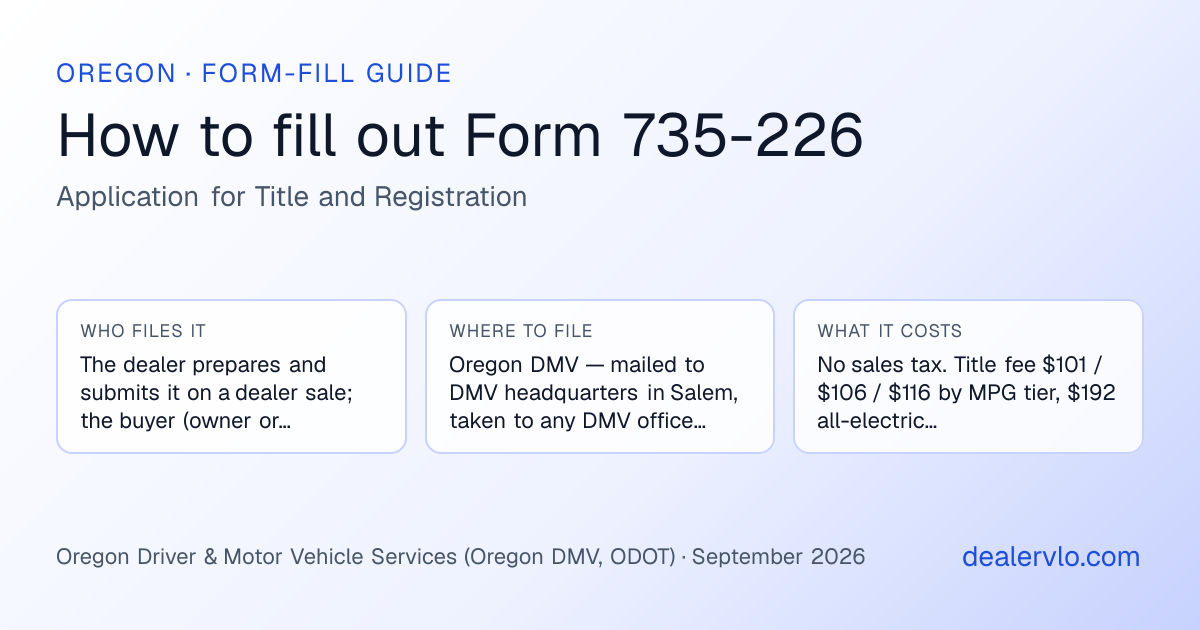
Filling out the OR Form 735-226 after a sale:
- What it is
- Oregon's combined application for title and registration (Form 735-226, also called Form 226)
- Who completes it
- The dealer prepares and submits it on a dealer sale; the buyer (owner or lessee) signs Line 20
- Where to file it
- Oregon DMV — mailed to DMV headquarters in Salem, taken to any DMV office, or filed electronically through an EVR integrator
- Processing time
- Dealer must submit within 30 calendar days of the sale; a late title fee applies after day 30
- Cost
- No sales tax. Title fee $101 / $106 / $116 by MPG tier, $192 all-electric; plus registration; late fee $25 (days 31–60) or $50 (after 60)
This guide is informational and does not replace the official Oregon instructions. Always confirm the current form and procedure with Oregon Driver & Motor Vehicle Services (Oregon DMV, ODOT) before you file.
See the OR Form 735-226 filled — from just a VIN
Enter a VIN, the buyer's name, and the price. We decode the vehicle and drop it onto the actual Oregon Form 735-226 — the same fill DealerVLO produces from a deal. Watermarked preview; nothing is saved.
What the Form 735-226 is and why it matters
Form 735-226 is Oregon's Application for Title and Registration — one form that titles the vehicle in the buyer's name and registers it. On a dealer sale the dealer fills it out from the deal, the buyer signs it, and the dealer submits it with the assigned title to Oregon DMV. It's laid out in numbered lines (1 through 21), which makes it easy to walk top to bottom.
The thing that trips up dealers coming from other states: there's no sales tax line, because Oregon has no sales tax. What drives the money instead is the vehicle's MPG rating — Oregon's title and registration fees for passenger vehicles are tiered by MPG, with a separate, higher tier for all-electric vehicles. Oregon's 0.5% vehicle privilege tax exists, but it only reaches vehicles with 7,500 miles or less that have never been titled or registered in Oregon, so most used retail sales don't owe it — and it's reported to the Department of Revenue, not on this form. This guide walks the current (4-26) revision line by line.
Oregon DMV often calls it simply "Form 226" or the Title Application — it's the same form, 735-226. On a dealer sale the dealer normally prepares and submits it for the buyer: Oregon law gives a dealer 30 calendar days from the sale to submit the title application on the buyer's behalf (ORS 822.042), and DMV adds a late title fee to applications that come in after day 30. Dealers can file on paper or electronically through an Electronic Vehicle Registration (EVR) integrator.
Documents to have before you start
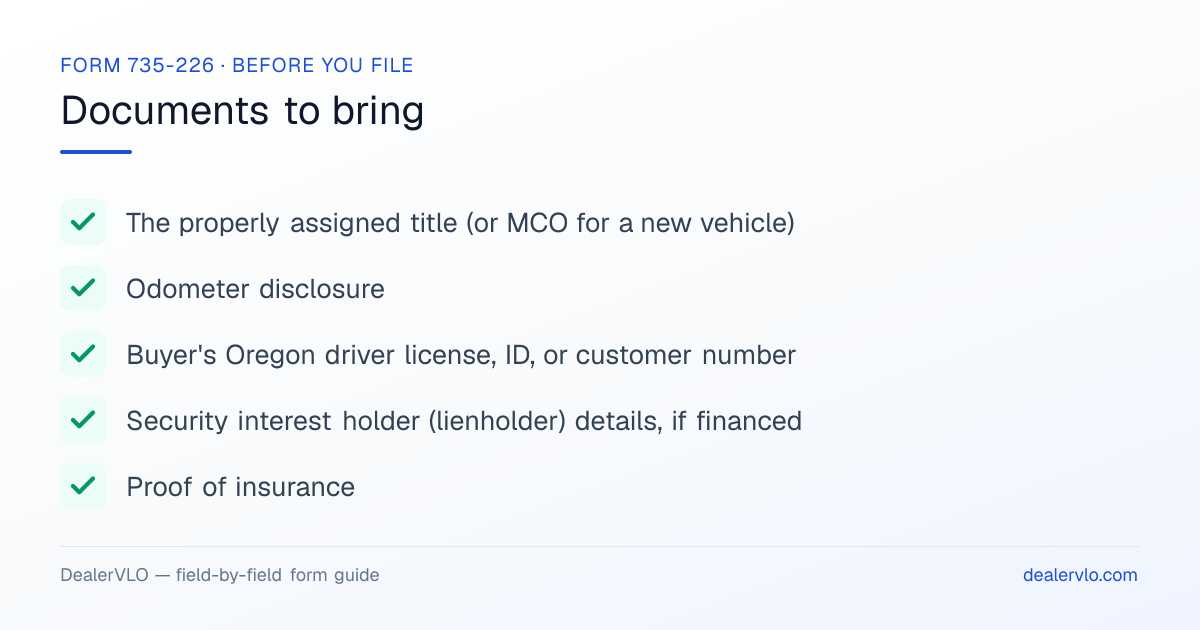
Gather these before you complete the Form 735-226. A missing attachment is the number-one reason the Oregon Driver & Motor Vehicle Services (Oregon DMV, ODOT) bounces a title application back.
- The properly assigned title (or MCO for a new vehicle) — Signed over to the buyer. If the vehicle is coming off an out-of-state title, DMV requires a VIN inspection ($9, can be done at a DMV office).
- Odometer disclosure — Required for model year 2011 and newer until the vehicle is 20 years old. Oregon uses secure odometer forms that can't be downloaded; Line 4 of the 735-226 is a fallback certification only when the seller's disclosure isn't available.
- Buyer's Oregon driver license, ID, or customer number — DMV links records by customer number; if the buyer doesn't have one, DMV assigns one.
- Security interest holder (lienholder) details, if financed — Name, address and customer number for Line 13–14, so the lien is recorded on the title.
- Proof of insurance — The buyer certifies financial responsibility on the form and lists the insurance company and policy number on Line 19.
- Title and registration fees — Title fee by MPG tier, registration fee, any plate fee, and any county registration fee that applies to the buyer's county.
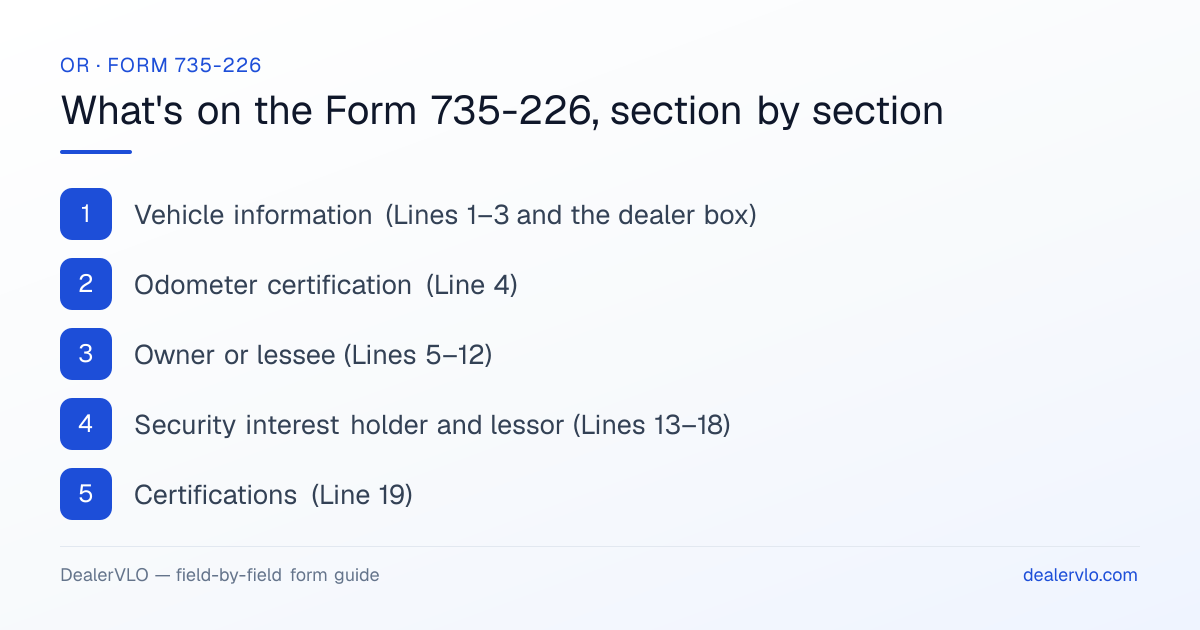
Form 735-226, section by section
Vehicle information (Lines 1–3 and the dealer box)
The top of the form identifies the vehicle and the selling dealer. The DMV Use Only box at the top right (title fee, VIN fee, late title fee, registration fee, county fee, total) is DMV's — leave it alone. Enter your dealer number in the Dealer # box. The MPG box matters more in Oregon than anywhere else: DMV bases the title and registration fee tier on the vehicle's combined MPG rating (you can confirm it at fueleconomy.gov), and all-electric vehicles sit in their own tier. Line 1 is the VIN, the Oregon title number if the vehicle already has one, and GVWR; Line 2 is any present Oregon plate, year, make, style and registration weight/length; Line 3 covers farm/fleet/equipment numbers and the fuel type.
| Field | Who fills it |
|---|---|
Dealer # Your Oregon dealer number. | You (dealer) |
MPG Combined MPG rating — sets the title and registration fee tier. | You (dealer) |
VIN (Line 1) Must match the title and the VIN plate. | You (dealer) |
Oregon title # (Line 1) If the vehicle is currently Oregon-titled. | You (dealer) |
GVWR (Line 1) | You (dealer) |
Present Oregon plate #, year, make, style (Line 2) Plate transfer and replacement boxes are here too. | You (dealer) |
Reg weight/length (Line 2) | You (dealer) |
Fuel type (Line 3) Gas, diesel, hybrid, plug-in hybrid, flex-fuel, electric, propane, natural gas, or other. | You (dealer) |
DMV Use Only fee box / VIN inspection | At the counter |
Odometer certification (Line 4)
Federal and Oregon law require a mileage statement on transfer for model year 2011 and newer until the vehicle is 20 years old. Line 4 is not the normal place for that disclosure — the seller's disclosure goes on the title or Oregon's secure odometer form. Use Line 4 only when a disclosure is required but you can't get a proper one from the seller. Enter the reading (no tenths) and the date of reading, and mark a box only if the mileage has rolled over or isn't actual. The form notes that a false odometer statement is a Class C felony under ORS 815.430.
| Field | Who fills it |
|---|---|
Odometer reading (no tenths) | You (dealer) |
Date of reading | You (dealer) |
Exceeds mechanical limits / not actual mileage Mark only if one of these is true. | You (dealer) |
Owner or lessee (Lines 5–12)
Line 5 is the owner whose address DMV will use for all mail about the vehicle — print the full legal name (last, first, middle), check Owner or Lessee, and add the Oregon driver license/ID/customer number and date of birth. The residence address on Lines 6–7 updates the buyer's driver license record, and a separate mailing address can go beside it. Additional owners go on Lines 8 and 9 (the order doesn't set ownership priority). Lines 10–11 hold an optional one-time mailing address and a vehicle address if the vehicle is kept somewhere other than the residence. Line 12 is the survivorship election for joint owners.
| Field | Who fills it |
|---|---|
Full legal name; Owner or Lessee (Line 5) | Buyer |
ODL / ID / customer #, date of birth (Line 5) | Buyer |
Residence/business address, city, state, ZIP, county (Lines 6–7) Used to update the buyer's ODL/ID card. | Buyer |
Mailing address and county (Lines 6–7) Only if different from residence. | Buyer |
Joint owner or lessee (Lines 8–9) | Buyer |
One-time mailing address / vehicle address (Lines 10–11) Optional. | Buyer |
Survivorship yes/no (Line 12) | Buyer |
Security interest holder and lessor (Lines 13–18)
If the buyer financed, the lender goes on Line 13 (name, customer number) and Line 14 (address and phone) so the security interest is recorded on the Oregon title. A second lender goes on Lines 15–16. Lines 17–18 are for a lessor, and only when the lessee is shown as owner on Line 5.
| Field | Who fills it |
|---|---|
Security interest holder name + customer # (Line 13) | You (dealer) |
Security interest holder address + phone (Line 14) | You (dealer) |
Secondary interest holder (Lines 15–16) | You (dealer) |
Lessor (Lines 17–18) Leases only, when the lessee is on Line 5. | You (dealer) |
Certifications (Line 19)
By signing, the applicant certifies everything on the form is true — a knowingly false statement on a title or registration application is a Class A misdemeanor in Oregon. The insurance certification covers financial responsibility; the buyer lists the insurance company (not the agent) and policy number on Line 19. The domicile certification confirms the buyer lives in Oregon or is otherwise eligible to register there. The replacement-title box is for a lost or destroyed Oregon title and doesn't apply to a normal retail sale.
| Field | Who fills it |
|---|---|
Insurance company + policy # (Line 19) The insurer, not the agent. | Buyer |
Domicile / residency certification | Buyer |
Replacement Oregon title box Only if the Oregon title is lost, destroyed or mutilated. | Buyer |
Signatures (Lines 20–21)
The owner or lessee shown above signs and dates Line 20 and adds a phone number. Line 21 is the lessor's signature, required only on a lease where the security interest holder is different from the lessor. The back of the form holds additional certifications (assembled/reconstructed/replica vehicles, commercial, RV, special-use) and the specialty-plate choice — skip them unless they apply.
| Field | Who fills it |
|---|---|
Owner or lessee signature, date, phone (Line 20) | Buyer |
Lessor signature (Line 21) Leases only. | You (dealer) |
The Form 735-226 is one car's paperwork. A 20-second read on your lot, and the tax-and-fee math for the whole deal — built for dealers, no signup. Free calculators dealers actually use — no signup, no email.
DealerVLO fills the official Oregon Form 735-226 straight from your deal — VIN-decoded vehicle, buyer, co-buyer, and sale price already in place. $29/month, free to try — cancel any time.
Common Form 735-226 mistakes that cause rejections
Oregon has no sales tax on vehicles, and the 735-226 has no tax section. Don't carry another state's tax habit onto an Oregon deal. The 0.5% vehicle privilege tax only applies to vehicles with 7,500 miles or less that have never been titled or registered in Oregon, and dealers report it to the Department of Revenue quarterly — not on this form.
Oregon's title and registration fees are tiered by combined MPG, and all-electric vehicles have their own higher tier. A wrong MPG entry means the wrong fee. Check the rating for the exact VIN (fueleconomy.gov) and mark the correct fuel type on Line 3.
Oregon gives the dealer 30 calendar days from the sale to submit the title application for the buyer. DMV then adds a late title fee — $25 from day 31 through day 60, $50 after that. If you can't file in time, Oregon law requires a notice of delay to the buyer and any lender within 25 business days.
Line 4 is a fallback for when a disclosure is required but the seller's isn't available. The normal disclosure belongs on the title assignment or Oregon's secure odometer form, which can't be downloaded — DMV doesn't supply them to dealers directly, so buy a supply from one of DMV's authorized Secure Form Agents (dealer associations).
DMV sends all mail about the vehicle to the owner on Line 5, and that residence address updates the buyer's driver license record. Put the primary buyer on Line 5 and co-owners on Lines 8–9, and use the one-time mailing address (Line 10) if the title should go somewhere else just this once.
Common questions
What form do I use to title a vehicle in Oregon?+
Oregon Form 735-226, the Application for Title and Registration (often just called Form 226), issued by Oregon DMV. On a dealer sale the dealer prepares it, the buyer signs it, and the dealer submits it with the assigned title.
Is there sales tax on a car in Oregon?+
No. Oregon has no sales tax, so a used-car buyer pays no sales tax on the purchase price. Oregon does have a 0.5% vehicle privilege tax, but it applies only to vehicles with 7,500 miles or less that have never been titled or registered in Oregon — so most used vehicles don't owe it.
Does Oregon's vehicle privilege tax apply to used cars?+
Usually not. The tax is one-half of 1% of the retail price of a taxable vehicle, and a vehicle is only taxable if, among other things, it has 7,500 miles or less and has never been registered or titled in Oregon (dealer demonstrators excepted). A low-mileage used vehicle that meets every condition can be taxable. The dealer pays it to the Oregon Department of Revenue and may collect it from the buyer; a trade-in does not reduce the taxable price.
How much is the Oregon title fee?+
For passenger vehicles and trucks up to 26,000 lbs GVWR, Oregon's title fee is tiered by MPG: $101 for 0–19 MPG, $106 for 20–39 MPG, $116 for 40+ MPG, and $192 for all-electric vehicles. Registration is a separate fee, also tiered by MPG. Confirm current amounts on Oregon DMV's fee page.
How long does an Oregon dealer have to submit the title application?+
30 calendar days from the sale (ORS 822.042). If the application reaches DMV after 30 days, a late title fee applies: $25 from day 31 through day 60, and $50 after that. DMV's fee schedule lists the late fee for transfers of Oregon-titled vehicles — confirm with DMV how it applies to an out-of-state title.
How much can an Oregon dealer charge for a doc fee?+
Oregon caps the document processing fee at $250 if the dealer uses an EVR integrator and $200 if it doesn't (ORS 822.043). Since Oregon has no sales tax, the doc fee isn't taxed; it's also excluded from the retail price for the vehicle privilege tax.
Does Oregon require a VIN inspection?+
Yes, when the vehicle has an out-of-state or foreign title. The VIN inspection fee is $9 and it can be done at a DMV office during the title appointment.
Is there software that fills out the Form 735-226 automatically?+
Yes. Dealer management software like DealerVLO fills the Oregon Form 735-226 from the deal you already entered — the VIN-decoded vehicle, buyer, co-buyer, lienholder, and sale price are placed for you instead of hand-writing them. For most states that's the official DMV form itself; where a state issues its form only through its own dealer portal, you get a print-ready worksheet with every value already in place. It's $29/month flat with a 14-day free trial, and the same deal also generates your federal documents (Bill of Sale, FTC Buyers Guide, odometer disclosure) and any other state's title forms.
Stop filling out the Form 735-226 by hand.
DealerVLO fills the official OR Form 735-226 straight from your deal jacket — VIN-decoded vehicle, buyer, co-buyer, lienholder, and sale price already in place. Print, sign, and file in about 90 seconds. $29/month. 14-day free trial, cancel any time.
Curious how it works? See how DealerVLO auto-fills every dealer document — bill of sale, FTC Buyers Guide, odometer disclosure, and state title & registration forms for all 50 states, from one deal.
Bond amounts, fees, and form rules change. Get a short email when your state does. No spam, unsubscribe anytime.