Toyota VIN Decoder for Dealers: What the VIN Tells You (and What It Doesn't) Before You Bid
A Toyota VIN decoder workflow for dealers: verify year, make, and recall status on a trade-in or auction unit before you bid.
Part of the Inventory, pricing & aging guide: Inventory Turn Rate for Used Car Dealers: Benchmarks, Formula & How to Improve
Switching from another DMS? Compare DealerVLO to DealerCenter, Frazer, or Lot Wizard, or see what DealerVLO's car dealer management software includes.
Type "toyota vin decoder" into a search bar and you'll get a dozen sites promising instant trim, engine, and build-sheet details from 17 characters. Some are decent. A lot of them guess, fill gaps with marketing copy, or quietly disagree with each other on where Toyota even puts the engine code in the string. If you're deciding whether to bid on a Camry at the lane or what a trade-in's actual trim is worth, that's not good enough.
The reliable starting point is free and it's not a Toyota-specific tool at all — it's NHTSA's own VIN decoder, built from manufacturer-reported data, and it's what every legitimate Toyota decoder is ultimately pulling from anyway. This post walks through how to actually use it on a Toyota before you commit money, where it falls short, and what to check beyond the VIN before you bid or buy.
14-day free trial, then $29/mo · Cancel anytime
Why "decode the Toyota VIN" isn't one simple lookup
A VIN is a federally standardized 17-character string. The first section identifies the manufacturer and region, a middle block describes the vehicle, one position is a federally standardized check digit used to catch typos or altered VINs, and the rest covers model year, plant, and serial number. That structure is consistent across manufacturers, which is why NHTSA can decode any of them from one database (NHTSA VIN decoder).
What's not consistent is exactly which characters Toyota uses to encode trim, engine, and factory options for a given model and model year — that mapping has shifted across Toyota's own lineup over the decades, and every generic "Toyota VIN position chart" floating around the web seems to disagree with the next one on where engine or trim detail actually sits. That's a strong signal none of them should be trusted as a memorized cheat sheet. The safer move is to run the actual VIN through a decoder that pulls live from manufacturer-reported data rather than trusting a static chart, which is exactly what NHTSA's vPIC platform and tools built on it (including DealerVLO's free VIN decoder) are built to do.
One caveat worth knowing before you decode anything: NHTSA's vPIC data is built for model years 1981 and forward, following the VIN specifications manufacturers report under the federal 17-character standard (vPIC). If you're looking at an older Toyota or something with a non-U.S.-spec import VIN, expect lower-confidence or incomplete results — that's a NHTSA data limitation, not a bug in whatever tool you're using.
Step 1: Pull the VIN straight off the car, not off the paperwork
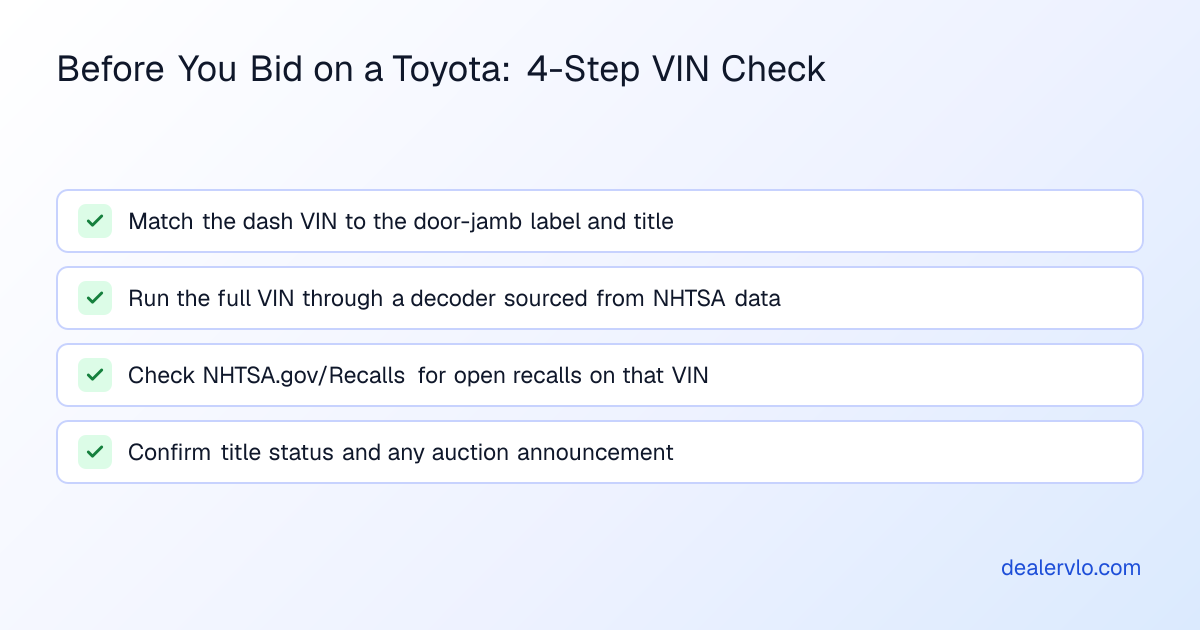
Before you decode anything, confirm the VIN you're about to run actually matches the car in front of you. The VIN is in the lower-left corner of the windshield and on the label inside the driver's door jamb, and it's printed on the registration (NHTSA). Check that all of them match each other and the title. On a trade-in, that's a 30-second check. At an auction, it's the single cheapest insurance you have against a swapped or reassigned VIN plate — verifying a VIN before you bid is worth reading in full if you buy at auction regularly.
If you're working off an auction run list before you've physically seen the car, NHTSA's decoder accepts partial VINs too, and it has an optional model year box: if you fill it in, the decoder uses your year instead of the one in the VIN (NHTSA vPIC decoder). That's useful for a first pass on a catalog listing, but treat it as a preview, not a final answer — confirm the full 17 characters once you're at the car.
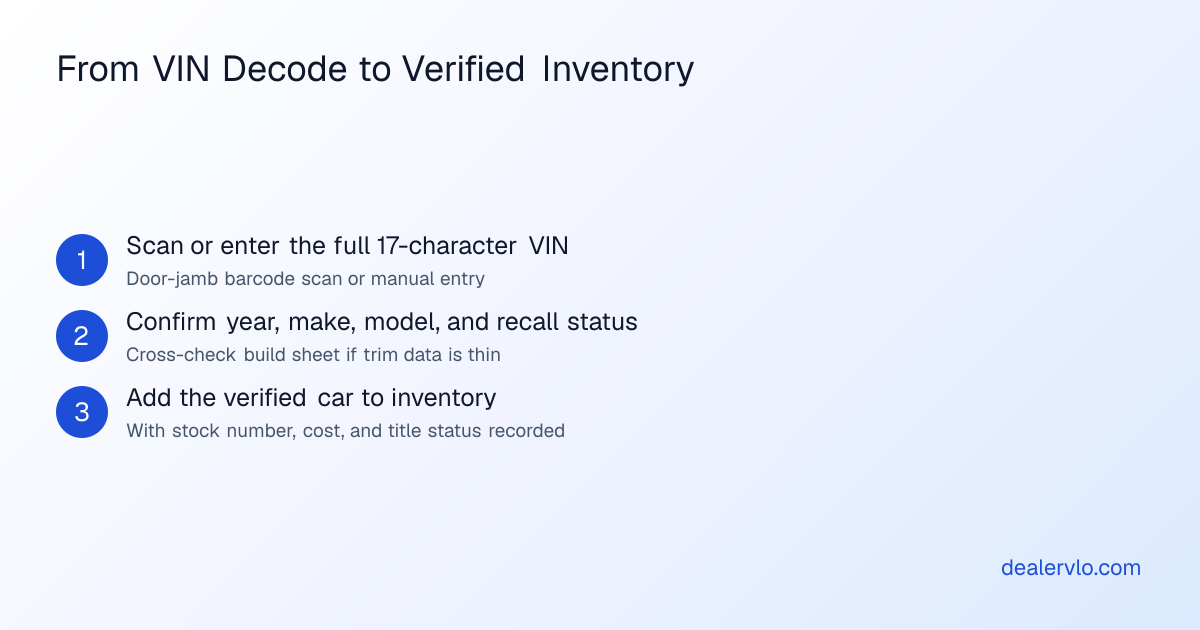
On a trade-in, this is also where Scan VIN earns its keep. DealerVLO's Add Vehicle screen reads the barcode on the door-jamb label with a phone or computer camera and runs the decode — no app to install, and no risk of a typo turning into a mismatched VIN on the title paperwork later.
Step 2: Decode it and read past the headline fields
Once you've got a confirmed, full VIN, running it through NHTSA's decoder (or a tool pulling the same data, like DealerVLO's VIN decoder) gets you year, make, and model straight from manufacturer-reported data. Don't stop at the first screen — click through to the build-plant field, which NHTSA's tool lists explicitly at the bottom of the result (NHTSA). It's one more field to match against the door-jamb label.
If a field looks obviously wrong — say the year or model doesn't match the car sitting on your lot — NHTSA's advice is to re-check the VIN for a typo first, and for a persistent decoding error it suggests contacting the manufacturer for a Manufacturer VIN Correction letter to help with registration (NHTSA vPIC About). That's a rare situation, but it's exactly the kind of thing you want to catch before you write a check at the lane, not after.
For the trim-and-options layer specifically — the exact option package, interior color code, or sometimes even the precise trim name — manufacturer-reported VIN data doesn't always carry that level of granular detail the same way across every model year. When a decode comes back thin on trim specifics, cross-check the car's actual build sheet or window sticker if one's available, and lean on your own inspection rather than assuming the VIN alone will spell out every factory option. This is one spot where trim mismatches on a trade-in quietly cost dealers real money — a VIN decode that comes back blank or generic on trim isn't a glitch, it's a gap in how granular the manufacturer data gets.
Step 3: Check for open recalls before you bid, not after
This is the step that actually protects money, and it's separate from the trim/engine question entirely. NHTSA's recall search lets you enter a VIN or license plate at NHTSA.gov/Recalls and see unrepaired safety recalls tied to that specific vehicle (NHTSA recalls). In 2025 there were 997 vehicle safety recalls affecting more than 29 million vehicles in the U.S. (NHTSA).
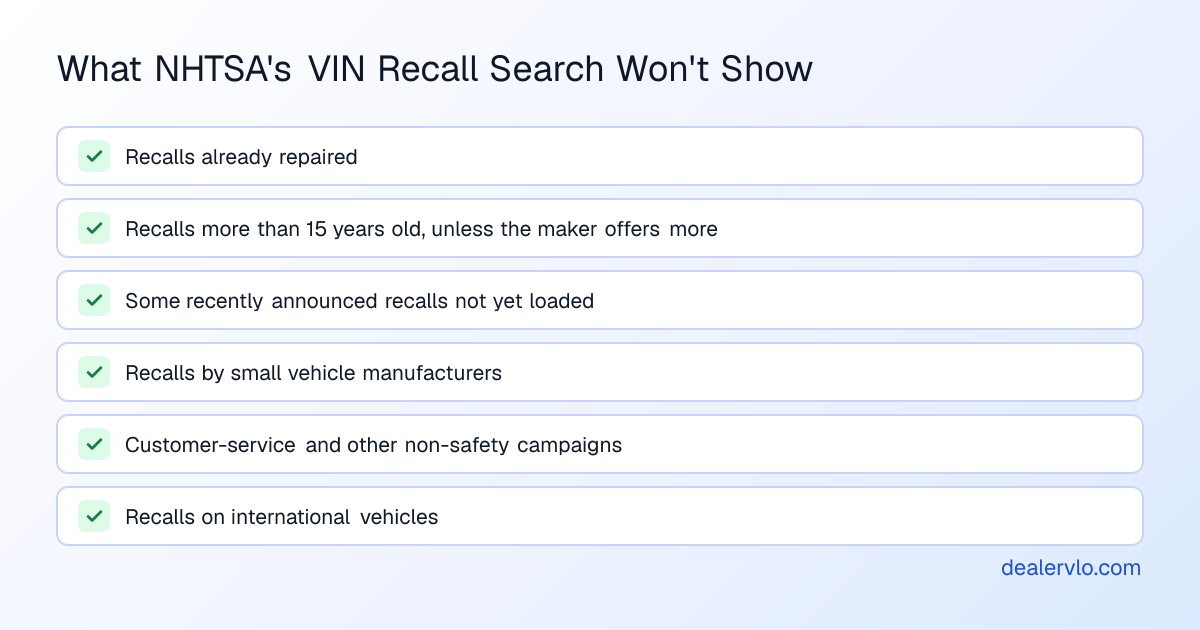
One point worth being precise about: the VIN search doesn't show everything. NHTSA says it won't show safety recalls more than 15 years old (unless the manufacturer offers more coverage), some recently announced recalls whose VINs haven't been loaded yet, recalls by small vehicle manufacturers, non-safety campaigns, or recalls on international vehicles (NHTSA recalls). So "0 unrepaired recalls" on an older trade-in isn't the final word. For an older Toyota, also check Toyota's own owner site or call a Toyota dealer's service department with the VIN, and re-check a car you're holding before you retail it, since new recalls get added.
If you're prepping for an auction run with a stack of units rather than one car, NHTSA's search also takes up to 100 VINs at once to check for open recalls (NHTSA recalls) — worth running the night before sale day rather than discovering a recall after you've already paid for transport. DealerVLO's free VIN decoder tool lists NHTSA recall campaigns for a car's year, make, and model at the model level — confirm the exact VIN against nhtsa.gov/recalls before you rely on it for a bid decision.
Decode any VIN free — year, make, model, trim, engine — straight from NHTSA.
Open the VIN DecoderStep 4: Know what the auction's own rules say about the VIN plate and title
If you're buying at a physical or online auction lane, the VIN decode is only half the verification. The National Auto Auction Association's arbitration policy — the industry-standard rulebook that individual auction houses adopt — requires that every consigned vehicle carry a visible VIN plate attached by the manufacturer (or a state-reassigned plate where applicable), and gives the auction the right to refuse a sale if that plate looks altered (NAAA Arbitration Policy). Title discrepancies — things like salvage history, theft recovery, flood damage, or a mileage mismatch — are supposed to be announced at the block; if they're not, that's typically grounds for arbitration after the fact, not a guarantee you'll get your money back cleanly (NAAA policy via Speedway Auto Auction).
This matters because NAAA's rules are private arbitration terms each auction house adopts, not state or federal law — they protect you if you catch the issue within the auction's arbitration window, not indefinitely. That's one more reason to run your own VIN check and plate inspection before you bid, instead of leaning entirely on the announcer's call. Auctions also use a specific light or flag to signal when a title isn't physically present at time of sale; if that signal isn't given and the car later turns out to have no title, it may be arbitrable depending on that auction's specific policy (NAAA policy).
Once you own the car, each vehicle record in DealerVLO has a Title Status field — In Hand, Pending, or Lienholder — along with a title number and title state. You can enter or update those on either the add or the edit vehicle screen, so a trade-in that comes in with "Pending" can get switched to "In Hand" the day the title actually arrives, and the current status prints on the bill of sale. It won't chase the title down for you or flag a late one; that part's still on you to track.
14-day free trial, then $29/mo · Cancel anytime
Where this fits once the Toyota is actually on your lot
Decoding and verifying a VIN is a pre-purchase step. Once the car's bought and on your lot, a separate federal requirement kicks in: the FTC's Used Car Rule requires dealers to post a Buyers Guide window sticker on every used car disclosing warranty terms, and that rule has been in place for decades (FTC). It's a different obligation from VIN verification — one happens before you own the car, the other starts the moment you do — but they're both part of the same "don't get this wrong on a used car" discipline. (This isn't legal advice; confirm current Used Car Rule requirements and any state-specific disclosure rules with the FTC and your state's DMV or dealer licensing authority.)
DealerVLO's vehicle page prints the current FTC Buyers Guide directly from the car's record — no deal needed — so it's ready to hang on the Toyota the same day it hits the lot.
The free inventory turn calculator is worth running numbers through separately if aging inventory is a recurring pattern on your lot rather than a one-car problem.
A quick decision framework for trade-ins vs. auction buys
The VIN check itself is the same either way, but what you do with the result differs a little depending on where the car's coming from.
| Scenario | What to verify first | What a bad result means |
|---|---|---|
| Walk-in trade-in | Door-jamb VIN matches dash and title | Mismatch = stop, ask questions, don't take the car at face value |
| Single auction unit | VIN plate condition + decode + recall check | Altered plate or open recall = factor into your max bid or walk |
| Auction run list (multiple units) | Bulk recall check (up to 100 VINs) the night before | Catches recall exposure across the whole run, not just one car |
| Older or imported Toyota | Confirm model year is 1981+ for full vPIC coverage | Pre-1981 or non-U.S. VINs may decode with gaps — inspect manually |
A lot of small lots treat the VIN decode as a formality they do after the handshake. Flipping that order — decode and verify first, then negotiate — costs maybe two or three minutes per car and catches the occasional altered plate or open recall before it becomes your problem instead of the seller's.
Frequently asked questions
Is there a Toyota-specific VIN decoder, or do I use the same one for every make?
There's no single reliable, Toyota-only decoder worth trusting over NHTSA's general-purpose tool. NHTSA's vPIC database decodes any manufacturer's VIN from the same manufacturer-reported data, and it's the source most commercial decoders — Toyota-specific or not — ultimately pull from, so starting there avoids relying on a third-party site's possibly outdated or conflicting trim chart.
Can a VIN decoder tell me the exact trim and factory options on a Toyota?
It can tell you year, make, and model reliably, but granular trim and factory-option detail isn't always encoded the same way across every Toyota model and model year, so manufacturer-reported VIN data sometimes comes back thin on that specific layer. When it does, cross-check the physical build sheet or window sticker and inspect the car directly rather than assuming the VIN alone spells out every option.
How do I check if a Toyota has an open recall before I bid on it?
Enter the full VIN at NHTSA's recall search (NHTSA.gov/Recalls), which shows unrepaired safety recalls tied to that specific vehicle, with some gaps: it doesn't show recalls more than 15 years old unless the manufacturer offers more coverage, and very recent recalls may not be loaded yet. If you're prepping for an auction sale day with multiple units, NHTSA also offers a bulk lookup that checks up to 100 VINs at once for unrepaired recalls.
Does NHTSA's VIN recall search show every recall, no matter how old the car is?
No. NHTSA says its VIN and license plate search doesn't show safety recalls more than 15 years old (unless the manufacturer offers more coverage), some recently announced recalls whose VINs aren't loaded yet, recalls by small manufacturers, or recalls on international vehicles. On an older Toyota, a clean result isn't proof there's no open recall; check Toyota's own owner site or ask a Toyota dealer's service department.
What's the difference between checking the VIN and checking NAAA auction arbitration rules?
The VIN decode and recall check are about the vehicle itself — identity, specs, and safety history. NAAA's arbitration policy is a separate, private set of rules that auction houses adopt covering how VIN plates, title discrepancies, and mileage issues must be disclosed at the block; it protects you only if an issue is caught within that auction's arbitration window, so it's a backstop, not a substitute for checking the VIN yourself first.
Does DealerVLO decode VINs or just store the result?
DealerVLO's free VIN decoder tool pulls from NHTSA's vPIC data and also lists NHTSA recall campaigns for that year, make, and model — confirm the exact VIN at nhtsa.gov/recalls before making a buying decision. The Add Vehicle screen separately runs its own VIN decode when you add a car one at a time, and its camera-based Scan VIN feature reads the door-jamb barcode so you don't have to type the VIN by hand.
Bottom line
A Toyota VIN decoder isn't a special tool — it's the same federal VIN data every make shares, run through a decoder that pulls from NHTSA's manufacturer-reported database instead of a static chart that may be years out of date or flat wrong on where Toyota puts its trim and engine codes. Check the physical VIN against the paperwork, decode it, check for open recalls, and know the auction's own disclosure rules before you bid — in that order, every time, whether it's a walk-in trade-in or a unit at the lane. Run the VIN before you run the numbers, and the rest of the deal gets a lot less risky. Give that workflow a home on your lot with DealerVLO.
14-day free trial, then $29/mo · Cancel anytime