The Missed Callback Problem: How to Stop Salespeople From Silently Losing Deals
The missed callback problem car dealership owners rarely see in a report — and a system to catch it before the deal dies.
Part of the Choosing dealer software guide: The best car dealership software in 2026: 14 DMS options for independent lots, with real prices
Switching from another DMS? Compare DealerVLO to DealerCenter, Frazer, or Lot Wizard, or see what DealerVLO's car dealer management software includes.
Here's the thing about a broken promise to call someone back: it doesn't show up anywhere. No report flags it. No pipeline stage turns red. The customer just stops answering, the deal goes cold, and three weeks later nobody — not the salesperson, not the manager — can tell you it ever happened. That's the missed callback problem, and it's probably costing your lot more deals than a weak ad budget or a slow lead response ever will.
The failure mode has a name because it's common enough that dealer forums have been arguing about it for years. One long-running thread on a dealer industry forum lays out the mechanism plainly: salespeople and managers often assume they've already sorted who can and can't buy, so follow-up with an unsold prospect gets quietly deprioritized — and management consistently underestimates how many of those "I'll call you back" promises just evaporate (citation 1). This isn't a training problem you fix with a pep talk. It's a tracking problem, and it needs a system, not a reminder.
14-day free trial, then $29/mo · Cancel anytime
Why this never shows up in any report
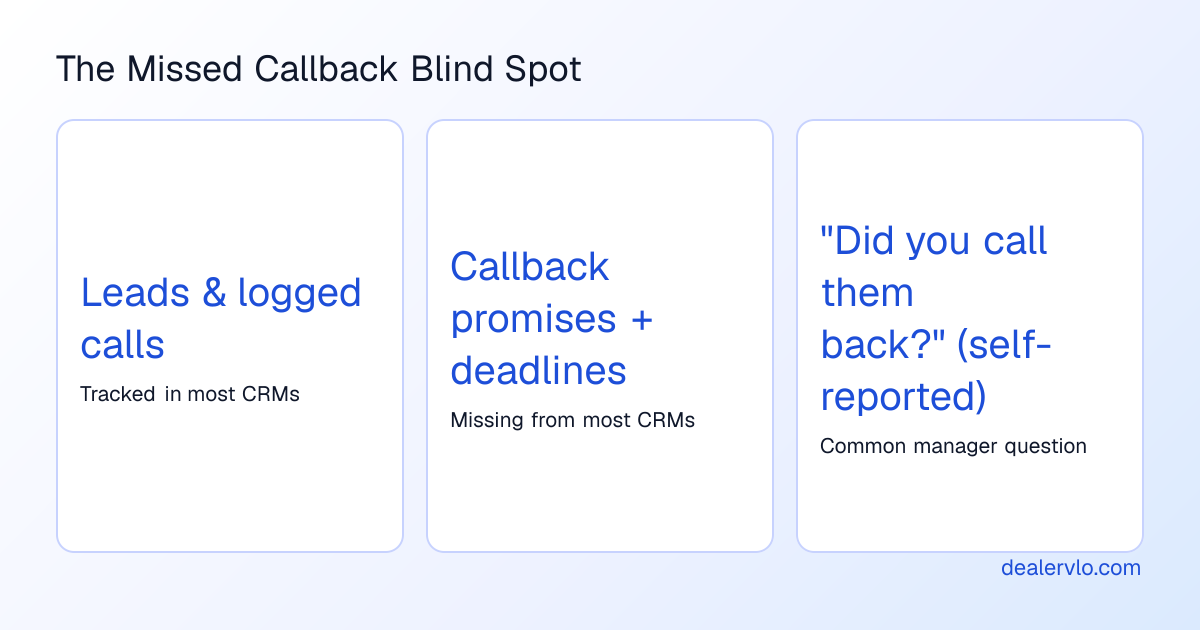
A missed callback is invisible by design. Your call log shows calls that happened. Your CRM shows leads that came in. Neither one shows the promise a salesperson made and then didn't keep — because that promise was never a tracked object in the first place. It lived in a notepad, a mental note, or a "yeah I'll get to it" on the way out the door.
The same forum community has separately documented this blind spot on the inbound side too. One veteran industry voice, discussing missed inbound calls specifically, put it bluntly: "Seldom do they know about the missed call. It is a major problem" (citation 2). The forum's own synthesis of that discussion goes further, noting that most dealerships simply don't have systems in place to detect or track missed calls at all — this isn't a case of dealers using different strategies with different success rates, it's a widespread gap where nothing is being measured (citation 2).
Put outbound and inbound together and you get the real mechanism: there's no detection system, and even where there's a manager in the loop, that manager is asking the wrong question. The same unsold-prospects thread flags this exact failure — managers tend to ask reps whether they called a prospect back, instead of independently verifying the outcome. "Did you call yesterday's prospects back?" gets a yes, the manager moves on, and nothing was actually inspected (citation 1). That's trust substituting for verification, and it's why the problem survives even at stores that think they're on top of follow-up.
The structure that actually closes this gap is straightforward: log each callback promise with its own deadline, and escalate to a manager when that deadline passes with no recorded follow-through. It's worth building into however you run your floor, whatever software sits underneath it.
The three things a real system needs
A real system for this comes down to a short list — this is management practice, not a specific vendor's trick, and you can build a version of it with a whiteboard if you have to.
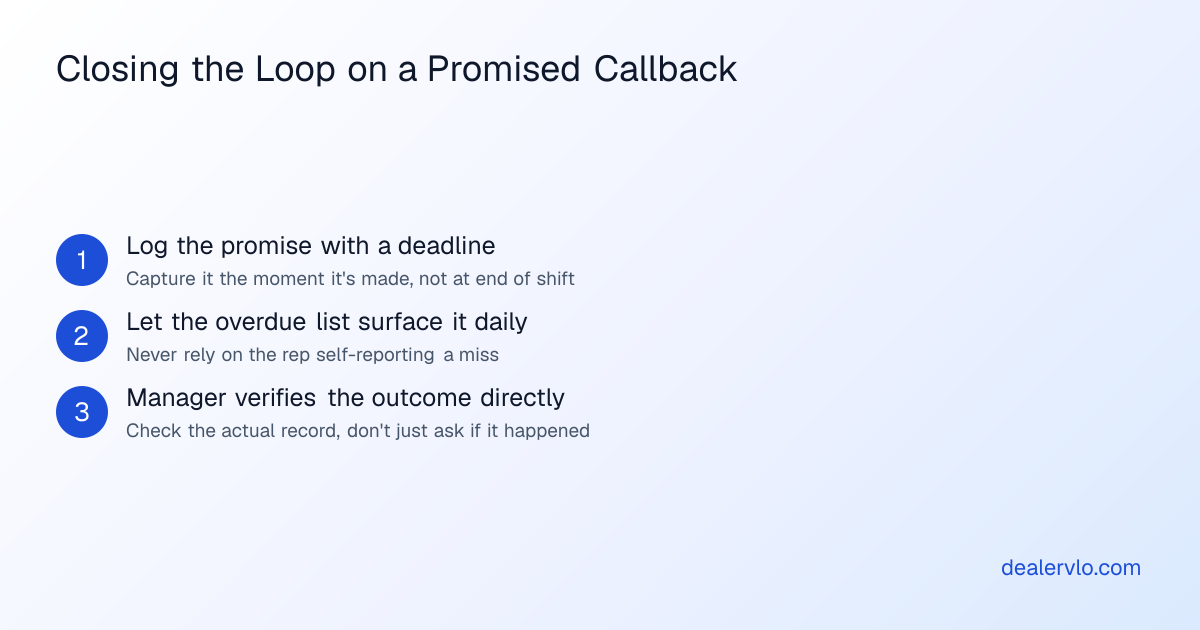
1. Capture the promise, not just the lead. "I'll call her back Thursday by 5" is a different data object than "lead exists" or "call happened." A generic CRM task that says "follow up" doesn't carry the deadline, the specific commitment, or the fact that a customer is now expecting contact at a specific time. If your system only tracks leads and calls, it has nowhere to put the promise itself — which means the promise lives in the salesperson's head, and heads forget. In DealerVLO, every lead can carry a follow-up date — type one in or pick Tomorrow, 3 days, or 1 week — which is at least a place to put the deadline instead of a sticky note.
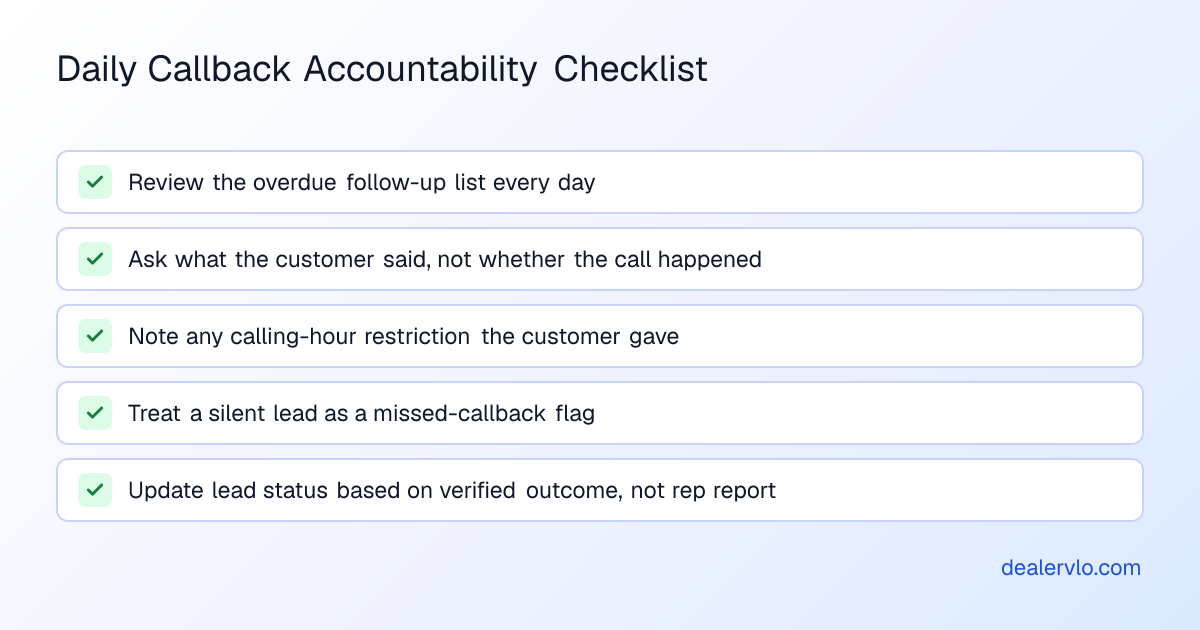
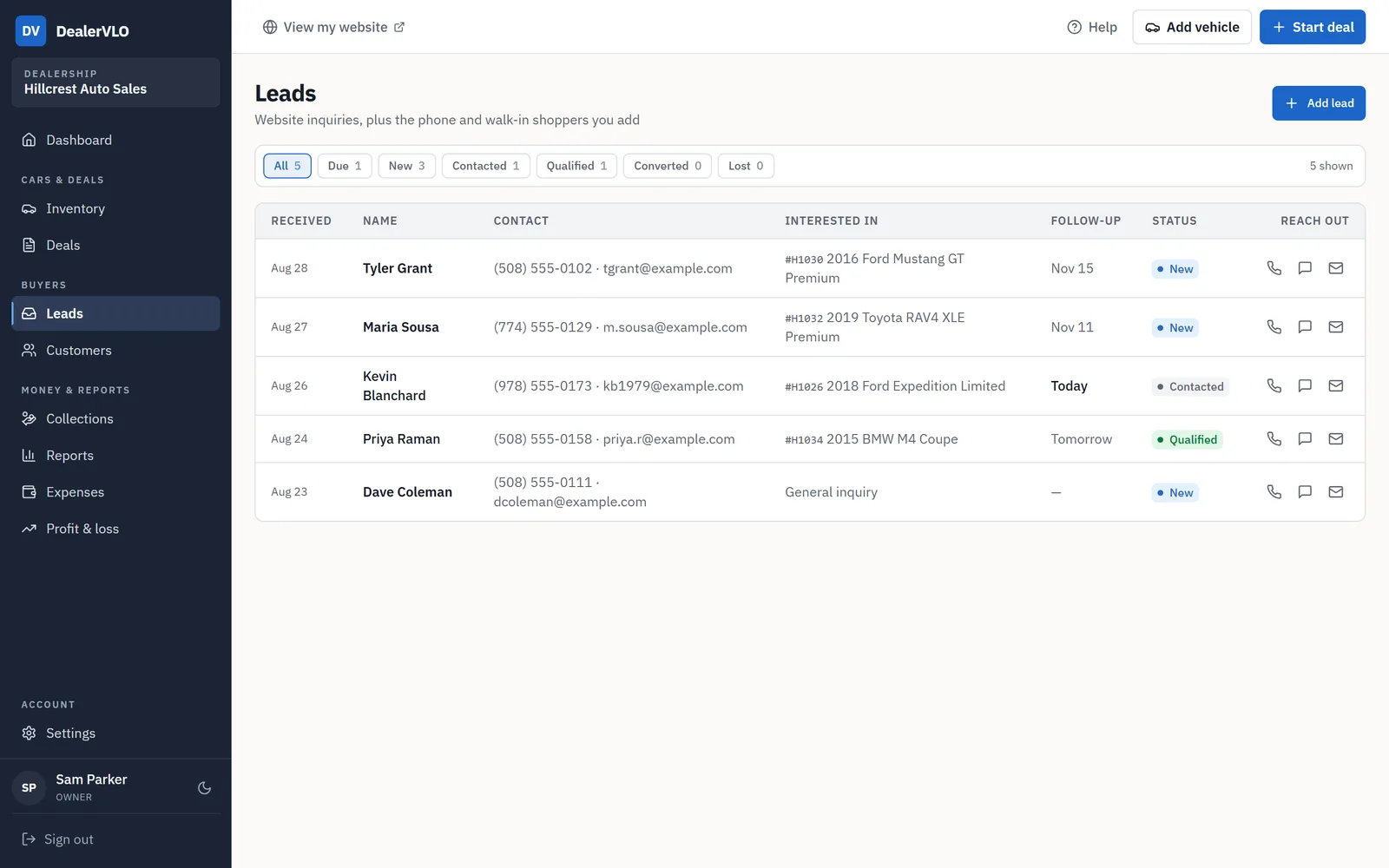
2. Deadlines that surface on their own, not voluntary reporting. This can't depend on the rep remembering to flag their own miss — that catches close to none of the misses people don't want to admit to. DealerVLO's lead list has a Due view that filters to everything with a follow-up dated today or earlier, most overdue first, and on days something's due the account owner gets one email listing those leads (up to 25, most overdue first). That's a once-a-day nudge, not a live alarm — it still needs someone to open it and act.
3. Manager verification, not manager inquiry. Spot-check the actual customer record — was the call logged, was there an outcome, is there a next step — instead of asking the rep if they handled it. The forum thread on unsold prospects names this exact gap: managers ask the wrong question and don't inspect what they expect (citation 1).
If you run a small lot, this doesn't need to be complicated. What it needs is to be consistent — a callback promise gets written down with a deadline the moment it's made, and somebody (you, if you're the only manager on the floor) looks at what's overdue every single day without exception.
A legal wrinkle worth knowing before you build a callback schedule
If your promise-tracking system is going to capture when a callback happens, it's worth building in the one federal rule that actually governs outbound sales calls to a customer's home. The FCC's consumer guidance states that telemarketing calls to a residence are prohibited before 8 a.m. and after 9 p.m., that callers must identify themselves and provide contact information for who they represent, and that any do-not-call request made during a call must be honored immediately (citation 4). The National Do Not Call Registry itself is run by the FTC, and a consumer's request to stop being called or texted with promotional pitches has to be respected going forward (citation 5).
Practically, that means your callback-promise record should capture any timing restriction the customer gives you — "don't call before 9," "evenings only," "put me on your do-not-call list" — right alongside the deadline, not as a separate note somebody has to remember exists. This isn't legal advice; confirm the current rules and any state-specific restrictions with the FCC, FTC, or your own counsel before you set calling-hour policy for your team.
Turn your ad spend into a cost per car sold and a real ROI — and see how many units the spend has to produce just to break even.
Open the Marketing ROI CalculatorHow DealerVLO fits into closing this gap
Every lead carries a status — New, Contacted, Qualified, Converted or Lost — plus an optional follow-up date, internal notes, and the car the shopper asked about when it came from a car's page. The lead list shows newest first and filters to a Due view: everything with a follow-up dated today or earlier, most overdue at the top. That gives a manager a concrete list to check against, instead of having to ask each rep what's outstanding.
On days something is due, the account owner gets a single daily email listing those leads, up to 25, most overdue first. That's the "surface it without self-reporting" half of the system — it's one email a day, not a live alert, so the habit of actually opening the Due view and working it still has to be built on top. It's also not an automated texting or calling system: the Email, Call and Text buttons on a lead open your own phone or email app, and DealerVLO doesn't contact the customer automatically or send bulk follow-up on your behalf. The verification step — did the call actually happen and what was the outcome — still has to be a human checking the notes field and updating the status, which is exactly the "manager verification over manager inquiry" discipline the forum thread describes.
14-day free trial, then $29/mo · Cancel anytime
Building the habit on top of the tool
A tool alone doesn't fix the missed callback problem — a lot of small lots find the software only works as well as the daily habit wrapped around it. A few things worth locking in regardless of what system you run:
- Log the promise the moment it's made, not at the end of the shift from memory. If a rep tells a customer "I'll call you back Thursday," that commitment goes into the record before the customer walks out the door or hangs up the phone.
- Review the Due list yourself, daily, even if you're also the one selling cars. On a small lot, the owner is often the only manager there is — which means the review has to happen whether or not anyone's watching.
- Ask what happened, not whether something happened. "What did she say when you called?" gets you an actual answer you can check against the notes. "Did you call her back?" gets you a yes.
- Treat a silent lead the same as a missed callback. If a prospect went quiet with no logged next step, that's the exact blind spot this whole system exists to close — the same underlying gap the forum discussion describes between "lead exists" and "promise tracked."
If you're setting up a follow-up process for the first time, bringing your current customer list in is a reasonable first step — DealerVLO's inventory and customer CSV import brings over contact records so you have something to attach follow-up dates to, though it only covers inventory and customer contacts, not past deals or history. See the best DMS options for independent lots for a broader comparison if you're shopping around, or the relevant switching guide for your current system if you're moving off one of the major platforms. If call volume specifically is where you're losing track of things, call tracking at a small lot is worth reading before you add another tool to the stack.
A related discipline worth mentioning: trade groups exist partly to address exactly this kind of operational gap. NIADA, the National Independent Automobile Dealers Association, was formed in 1946 and runs training programs through publications, online resources, and NIADA.tv aimed at advancing independent dealers (citation 6) — worth a look if you want structured sales-process training beyond what any single software vendor provides.
14-day free trial, then $29/mo · Cancel anytime
Frequently asked questions
What exactly is the "missed callback problem" at a car dealership?
It's when a salesperson tells a customer they'll call back by a certain time and then doesn't — and that broken promise never shows up in any call log, CRM report, or pipeline stage because it was never tracked as its own event. The deal usually just goes quiet and gets written off as "not a real buyer" rather than recognized as a follow-up failure.
Why don't standard CRM reports catch salespeople not calling customers back?
Most CRM reports track leads and logged calls, not promises. A promise with a deadline is a different data object — if your system doesn't capture it separately, it lives in a notepad or a rep's memory, and a manager asking "did you call them back?" gets a self-reported yes instead of a verified outcome.
How do I build callback accountability without expensive new software?
Start with three things: log every promise with a specific deadline the moment it's made, make sure missed deadlines surface somewhere visible rather than depending on self-reporting, and check actual outcomes yourself instead of asking reps if they handled it. DealerVLO's lead inbox supports this with status tracking, follow-up dates, a filterable Due view, and a daily email to the account owner listing what's overdue.
Is there a legal rule about what time of day a promised callback can happen?
Yes — the FCC's consumer guidance prohibits telemarketing calls to a residence before 8 a.m. and after 9 p.m., requires callers to identify themselves and their employer, and requires immediate honoring of any do-not-call request made during the call. Confirm current rules and any state-specific restrictions with the FCC, FTC, or your counsel before setting your team's calling-hour policy.
Does DealerVLO automatically call or text customers when a follow-up is due?
No. DealerVLO surfaces overdue follow-ups in a Due view and sends the account owner one daily email listing what's overdue, but the Call and Text buttons simply open your own phone or text app — it doesn't place calls, send texts, or contact leads automatically on your behalf.
What's the difference between tracking leads and tracking callback promises?
A lead record tells you someone's interested; a callback promise tells you a specific commitment with a specific deadline was made to that person. You can have a perfectly logged lead with a completely broken promise sitting inside it — which is exactly why the two need to be tracked as separate things, with the deadline and a visible overdue list built around the promise itself.
Bottom line
The missed callback problem survives because it's invisible to every standard report and because "did you call them back?" is the wrong question to ask. The fix isn't more hustle — it's logging the promise with a deadline the moment it's made, checking a visible overdue list every day without exception, and verifying outcomes instead of taking a rep's word for it. Start with DealerVLO's lead follow-up tracking and see how many deals were quietly sitting overdue.
14-day free trial, then $29/mo · Cancel anytime