How to fill out the VSD 609 in Illinois
A field-by-field walkthrough of the Illinois VSD 609 (Affidavit of Repossession) for licensed used car dealers — what goes in every section, who signs what, and the documents you attach. Verified against the official form as of October 2026.
Don't waste another second filling out the Illinois VSD 609.
Upload the fillable VSD 609 to DealerVLO once, and it fills the form from every deal instantly.
Filing these every week? Upload the VSD 609 to DealerVLO once and it fills from every deal you enter, $29/month flat. See pricing
Switching from another DMS? Compare DealerVLO to DealerCenter, Frazer, or Lot Wizard.
Filling out the IL VSD 609 after a sale:
- What it is
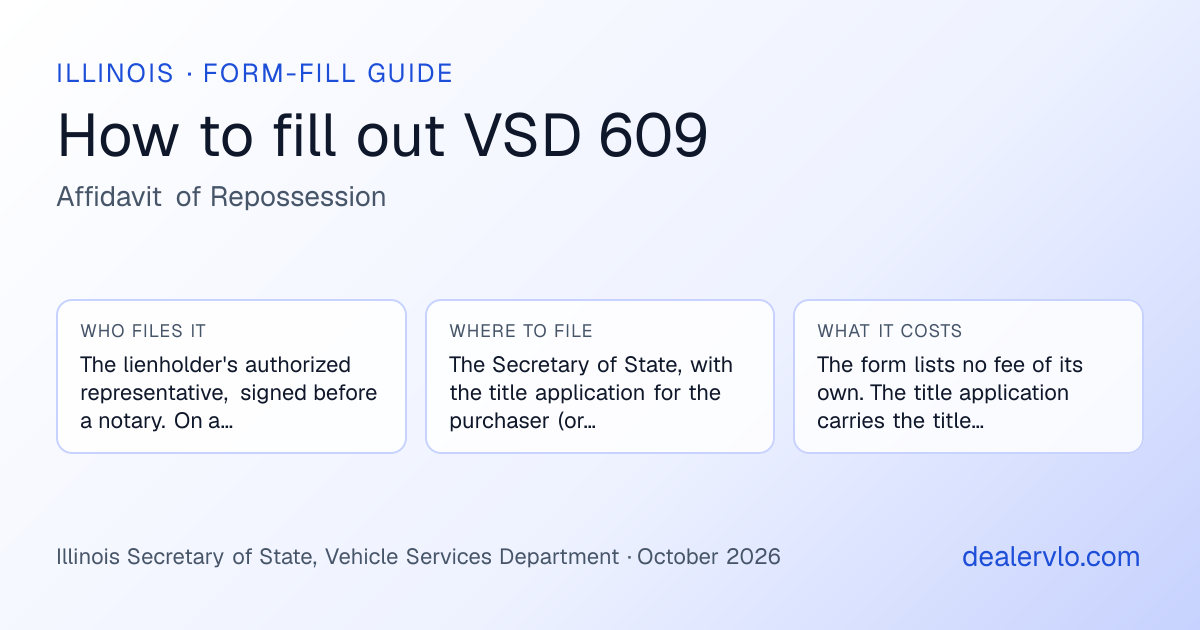
- The Illinois Secretary of State's Affidavit of Repossession: the lienholder's sworn statement about an involuntary repossession and sale
- Who completes it
- The lienholder's authorized representative, signed before a notary. On a BHPH note, that's your dealership
- Where to file it
- The Secretary of State, with the title application for the purchaser (or for the lienholder when the title is lost). The form's header reads Vehicle Services Department, 501 S. Second St., Springfield, IL 62756
- Processing time
- None of its own. It travels with the title application
- Cost
- The form lists no fee of its own. The title application carries the title fee
This guide is informational and does not replace the official Illinois instructions. Always confirm the current form and procedure with the Illinois Secretary of State, Vehicle Services Department before you file.
The VSD 609 is one car's paperwork. A 20-second read on your lot, and the tax-and-fee math for the whole deal — built for dealers, no signup. Free calculators dealers actually use — no signup, no email.
Upload the fillable Illinois VSD 609 to DealerVLO once. It maps the fields, then fills the form from every deal — buyer, co-buyer, the vehicle you sold, and your dealership already in place. $29/month, free to try — cancel any time.
What the VSD 609 is and why it matters
VSD 609 is the Illinois Secretary of State's Affidavit of Repossession. The lienholder completes it after an involuntary repossession, and it goes to the Secretary of State with the title paperwork for whoever buys the car next. If you sold the car on a buy-here-pay-here note, the lienholder is your dealership.
This guide covers the paperwork: what each box asks for, the notary block, and what the SOS fact sheet (VSD 608) says goes with it. It doesn't cover the notices or timelines that come before a sale. Those are in VSD 608 and the Illinois Vehicle Code, and they're a question for your attorney.
The current printing is VSD 609.4 (September 2022). When people search for an "affidavit of repossession Illinois," this is the Secretary of State form. The SOS fact sheet VSD 608 calls it the Affidavit of Repossession "on a form prescribed by the Secretary of State." It's one page and notarized. The PDF is fillable, so you can upload it to DealerVLO once under Settings → Forms, but its boxes are just numbered 1 to 26, so you map each one by hand the first time. Ignore the one suggestion auto-map makes (it points the lienholder's signature box at the lender name) and leave the signature and notary boxes unmapped.
Documents to have before you start
Gather these before you complete the VSD 609. A missing attachment is the number-one reason the the Illinois Secretary of State, Vehicle Services Department bounces a title application back.
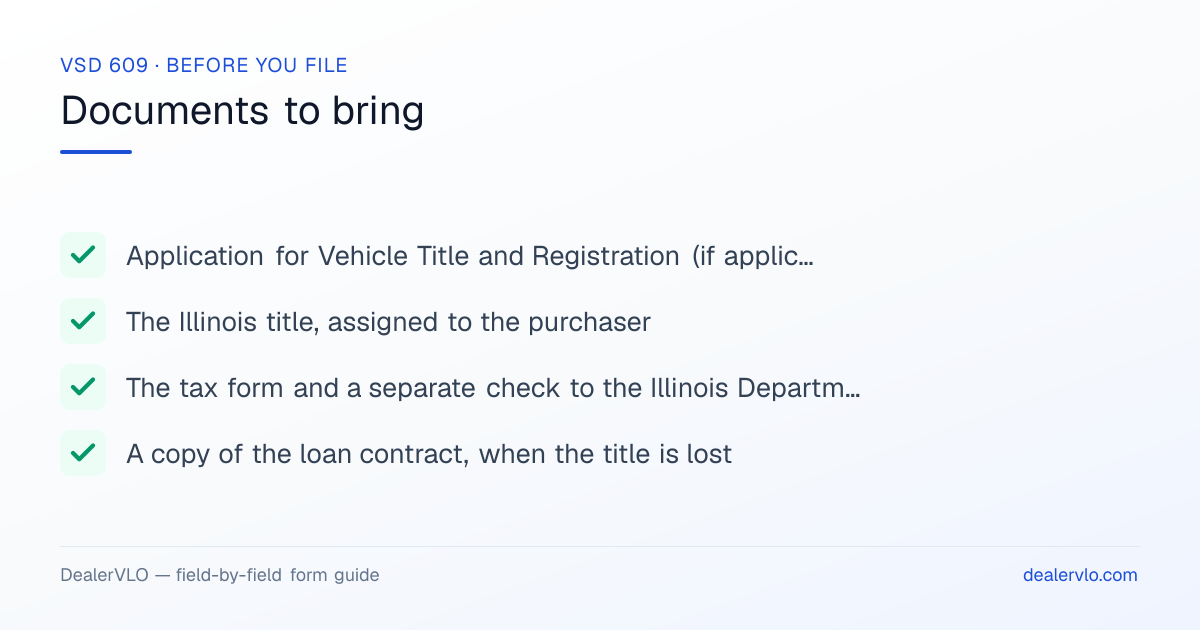
- Application for Vehicle Title and Registration (if applicable) and the fee — In the purchaser's name. When the title is lost, VSD 608 says the application is in the lienholder's name instead. See the VSD 190 guide.
- The Illinois title, assigned to the purchaser — For a non-commercial vehicle, VSD 608 lists the title with a release of interest signed by the lienholder and assigned by the lienholder to the purchaser.
- The tax form and a separate check to the Illinois Department of Revenue — VSD 608 says which form depends on how the car is sold. See the tax section below.
- A copy of the loan contract, when the title is lost — VSD 608 lists it with the application in the lienholder's name and an affidavit stating the title is lost.
VSD 609, section by section
Commercial or non-commercial vehicle
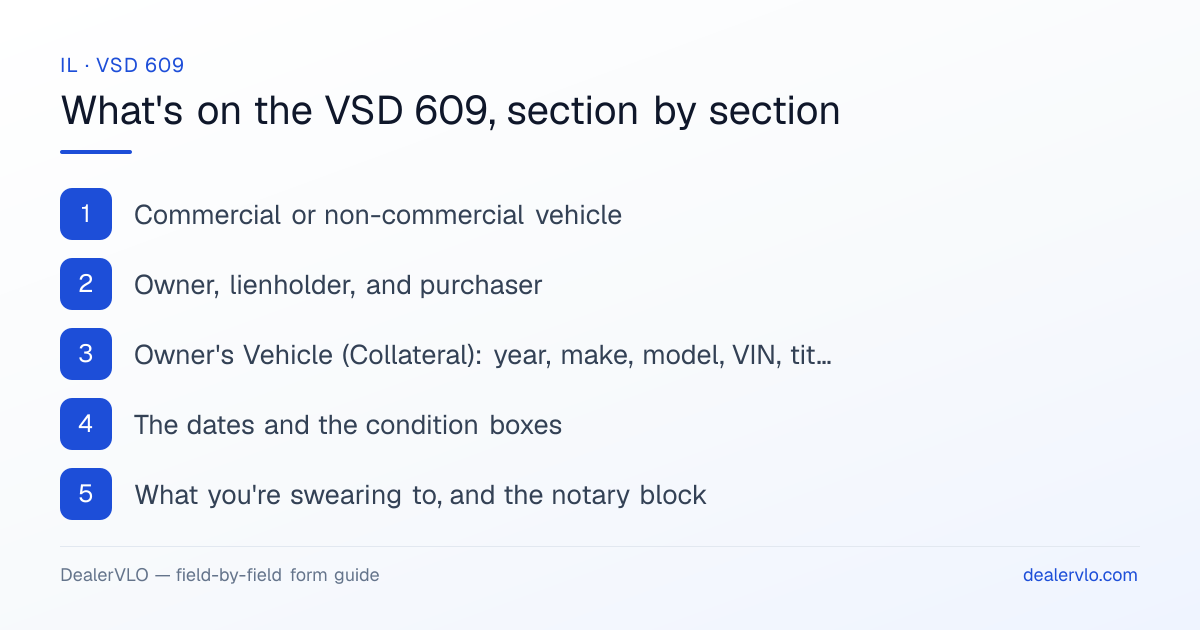
Check one box at the top right: Commercial Vehicle or Non-Commercial Vehicle. VSD 608 treats them as separate cases, and the paragraph you'll sign has a sentence that applies only to non-commercial vehicles. A car you sold to a retail customer for personal use is the non-commercial case in VSD 608's words: "a vehicle used primarily for personal, family or household purposes."
| Field | Who fills it |
|---|---|
Commercial Vehicle / Non-Commercial Vehicle Check one. | You (dealer) |
Owner, lienholder, and purchaser
Three blocks, each with a name, address, city/state, and ZIP. "Repossessed from Owner (Borrower) Name" is the person on the title you repossessed from: your BHPH buyer. "Creditor (Lienholder) Name" is your dealership, by the name recorded as lienholder on the title. "Purchaser(s) Name" is whoever bought the car from you after the repossession.
| Field | Who fills it |
|---|---|
Repossessed from Owner (Borrower) Name, Address, City/State, ZIP | You (dealer) |
Creditor (Lienholder) Name, Address, City/State, ZIP Your dealership, as recorded on the title. | You (dealer) |
Purchaser(s) Name, Address, City/State, ZIP The person buying the repossessed car. | You (dealer) |
Owner's Vehicle (Collateral): year, make, model, VIN, title number
Copy these from the Illinois title so they match the title application. Title # is the certificate of title number. If the title is lost, you'll check the lost-title box further down.
| Field | Who fills it |
|---|---|
Year, Make, Model | You (dealer) |
VIN All 17 characters. | You (dealer) |
Title # | You (dealer) |
The dates and the condition boxes
Three dates: the Date of Repossession, the Date of Mailing or Delivery of Notice of Redemption, and the Date of Sale of Vehicle to Purchaser. Take them from your file, not from memory. Then check one condition box: "Vehicle repossessed is not damaged in excess of 50%" or "Vehicle repossessed is damaged in excess of 50% of its fair market value." VSD 608 says that if the damage on the date of repossession is over 50% of fair market value, the lienholder must apply for a Salvage Certificate. Last, check "Certificate of Title is lost and no third party is involved in the transaction" only if both are true.
| Field | Who fills it |
|---|---|
Date of Repossession | You (dealer) |
Date of Mailing or Delivery of Notice of Redemption | You (dealer) |
Date of Sale of Vehicle to Purchaser | You (dealer) |
Not damaged in excess of 50% / damaged in excess of 50% Check one. | You (dealer) |
Certificate of Title is lost and no third party is involved Only if both are true. | You (dealer) |
What you're swearing to, and the notary block
Read the paragraph in the middle of the form before you sign. It states that the owner's vehicle "was lawfully repossessed by the lienholder for default," and lists the notices the lienholder sent and when the sale happened. The line above the signature reads: "Under penalties of perjury, the undersigned lienholder states that the above requirements have been complied with and the undersigned lienholder will assume all liability and costs for any litigation that may arise from the issuance of a Certificate of Title." If any of it isn't true for your file, stop there. The lienholder's authorized representative signs on the "By" line and dates it. The notary completes "Subscribed and sworn to before me," the day, month, and year, their signature, commission expiration, and seal. Sign in front of the notary.
| Field | Who fills it |
|---|---|
Signature of Lienholder's Authorized Representative, Date In front of the notary. | You (dealer) |
Notary: subscribed and sworn date, Notary Public, commission expires, seal You bring it to a notary; the notary completes this block. | You (dealer) |
This space for use by Secretary of State | At the counter |
The tax form that goes with it
VSD 608 spells out which Illinois Department of Revenue form goes in the packet. If the lienholder titles the repossessed vehicle in its own name and then sells it, a retail sale occurs: Form ST-556 from the lienholder (if registered with the Department of Revenue) or Form RUT-25 from the purchaser. If the lienholder doesn't title it and reassigns the title to the purchaser, the purchaser owes Vehicle Use Tax on Form RUT-50. No tax form or payment is needed if the lienholder sells to a licensed dealer. The tax check is separate, payable to the Illinois Department of Revenue, and goes in with the title documents.
| Field | Who fills it |
|---|---|
ST-556 or RUT-25 (lienholder titled it first) | You (dealer) |
RUT-50 (title reassigned to the purchaser) | Buyer |
Separate check to the Illinois Department of Revenue | You (dealer) |
Common VSD 609 mistakes that cause rejections
VSD 608 handles a voluntary surrender differently: the lienholder reassigns the title, releases its lien on the face of the title, and submits a statement on its letterhead that the transaction is a voluntary repossession.
Your BHPH buyer is the Owner (Borrower). The Purchaser is whoever buys the car from you afterward.
Check one. VSD 608 treats the two cases differently, and part of the sworn paragraph applies only to non-commercial vehicles.
The box reads "Certificate of Title is lost and no third party is involved in the transaction." Both have to be true.
The notary block reads "Subscribed and sworn to before me." Sign in front of the notary.
VSD 608 says the tax check is separate, payable to the Illinois Department of Revenue, with the right tax form.
Common questions
What is the Illinois affidavit of repossession?+
It's Secretary of State Form VSD 609, the Affidavit of Repossession. The lienholder completes it, signs it before a notary, and it's submitted with the title application after an involuntary repossession. The current printing is VSD 609.4, dated September 2022.
Does the VSD 609 have to be notarized?+
Yes. The form has a notary block ("Subscribed and sworn to before me") with the notary's signature, commission expiration, and seal.
Who submits the VSD 609?+
The lienholder completes it. VSD 608 lists it among the documents the purchaser submits to the Secretary of State with the title application, the title, and the tax form. When the title is lost, the lienholder submits it with an application for title in the lienholder's own name.
What if I don't have the title to the repossessed car?+
Check the lost-title box on the VSD 609 if no third party is involved. VSD 608 lists the documents: an application for vehicle title in the lienholder's name with the title fee, the Affidavit of Repossession stating the title is lost, and a copy of the loan contract.
Do I need the VSD 609 for a voluntary repossession?+
VSD 608 doesn't list it for a voluntary surrender. Once the owner assigns the vehicle to the lienholder, the lienholder reassigns the title to the purchaser, releases its lien on the face of the title, and submits a statement on its letterhead that it's a voluntary repossession. VSD 608 gives the lienholder 20 days from the sale to provide the purchaser with the reassigned title.
Which tax form goes with a repossessed vehicle in Illinois?+
Per VSD 608: ST-556 from the lienholder (or RUT-25 from the purchaser) if the lienholder titled the vehicle in its name before selling; RUT-50 from the purchaser if the lienholder reassigned the title without titling it; none if the lienholder sold to a licensed dealer.
Is there software that fills out the VSD 609 automatically?+
Yes. The Illinois VSD 609 is a fillable PDF, so dealer management software like DealerVLO can fill it for you: upload the blank form once, DealerVLO detects its fields and suggests a mapping you confirm, and from then on it fills from every deal you enter — the buyer, co-buyer, the vehicle you sold, and your dealership's details already in place. It's $29/month flat with a 14-day free trial, and the same deal also generates your federal documents (Bill of Sale, FTC Buyers Guide, odometer disclosure) and your state title paperwork.
- Affidavit of repossession forms by state
- Vehicle lien release form by state
- How to fill out Illinois Form VSD 190
- Illinois used car dealer license
- Illinois dealer plates
- E-signatures and e-titling for Illinois dealers
- Illinois odometer disclosure statement (VSD 333)
- Title application forms in every state
- How much is a dealer's license? Cost in every state
Stop filling out the VSD 609 by hand.
Upload the fillable IL VSD 609 once. DealerVLO detects its fields, you confirm the mapping, and every deal after that prints it with the buyer, co-buyer, vehicle, and your dealership already in place. $29/month. 14-day free trial, cancel any time.
Curious how it works? See how DealerVLO auto-fills every dealer document — bill of sale, FTC Buyers Guide, odometer disclosure, and state title & registration forms for all 50 states, from one deal.
Bond amounts, fees, and form rules change. Get a short email when your state does. No spam, unsubscribe anytime.