How to fill out the TR-212a in Kansas
A field-by-field walkthrough of the Kansas TR-212a (Title and Registration Manual Application) for licensed used car dealers — what goes in every section, who signs what, and the documents you attach. Verified against the official form as of September 2026.
Filing these every week? DealerVLO fills the TR-212a from the deal you already entered, $29/month flat. See pricing
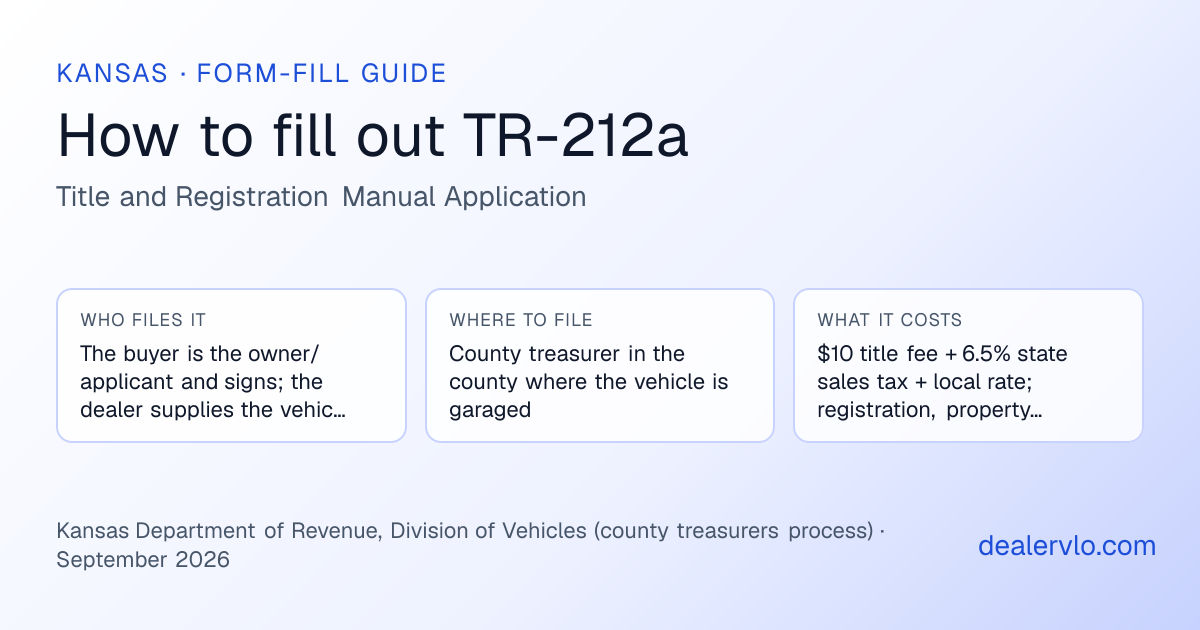
Filling out the KS TR-212a after a sale:
- What it is
- Kansas's combined application for title and registration, filed at the county treasurer
- Who completes it
- The buyer is the owner/applicant and signs; the dealer supplies the vehicle, lien and tax details; the treasurer fills the fee summary
- Where to file it
- County treasurer in the county where the vehicle is garaged
- Processing time
- A title without a lien typically arrives 10–40 days after application (Kansas holds applications 35 days from purchase for lien filings)
- Cost
- $10 title fee + 6.5% state sales tax + local rate; registration, property tax and county fees vary; late penalty after 60 days
This guide is informational and does not replace the official Kansas instructions. Always confirm the current form and procedure with Kansas Department of Revenue, Division of Vehicles (county treasurers process) before you file.
See the KS TR-212a filled — from just a VIN
Enter a VIN, the buyer's name, and the price. We decode the vehicle and drop it onto the actual Kansas TR-212a — the same fill DealerVLO produces from a deal. Watermarked preview; nothing is saved.
What the TR-212a is and why it matters
TR-212a is Kansas's Title and Registration Manual Application — one form that applies for the buyer's Kansas title and registers the vehicle at the same time. It's filed with the county treasurer in the county where the vehicle is garaged, and the treasurer completes the fee summary on the right side of the form.
The Kansas quirk is how the sales tax splits. On a dealer sale, the dealer collects the full 6.5% state rate plus the local rate in effect at the dealership and hands the buyer a DST-8 receipt. If the local rate at the buyer's home is higher, the buyer pays the difference to the county treasurer at registration — that's what lands on the TR-212a's Sales Tax line. Trade-ins reduce the tax; administrative and doc fees are taxable. This guide walks the current (07/24) form top to bottom.
Kansas titles and registers through the county treasurer's office in the county where the vehicle is garaged — the Department of Revenue's Division of Vehicles publishes the form, but the treasurer processes it and fills in the fee summary. On a dealer sale the buyer is the owner/applicant; a buyer can authorize the dealership as their agent to present the application with form TR-134. The buyer has 60 days from purchase to apply before a penalty attaches, and a Kansas dealer must deliver the assigned title at delivery or by an agreed date no later than 60 days.
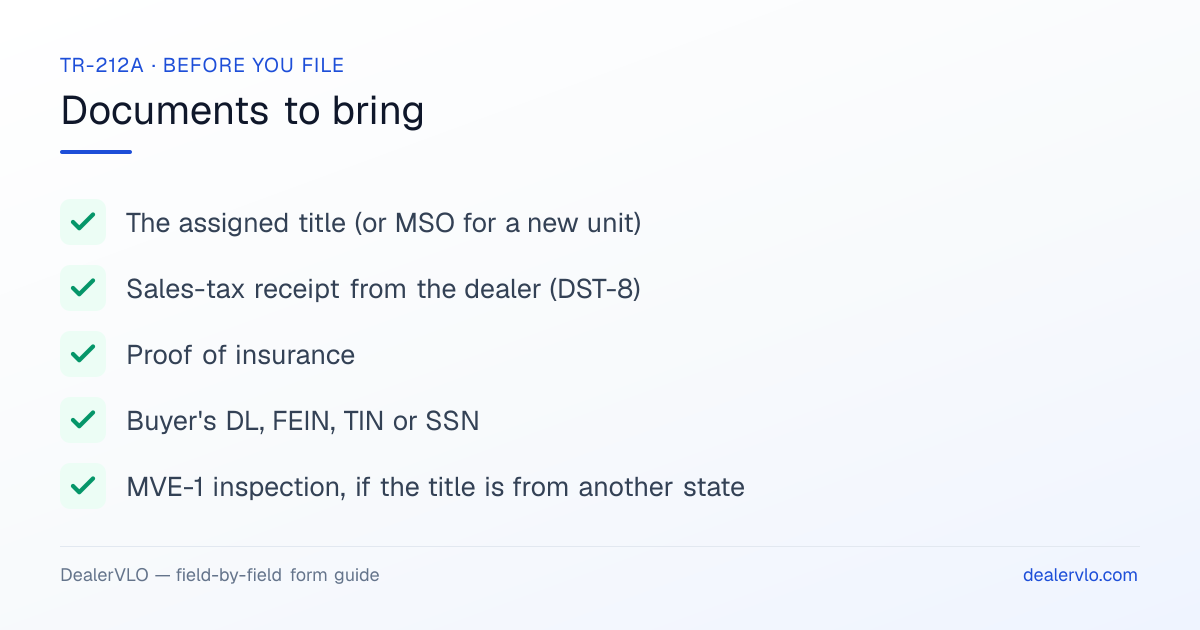
Documents to have before you start
Gather these before you complete the TR-212a. A missing attachment is the number-one reason the Kansas Department of Revenue, Division of Vehicles (county treasurers process) bounces a title application back.
- The assigned title (or MSO for a new unit) — Signed over to the buyer with the purchase price, sale date and odometer reading completed.
- Sales-tax receipt from the dealer (DST-8) — Shows the tax base and the sales tax the dealer collected, so the treasurer only charges any local difference.
- Proof of insurance — The owner certifies on the form that financial security is in effect; bring the insurance company and policy number.
- Buyer's DL, FEIN, TIN or SSN — The form asks for one identifier per owner, up to five owners.
- MVE-1 inspection, if the title is from another state — Kansas requires a vehicle inspection when the title being surrendered was issued by another state — confirm with the county treasurer on your transaction.
- TR-134 authorization, if the dealer presents the application — Lets the buyer name the dealership as agent to present the title application and receive the title.
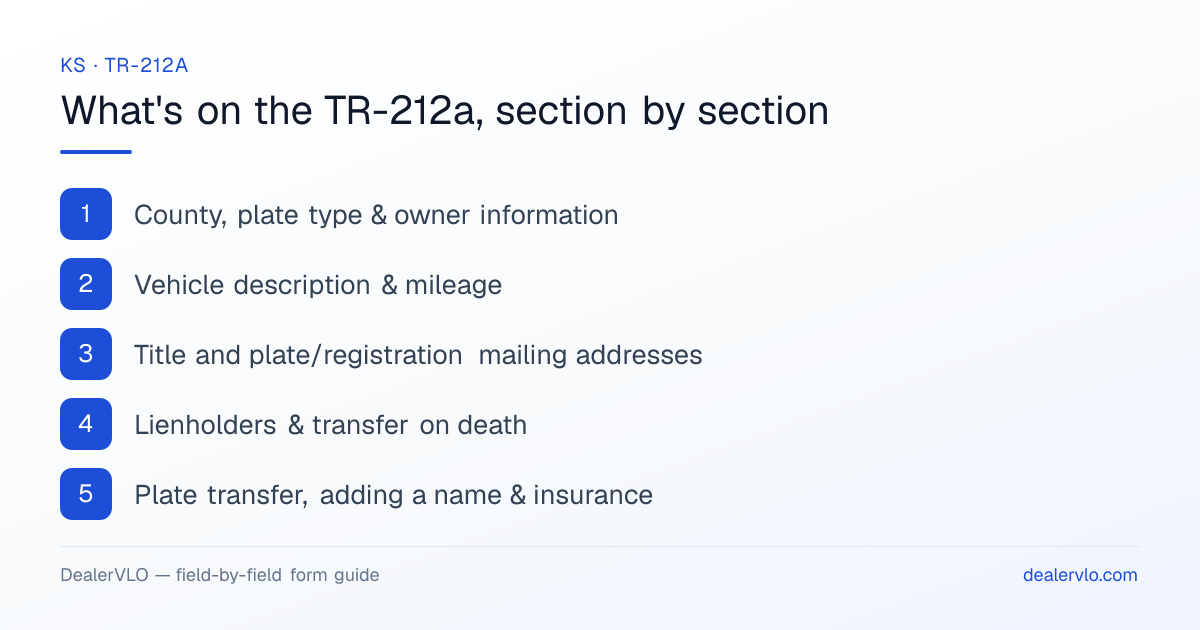
TR-212a, section by section
County, plate type & owner information
The top block identifies where the vehicle is being registered and who owns it. County Name is the county where the vehicle is garaged — the same county whose treasurer takes the application. List every owner exactly as they'll appear on the title (last, first, middle initial), each with one identifier: driver's license, FEIN, TIN or SSN. The address is the owner's residence, which also drives the local sales-tax comparison.
| Field | Who fills it |
|---|---|
County Name County where the vehicle is garaged. | Buyer |
Plate Type | Buyer |
Application Date | Buyer |
Owner's Name(s) (Last, First, Middle Initial) Up to five owners. | Buyer |
DL, FEIN, TIN, SSN (provide one) One identifier per owner. | Buyer |
Address, City, State, Zip | Buyer |
Vehicle description & mileage
Describes the vehicle being titled. The VIN has to match the assigned title and the vehicle. Purchase/Brought into KS Date is the sale date on a dealer sale — it starts the buyer's 60-day clock. Mark the mileage with one status: Actual, Exceeds (mechanical limits), Not Actual, or Exempt (for vehicles exempt from federal odometer disclosure). Weight and truck class only matter for trucks.
| Field | Who fills it |
|---|---|
VIN Must match the assigned title. | You (dealer) |
Fuel type, Year, Make, Model, Color | You (dealer) |
Purchase/Brought into KS Date Sale date — starts the 60-day window. | You (dealer) |
Mileage + Actual / Exceeds / Not Actual / Exempt Must agree with the odometer disclosure on the title. | You (dealer) |
Empty Weight, Declared/Gross Weight, Truck Class Trucks only. | You (dealer) |
Title and plate/registration mailing addresses
Where the title and the plate/registration go if they're different from the owner's address. The plate block also has a Push Notification Phone or Email line for registration notices. On a financed deal, the lienholder block below is what gets the lien recorded — don't use the title mailing address as a stand-in for it.
| Field | Who fills it |
|---|---|
Title Mailing Address (name, address) | Buyer |
License Plate/Registration Mailing Address | Buyer |
Push Notification Phone or Email | Buyer |
Lienholders & transfer on death
If the buyer financed, the 1st lienholder's name and mailing address go here so the lien is recorded. The form limits the 2nd lienholder block to trucks and mobile homes. Transfer on Death lets the owner name up to two beneficiaries who take the vehicle on the owner's death — optional, and the buyer's call.
| Field | Who fills it |
|---|---|
1st Lienholder Mailing Address From the retail installment contract. | You (dealer) |
2nd Lienholder Mailing Address Trucks and mobile homes only, per the form. | You (dealer) |
1st / 2nd TOD Name and address Optional beneficiaries. | Buyer |
Plate transfer, adding a name & insurance
Plate Transfer Information is for moving the buyer's existing plate from their previous vehicle — enter that vehicle's VIN, year, make and model, and who it was sold to or repossessed by. Adding Name to Title/Registration covers adding a spouse, parent or child, who signs on the line below. Every application lists the insurance company and policy number.
| Field | Who fills it |
|---|---|
Previous Vehicle's VIN, Year, Make, Model Only when transferring a plate. | Buyer |
Vehicle Sold to/Repossessed by | Buyer |
Relationship (Spouse / Parent / Child) + signature of person being added Only when adding a name. | Buyer |
Insurance Co. Name, Insurance Policy No. | Insurance agent |
Owner's certification & fee summary
The owner signs a certification that they're a resident of (or have a place of business in) the county, carry the insurance Kansas requires, and have listed every lien — false certification can be prosecuted. The fee summary is the treasurer's side of the form: title fee, penalties, registration, property tax, the state and county fees, and Sales Tax. On a dealer sale where the dealer already collected tax (shown on the DST-8), the Sales Tax line is only any local difference owed because the buyer's home rate is higher than the dealership's.
| Field | Who fills it |
|---|---|
Owner's Signature(s) + Date | Buyer |
Title Fee / Title Penalty $10 title fee; penalties apply from day 61. | At the counter |
Registration Fee / Registration Penalty | At the counter |
DMV Modernization, County Service, LETC, Reflectorized Plate, KHP Staffing, Miscellaneous fees | At the counter |
Property/Tax Due + penalties Vehicle property tax collected at registration. | At the counter |
Sales Tax Local difference if the buyer's home rate exceeds the dealer's. | At the counter |
GRAND TOTAL | At the counter |
KS Sales tax & title fee calculator
Free · no signup · updates as you type
Kansas state sales tax is 6.5% plus the local (city/county/special district) rate. On an in-state dealer sale the dealer collects state tax plus the local rate at the dealership; if the buyer's home rate is higher, the buyer pays the difference to the county treasurer — the combined local rate ends up being the higher of the two. Tax is on the price after a trade-in allowance (the trade must be part of the same deal and go into the dealer's inventory); administrative and handling fees are taxable. Registration, vehicle property tax and county/state fees vary and are figured by the treasurer. A $2 late-registration penalty applies after 60 days (K.S.A. 8-135). Look up local rates with the KDOR rate locator and confirm totals with the county treasurer.
Stop re-keying this onto the TR-212a.
DealerVLO runs this math on every deal and drops it — with the VIN, buyer, and sale price — straight onto the official KS TR-212a, the bill of sale, and the FTC forms. One screen, no re-keying.
14-day free trial — a card starts it, no charge until day 14, then $29/month. Cancel any time.
The TR-212a is one car's paperwork. A 20-second read on your lot, and the tax-and-fee math for the whole deal — built for dealers, no signup. Free calculators dealers actually use — no signup, no email.
DealerVLO fills the official Kansas TR-212a straight from your deal — VIN-decoded vehicle, buyer, co-buyer, and sale price already in place. $29/month, free to try — cancel any time.
Common TR-212a mistakes that cause rejections
On a Kansas dealer sale the dealer collects the combined rate in effect at the dealer's place of business, then gives the buyer a DST-8. If the buyer lives somewhere with a higher local rate, the buyer pays that difference at the county treasurer — the dealer doesn't. If the dealership's rate is higher, nothing more is due.
Kansas counts administrative and handling fees, dealer prep, freight and warranties in the taxable selling price, whether or not they're separately stated. Separately stated interest/finance charges and GAP are not taxed.
The trade-in allowance only reduces the tax when the trade is part of the same transaction and becomes dealer inventory. A trade titled to someone other than the buyer generally doesn't qualify, and a separate sale whose cash goes toward the purchase isn't a trade.
The buyer has 60 days from purchase to apply for title and registration; a penalty is added on day 61. Deliver the assigned title (the dealer's own deadline is at delivery or an agreed date within 60 days) and a complete packet up front.
File with the treasurer of the county where the vehicle is garaged, and give one DL, FEIN, TIN or SSN for each owner listed. The owner certifies residency in that county when they sign.
Common questions
What form do I use to title a car in Kansas?+
Form TR-212a, the Title and Registration Manual Application, published by the Kansas Department of Revenue's Division of Vehicles. It applies for the title and registers the vehicle together, and it's filed with the county treasurer in the county where the vehicle is garaged.
Who collects sales tax on a Kansas dealer sale?+
The dealer. A Kansas dealer collects the 6.5% state rate plus the local rate in effect at the dealership and gives the buyer a DST-8 receipt. If the local rate where the buyer lives is higher, the buyer pays the difference to the county treasurer when registering.
Does a trade-in reduce Kansas sales tax?+
Yes. Kansas dealers charge sales tax on the net price after the trade-in allowance, as long as the trade is part of the same transaction and becomes part of the dealer's inventory.
Is the dealer doc fee taxable in Kansas?+
Yes. Kansas includes administrative and handling fees in the taxable selling price of a vehicle, along with dealer prep, freight and warranties. Separately stated finance charges and GAP are not taxed.
How much is a Kansas title?+
The Kansas title fee is $10. Registration, vehicle property tax and several state and county fees are added by the county treasurer and vary by vehicle and county.
How long do you have to title a car in Kansas after buying it?+
60 days from the date of purchase. Apply at the county treasurer's office in the county where the vehicle is garaged; a penalty is assessed starting on the 61st day.
How long does a Kansas dealer have to deliver the title?+
Under K.S.A. 8-135, a dealer must deliver the assigned title at the time the vehicle is delivered, or at a time agreed by the parties that's no more than 60 days after the sale.
Is there software that fills out the TR-212a automatically?+
Yes. Dealer management software like DealerVLO fills the Kansas TR-212a from the deal you already entered — the VIN-decoded vehicle, buyer, co-buyer, lienholder, and sale price are placed for you instead of hand-writing them. For most states that's the official DMV form itself; where a state issues its form only through its own dealer portal, you get a print-ready worksheet with every value already in place. It's $29/month flat with a 14-day free trial, and the same deal also generates your federal documents (Bill of Sale, FTC Buyers Guide, odometer disclosure) and any other state's title forms.
Stop filling out the TR-212a by hand.
DealerVLO fills the official KS TR-212a straight from your deal jacket — VIN-decoded vehicle, buyer, co-buyer, lienholder, and sale price already in place. Print, sign, and file in about 90 seconds. $29/month. 14-day free trial, cancel any time.
Curious how it works? See how DealerVLO auto-fills every dealer document — bill of sale, FTC Buyers Guide, odometer disclosure, and state title & registration forms for all 50 states, from one deal.
Bond amounts, fees, and form rules change. Get a short email when your state does. No spam, unsubscribe anytime.